Kitchen Fire Safety in HMOs: A Manchester Landlord’s Guide
08/10/2026
Cooking appliances are the single biggest cause of accidental house fires in England. They were responsible for 44% of them in the year to March 2024, according to Home Office fire statistics. In Greater Manchester, our own fire and rescue service attended 603 accidental home fires started by cooking in a single year – nearly half of every accidental dwelling fire it responded to.
For a standard family home, that is a sobering statistic. For an HMO, where several unrelated people are sharing one kitchen, cooking at different times, with different habits and different levels of care, it is the single biggest risk a fire risk assessment has to manage.
I see the same pattern on assessment after assessment: landlords who have fitted good fire doors, serviced the alarm system and sorted the paperwork, then given almost no thought to the one room where a fire is most likely to actually start. It’s an understandable blind spot – a kitchen doesn’t look like a fire safety feature the way a door closer or an alarm panel does.
This guide covers what the law expects of an HMO kitchen, what a fire risk assessor is actually looking for when they walk into one, and the practical steps that bring the risk down without turning your kitchen into something nobody wants to cook in.
A kitchen in a family home gets used by people who know each other’s habits, share an interest in not burning their own house down, and usually cook at broadly similar times. A shared kitchen in an HMO is a different environment entirely.
Several households are using the same hob, the same worktop sockets and often the same two or three pieces of countertop equipment, at all hours of the day. There’s no guarantee any of them have ever been shown how to use the extractor fan or where the fire blanket is.
That matters because the Home Office’s own analysis of fires attended by fire and rescue services found that while cooking appliances cause nearly half of all accidental dwelling fires, they account for a much smaller share of fatalities – because most cooking fires are caught early, by someone in the room. Take that “someone in the room” element away, or multiply the number of people cooking without taking responsibility for the room as a whole, and the maths changes quickly.
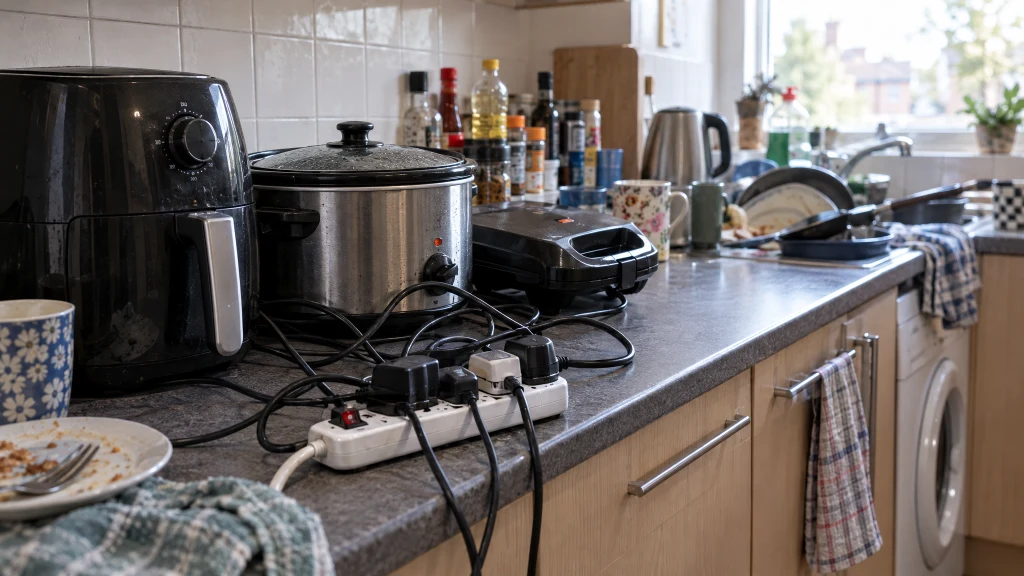
I’ve lost count of the number of HMO kitchens I’ve walked into where the extractor duct is caked in grease, there’s a toastie maker, an air fryer and a slow cooker all running off one extension lead, and nobody living there has ever been told that’s a problem. It’s rarely one dramatic hazard. It’s five small ones, stacked on top of each other.
Greater Manchester Fire and Rescue Service runs an ongoing “Keep Looking When Cooking” campaign for exactly this reason. It reports that the number of cooking fires it attends has fallen by almost 150 incidents a year since the campaign launched – proof that awareness and small behavioural changes genuinely move the numbers, even before you touch the physical layout of the room.
The Regulatory Reform (Fire Safety) Order 2005 puts the legal duty on the “responsible person” – in practice, the landlord or managing agent – to assess and manage fire risk in the common parts of any multi-occupied building, kitchens included. It does not hand you a checklist of kitchen-specific measurements.
Instead it requires a suitable and sufficient fire risk assessment, which is where most of the detailed, room-by-room standards actually come from. Local authorities fill in a lot of that detail through their own HMO licensing standards.
Because this site’s audience is overwhelmingly Greater Manchester landlords, Manchester City Council’s own published HMO standards and guidance are the right starting point.
Manchester’s guidance sets a clear minimum: one four-ring cooker, with an oven and grill, per five people sharing a kitchen. Once you go above five occupants, the expectation steps up – either a second set of cooking facilities or a materially larger cooker.
The council will look at alternative layouts above fifteen occupants rather than apply the table mechanically. The table below sets out the standard as published.
| Persons sharing the kitchen | Minimum cooking facilities required |
|---|---|
| 1 to 5 | One 4-ring cooker with oven and grill |
| 6 to 8 | One 4-ring cooker plus an additional combination microwave/hob, or one larger range cooker (more than 4 rings, 2 oven compartments) |
| 9 to 10 | Two 4-ring cookers |
| 10 to 14 | Two 4-ring cookers plus an additional combination microwave/hob |
| 15 | Three 4-ring cookers |
Bedsits with their own individual cooking facilities are treated differently again. A single occupant needs at least two rings or hotplates with an oven and grill of 28 litres or more, two occupants need three rings with a full-size oven, and three or more occupants need a full-size cooker.
Cramming a full household’s cooking needs onto a single two-ring hob because the licence was issued years ago, before the room was more intensively occupied, is one of the more common gaps an assessment turns up.
Manchester’s standards require a non-asbestos fire blanket in every kitchen, mounted at a convenient height next to the exit door nearest the cooker – not tucked in a drawer, not on the far side of the room from the hob, and not shared between two kitchens on different floors.
The same guidance requires an extractor fan capable of at least six air changes per hour, which matters for more than comfort. A well-ventilated kitchen clears smoke and grease-laden air before it builds up into something that catches.
Extraction only works as a fire safety measure if the ductwork is actually cleaned. A fan that still spins but is pulling air through a duct lined with years of grease is a fire risk with a working switch.
In older Manchester terraces converted into HMOs, the ducting often runs a surprising distance before it reaches an external vent, through a loft space or along the back of a cupboard. That’s exactly the stretch of ductwork that tends to get skipped on a quick annual check, because nobody can see it without taking something apart.
Open-plan kitchen-diners are increasingly common in converted HMOs, where a wall has been taken out to create a larger communal living space. That layout can work perfectly well, but it changes the fire safety picture.
Smoke from a kitchen fire now spreads straight into a room where tenants may be sitting, with the only way out beyond it, rather than being contained behind a door. Where a conversion has created this kind of open-plan arrangement, the assessment needs to look at the room as a single space – furniture, soft furnishings and escape routes included – rather than treating the kitchen and the living area separately.
Kitchens are deliberately excluded from standard smoke alarm coverage, because cooking smoke and steam trigger constant false alarms. A resident who is sick of nuisance alarms will disconnect the unit – which is far more dangerous than having no alarm specific to the kitchen at all.
The usual approach, reflected in HMO fire safety guidance from councils across the country including Hammersmith & Fulham’s published standards, is a heat alarm rather than a smoke alarm in any shared kitchen. It should be interlinked to the rest of the system in a two-storey property, and tied into a full detection and alarm panel in anything three storeys or taller.
Heat alarms respond to a genuine fire’s temperature rise rather than to toast, and they are far less likely to end up disabled by a frustrated tenant.
Manchester’s own HMO guidance deliberately leaves the detailed means-of-escape standard for kitchens to the fire risk assessment itself, carried out under the Fire Safety Order. That’s exactly where a properly conducted assessment earns its fee, rather than just confirming what a generic checklist already told you.
The underlying principle, reflected consistently in local authority HMO standards up and down the country, is straightforward: a kitchen should never open directly onto a hallway, corridor or stairway that forms part of the building’s only escape route. A cooker should never be sited next to an exit door.
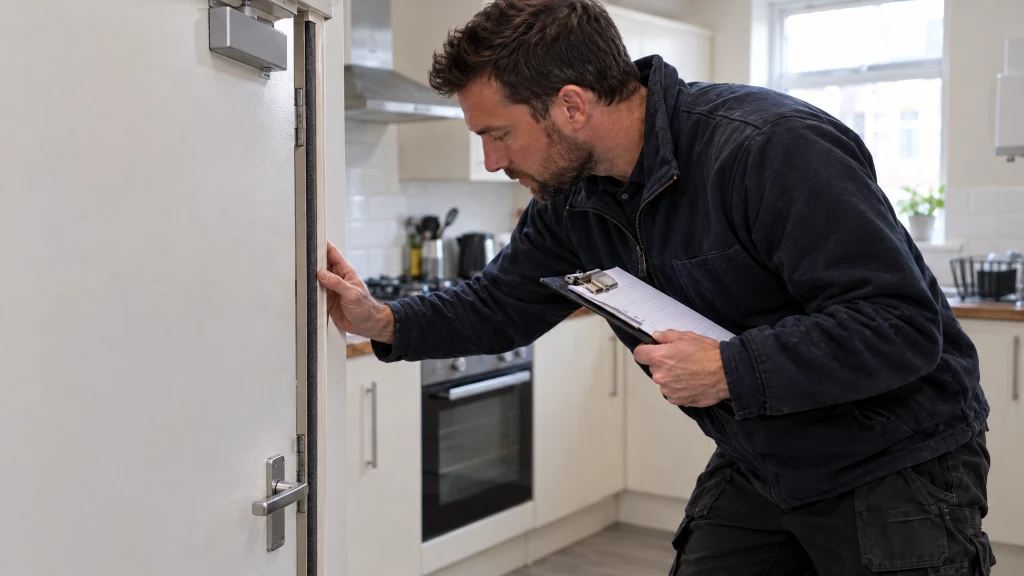
Where a kitchen does sit on or near an escape route, the standard response is a fire-resisting door – typically rated to 30 minutes, fitted with intumescent strips and cold smoke seals, a self-closing device, and a lock that opens from the inside without needing a key.
That last point catches out more landlords than you’d expect. A kitchen door fitted with a keyed lock “for security”, because tenants were leaving food in there, is a door nobody can guarantee will open in a hurry.
The fire door that gets propped open with a fire extinguisher, because the kitchen gets too hot and steamy otherwise, is one of the most common things I correct on an assessment. It’s an easy fix once someone points it out – better extraction, or a door closer that still allows a brief hold-open function. Almost nobody spots it themselves, because propping a door open feels completely harmless in the moment.
Across the kitchens we assess, the same handful of issues come up far more often than anything exotic. None of them are difficult to fix once they’re identified, which is exactly why a proper walk-through assessment, rather than a box-ticking exercise, pays for itself.
Individually, most of these look minor. Together, in a kitchen used by five or more households who have never met each other’s families or seen each other’s cooking habits, they compound in exactly the way fire risk assessments exist to catch.
There’s also an insurance angle worth flagging. Landlord insurers increasingly ask, at renewal or claim stage, whether a current fire risk assessment exists and whether its recommendations have been actioned.
A kitchen fire that traces back to a hazard your own assessment flagged months earlier – and which was never fixed – is a far harder conversation with an insurer than one that was simply bad luck.
We’ve written in detail about fire risk assessments for student HMOs in Manchester, and kitchens are consistently where that higher baseline risk shows up most clearly.
New tenants moving in each September are often cooking for themselves, in a shared kitchen, for the first time in their lives. That happens during the same weeks that Greater Manchester Fire and Rescue Service runs its own student safety campaign, warning against cooking after drinking, leaving pans unattended, and letting grease build up on hobs and in ovens.
None of that is unique to students specifically – it’s unique to anyone cooking in an unfamiliar shared kitchen for the first time. In Manchester’s dense student housing stock around Fallowfield, Rusholme and Withington, that happens on a large scale every autumn.
A fire risk assessment carried out before the new academic year, rather than left until a licence renewal forces the issue, catches problems while there’s still time to fix them before the kitchen sees its heaviest use of the year.
September and October are consistently when I see the newest hazards in student kitchens – not because anyone’s being careless on purpose, but because a kitchen that worked fine for last year’s tenants doesn’t automatically suit this year’s cooking habits, appliance count or group size.
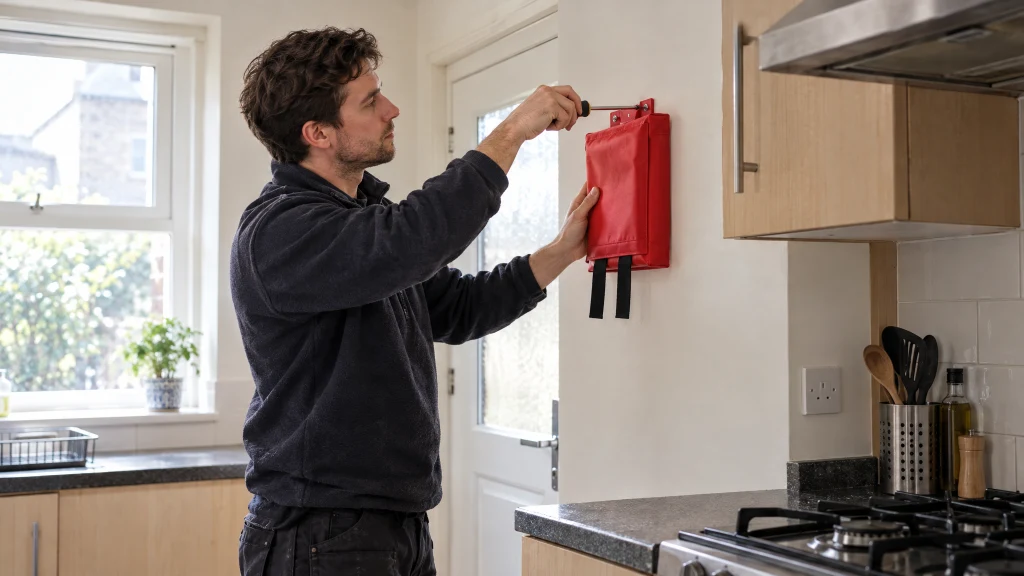
Most of the fixes that come out of a kitchen-focused fire risk assessment are inexpensive and quick to put right. The ones that get missed are usually missed because nobody thought to check them, not because they’re difficult.
Even a well-managed kitchen can have a fire, and what a tenant does in the first thirty seconds matters more than almost anything else. Greater Manchester Fire and Rescue Service’s own advice is worth putting on a laminated card by the kitchen door, not just mentioning once at check-in:
A working heat alarm and an accessible fire blanket only help if people know they’re there, and know not to go back for a phone charger. That’s a five-minute conversation at move-in that costs nothing and occasionally matters enormously.
It’s also worth thinking about who in the building actually knows this information. In a five- or six-bedroom HMO with a high turnover of tenants, it’s easy for safety knowledge to live entirely with whoever happened to be shown round by the outgoing tenant.
A short written house-fire-safety sheet, covering the kitchen basics above alongside what to do if any other alarm in the property sounds, closes that gap at effectively no cost.
When we assess a kitchen as part of an HMO fire risk assessment, we’re checking the cooking facilities against the occupancy they actually serve, not just the occupancy on the original licence. We check the fire blanket is present, in date and accessible, and that the extractor is working and has been maintained.
We check the kitchen door and its hardware if it sits anywhere near an escape route, and we look for the small, cumulative hazards – the overloaded socket, the battery charger left on the worktop, the duct that hasn’t been cleaned – that rarely show up on a desk-based review but show up immediately on a walk-through.
That walk-through is also where the kitchen gets weighed against the rest of the building, including the communal areas covered in our separate guide, so the finished assessment reflects how the building actually functions rather than treating each room in isolation.
If you’re trying to work out what that’s likely to cost for your property, our guide to fire risk assessment costs for UK landlords sets out current pricing in more detail. Kitchen risk in winter deserves its own look too, covered in our guide to winter fire safety in HMOs.
If your HMO’s kitchen hasn’t had a dedicated look in a while, or you’ve added tenants, appliances or a second cooker since the last assessment, it’s worth getting a professional fire risk assessment booked in rather than waiting for a licence renewal to force the question. It’s a straightforward visit to arrange, and the kitchen is usually where it earns its fee fastest.
Yes. Manchester City Council’s HMO standards require a fire blanket in every kitchen, mounted near the exit closest to the cooker. If a property has more than one shared kitchen, each one needs its own blanket rather than relying on tenants to fetch one from elsewhere in the building.
Not as the primary detector. Cooking smoke and steam trigger constant false alarms on a standard smoke detector, which leads to units being disabled altogether. The established approach is a heat alarm in the kitchen, interlinked with the rest of the property’s alarm system.
Manchester’s published HMO standards set a minimum of one four-ring cooker with an oven and grill per five occupants. Above five occupants, you need either a second set of cooking facilities or a significantly larger cooker, assessed case by case above fifteen occupants.
It can be, particularly in an older HMO kitchen whose sockets and wiring weren’t specified for the level of appliance use that’s now normal. An EICR will confirm whether the existing circuit can safely handle current appliance loads, and a fire risk assessment will flag the extension lead itself as a hazard regardless.
They need to be able to close and latch on their own, via a self-closing device, and they shouldn’t be propped open to deal with heat or steam from cooking. If a kitchen door is routinely propped open because the room gets too hot, that’s a sign the extraction needs improving, not a reason to defeat the fire door.
The “responsible person” under the Regulatory Reform (Fire Safety) Order 2005 – in practice, the landlord or the managing agent acting on their behalf – is legally responsible for assessing and managing fire risk in shared parts of the property, including shared kitchens.
Most HMO landlords I talk to can rattle off their fire door requirements, their alarm grade, and their emergency lighting checks without missing a beat....
Most of the fire safety advice on this site assumes you already have a working HMO. This one is for the stage before that: the...