
Lithium Ion Battery Fire Hazard: UK Property Guide 2026
14/09/2026
UK fire brigades attended 1,760 fires linked to lithium-ion batteries in 2025, a 147% increase from 2022, according to reporting based on data compiled from 46 fire brigades across the UK by QBE and published by The Guardian. For landlords, HMO managers, managing agents, employers, and property teams, that changes the conversation. This isn't a niche issue tied only to warehouses or electric vehicles. It's now a routine building safety problem turning up in hallways, bedrooms, bin stores, reception areas, and staff rooms.
The practical challenge isn't just recognising the lithium ion battery fire hazard. It's turning that knowledge into rules, inspection points, records, and day-to-day management that stand up in real buildings with real occupants. Multi-tenancy properties are where this often breaks down. People charge devices where it's convenient, not where it's safe. Policies are vague, staff assume tenants understand the risk, and fire risk assessments still miss battery charging and storage altogether.
This guide is for UK duty holders who need a workable approach. It covers what makes these fires different, where the highest-risk situations arise in HMOs and commercial premises, what the responsible person must document, and what a competent fire risk assessor should check.
Fire services across the UK are attending these incidents often enough that battery charging can no longer be treated as a minor housekeeping issue. For landlords, managing agents, and commercial property managers, that changes the standard of what is reasonably foreseeable in a fire risk assessment and in day-to-day control measures.
The shift is operational as much as technical. In multi-tenancy buildings, the hazard turns up in places that are hard to supervise and easy to overlook. A bike charging in a hallway. A spare battery left overnight in a shared kitchen. A charger connected to a multi-plug adaptor beside coats, parcels, or waste. In offices and mixed-use premises, the same pattern appears under desks, in cleaners' cupboards, behind reception, and in staff rooms.
Beyond ignition, the key concerns are location, supervision, and the effect on escape. A battery failure in a protected route or near a final exit can turn a manageable incident into a life safety event within moments.
Practical rule: Do not allow charging in escape routes, lobbies, stair enclosures, or other areas people may need to pass through during evacuation.
I see the same gap repeatedly. People know batteries can catch fire, but the building still has no written rules on where charging is allowed, who checks for breaches, what to do with damaged batteries, or how tenants and staff are told about the risk. That is where compliance starts to fail.
A documented response applies directly to:
Good management is straightforward. Identify where batteries are present. Decide where charging and storage are permitted. Communicate the rules in tenant information, staff instructions, and contractor controls. Record the arrangements in the fire risk assessment and supporting procedures.
A lithium-ion battery doesn't behave like an ordinary combustible item. The phrase thermal runaway describes a self-sustaining chemical reaction inside the battery. Once it starts, heat builds quickly, the internal breakdown accelerates, and the battery can vent gases, ignite, or explode.
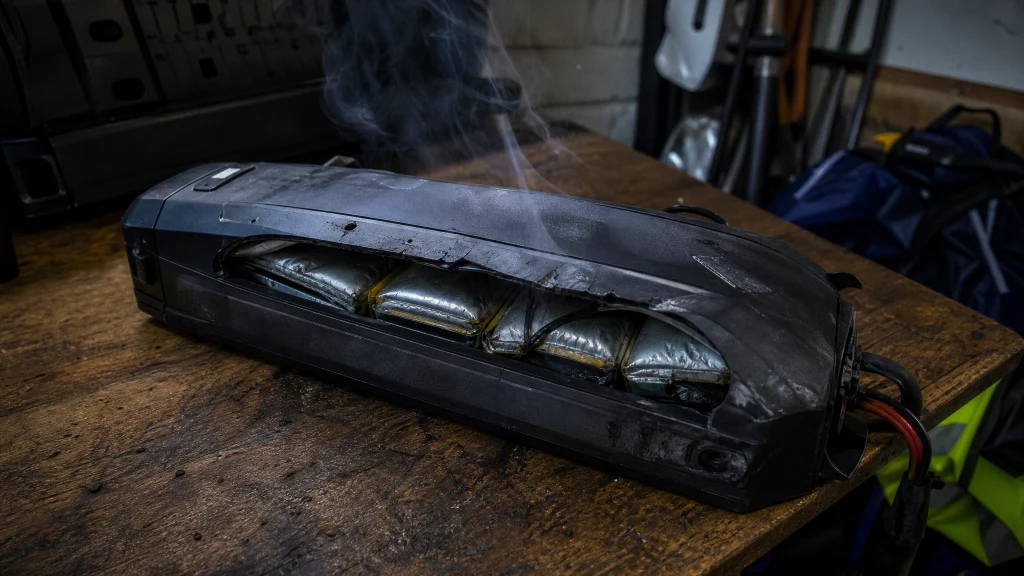
The simplest way to explain it is as a chain reaction that feeds itself. Heat causes internal damage. That damage creates more heat. The process doesn't wait for a fire elsewhere in the room to spread to it. The battery becomes its own rapidly escalating source of heat and flame.
That matters because once visible signs appear, there may be very little time to react safely. A lithium-ion battery fire can bring a room to flashover in seconds, and between 2020 and early 2025 these fires killed 10 people and injured 190 in the UK, according to Ideal Response.
People often assume they can spot trouble early, fetch an extinguisher, and deal with it. That's a dangerous assumption with this type of fire. These incidents can produce intense heat, toxic smoke, and rapid fire spread. They can also reignite.
A conventional response that might work for a small waste-paper fire isn't reliable here. By the time occupants realise a battery is failing, conditions in the immediate area may already be unsurvivable.
The room of origin may become immediately fatal. That's why battery charging in bedrooms, corridors, and near final exit routes is such a poor risk decision.
Thermal runaway can start for several reasons seen regularly in rented and managed property:
For responsible persons, the lesson is straightforward. The lithium ion battery fire hazard isn't just about what the device is. It's about how the building allows that device to be stored, charged, monitored, and kept away from people.
In practice, the worst risks are rarely hidden. They're usually visible during a walk-through if you know what to look for.
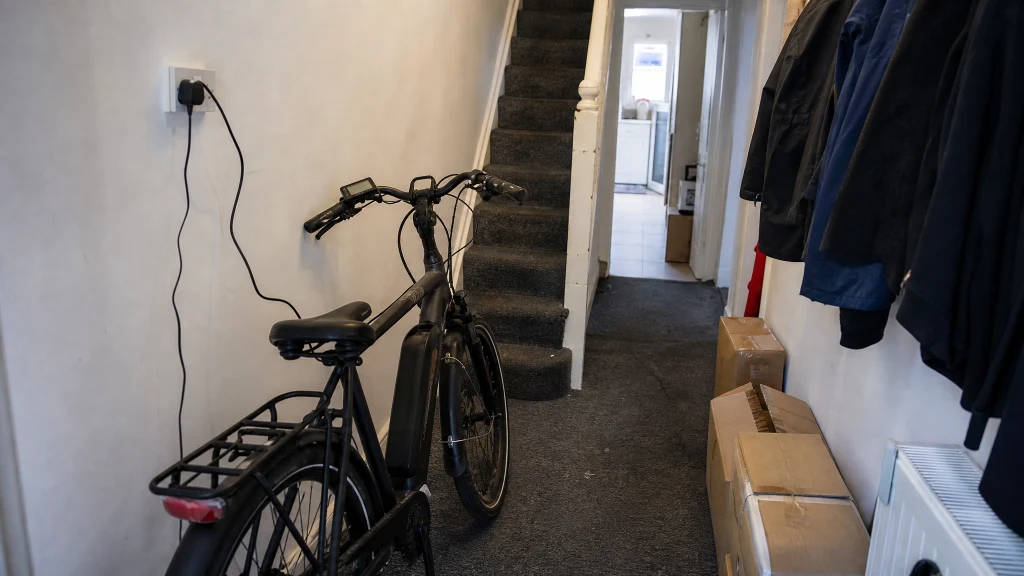
One common HMO scenario is the narrow front hallway with an e-bike parked beside the stairs, battery on charge, coats hanging nearby, and only one protected route out. That arrangement is more common than many landlords realise. London Fire Brigade now attends a lithium-ion battery fire from an e-bike or e-scooter roughly every two days in the capital alone, and runs a dedicated ChargeSafe campaign aimed squarely at this kind of communal storage and charging risk.
If battery charging hasn’t been considered as its own line item before, it’s worth reading alongside a wider fire risk assessment for HMOs rather than in isolation, since the same walk-through picks up both issues together.
The pattern is familiar:
The issue isn't only ignition. If a fire starts in the route out, occupants may have no safe way past it.
In offices and mixed-use premises, the risk is often created informally. Staff bring in their own devices, no one wants to appear difficult, and a charging habit becomes normal before anyone assesses it. I've seen battery charging tucked under reception desks, behind café counters, and in cleaners' cupboards because it seemed out of the way. In fire safety terms, "out of the way" often means "out of sight and unmanaged".
A few warning signs deserve immediate attention:
| Scenario | Why it matters |
|---|---|
| Personal e-bike charging in staff areas | No formal control over charger type, battery condition, or supervision |
| Batteries stored near stock or waste | Fire load increases and early spread becomes more likely |
| Locked cupboards with no ventilation | Heat build-up and delayed discovery of a fault |
| Shared extension leads for multiple devices | Electrical misuse combines with battery risk |
Disposal is another weak point. Occupants often treat old batteries like ordinary rubbish. In managed buildings, that means damaged or spent batteries end up in domestic bins, caretaker waste sacks, or commercial refuse areas. If your property has a bin store or central waste area, battery disposal instructions need to be explicit, visible, and enforced. Otherwise, you shift the risk from the corridor to the waste stream.
For most HMOs and many commercial premises, the responsible person is the landlord, managing agent, employer, or another duty holder with control over the premises. The title matters less than the function. If you control the building, the common parts, the safety arrangements, or the work activity, the duty is yours.
Under the Regulatory Reform (Fire Safety) Order 2005, the responsible person must record the findings of the fire risk assessment. Failure to document and act on significant findings, including lithium-ion battery hazards, can lead to enforcement action, and GOV.UK’s own enforcement guidance puts the maximum penalty at an unlimited fine in the magistrates’ court, or an unlimited fine and up to two years’ imprisonment at the Crown Court. See our own guide to the Regulatory Reform Fire Safety Order for the wider duties this sits alongside.
That matters because a lot of battery-related control measures sit in the grey area between housekeeping and formal fire precautions. If you haven't written them down, assigned responsibility, and checked that they're being followed, you're relying on assumption.
An enforcing authority won't be impressed by a general statement that tenants should "use chargers safely". They will look for evidence that you identified where battery charging happens, assessed whether those locations are suitable, and introduced sensible controls.
That usually means being able to show:
Compliance point: A fire risk assessment isn't complete because a document exists. It's complete when significant findings are recorded and acted upon.
The common failure is treating lithium-ion batteries as a tenant choice rather than a building risk. That approach breaks down in shared housing and managed workplaces because individual behaviour affects everyone else. One person charging an e-scooter on a landing can compromise the escape route for the whole property.
Another mistake is assuming a generic FRA already covers it because it mentions electrical fire risk. It often doesn't. A battery fire hazard needs its own consideration because the speed, intensity, and management controls are different from ordinary portable appliance use.
If you're the responsible person, the sensible question isn't whether batteries are present. It's whether your records, rules, and inspections reflect the way people use them in your building.
Most fire risk assessments already cover ignition sources, means of escape, alarm provision, and housekeeping. The issue is whether the assessor and the duty holder have looked closely enough at battery-specific behaviour in the property. For licensed HMOs, the assessment should already verify compliance with BS 5839-6 Grade D interlinked smoke alarms – see our guide to smoke alarm requirements for the detail – which makes a battery-specific review a practical extension of the same legal duty. Fire risk assessments are a legal requirement for most rented property, per the NRLA.

A useful benchmark is to compare your current FRA against a structured fire risk assessment checklist and then test whether lithium-ion battery risks are properly built into it rather than treated as an afterthought.
Use these points during inspection, review meetings, or when checking an assessor's report.
Where are batteries being charged?
Don't rely on stated policy. Walk the building and look for evidence. Hallways, bedrooms, receptions, cleaners' stores, kitchens, bike rooms, and under-stair spaces are all common locations.
Are any charging locations in escape routes or near final exits?
If they are, that needs immediate correction. Convenience doesn't justify creating a fire risk in a route occupants depend on.
What chargers are being used?
Check for mismatched adaptors, damaged leads, and cheap replacement chargers. If occupiers provide their own equipment, your rules need to say what's acceptable and how defects are reported.
Are batteries charged on or near combustible materials?
Beds, sofas, carpets, cardboard, stock, clothing, and refuse all increase the chance of rapid spread.
Is overnight or unattended charging taking place?
If it is, the risk rises sharply because early warning and intervention are reduced.
A competent fire risk assessor shouldn't stop at paperwork. They should look for the physical signs of unmanaged battery use.
A thorough FRA should lead to written controls, not verbal understandings.
| Document or record | What to check |
|---|---|
| House rules or tenancy pack | Battery charging restrictions are clear and specific |
| Staff handbook or site rules | Personal device charging is addressed |
| Inspection records | Unsafe charging and storage are picked up and followed through |
| Maintenance actions | Alarm defects, socket issues, and storage changes are completed |
| Incident log | Battery overheating, damaged chargers, or near misses are recorded |
Ask one simple question when reading your FRA: could a new manager pick this up tomorrow and understand exactly what battery risks exist, where they exist, and what controls must be maintained?
Three items are regularly overlooked. Spare batteries. Waste disposal. Occupier communication.
If your assessment doesn't say how old or damaged batteries should be isolated and removed, people will improvise. If it doesn't explain disposal routes, batteries will end up in general waste. If tenants or staff haven't been told the rules in writing, management can't assume they know them.
A lithium-ion battery policy should answer a simple operational question. What are tenants, staff, contractors, and visitors allowed to do in this building, and what happens if a battery starts to fail? If the answer sits in a manager's head rather than in writing, controls usually fall apart during changeovers, void periods, and busy tenancy cycles.
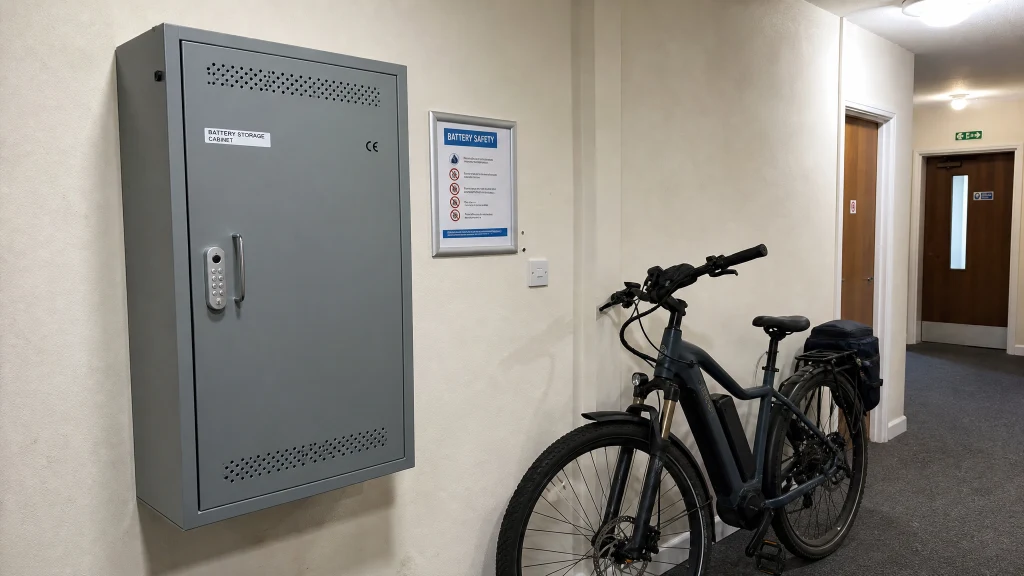
Good policy is specific enough to enforce and simple enough to follow. In practice, that means naming the devices covered, the areas where charging is banned, the limited places where it may be allowed, and the action required if a battery is damaged or overheating. A line such as "use equipment safely" will not help you during an inspection, after a complaint, or after a fire.
Policy wording should cover:
For buildings that need battery storage, the control measure has to match the risk. A single office e-bike used by a caretaker is one thing. A mixed-use property with delivery riders coming and going needs tighter arrangements, clearer supervision, and a defined place for any permitted charging. London Fire Brigade’s guidance for responsible persons points to proprietary metal battery storage cabinets or fireproof safety bags as the practical control for buildings that need dedicated charging or storage space. Those controls should sit inside a written fire and safety policy for managed properties, with named responsibilities for issuing rules, monitoring breaches, and reviewing incidents.
Many buildings still make a critical error in this regard. Occupiers are left to improvise. Some try to carry the device outside. Some stay to investigate the smoke. Some lose time deciding whether the alarm is really necessary.
The safer instruction is short and firm. Leave the area immediately, raise the alarm, call 999, and tell the operator it involves a lithium-ion battery if that is known. Do not move the device. Do not delay to save property. Do not reopen the door to check whether it has stopped.
A simple Do and Don't format works well on signs, induction sheets, and tenancy packs:
Do
Don't
If someone has to choose between saving a device and getting out, your written procedure should remove the doubt. Leave it, get out, call 999.
The reason this is important is simple. A policy only reduces risk if people have received it, understood it, and seen management enforce it. In HMOs and multi-let commercial buildings, that usually means several communication points. Tenancy agreements, welcome packs, staff induction, contractor rules, signage near likely charging areas, and periodic reminders after inspections.
Follow-through needs a paper trail. Record breaches. Record damaged chargers or batteries found on site. Record the action taken, who was told, and when the issue was checked again. If a tenant keeps charging an e-bike in a corridor, or a business unit stores spare batteries badly, management action should escalate in the same way any other serious fire safety breach would.
That is the difference between knowing there is a lithium-ion battery fire hazard and managing it properly in a way you can evidence.
Yes, within a tenancy agreement a landlord can restrict or prohibit e-bikes, e-scooters, and similar battery-powered devices, provided the terms are set out clearly before the tenancy starts. In practice, an outright ban is often harder to enforce than a clear charging and storage policy, since tenants who rely on these devices for work or commuting may simply charge them covertly if there’s no permitted alternative. Most fire risk assessors recommend a workable policy over a blanket ban for that reason.
Yes. Conversion kits and non-standard batteries are a recognised higher-risk category because they haven’t been tested as a complete system by the original manufacturer, and mismatched chargers are common. If your fire risk assessment identifies converted bikes on site, that’s a reasonable trigger to tighten charging location rules specifically for those devices.
It depends on the policy and the circumstances, and insurers are increasingly asking about battery charging arrangements at renewal. A documented fire risk assessment that specifically addresses battery storage and charging, plus evidence that the policy was communicated and enforced, is exactly the kind of record an insurer or loss adjuster will ask for if a claim follows a battery-related fire.
Review it at the same interval as the wider fire risk assessment, and immediately after any incident, near miss, or noticeable change in occupancy or device use. If you start seeing more e-bikes, more deliveries, or more spare batteries on site than when the policy was written, that’s a trigger for an earlier review rather than waiting for the scheduled date.
The lithium ion battery fire hazard now sits firmly within day to day property management in the UK. In HMOs, mixed-use buildings, offices, and other multi-tenancy properties, the risk usually comes from ordinary behaviour. Charging in the wrong place, damaged batteries kept on site, unapproved chargers, and no clear reporting route when a device starts to fail.
Good management is not complicated, but it does need to be deliberate and documented. Responsible persons should be able to show where batteries are likely to be used, what the house or building rules say, how those rules are communicated, what the fire risk assessment checks, and what action follows when people ignore the policy. That is the standard enforcing authorities expect to see in practice.
For waste handling and end-of-life battery processes, duty holders reviewing disposal arrangements should check GOV.UK’s guidance on recycling batteries and electrical waste when tightening site procedures and contractor expectations.
The final test is straightforward. If a fire inspector, insurer, or enforcing authority asked for evidence tomorrow, could you produce a current assessment, a written policy, tenant or staff communications, inspection records, and clear follow-up on breaches?
If the answer is no, treat that as an immediate management issue. A battery-aware fire risk assessment, backed by a working policy that reflects what happens on site, gives you the basis to protect people, protect the property, and demonstrate compliance if something goes wrong.
If you need a clear, documented review of your HMO or multi-occupancy property's fire safety arrangements, HMO Fire Risk Assessment provides UK fire risk assessments with practical recommendations, straightforward reporting, and compliance-focused support for landlords, managing agents, and duty holders.
Most HMO landlords I talk to can rattle off their fire door requirements, their alarm grade, and their emergency lighting checks without missing a beat....

Most of the fire safety advice on this site assumes you already have a working HMO. This one is for the stage before that: the...