Furniture Fire Safety in HMOs: What Manchester Landlords Must Legally Provide
15/10/2026
Most HMO landlords I talk to can rattle off their fire door requirements, their alarm grade, and their emergency lighting checks without missing a beat. Ask about the sofa in the shared lounge, and the conversation usually stops dead. It shouldn’t. The furniture you supply in a House in Multiple Occupation is covered by its own piece of product safety law, it carries criminal liability if you get it wrong, and it is one of the most commonly overlooked items on a fire risk assessment.
This guide sets out exactly what the Furniture and Furnishings (Fire)(Safety) Regulations 1988 require of a Manchester HMO landlord in 2026, what changed when they were amended in October 2025, why second-hand furniture is the single biggest source of risk, and what a fire risk assessor will actually be looking for when they walk into your communal lounge.
The Regulations have applied to anyone supplying furniture “in the course of business” since 1988, and letting a furnished HMO room counts as supplying furniture in the course of business. That includes every private landlord and every letting agent acting on a landlord’s behalf. It is not a landlord-specific law, but it reaches landlords directly because providing furnished accommodation is, in the eyes of the Regulations, no different from running a furniture shop.
The official government-backed guidance for landlords letting furnished accommodation confirms that both new and second-hand upholstered furniture must comply before it is supplied to a tenant. There is no exemption for furniture you already owned, furniture a previous tenant left behind, or furniture you picked up for free. If you are the one putting it in a let room, you are the one responsible for it meeting the standard.
The Regulations apply to upholstered furniture intended for indoor domestic use. In practice, that means:
Curtains, carpets, bedding, and loose furniture covers sit outside these specific Regulations, though other general product safety law still applies to them. Furniture made before 1 January 1950 is also exempt, on the basis that it predates the testing regime entirely, though I would not take “it’s an antique” as any kind of fire safety reassurance in practice.
The Regulations set out three separate tests, and compliant furniture has to pass whichever ones apply to it. Upholstery fabric has to resist ignition from a smouldering cigarette. The filling material, typically foam, has to resist ignition from a small flame and not propagate fire quickly if it does ignite. Covers have to pass a match test, representing a naked flame briefly in contact with the fabric. Mattresses, bed bases, pillows, and cushions are tested slightly differently and to a separate British Standard, which is why you will see a different label on a mattress than on a sofa.
You cannot tell whether furniture complies by looking at it, sitting on it, or trusting what the seller told you. The only reliable evidence is the permanent label, and in a decade of working around this sector, I have seen more unlabelled furniture in HMOs than labelled furniture.
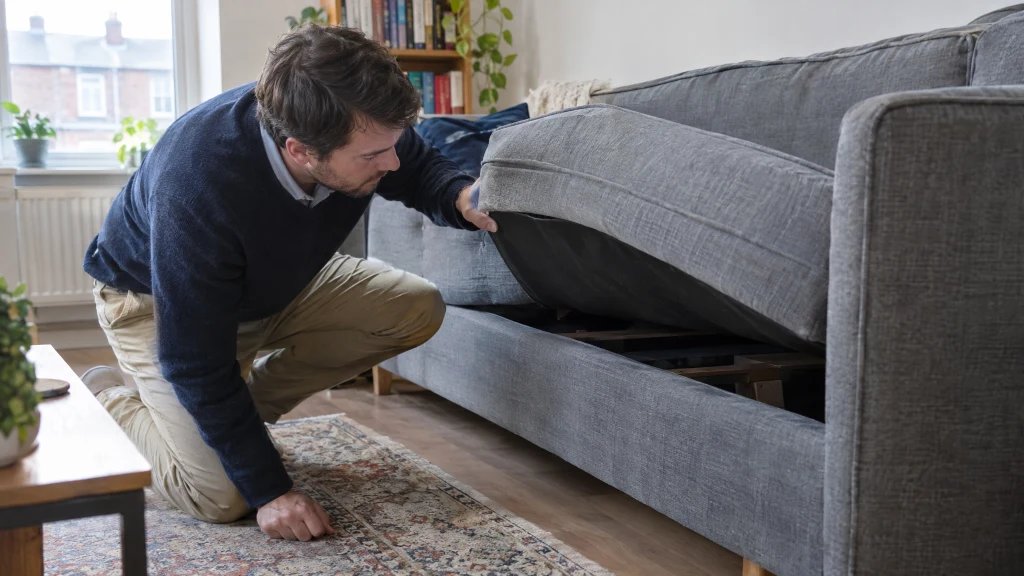
Compliant upholstered furniture carries a permanent label headed “CARELESSNESS CAUSES FIRE.” It is usually sewn or stapled under the seat cushion, on the underside of the frame, or on the base of the item, which is exactly why it is so easy to miss during a quick viewing before you buy. A genuine label carries a batch or identification number so the manufacturer can be traced, states whether the item contains an interliner, and summarises which compliance tests it passed.
I’ve walked into more than one HMO where everything else was spot on: a new fire door, a tested interlinked alarm system, a clean fire risk assessment file. And then there’s a secondhand three-piece suite in the lounge with no label in sight, bought off a local marketplace listing for £80 because it looked fine in the photos.
Mattresses and divan bases are tested to BS 7177:2008+A1:2011 rather than the general upholstery tests, and compliant items carry a label with a distinctive blue border and white lettering rather than the “CARELESSNESS CAUSES FIRE” wording. If you are furnishing bedrooms in an HMO, check mattresses specifically for this label rather than assuming the sofa rules cover them.
If an item has no label at all, the safe assumption under the Regulations is that it does not comply. That same official guidance is direct on this point: don’t let an unlabelled item until you have evidence of compliance, ideally from the original manufacturer or supplier. In practice that evidence rarely exists for anything bought second-hand, which is the problem this article comes back to repeatedly.
The 1988 Regulations were amended by a statutory instrument laid before Parliament on 30 April 2025, which came into force on 30 October 2025. Three things changed. Certain baby and young children’s products, including car seats, highchairs, prams, and cots, were removed from scope entirely. The requirement for manufacturers to attach a separate display label, as opposed to the permanent label, was dropped. And the time limit for Trading Standards to bring prosecutions under the Consumer Protection Act 1987 was extended from six months to twelve.
None of that changes what you, as a landlord, need to supply. The core upholstery, filling, and cover tests are unchanged, and the permanent label remains the thing to check for. The longer prosecution window is the detail worth noting: it gives enforcement officers more time to act once non-compliant furniture comes to light, which matters if you are weighing up the risk of using something you are not entirely sure about.
There is a bigger change still working its way through government. The OPSS ran a consultation on a comprehensive overhaul of the whole flammability testing regime, closing on 23 June 2026, built around a new smoulder-based test and a reduced reliance on chemical flame retardants in foam fillings. The consultation has closed and the government says it is analysing responses, with the outcome to be published in due course. Nothing has changed yet as a result of it, but it is worth knowing this area of law is actively moving, not settled, so a furniture decision that is compliant today is not guaranteed to stay compliant under identical rules forever.
Almost every genuine breach I come across in this space starts the same way: a landlord furnishing a room cheaply, quickly, and without checking labels, because the alternative felt like an unnecessary expense on a sofa that “looks fine.” Manchester’s HMO market makes this temptation particularly strong, because of how much furniture changes hands across the city every summer.
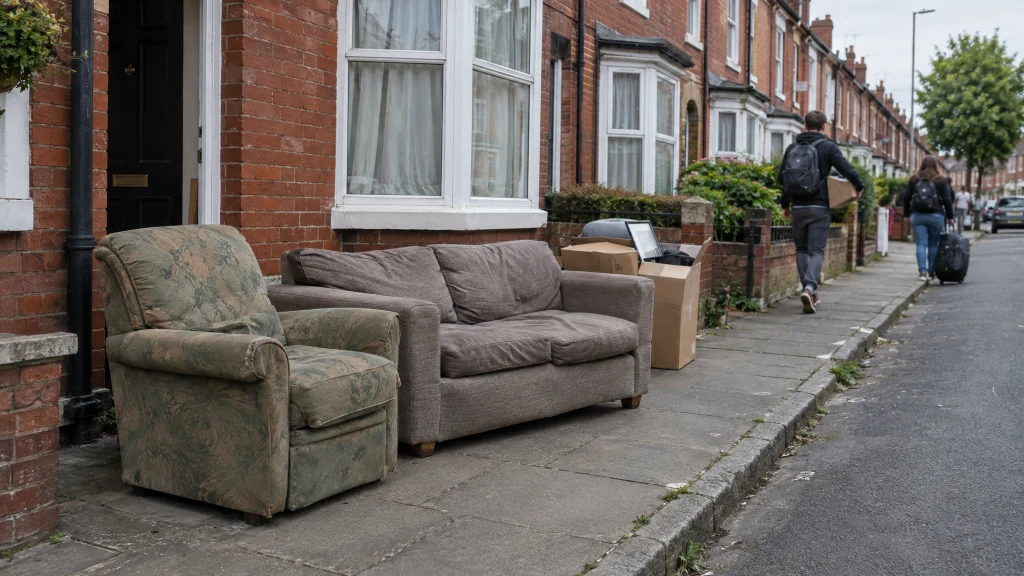
Manchester has one of the largest concentrations of student HMOs in the country, heavily clustered in Fallowfield, Rusholme, and Withington, and the end of the academic year produces a predictable surge of furniture leaving properties all at once. The University of Manchester runs an annual “Give It, Don’t Bin It” campaign with Manchester City Council, Manchester Student Homes, the British Heart Foundation, and Manchester Metropolitan University specifically to redirect what students leave behind away from landfill and into donation and reuse. It is a genuinely good scheme for reducing waste, but it also means a large volume of secondhand furniture is actively being passed between households, charities, and incoming tenants in exactly the areas where HMO density is highest.
None of that furniture has been fire-safety checked as part of being donated or reused. A sofa that gets handed on from an outgoing student let to a landlord furnishing a different room, or picked up from a charity collection point, carries whatever compliance status it had when it was first sold, and that status is invisible unless you physically find and check the label.
If a tenant leaves furniture behind and you intend to keep using it in the room, or move it to another room in the same property, treat it exactly as you would a second-hand purchase. Find the permanent label. If you cannot find one, do not assume the item is fine because it has been sitting there safely for the last two years. Age is not evidence of compliance, and a missing label is not a paperwork technicality, it is the only proof you have.
| Item type | Covered by the 1988 Regulations? | What to check before using it in a let room |
|---|---|---|
| Sofas, armchairs, sofa beds | Yes | Permanent “CARELESSNESS CAUSES FIRE” label with a batch or identification number |
| Upholstered headboards | Yes | Same permanent label requirement as sofas and chairs |
| Mattresses and divan bases | Yes, under a separate test | BS 7177 label with a blue border and white lettering |
| Scatter cushions and pillows | Yes, if supplied with the furniture | Permanent label, or written proof of compliance from the supplier |
| Curtains, carpets, bedding, loose covers | No | Not covered by these specific Regulations, though other safety duties still apply |
| Furniture made before 1 January 1950 | No, exempt | Treat with ordinary care; age alone is not a fire safety guarantee |
| Any upholstered item with the label missing or removed | Treated as non-compliant until proven otherwise | Do not use it until you have written confirmation from the original manufacturer or supplier |
There are a handful of specific situations where non-compliant furniture ends up in HMOs again and again, usually without the landlord intending it.
Furniture compliance is not a side issue sitting next to your fire risk assessment. It is a mandatory licence condition and a specific legal duty that sits underneath the Regulatory Reform (Fire Safety) Order 2005, and both your council and your assessor will treat it that way.
Manchester City Council’s HMO licence conditions, issued under Schedule 4 of the Housing Act 2004, require the licence holder to keep electrical appliances and furniture they supply “in a safe condition,” and to provide the council with a written declaration confirming this on request. Greater Manchester Fire and Rescue Service goes further on its own landlord guidance, stating explicitly that HMO landlords must “make sure any furniture and furnishings they provide meet the fire resistance regulations” as one of their core legal duties, alongside gas safety checks and electrical installation maintenance. This sits next to, not instead of, the wider conditions covered in Manchester’s HMO licensing rules, and it is treated as seriously as the furniture checks that come up during a kitchen fire safety review in shared HMO kitchens.

A competent fire risk assessor walking through your HMO’s communal areas and let rooms will physically look for permanent labels on upholstered furniture, exactly as they check fire door seals or smoke alarm placement. This is not a theoretical risk sitting in legislation somewhere. It is a line item on the assessment, and an assessor who finds unlabelled furniture is obliged to flag it as a significant finding, because the consequences of a fire involving non-compliant upholstery are measurably worse than one that does not.
A government-commissioned study into the fire risks of upholstered products, published by OPSS in 2023, found that upholstered items including beds, mattresses, and furniture were the material first ignited in 12% of domestic fire incidents in England, but accounted for 29% of fire fatalities over the same period. Upholstered furniture fires are disproportionately deadly relative to how often they happen, largely because of how quickly modern foam fillings can produce dense, toxic smoke. That is the entire reasoning behind the Regulations existing in the first place, and it is why “the sofa looked fine” is not a defence an assessor, or a court, is likely to accept.
I tell every landlord the same thing when this comes up: a fire door slows a fire down. A smoke alarm buys you time to react. Compliant furniture changes whether the fire that starts in your lounge produces a slow, survivable smoulder or a fast, lethal flashover. It’s doing a different job to everything else on your checklist, which is exactly why it gets forgotten.
Breaching the Furniture and Furnishings (Fire)(Safety) Regulations is a criminal offence under the Consumer Protection Act 1987, enforced locally by Trading Standards rather than the fire service, though a fire risk assessment finding will often be what brings it to a council’s attention in the first place.
Real enforcement outcomes give a sense of scale. Trading Standards in Wales fined the director of a sofa retailer close to £20,000 after inspectors found 31 items with no display label, 15 items with no permanent label at all, and a further 33 upholstered items where the permanent label was missing required batch numbers or producer details. The final penalty combined fines, a government surcharge, prosecution costs, and compensation to an affected consumer. That case involved a retailer rather than a landlord, but the same offence, and the same enforcement route, applies to anyone supplying non-compliant furniture in the course of business, which a letting plainly is.
For an HMO landlord specifically, the practical consequences stack up beyond the criminal offence itself.
This is the sequence I’d actually work through, whether you’re furnishing a room from scratch or deciding whether to keep something a previous tenant left behind.
If you are furnishing a room for the first time, during a property’s initial conversion into an HMO, this is the point to build furniture compliance into your snagging list alongside the fire doors and alarms, rather than treating it as an afterthought once the building work is signed off. It is far cheaper to buy correctly labelled furniture once than to replace it after a council or Trading Standards visit, and it is worth factoring into whatever you have budgeted for the overall fire risk assessment and compliance costs for the property.
Second-hand furniture is allowed under the Regulations, provided it carries a valid permanent label showing it passed the required tests when it was made. The same standard applies to new and used furniture equally. The problem is practical, not legal: second-hand items are far more likely to have lost their label than to have failed a test.
It is a permanent label, usually sewn or stapled, found under the seat cushion, on the underside of the frame, or on the base of the item. It states the warning text, a batch or identification number, and a summary of which compliance tests the item passed.
Not automatically. Upholstered flat-pack items, such as fabric headboards or armchairs, still need to carry the permanent label like any other upholstered furniture. Non-upholstered flat-pack furniture, such as a wardrobe or a bookshelf, generally falls outside these specific Regulations, though it must still meet general product safety law.
Treat the item as non-compliant until you can prove otherwise. Contact the original manufacturer or retailer if you know who it was, in case they can confirm the model’s compliance. If you cannot establish this, the safest and simplest option is to replace the item rather than let a room with an unverified piece of furniture in it.
No. The Regulations apply to furniture you, as the landlord, supply as part of the letting. Furniture a tenant personally owns and brings into their own room is their responsibility, not yours, though it is still worth including in your general fire risk assessment of the property as a whole.
Trading Standards enforces the Furniture and Furnishings (Fire)(Safety) Regulations themselves, since the offence sits under the Consumer Protection Act 1987. In practice, a council’s housing or licensing team, or your fire risk assessor, is often what first identifies a problem, which then gets referred into the Trading Standards enforcement route alongside any separate licensing or Fire Safety Order action.
The core testing requirements are stable for now. A government consultation on a wider overhaul, built around a new smoulder-based test and reduced chemical flame retardants, closed in June 2026 and the outcome has not yet been published. Nothing has changed as a result of it yet, but landlords furnishing HMOs should expect this area of regulation to keep moving rather than treat today’s rules as permanent.
A competent assessor won’t “fail” a property in the way a licence inspection might, but they will record unlabelled or non-compliant furniture as a significant finding in your fire risk assessment, with a recommendation to replace or remove it. Leaving that finding unresolved is what then exposes you to licensing, insurance, and enforcement problems down the line, so it is worth acting on quickly rather than letting it sit on the action plan.
Furniture compliance is a small, cheap thing to get right next to everything else an HMO landlord has to manage, and it is one of the few areas where a thorough fire risk assessment will catch a problem before it becomes a Trading Standards case or an insurance dispute. If you are not confident every upholstered item in your property carries a valid label, that is worth resolving before your next assessment, not after.
Most HMO landlords I talk to can rattle off their fire door requirements, their alarm grade, and their emergency lighting checks without missing a beat....
Most of the fire safety advice on this site assumes you already have a working HMO. This one is for the stage before that: the...