Fire Risk Assessments and Landlord Insurance: What HMO Landlords Need to Know
23/09/2026
I’ve lost count of the number of landlords who tell me their fire risk assessment is “just for the council.” It isn’t. Every time I review a claim story from a landlord whose HMO has had a fire, the same question comes up sooner or later from the insurer: can you show us your fire risk assessment, and were you actually following it?
Most landlords never find out how their insurer feels about fire safety compliance until they’re standing in a scorched kitchen wondering whether the payout is coming. By then it’s too late to fix a missing or out-of-date assessment. This guide sets out, in plain terms, how fire risk assessments and landlord insurance actually connect, what a typical policy expects of you, and what to check before your next renewal.
None of this is scaremongering. The legal duty to have a fire risk assessment and the practical need to keep your insurance intact are two separate obligations that happen to point at exactly the same document. Get that one document right, and both problems tend to look after themselves.
A fire risk assessment is a legal requirement for the common parts of any HMO under the Regulatory Reform (Fire Safety) Order 2005, and since 1 October 2023 it must be recorded in writing regardless of the size of the property or whether a licence is in force. That’s the compliance side, and it’s the side most landlords focus on.
But insurers read the same document differently. To an insurer, a fire risk assessment is evidence. It shows what hazards you knew about, what you did to control them, and whether you kept that control in place. Home Office figures for the year to March 2026 recorded 23,795 accidental dwelling fires in England, a 3.5% rise on the year before. Every one of those incidents eventually crossed an insurer’s desk, and in a shared house with several tenants, several kitchens’ worth of appliances and shared escape routes, the stakes for both compliance and cover are higher than in a single-let.

A landlord I’ll call Dave, because this happens often enough that it isn’t really about one person, converts a three-storey terrace near Fallowfield or Rusholme into a six-bed student let. He gets his mandatory HMO licence from Manchester City Council, insures the property, and moves on. Three years pass. Tenants change every September. A tumble dryer gets added to the kitchen. Nobody updates the fire risk assessment, because nobody remembers it needs updating.
Then a phone charger left on a sofa overnight causes a small fire in a communal lounge. The damage is contained, but the insurer’s investigator asks a simple question: when was the fire risk assessment last reviewed, and did it cover the room where the fire started? If the honest answer is “three years ago, and no,” the claim gets harder, slower and more likely to be reduced, even though nobody did anything reckless. The fire risk assessment is the difference between an insurer treating this as bad luck or as a foreseeable, unmanaged risk.
Read the small print of most landlord insurance policies and you’ll find a “reasonable precautions” or “maintenance” condition. In plain English, it means you’re expected to keep the property in good repair and to comply with relevant safety law, not just at the point you took the policy out, but continuously.
Cover4LetProperty, a UK landlord insurance broker, puts it plainly: “if a loss is connected with a failure to maintain the property or comply with a relevant policy condition, this could affect how a claim is handled, depending on the circumstances and the policy wording.” That principle applies to gas and electrical safety, and it applies just as directly to fire.
An insurer won’t usually ask to see your fire risk assessment when you take out a policy. They’re far more likely to ask for it after something has gone wrong, when they’re deciding whether your claim falls inside or outside the policy’s conditions. A current, accurate, acted-upon assessment is exactly the kind of evidence that keeps a claim inside those conditions.
Total Landlord Insurance, one of the UK’s specialist landlord insurers, is more specific about one common failure point: propping open a fire door or disabling its self-closing device “may violate the terms of any property licence and invalidate your landlord insurance.” The same logic extends to disconnected smoke alarms, blocked escape routes, and any other fire precaution your assessment identified as necessary but that never actually got fixed.
A fire risk assessment that sits in a drawer, unread and unactioned, protects you from almost nothing. The document itself isn’t the safeguard. What you did because of it is.
Total Landlord Insurance’s own figures put the average fire damage claim at over £22,000, among the most expensive categories of claim insurers see. That’s before you factor in lost rent while the property is uninhabitable, alternative accommodation costs for tenants, and the time it takes to get an HMO back into a lettable, licensable condition. On the legal side, a serious breach of the Fire Safety Order can bring an unlimited fine and up to two years’ imprisonment.
Government enforcement figures add another layer. Fire and rescue authorities carried out 50,195 fire safety audits of non-domestic premises in the year to March 2026, with only 60% receiving a satisfactory outcome. The most common breaches were failures around emergency routes and exits (11,286 breaches of Article 14) and failures to maintain fire safety measures (9,727 breaches of Article 17) — exactly the areas a good fire risk assessment is designed to catch before an inspector, or a fire, finds them for you.
| Scenario | Legal exposure | Insurance exposure |
|---|---|---|
| No fire risk assessment at all | Unlimited fine, up to 2 years’ imprisonment for serious breaches | Insurer likely treats this as a fundamental breach of policy conditions |
| Assessment exists but is out of date | Enforcement notice, minimum 28 days to remedy | Insurer may argue known risks weren’t controlled |
| Assessment identifies a hazard that’s never fixed | Prohibition notice possible if risk is serious | Strongest grounds for an insurer to dispute a related claim |
| Assessment current, hazards controlled and evidenced | Compliant, low enforcement risk | Claim proceeds on its merits, not on a compliance dispute |
Insurers don’t price an HMO the same way they price a single-family let, and fire is the main reason why. More occupants means more cooking, more electrical appliances, more shared kitchens and more people who didn’t choose each other as housemates and may not look out for each other’s safety habits. Home Office data shows cooking appliances cause 42% of accidental dwelling fires, though they account for only 11% of fire deaths; smoking materials cause just 7.6% of fires but 27% of fatalities. In a house with five or six unrelated occupants, both risks multiply.
I see the same pattern repeatedly across the HMOs I assess: a kitchen built for a family of four now serving six unrelated tenants, each with their own kettle, toaster, microwave and phone charger, all plugged into the same run of extension leads. None of that shows up on a standard landlord insurance application form. It shows up in a fire risk assessment, which is exactly why insurers who understand HMOs treat that document as more than paperwork.
Manchester adds its own layer to this. The city has one of the largest concentrations of converted-terrace student and professional HMOs outside London, much of it built well before shared-house occupancy was ever anticipated. Converted properties usually mean older wiring, retrofitted kitchens and escape routes that were never designed with several unrelated households in mind, all factors a licensed Manchester HMO has to account for and an insurer will expect to see accounted for too.
Under the Fire Safety Order, the Responsible Person for an HMO’s common parts is usually the landlord or their managing agent, not the tenants living there. That matters for insurance because it means the duty to identify and control these shared-area risks sits squarely with the person named on the insurance policy, not with whoever happens to be living in the house that year.
A generic landlord policy is often written with a single-family let in mind and may exclude or restrict cover for multi-occupancy use altogether if you don’t declare it correctly. Specialist HMO insurance is priced with the higher occupancy and shared-space risk factored in from the start, but that pricing assumes you’re managing the fire risk properly, which is precisely what a fire risk assessment demonstrates.
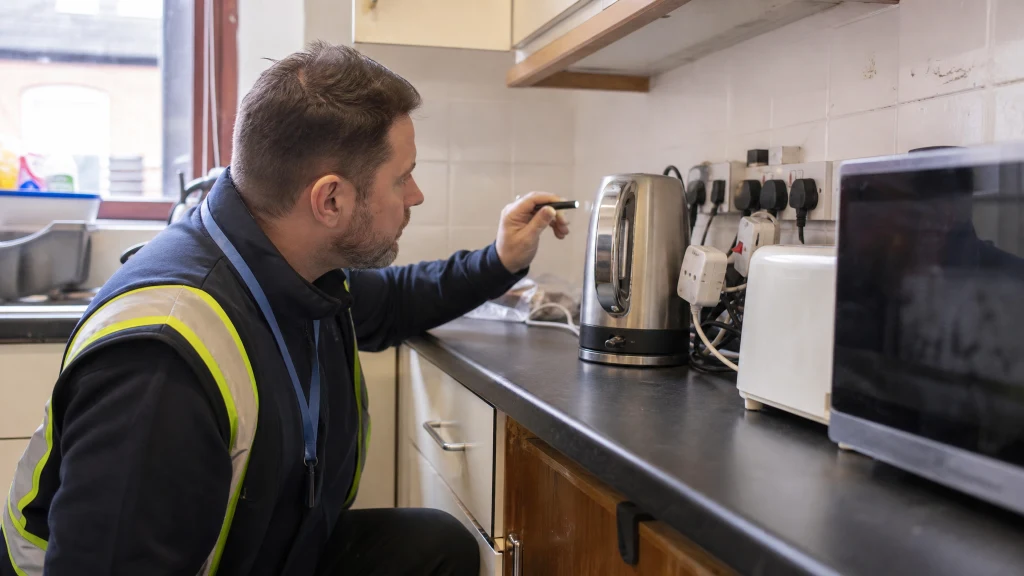
The law doesn’t insist that every fire risk assessment is carried out by a paid, third-party assessor. The Home Office’s own guidance for Responsible Persons says they must be “competent,” meaning they have the training, knowledge and experience to identify the hazards in that specific building and judge whether existing precautions are adequate. For a straightforward single-let, an experienced, well-informed landlord can sometimes meet that bar themselves.
For most HMOs, particularly older converted properties with several fire doors, alarm zones and escape routes to assess, that bar is harder to clear without training most landlords don’t have and don’t need for anything else they do. This is where insurers start to pay closer attention. A self-completed assessment on a complex property is far easier for an insurer’s investigator to pick apart after a fire than a dated, professionally produced report from a named, competent third party with the qualifications to back their judgement.
This isn’t really about paying for a certificate. It’s about producing an assessment that will still hold up months later, under scrutiny, when the person reading it is trying to find a reason not to pay out rather than a reason to help you.
A properly written fire risk assessment does more than tick a legal box. Done well, it gives you a working record you can hand to an insurer, an inspector or a letting agent without having to explain gaps.
None of that happens automatically just because a document exists. It happens because the actions it lists were actually completed and the completion was recorded.
If a fire does happen, most insurers follow a broadly similar process, and your fire risk assessment sits at the centre of several of these steps.
The single biggest factor in how smoothly that process goes is whether you can produce a fire risk assessment that was current, accurate and acted on before the fire, not one hastily backdated afterwards. Insurers and their investigators are experienced at spotting the difference.
Keep every version of your fire risk assessment, not just the most recent one, along with dated evidence of the work done against it: invoices, photos, or a simple email trail confirming a repair was completed. If a claim ever comes down to your word against a loss adjuster’s interpretation of events, a paper trail beats a memory every time, and it takes minutes to build as you go rather than hours to reconstruct after a fire.
I see the same handful of mistakes on almost every HMO where insurance and fire safety end up in conflict.
An insurer doesn’t need to prove you caused the fire to dispute a claim. They only need to show a known, documented hazard was left unaddressed.
Most of these mistakes aren’t dishonesty. They’re the ordinary result of running several properties, relying on agents, and treating fire safety paperwork as something to file rather than something to act on. The fix is rarely expensive. It’s usually just a calendar reminder and a habit of closing out action points before they’re forgotten.
The NRLA’s general guidance is to review a fire risk assessment every two years and update it every four, alongside reviews triggered by any significant change, such as a new tenant with different needs, building work, or a change in how rooms are used. For an HMO, I’d treat two years as a maximum rather than a target. Tenant turnover, new appliances and layout changes happen far more often in shared housing than that guidance assumes.
From an insurance standpoint, the safest habit is to review the assessment at every insurance renewal, not just when the compliance calendar says it’s due. If anything in the property has changed since the last review, tell your insurer, because an assessment they don’t know has changed is one they’ll assume hasn’t.
If your property falls under Manchester City Council’s mandatory or selective HMO licensing scheme, lining your fire risk assessment review up with your licence renewal cycle is a sensible way to make sure neither one quietly lapses while you’re focused on the other. Councils and insurers are asking for evidence of broadly the same thing, just for different reasons.
Before your next renewal, it’s worth running through a short list rather than assuming last year’s policy still fits the property as it stands today.
| Checklist item | Why it matters |
|---|---|
| Is the property correctly declared as an HMO on the policy? | Misdeclaration is one of the most common grounds for a disputed claim |
| Is the fire risk assessment less than two years old? | Matches NRLA guidance and shows an active review cycle |
| Have all action points from the last assessment been closed out? | An open action point is a documented, unaddressed hazard |
| Are smoke alarms and fire doors checked and working? | The most common single point insurers query after a fire |
| Has the insurer been told about any building or occupancy changes? | Keeps the policy’s risk picture accurate and enforceable |
| Is the assessor named, competent and their report dated? | Supports a “reasonable precautions” defence if challenged |

If you go through that list and find gaps, the sensible order is to close them before your renewal date, not after. A fresh, professionally documented assessment costs a fraction of what a single disputed claim can cost you, and we’ve set out realistic UK pricing in our fire risk assessment cost guide if budgeting for it is what’s holding you back. It’s also worth reading what actually happens, legally and financially, if you don’t have one at all, alongside the specific rules covering shared and communal areas in an HMO.
An insurer can dispute or reduce a claim if it can show you failed to comply with a relevant legal or policy condition, and a missing fire risk assessment on an HMO is a clear example of that. It’s rarely an automatic void, but it puts you in a far weaker position when a claim is being assessed.
No single document guarantees a claim outcome. What it does is remove one of the main grounds an insurer could use to dispute or reduce a payout, provided the assessment was current and its recommendations were actually carried out.
Yes. The legal duty to assess the common parts under the Regulatory Reform (Fire Safety) Order 2005 applies to any building that isn’t a single private dwelling, regardless of whether the property meets the threshold for mandatory HMO licensing. Our full fire risk assessment for HMOs guide covers exactly what’s required at each size of property.
It isn’t guaranteed to reduce the premium directly, since pricing depends on many factors, but a current assessment with resolved actions gives insurers less reason to load the premium for perceived risk, and removes a common excuse to dispute a claim later.
Someone competent to identify fire hazards and assess the adequacy of existing precautions, whether that’s a suitably experienced landlord for a very simple property or, for most HMOs, a qualified third-party fire risk assessor whose report is professionally documented.
Record the hazard, put in place an interim control such as restricting use of the affected area, set a realistic date to complete the fix, and tell your insurer if the hazard is significant. An acknowledged, managed risk is treated very differently to an ignored one.
Generally no. A fire risk assessment is a compliance cost you pay for directly, the same as a gas safety check, rather than something your insurance policy funds. What the assessment can do is protect the much larger sums your policy would otherwise pay out after a fire.
Not on its own. Ask them directly whether the property is declared correctly as an HMO, whether the fire risk assessment has been reviewed recently, and whether any action points from it are still open. Agents manage many properties, and assumptions about who checked what are exactly where gaps appear.
Most HMO landlords I talk to can rattle off their fire door requirements, their alarm grade, and their emergency lighting checks without missing a beat....
Most of the fire safety advice on this site assumes you already have a working HMO. This one is for the stage before that: the...