
Fire Safety During HMO Renovations: A Manchester Landlord’s Guide
10/11/2026
Most fire safety guidance for HMO landlords deals with one of two moments in a property’s life: getting it ready to let for the first time, or keeping an already-settled household safe day to day. Almost nothing deals with the messy bit in between.
That’s when a licensed, tenanted HMO in Manchester goes through a kitchen refit, a rewire, a loft conversion or a full refurbishment while people are still living there.
I see this gap constantly in conversations with landlords. They’ve planned the trades, the budget and the council paperwork down to the week.
What they haven’t asked is who’s legally responsible for fire safety on site while the work is actually happening. That matters, because building work is one of the most common moments a Manchester HMO’s fire precautions quietly fail.
This guide covers what the law actually requires of you during a renovation, the real risks a half-finished HMO creates, and the practical steps that keep your fire risk assessment valid and your tenants safe from the first delivery of scaffolding to the final coat of paint.
It’s a common assumption that fire safety law is mainly about the finished product – the fire doors, the alarm panel, the signage once everything is back in place. In reality, the Regulatory Reform (Fire Safety) Order 2005 applies to the premises throughout the works, not just once the dust sheets come down.
As the responsible person under Article 9 of the Fire Safety Order, you must keep your fire risk assessment under review. You must update it if there’s a significant change to the premises, the fire safety measures in place, or how work is organised on site – and a renovation is very often exactly that.
Separately, the Management of Houses in Multiple Occupation (England) Regulations 2006 place a standing duty on the HMO’s manager, under Regulation 4, to keep every escape route free from obstruction and in good repair. Fire-fighting equipment and alarms must also be kept in working order throughout.
That duty doesn’t have a building-work exemption. If scaffolding, materials, skips or trade vans compromise an escape route during a refurbishment, you’re in breach of Regulation 4 for as long as that lasts – however temporary it feels to you.
In practice, I’d always recommend reviewing the fire risk assessment before the first contractor sets foot on site, not after. A pre-works review should cover the sequence of work, and which escape routes or compartment walls will be affected at each stage.
It should also set out where materials and skips will sit, and what temporary fire precautions – extra extinguishers, temporary signage, interim alarm cover – are needed while normal protection is disrupted.
A second review belongs at practical completion, once fire doors, alarm wiring and compartmentation are back to their finished state. Treat the pre-works document as provisional, covering the works period only, with a full review to follow once the job is finished.
Not every repair triggers a formal review. A like-for-like boiler swap or a repaint doesn’t usually change the risk picture.
Work that removes or breaches a fire-separating wall or floor, alters a means of escape, or changes the room layout or occupancy of a storey does. So does work that introduces new ignition sources, or takes a fire door out of its frame for any length of time.
A lot of landlords assume that once they’ve hired a builder, fire safety on site becomes the builder’s problem. Under the Construction (Design and Management) Regulations 2015, that isn’t how it works for a letting business.
The HSE’s own guidance on who counts as a commercial client is direct on this point: “commercial clients include local authorities, housing associations or other landlords who own domestic properties.”
If you let the HMO as a business – which, if it’s licensed, it is – you’re a commercial client under CDM 2015, not a domestic client. Commercial clients carry the full set of client duties under the regulations, starting at the planning stage and continuing through to completion.
I see this gap all the time: landlords plan a refurbishment around trades, budget and council sign-off, and never once ask who is actually responsible for fire safety on site while the work is happening. Under CDM 2015, that answer is usually you.
You don’t need to become a construction health and safety expert overnight. You do need to make sure someone competent is managing fire risk on site for the duration of the job.
A principal contractor should be appointed and briefed on the premises’ fire strategy. Satisfy yourself, in writing ideally, that whoever is running the job understands they’re working in an occupied, licensed HMO with tenants still present.
For a one-off job with a single small contractor, this is usually a short conversation and a written confirmation of who’s managing site fire safety. For a larger refurbishment with multiple trades, put it in the contract itself, alongside your updated fire risk assessment for the works period.
Fire doors are worth singling out here, because they’re the single most common casualty of a renovation. If a door comes off its hinges for any part of the job – to fit new flooring, replace a frame, or simply get furniture through – make sure whoever’s managing site fire safety understands the regulatory standard it has to go back to, not just that it needs rehanging by the end of the day.
It’s tempting to think of a renovation fire as a freak event. The data doesn’t support that.
Analysis of Office for National Statistics figures by hot-work training specialist CE Safety, covering England’s fire and rescue services, recorded 199 hot-work fires in non-dwelling buildings in 2023/24 and 182 in 2024/25 – a 9% year-on-year fall, but still close to one every other day.
Welding or cutting work caused 85% of them in both years. Of those fires, 12 happened in buildings actually under construction in 2023/24 and 8 in 2024/25, with 32 casualties recorded across both years combined.
Most of that risk sits with a short list of renovation tasks that come up on almost every HMO refurbishment. The table below sets out the ones I’d flag before any job starts, alongside the precaution that actually addresses each one.
| Renovation Task | Main Fire Risk | What Should Happen On Site |
|---|---|---|
| Rewiring or consumer unit replacement | Exposed live wiring, overloaded temporary supplies, interrupted alarm power | Electrician provides temporary alarm cover or battery back-up; isolate circuits properly; no reliance on trailing leads overnight |
| Kitchen or bathroom refit | Hot works near combustible units; fire doors removed from the escape route | Fire door re-hung or escape route rerouted before end of each working day; extinguisher on site |
| Loft conversion or insulation work | Hot works near timber and insulation; escape route altered | Hot work permit; fire watch after torch or grinder use; temporary escape signage if layout changes |
| Re-roofing or felt/bitumen work | Blowtorches directly above timber structure; debris blocking ground-level exits | Hot work permit; clear 10-metre zone of combustibles; keep exits and access roads clear at all times |
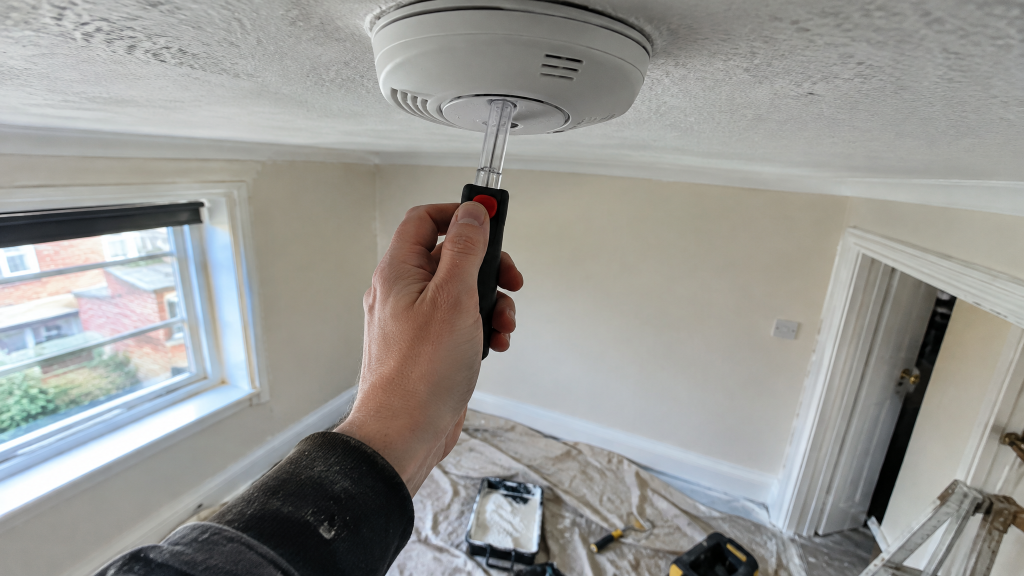
| Replastering or dry lining | Dust disabling smoke alarms; fire-stopping gaps left open overnight | Alarms covered only during active work and uncovered immediately after; fire-stopping reinstated before end of day |
| Damp-proofing or tanking | Flammable solvents and resins stored or used in confined spaces | Minimum quantities on site; proper ventilation; no ignition sources nearby while curing |
If any trade on site is using an open flame or heat-producing tool – welding, cutting, grinding, soldering, or a blowtorch on roofing felt – treat it as hot work and insist on a proper permit system.
NFU Mutual’s own fire safety guide to hot works sets out the standard most competent contractors already follow: a written, task-specific permit naming the location, the controls in place and the post-work inspection.
At least two suitable extinguishers should be immediately to hand. Combustible materials need clearing for at least 10 metres around the work, or covering with non-combustible sheeting if they can’t be moved.
The part landlords most often miss is the fire watch. A trained person not involved in the work itself should watch the area while the hot work is happening.
They should then keep monitoring it for at least 60 minutes afterwards, with checks at intervals of 20 minutes or less, for up to two hours after the torch or grinder goes off. That includes checking the floor above, the floor below, and the far side of any wall the work was carried out against – smouldering can travel somewhere you can’t see for hours before it becomes a visible fire.
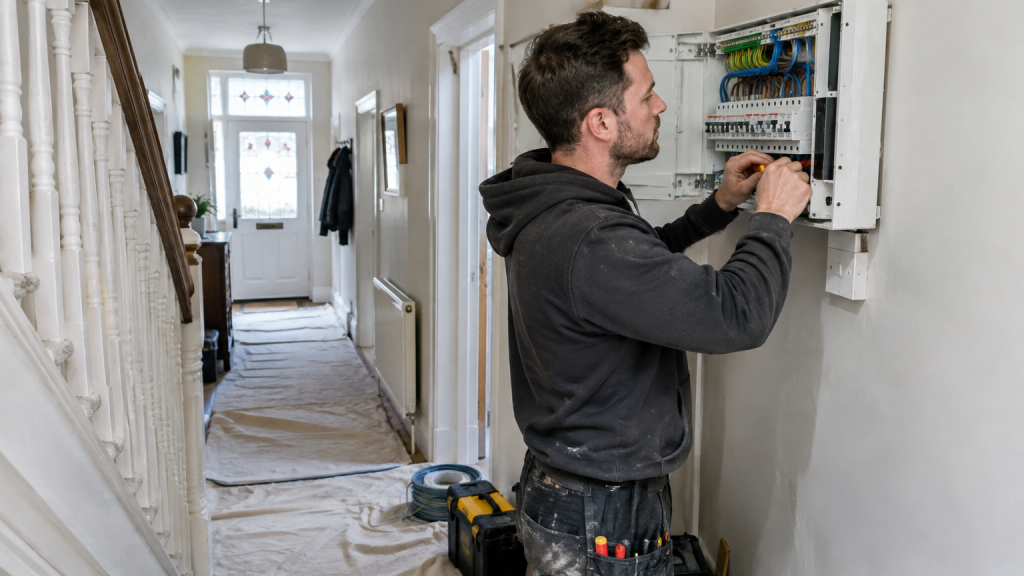
Fire and rescue services see this problem often enough to publish specific guidance on it. Hereford and Worcester Fire and Rescue Service’s own note on fire safety in buildings under construction or renovation is blunt: temporary works “must not block or reduce access to emergency exits,” whatever stage the job is at.
In an HMO, that’s really an extension of the ongoing duty you already carry around communal area fire safety, just under much harder conditions than a normal inspection ever covers.
For a Manchester HMO with tenants still living in it, that guidance translates into a short, practical set of rules I’d apply to every job, large or small.
Access during a tenancy still runs through the usual rules: reasonable notice, a sensible time of day, and cooperation from the tenant. That cooperation is far easier to get if they understand why the work matters and how long it will take.
Put a written notice up in communal areas as well as giving individual notice. Cover the dates, which rooms or areas are affected, and any temporary change to escape routes or the fire alarm.
Some jobs genuinely can’t be done safely around people living in the building. If a renovation will, at any point, leave a room without a usable final exit, disable the whole fire alarm system overnight, or remove compartmentation between occupied rooms and the works area, that’s the point to talk to tenants about a temporary move.
That move might be to another room in the same HMO, a short stay elsewhere that you fund, or simply a pause in the works until it can be done safely.
I’ve seen landlords push a refurbishment through around tenants purely to avoid the cost or hassle of a temporary decant, on jobs where the fire alarm was effectively down for days at a time. That’s not a corner worth cutting – if the reasonable precautions clearly weren’t in place, it’s your licence and your liability on the line, not the contractor’s.
As a rule of thumb, budget for moving tenants out if a competent contractor tells you the fire alarm, a fire door or a compartment wall will be out of action for more than a single working day. The same applies if dust and debris will make an escape route genuinely unsafe rather than just inconvenient.
It’s a real cost, but it’s smaller than the cost of an enforcement notice, an insurance dispute, or worse, after an incident during the works.

Most of the problems that turn up on a mid-renovation fire risk assessment visit follow the same handful of patterns. None of them are exotic, and all of them are avoidable with a bit of planning before the first van turns up.
Keep this close to hand for every renovation, however small it looks on paper.
Before work starts: confirm who is managing fire safety on site under CDM 2015, and review and update the fire risk assessment for the works period. Agree escape route arrangements and alarm cover with the contractor in writing, brief tenants in writing and individually, and check the contractor’s insurance covers works to an occupied, licensed HMO.
During the works: inspect escape routes and fire doors at the end of every working day, and confirm the fire alarm is live overnight, every night. Operate a hot work permit for any welding, cutting or torch work, and keep a daily log of anything temporarily disabled and when it was restored.
After practical completion: reinstate every fire door, alarm zone and compartment wall to its original specification or better. Carry out a full fire risk assessment review covering the finished layout, and update your fire action notices and escape plans if anything changed.
Keep the paperwork from every stage – it’s exactly what an enforcement officer or insurer will ask to see if anything goes wrong later. If you’re not confident the finished job meets the standard your original HMO conversion work was built to, a fresh professional assessment is the safest way to find out before the council does.
Not a brand-new one from scratch every time, but you do need to review your existing assessment and update it if the work changes the premises, the fire precautions in place, or how the site is organised – which most renovations do. A short interim review covering the works period, followed by a full review at completion, is usually the right approach.
Day-to-day site safety sits with the contractor, but as the landlord letting the HMO as a business, you’re a commercial client under CDM 2015, which carries its own legal duties from the planning stage onward. You can’t simply hand the whole responsibility over by hiring a builder.
Only briefly, only during the active work itself, and only with a fallback in place – a fire watch, a second working alarm, or a temporary standalone detector. Alarms should be reinstated immediately once the dusty work for the day has finished, not left off overnight.
Not for most jobs, but you should budget for a temporary move if the fire alarm, a fire door or a compartment wall will be out of action for more than a day, or if dust and debris genuinely make an escape route unsafe rather than just inconvenient.
Any activity using an open flame or heat-producing equipment – welding, cutting, grinding, soldering, and blowtorch work on roofing felt or old paint are the ones that come up most often on HMO refurbishments. Each one should be covered by a written permit and followed by a fire watch.
Selective licensing itself doesn’t change the fire safety rules during the works, but it does mean your record – including how any renovation was managed – can be scrutinised as part of a licence renewal or council inspection across Greater Manchester. Keeping a clear paper trail from the works protects your licence as well as your tenants.
Raise it immediately and put it in writing – a fire door that isn’t closed isn’t doing its job, and repeated incidents are worth documenting in case you need to change contractor. It’s also worth noting in your fire risk assessment review as evidence the escape route was compromised, even temporarily.
Renovation work is one of the few times a fire risk assessment genuinely needs to flex with the building rather than sit on a shelf. If you’re planning works on a Manchester HMO and want a professional review of what the job means for your fire safety duties – before or after the trades arrive – get in touch for a fire risk assessment that covers exactly where your property is in the process.

Ask ten Manchester landlords what their HMO's fire evacuation strategy is, and most will tell you it has an alarm and a fire door. That...

Most fire safety guidance for HMO landlords deals with one of two moments in a property’s life: getting it ready to let for the first...