
Selective Licensing Across Greater Manchester: What It Means for Your Fire Safety Duties
29/10/2026
If you own a rental property anywhere near Clayton, Longsight, Eccles, Broughton or parts of Oldham, there is a reasonable chance your local council now requires you to hold a selective licence, even if your property is a straightforward single let with no shared facilities at all. I speak to landlords most weeks who assume licensing is something that only applies to HMOs. It does not, and the gap between what a selective licence actually checks and what fire safety law actually requires is where a lot of Greater Manchester landlords are getting caught out.
This article sets out exactly where selective licensing currently applies across Greater Manchester, what a licence does and does not cover, and why holding one is not the same thing as meeting your fire safety obligations. If you are a landlord or managing agent working across several boroughs, this is the distinction that matters most.
Selective licensing is a scheme under which a council requires every privately rented property within a defined area to be licensed, regardless of whether it is a single let, a couple sharing, or a full HMO. That is the key difference from HMO licensing, which only applies to larger shared houses. Under a selective licensing designation, an ordinary two-bedroom flat let to one tenant needs a licence just as much as a six-bedroom shared house down the road.
Councils do not introduce these schemes lightly. They have to show a genuine problem exists, consult landlords and tenants, and get sign-off before the designation takes effect.
The power sits in Part 3 of the Housing Act 2004. Under section 80, a council can designate an area for selective licensing on one of two general grounds: that the area has, or is likely to develop, low housing demand, or that it has a significant and persistent problem with anti-social behaviour that private landlords are failing to address.
Here is the bit that catches people out. Poor property condition on its own is not one of the stated grounds in section 80. Councils tackle hazardous conditions separately, through Part 1 of the same Act. In practice, though, the areas that get designated are very often the same areas where property condition, including fire safety, is also weak, which is exactly why the two issues get mixed up in landlords’ minds.
A designation must be consulted on, must fit the council’s wider housing strategy, needs sign-off from the relevant national authority before taking effect, and cannot run for more than five years before it has to be reviewed and, usually, renewed.
I still find landlords conflating these three schemes, so it is worth being precise. Mandatory HMO licensing has applied across England since 2006 to any HMO with five or more occupants forming more than one household, wherever it is located. Selective licensing is geographic: it catches every privately rented property, HMO or not, inside a designated boundary. Additional licensing, sometimes called Section 257 licensing when it covers converted blocks of flats, is a further scheme some councils run for smaller HMOs that fall outside the mandatory scheme.
You can be inside a selective licensing area and also need an HMO licence for the same property. The two schemes are not alternatives to each other. Check both separately for every address you own, not just the one you assume applies.
The question I get asked most often isn’t “do I need a licence”, it’s “which licence”. Landlords with a handful of properties scattered across Manchester, Salford and Oldham can easily have three different licensing regimes running on three different addresses at the same time.
Coverage varies hugely by borough, and it changes street by street rather than by whole ward in most cases. Always check your exact address against the council’s own designation map before assuming either way. The table below sets out the picture as it currently stands.

| Borough | Scheme and areas | Dates | Standard fee |
|---|---|---|---|
| Manchester | Selective licensing in three phases: Clayton & Openshaw, Gorton & Abbey Hey, Harpurhey; Longsight, Rusholme, Levenshulme, Moss Side & Whalley Range; Cheetham, Crumpsall, Miles Platting & Newton Heath | 1 May 2022 to 24 May 2030 (phased end dates) | Selective fee set separately; HMO licence from £1,321 |
| Salford | Eccles, Barton and Winton; Broughton and Kersal & Broughton Park. Citywide Section 257 additional licensing for converted blocks of flats | 2022 to 2031 (phased by area) | From £609 (£390 for accredited landlords) |
| Oldham | 11 of the borough’s 20 wards, including Coldhurst, Werneth, Waterhead and St Mary’s | 4 July 2022 to 3 July 2027 | £582 |
| Rochdale | No selective licensing scheme currently in force, per the council’s own guidance | Not applicable at present | Not applicable |
Manchester City Council has rolled out selective licensing in overlapping phases rather than one single designation. The earliest, covering Clayton & Openshaw, Gorton & Abbey Hey and Harpurhey, runs to the end of April 2027. A second phase covering Longsight, Rusholme, Levenshulme, Moss Side and Whalley Range runs to August 2028. A third, covering Cheetham, Crumpsall, Harpurhey, Longsight, Miles Platting & Newton Heath and Moss Side, runs to May 2030. Because the boundaries are set street by street, two houses on the same road can sit on opposite sides of the line, so a ward name alone tells you nothing certain.
Salford’s selective licensing covers Eccles, Barton and Winton, designated from September 2022 to August 2027, and Broughton and Kersal & Broughton Park, a newer designation running from January 2026 to January 2031 with a standard fee of £609, reduced to £390 for landlords who join the council’s accreditation scheme and apply early. Salford also runs a citywide additional licensing scheme for converted blocks of flats under Section 257, which matters a great deal for this article’s purposes, for reasons covered in the next section.
Oldham’s selective licensing scheme covers 11 of the borough’s 20 wards and runs from July 2022 to July 2027, with a standard fee of £582. Bolton, Tameside, Bury, Trafford, Wigan and Stockport do not currently operate boroughwide selective licensing schemes in the same way, though individual councils can and do introduce them, and existing designations get renewed or expanded. Rochdale’s own guidance is explicit that it has not yet introduced a scheme at all. Never assume coverage either way. Check the exact address against the current designation map before you apply, or before you decide you do not need to.
A selective licence is primarily a management and property-standards tool. It is the council’s way of satisfying itself that a landlord is a fit and proper person, that the property is reasonably managed, and that basic standards are being met. Conditions typically cover things like gas and electrical safety checks, keeping the property free of damp and mould, responding to repair requests, and providing a written tenancy agreement.
These conditions sit alongside, rather than replace, whatever your HMO licence already requires if the property also meets that separate threshold. A property can need both at once, and each has its own application, its own fee and its own renewal date.
Fire safety sits inside this picture in two different ways, and conflating them is the single biggest misunderstanding I see. First, basic items like working smoke alarms and, where relevant, carbon monoxide alarms are typically expected as part of being a competent, licensed landlord, in the same way gas safety checks are. Second, and separately, any property that is an HMO, or that has shared means of escape such as a communal stairwell in a converted block of flats, carries its own distinct fire safety duty under different legislation entirely, covered in the next section.
Where this becomes very real is in enforcement. Salford Council’s own data on the HMOs it has inspected under its Section 257 additional licensing scheme found inadequate fire safety in 97% of the properties checked. That is not a typo, and it is not a historic figure from years ago. It reflects inspections carried out as the scheme has rolled out, on properties whose landlords, in many cases, believed they already had fire safety covered.
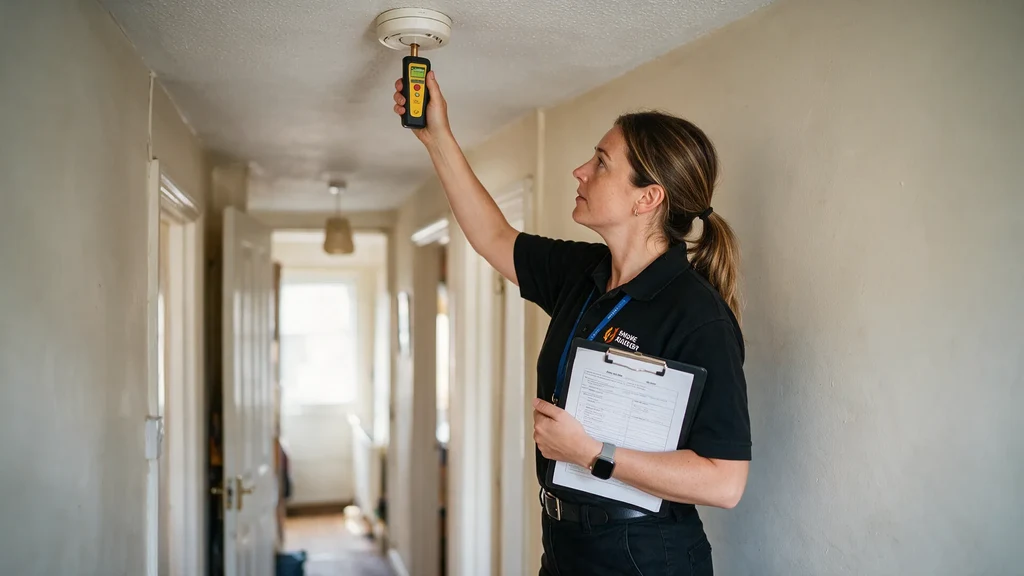
Ninety-seven per cent is the kind of number that should stop any landlord in their tracks. I’ve seen plenty of properties where the landlord has smoke alarms fitted and genuinely believes that is the job done, without ever having had anyone independently check escape routes, fire doors or compartmentation.
This is the distinction that matters most, so it is worth stating plainly. A selective or HMO licence is granted under housing law, administered by your local council’s licensing team. A fire risk assessment is a separate legal duty under the Regulatory Reform (Fire Safety) Order 2005, which applies to the “responsible person” for premises with shared areas, regardless of whether that property also happens to sit inside a licensing designation.
Under Article 9 of that Order, the responsible person must make a suitable and sufficient assessment of the risks to anyone who might be affected by fire, identify the general fire precautions needed, and keep that assessment under review as the property or its occupancy changes. None of that is satisfied by holding a selective licence, an HMO licence, or a gas safety certificate, however reassuring those documents feel.
In practice, a council processing a licence application, or inspecting a property under an existing one, will often ask to see evidence of a current fire risk assessment, particularly for HMOs and converted blocks of flats. Having one ready, carried out by someone independent of the letting process, tends to make that conversation far more straightforward than producing it under pressure after an inspection has already flagged a problem.
Part of why licensing alone does not satisfy the fire safety duty is that the two exercises are checking fundamentally different things. A licence inspection is largely a management and condition check. A fire risk assessment is a structured safety-case document, and it goes considerably further than confirming a smoke alarm is fitted and beeps when tested.
An assessor carrying out a proper fire risk assessment will look at means of escape and whether they stay clear and usable, the condition and self-closing function of fire doors, compartmentation between units and communal areas, the location and maintenance of fire extinguishers where provided, emergency lighting on escape routes, and the suitability and interconnection of the alarm system itself for the specific layout of the building. Each of these is assessed against the actual property, not a generic checklist, because a three-storey converted Victorian terrace and a purpose-built block of flats need different answers.

I always tell landlords that the written record matters almost as much as the site visit itself. A suitable and sufficient assessment identifies specific actions, assigns a timescale to each one, and gets reviewed again once those actions are complete or circumstances change, such as a new tenant with a disability, a loft conversion, or a change of use. A folder with last year’s smoke alarm receipt is not the same thing, and it is the written, dated, acted-upon assessment that a council or the fire service will actually ask to see.
Enforcement across Greater Manchester has become noticeably more joined up over the past couple of years. Licensing teams, environmental health officers and, in the case of HMOs with communal areas, the fire and rescue service itself are increasingly sharing information rather than working in isolation. A licence application or renewal is now a realistic trigger point for a wider look at a property’s fire safety, not just its gas certificate and its tenancy paperwork.
This is especially true for landlords who were told, incorrectly, that an unlicensed HMO sits outside the fire safety net altogether. It does not, as covered in our guide to whether unlicensed HMOs still need a fire risk assessment, and the same logic applies just as firmly to a single let sitting inside a selective licensing area.
The financial consequences of getting this wrong have also hardened considerably. Civil penalties for licensing and fire safety offences can now reach up to £40,000 per property, and that figure applies on top of, not instead of, a potential rent repayment order of up to 24 months’ rent. Letting agents who manage a property or collect rent on a landlord’s behalf can be fined separately from the property owner, which matters if you use a managing agent and have assumed the liability sits with them alone.
The practical consequences stack up quickly once a council or the fire service identifies a gap, and they rarely stop at a single penalty. In order of how they tend to land:
None of these outcomes require a fire to have actually happened. They follow from the paperwork and the physical checks alone, which is precisely why getting the fire risk assessment done properly, ahead of any inspection, is the cheaper option by a wide margin.
If you own or manage rental property anywhere in Greater Manchester, work through these steps in order rather than assuming your existing paperwork already covers you.
If you are not sure where to start, a fire risk assessment costs considerably less than a single civil penalty, and it is the one step on this list that genuinely protects people rather than just satisfying a form.
Selective licensing designations do not disappear when a property changes hands or changes use, and neither does the fire safety duty attached to it. If you are converting an existing house into an HMO, you need to check licensing and fire safety requirements from the outset, not retrofit them once tenants are already in place. If you are selling or remortgaging a licensed property, expect the buyer’s solicitor or the lender to ask for both the current licence and a recent fire risk assessment before anything completes.
I would also flag that councils are not shy about issuing enforcement notices once a gap is found, and a notice on record makes a future sale considerably harder to negotiate cleanly.
It applies to every privately rented property inside the designated area, including a single let with one tenant. This is the main difference from HMO licensing, which only catches larger shared houses regardless of location.
Yes, if the property has any shared means of escape, such as a communal stairwell in a converted block of flats or an HMO. The licence and the fire risk assessment are separate legal duties under different legislation, and holding one does not satisfy the other.
Check your council’s published designation map using the exact address, not just the ward name, since boundaries are often set street by street. Manchester, Salford and Oldham all publish maps and address checkers on their own websites.
Letting an unlicensed property that needs a licence is a criminal offence. You risk a civil penalty of up to £40,000 per property, a rent repayment order of up to 24 months’ rent, and potential prosecution for the most serious cases.
An agent who manages the property or collects rent on your behalf can be fined separately from you as the owner. That does not remove your own liability as the landlord, so relying on an agent to have this covered without checking is a risk in itself.
Not currently. Rochdale Council’s own published guidance confirms it has not introduced a selective licensing scheme at the time of writing, unlike Manchester, Salford and Oldham. This can change, so it is worth checking again before assuming it still holds.
Under the Housing Act 2004, a designation cannot run for more than five years before it needs reviewing and, typically, renewing. The current Greater Manchester schemes have staggered end dates between 2027 and 2031 depending on the borough and phase.
Salford’s own figures found inadequate fire safety in 97% of the Section 257 HMOs it inspected under its additional licensing scheme. Much of this reflects landlords assuming that smoke alarms alone meet the duty, when a proper assessment also covers escape routes, fire doors, compartmentation and management arrangements.
An HMO licence does set standards that touch on fire safety, amenities and room sizes, but it still sits alongside, not instead of, the separate duty to carry out and act on a fire risk assessment under the Regulatory Reform (Fire Safety) Order 2005.
Selective licensing covers every privately rented property in a designated area. Additional, or Section 257, licensing is a separate scheme some councils run specifically for smaller HMOs, including converted blocks of flats, that fall outside mandatory HMO licensing. A property can need more than one at once.
It is usually the landlord, or whoever has control of the premises in connection with their work, which can mean a managing agent in practice. Ownership alone does not automatically transfer the duty away from you just because an agent handles the day-to-day letting.

If you own a rental property anywhere near Clayton, Longsight, Eccles, Broughton or parts of Oldham, there is a reasonable chance your local council now...
If you own, let, or manage a building with a shop on the ground floor and flats above it, you are sitting on one of...