Do Unlicensed HMOs Still Need a Fire Risk Assessment? A Manchester Landlord’s Guide
24/09/2026
Ask most Manchester landlords whether they need a fire risk assessment and the first thing they’ll tell you is their HMO licence status. No licence, no assessment — that’s the logic. It’s also wrong, and it’s the single most common misunderstanding I come across when I’m talking to landlords about fire safety compliance in this city.
Manchester City Council’s own Housing Need Assessment puts the total number of HMOs in the city at around 8,000. Only 3,500 of those are licensed. That leaves roughly 4,500 shared properties operating entirely outside the mandatory licensing system — smaller houses let to three or four unrelated sharers, the kind of property that’s everywhere in Fallowfield, Levenshulme, Chorlton and dozens of other Manchester neighbourhoods. None of them need an HMO licence. Every single one of them still needs a fire risk assessment.
This article sets out exactly why licensing and fire safety are two separate legal duties, what actually triggers each one in Manchester, and what happens to landlords who conflate the two and assume small means safe from scrutiny.
I see this mix-up constantly, and it’s an understandable one. Both duties involve the council, both involve inspections, and both can result in a fine. But they come from entirely different pieces of legislation, are enforced by different teams, and one has nothing to do with whether the other applies to you.
HMO licensing sits under the Housing Act 2004. It’s a property-management regime — the council checking that a landlord is a fit and proper person, that room sizes meet minimum standards, that management arrangements are adequate. It only bites once a property crosses a specific occupancy threshold.
Fire safety sits under the Regulatory Reform (Fire Safety) Order 2005 (the RRFSO, usually just called the Fire Safety Order). This is a completely separate duty that applies to the shared parts of almost any building that isn’t a single private household — hallways, stairs, shared kitchens, escape routes. London Fire Brigade’s own guidance is direct about the scope: the Order “applies to almost all buildings, places and structures other than individual private homes,” and explicitly includes “shared areas in houses in multiple occupation (HMOs).” There’s no occupancy threshold in that sentence. There’s no mention of licensing at all.
A property can sit completely outside HMO licensing and still carry the full weight of the Fire Safety Order. Landlords who treat “unlicensed” as a synonym for “unregulated” are working from the wrong law.
The National Residential Landlords Association puts it plainly too: as of October 2023, a fire risk assessment is a legal requirement for anyone responsible for a building that isn’t a single private dwelling — full stop. HMO status doesn’t determine whether the duty applies. What determines it is whether the building has shared parts used by people who aren’t one household, which is precisely what a shared house is, licensed or not.
To see why so many Manchester properties fall outside licensing altogether, it helps to look at exactly what does and doesn’t trigger a licence requirement in this city specifically.
Mandatory HMO licensing applies nationally, and the threshold is fixed by GOV.UK’s own guidance: a property needs a licence if it’s let to five or more people forming two or more separate households, who share toilet, bathroom or kitchen facilities, and where at least one tenant pays rent. Fall under that threshold — four sharers or fewer — and mandatory licensing simply doesn’t apply, regardless of which city you’re in.
Some councils run an “additional licensing” scheme that extends licensing down to smaller HMOs, typically three or four occupants. Manchester City Council’s own guidance is unambiguous on this point: the council states plainly that it does not currently run an additional licensing scheme. That single fact is the reason the 4,500-property gap exists. A three or four person shared house in Rusholme or Withington, outside a selective licensing street, needs no licence of any kind from Manchester City Council.
Manchester does run selective licensing, but it’s worth being precise about what that actually covers. Selective licensing applies to any privately rented property, HMO or not, within a designated area — it’s aimed at poor management and anti-social behaviour in specific streets, not fire safety specifically. As of this year, Manchester’s selective licensing directory lists schemes across parts of Rusholme, Moss Side, Longsight, Crumpsall, Cheetham, Harpurhey, Gorton and Abbey Hey, Clayton and Openshaw, Miles Platting and Newton Heath, and Levenshulme. A two-person let on one of these streets needs a selective licence. A four-person shared house two streets over, outside the designated boundary, needs neither a selective nor an HMO licence.
There’s a fourth thing that regularly gets tangled up in this conversation, and it isn’t licensing or fire safety at all — it’s planning. Manchester City Council runs an Article 4 Direction that requires full planning permission before converting an ordinary family home into a small HMO, generally for lettings to three to six unrelated people. This is a land-use control, decided partly on the density of shared housing already on a given street, and it sits entirely separate from both the Housing Act licensing regime and the Fire Safety Order. A landlord can hold valid planning permission under Article 4, have no HMO licence because they’re under the mandatory threshold, and still be non-compliant on fire safety if no assessment has ever been carried out. Three different tests, three different answers, and passing one tells you nothing about the other two.
The table below sets out how the different regimes actually interact, because I still see landlords assume that any one of these boxes being ticked means the others don’t apply.
| Licence type | What triggers it in Manchester | Does it require a fire risk assessment? |
|---|---|---|
| Mandatory HMO licence | 5+ occupants, 2+ households, shared amenities | Yes — a licence condition on top of the underlying Fire Safety Order duty |
| Selective licence | Any privately rented property inside a designated area (15 current Manchester schemes) | Not a direct licence condition, but the Fire Safety Order still applies if the property has shared parts |
| No licence (Manchester has no additional scheme) | 3–4 person shared house outside a selective area | Yes — the Fire Safety Order applies regardless of licensing status |
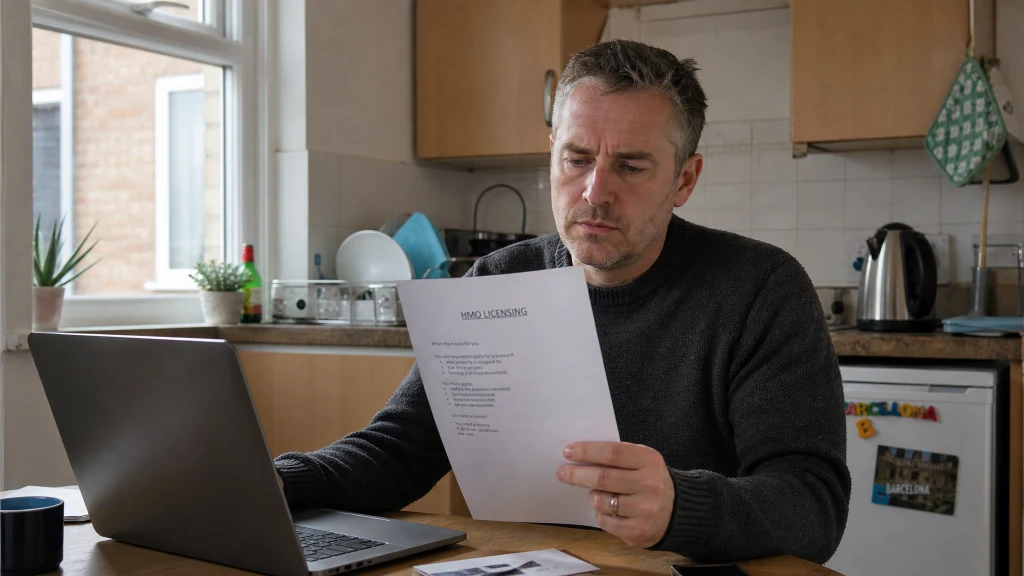
The Home Office’s own guidance for people with duties under the Fire Safety Order sets out who’s actually on the hook. For a shared house that isn’t run as a business premises in its own right, the “responsible person” is whoever has control of the property — in practice, the landlord or their managing agent. That responsible person has to make sure escape routes work, that there’s an appropriate way of raising the alarm, and that emergency lighting is adequate where needed. None of that is conditional on a licence being in place.
Greater Manchester Fire and Rescue Service’s own advice for landlords confirms the Order applies to HMOs generally, alongside converted flats and residential space above shops, and points landlords toward the established national guidance for the technical detail. GMFRS also flags a change that’s easy to miss: since October 2023, the fire risk assessment itself has to be recorded in writing, along with the fire safety arrangements that come out of it, and residents have to be told what risks were identified and what’s being done about them. A verbal once-over and a mental note doesn’t meet the standard any more, for any HMO, licensed or not.
None of that list mentions a licence number. It’s the same list whether the council has ever asked to see your HMO licence or not.
This is the other piece landlords with smaller, unlicensed properties tend to skip past. The Home Office’s own guidance is clear that a landlord can legally carry out their own fire risk assessment, but only if they’re genuinely competent to do so — and competence means specific training and knowledge of fire risk in residential premises, not general property experience or having read a few articles. The guidance is blunt about the limits of that self-assessment route: operating in a related trade, or having previous fire and rescue service experience, doesn’t automatically make someone a fire safety specialist.
For higher-risk premises — and the Home Office explicitly lists residential buildings with people sleeping on site among them — the official recommendation is to use a professional fire risk assessor with recognised accreditation, rather than attempt a DIY assessment and hope it holds up under scrutiny. That’s not a formality. If a fire does occur, the quality of the assessment behind it becomes exactly the kind of evidence a court or an insurer will pick apart, and a self-assessment carried out without the right competence is a weak position to be defending from, licensed HMO or not.
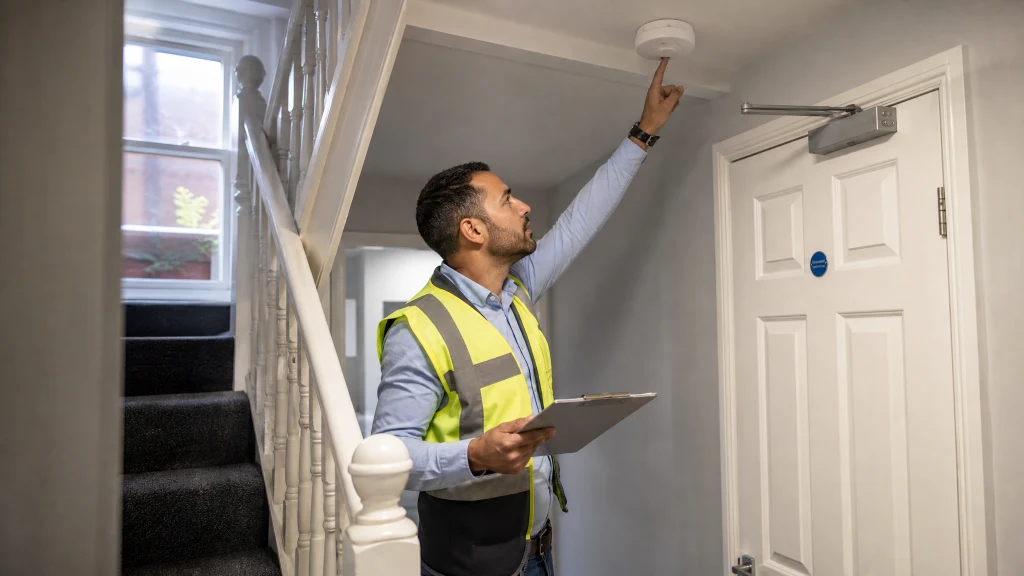
A proper assessment isn’t a five-minute walk-round. Expect a professional assessor to check escape routes and travel distances, test or review fire detection and alarm coverage, examine fire doors and their self-closing mechanisms, look at electrical and gas installations as fire sources, assess emergency lighting where it’s needed, and consider tenants who might need extra help evacuating. The output is a written document with findings, a risk rating, and an action plan with dates — not a verbal “looks fine to me.”
Because licensing and fire safety are enforced separately, a landlord can be entirely compliant on one front and badly exposed on the other — and the exposure on the fire safety side is, if anything, the more serious of the two. A breach of the Fire Safety Order can lead to an unlimited fine or up to two years in prison, enforced through the fire and rescue service rather than the council’s housing team. Licensing breaches, by contrast, are usually dealt with through a civil penalty — up to £40,000 per offence as of 1 May 2026, up from £30,000 previously, following the Renters’ Rights Act’s changes to Housing Act 2004 penalties.
A real case makes the point better than the theory does. A landlord in Slough was prosecuted for running a nine-occupant unlicensed HMO with a string of fire safety failures — no working fire alarm system, escape routes that didn’t function properly, missing or poorly maintained fire doors, and inadequate fireproofing between floors. The court’s sentencing, reported by the Fire Industry Association, broke the total penalty down by offence: £1,000 for the unlicensed HMO itself, £500 for failing to display the landlord’s name and address, £500 for failing to provide documents on request, and £2,000 for each of four separate fire safety breaches — £8,000 of the total £9,000 fine came from fire safety alone, not licensing. Add costs and the final bill came to just over £14,500.
The licensing offence cost that landlord £1,000. The fire safety failures cost £8,000. If your instinct is to worry more about the licence, the sentencing data says you’ve got the risk the wrong way round.
That case involved a property that should have been licensed and wasn’t. But the fire safety counts would have applied identically to a four-person shared house that never needed a licence at all — the same escape-route failures, the same missing fire doors, the same lack of an alarm system, assessed under the exact same law. Tenants can also pursue a rent repayment order against a landlord operating an unlicensed HMO where one was required, which is a separate financial exposure again, on top of the council’s own civil penalty.
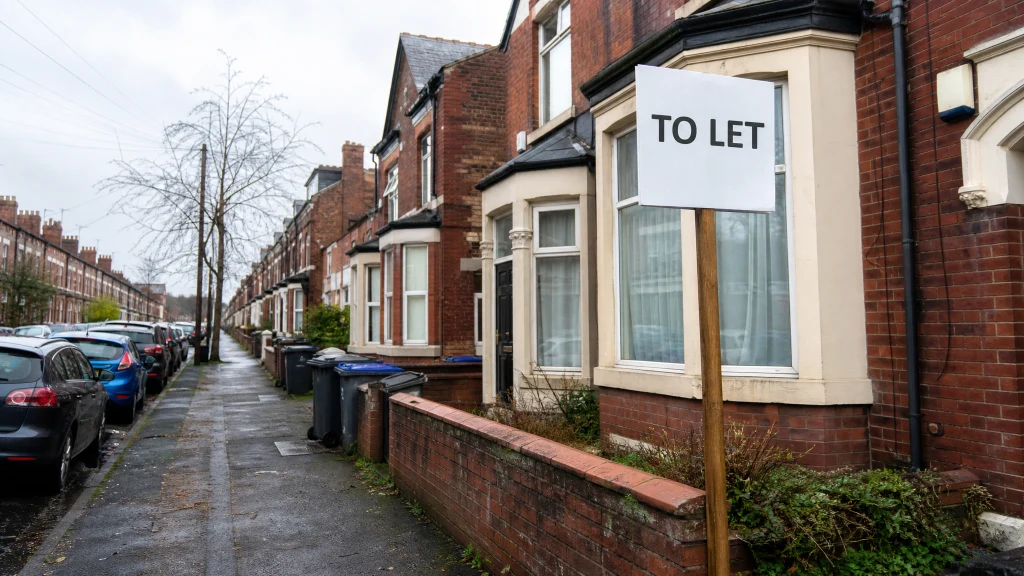
I’ll call her Priya, because the pattern repeats often enough that it isn’t really about one landlord. She owns a converted three-bedroom terrace in Withington, let to three university staff sharing a kitchen and bathroom. Three tenants, one household boundary crossed but nowhere near the five-person mandatory threshold, and the street isn’t inside any of Manchester’s selective licensing areas. No licence has ever been required, and none has ever been issued.
When I talk to landlords in Priya’s position, the fire safety conversation usually starts with genuine surprise. They’ve read enough about HMO licensing to know their numbers don’t reach the threshold — the same threshold we cover in more depth in our general guide to fire risk assessments for HMOs — and they’ve reasonably assumed that means the property sits outside regulation entirely. It doesn’t. The kitchen, hallway and stairs are shared parts used by people from different households, which is exactly the scope the Fire Safety Order describes. A working smoke alarm system, doors that shut properly, and a written record of what’s been checked and when are not optional extras for a property like this — they’re the same baseline duty that applies to a fully licensed ten-bed HMO down the road.
If you’re managing a small shared house and you’ve never had a licensing conversation with the council, here’s the order I’d actually work through:
A missing fire risk assessment doesn’t just create direct enforcement exposure — it can undermine the landlord insurance policy sitting behind the property too, since most insurers treat a documented fire risk assessment as a basic condition of cover for shared housing, not an optional extra. We’ve covered that side of the picture in detail in our guide to fire risk assessments and landlord insurance, which is worth reading alongside this one if cover is part of your concern.
It’s also worth remembering that licensing penalties themselves have just gone up. The civil penalty cap for Housing Act 2004 offences — including operating an unlicensed HMO where one is genuinely required — rose from £30,000 to £40,000 from 1 May 2026 as part of the Renters’ Rights Act’s wider enforcement changes. That change doesn’t affect landlords like Priya, whose property never needed a licence in the first place. But it’s a reminder that the regulatory environment for the wider private rented sector is tightening on several fronts at once, not just fire safety, and it’s worth reading our guide to HMO licensing in Manchester if you’re not certain which side of the mandatory threshold your property sits on.
If you manage a mixed portfolio — some licensed HMOs, some smaller shared houses, perhaps a student let like the ones we cover in our guide to student HMO fire risk assessments in Manchester — it’s genuinely easier to run the same fire safety standard across all of them than to maintain two different compliance mindsets depending on a licence number. Our guide to fire risk assessment in communal areas covers the shared-parts detail in more depth, and if you’re weighing up what a professional assessment actually costs against the enforcement risk of skipping one, our fire risk assessment cost guide sets out current UK pricing.
Whatever category your property falls into, the fastest way to close the gap is to get a proper assessment booked rather than keep guessing. Get in touch for a fire risk assessment quote and we’ll tell you plainly what’s needed for your specific property, licensed or not.
Yes, if the tenants form more than one household and share facilities such as a kitchen or bathroom. The Fire Safety Order applies to the shared parts of that property regardless of the fact that three people falls below the five-person mandatory licensing threshold.
Yes. Licensing exemptions relate to the Housing Act 2004 and have no bearing on your duties under the Regulatory Reform (Fire Safety) Order 2005. If the property has shared parts used by more than one household, the fire risk assessment duty applies.
Mandatory licensing applies nationally to HMOs with five or more occupants forming two or more households. Additional licensing is a local extension some councils apply to smaller HMOs — Manchester currently doesn’t run one. Selective licensing covers any privately rented property, HMO or not, within a council-designated area, and in Manchester currently applies to 15 specific scheme areas.
Yes. Fire Safety Order enforcement is entirely separate from licensing enforcement. A property that has never required a licence of any kind can still face an unlimited fine or prosecution under the Fire Safety Order if the responsible person hasn’t carried out and acted on a proper fire risk assessment.
Usually the landlord, or the managing agent if one is formally instructed to control the property on the landlord’s behalf. That person carries the legal duty to assess, record and act on fire risks in the shared parts of the building.
NRLA’s general guidance suggests a review every two years with a full update every four for standard properties, moving to annual reviews for older buildings or anything over three storeys. A change of tenants, layout or use should also trigger a fresh look regardless of where you are in that cycle.
Not directly. Selective licensing addresses property management and anti-social behaviour in designated areas. A property inside a selective licensing area still needs to meet its separate Fire Safety Order obligations, and having a selective licence doesn’t substitute for a fire risk assessment.
Check your occupancy numbers and household count against the mandatory threshold, then check your street against Manchester City Council’s current selective licensing directory. Whatever the answer, treat the fire risk assessment as a separate, non-negotiable step — it applies either way.
Most HMO landlords I talk to can rattle off their fire door requirements, their alarm grade, and their emergency lighting checks without missing a beat....
Most of the fire safety advice on this site assumes you already have a working HMO. This one is for the stage before that: the...