HMO Licensing in Manchester: A Landlord’s Guide to Fire Safety Rules
15/09/2026
If you own or manage a House in Multiple Occupation in Manchester, you’ve probably had licensing and fire safety explained to you as if they’re the same thing. They’re not. Your council licence and your fire risk assessment come from different laws, get checked by different people, and can each land you in trouble on their own, regardless of what the other one says.
I see this mix-up constantly. A landlord passes their HMO licence renewal, breathes a sigh of relief, and assumes their fire safety duties are sorted for another five years. They aren’t. Manchester City Council and Greater Manchester Fire and Rescue Service (GMFRS) run two separate enforcement tracks, and a licence in your hand doesn’t mean a fire risk assessment off your desk.
This guide sets out exactly how HMO licensing works in Manchester right now, where selective licensing fits in, what a fire risk assessment actually has to cover, and what happens when either one falls short. If you manage property anywhere from Rusholme to Didsbury to the city centre, this is the practical version, not the theory.
Licensing tells the council who’s managing a property and whether they’re fit to do it. A fire risk assessment tells you, in writing, what could cause a fire in that specific building and what you’re doing about it. One is a permission. The other is a duty of care. You need both, and neither substitutes for the other.
The confusion is understandable. Council licensing officers do look at fire precautions when they inspect an HMO, and a poor fire risk assessment can absolutely affect a licence application. But the legal duty to carry out and maintain a fire risk assessment exists under separate legislation, and it applies whether or not your property needs a licence at all.
I’ve lost count of the landlords who’ve told me their FRA is “part of the licensing thing.” It isn’t. It’s a standalone legal duty under fire safety law, and it’s the one most commonly missed because nobody chases it the way a council chases a licence renewal.
Manchester City Council runs mandatory HMO licensing, which applies automatically once a property meets three conditions. Get any one of them wrong and you could be managing an unlicensed HMO without realising it.
According to Manchester City Council’s own licensing criteria, a property needs an HMO licence if it’s occupied by five or more people, those people form two or more separate households, and the tenants share some amenities such as a kitchen, bathroom or laundry facilities.
If your property meets all three, you need a licence regardless of how many storeys it has or how long the tenants have lived there. Miss the threshold on any one point and mandatory licensing doesn’t apply, though that doesn’t mean you’re off the hook for fire safety.
Here’s where a lot of Manchester landlords go wrong. Some councils run additional licensing schemes that extend HMO rules down to smaller properties, typically three or four occupants in two households. Manchester City Council currently states plainly that it does not run an additional licensing scheme.
That doesn’t mean a smaller shared house is automatically exempt from everything. The council has retained the power to extend licensing to smaller HMOs where it identifies genuine problems with management standards or property condition in a particular area. And regardless of whether a licence is required, your fire safety duties under fire safety law apply to the property either way.

Separately from HMO licensing, parts of Manchester operate selective licensing, and this is where I see the most confusion among smaller landlords. Selective licensing isn’t about HMOs specifically. It applies to any private rented property, including ordinary single-let houses and flats, within a designated area.
Manchester City Council designates specific wards for selective licensing based on evidence of poor property conditions, anti-social behaviour or low housing demand in that area. Coverage changes over time as schemes end and new areas are proposed, so the only reliable way to check a specific address is through the council’s own selective licensing register rather than relying on an old blog post, including this one.
Where it applies, Manchester City Council’s selective licensing conditions require every landlord in the designated area to complete an online application, provide safety certificates such as a valid gas safety certificate and electrical safety documentation, and pay the relevant fee. Landlords typically have three months to apply once a scheme takes effect in their area.
Non-compliance is taken seriously. Operating an unlicensed property where a licence is required can carry a civil penalty of up to £30,000 issued directly by the council, or an unlimited fine if the case goes through the courts instead.
Selective licensing’s published conditions focus mainly on gas and electrical safety documentation rather than setting out fire safety requirements in detail. That’s a genuine gap worth understanding: passing selective licensing tells you nothing about whether your fire risk assessment is adequate, current, or exists at all.
This is the part that catches landlords out most often. Your fire risk assessment obligation doesn’t come from HMO licensing or selective licensing. It comes from fire safety law, and it applies to the “responsible person” for a building regardless of what licensing regime, if any, covers the property.
The Regulatory Reform (Fire Safety) Order 2005 places a duty on the responsible person, usually the landlord or managing agent, to assess fire risks in the common parts of a building and take reasonable steps to reduce them. For an HMO, that means the hallways, stairwells, shared kitchens and any other areas tenants pass through or share.
Since 1 October 2023, changes under the Fire Safety (England) Regulations 2022 have tightened this further. As Greater Manchester Fire and Rescue Service’s own landlord guidance confirms, the fire risk assessment must be recorded in writing, along with the details of whoever carried it out, and residents must be given information about the risks identified and the fire safety measures in place to protect them. A verbal once-over is no longer defensible, and it probably never really was.
Manchester City Council and Greater Manchester Fire and Rescue Service have signed up to the national protocol between local housing authorities and fire and rescue authorities, which sets out guidance on which body normally takes the lead on inspection and enforcement for a given property. In practice, that means your HMO can be looked at through two separate lenses: the council under the Housing Act 2004, including the Housing Health and Safety Rating System, and GMFRS under the Fire Safety Order.
Manchester City Council’s own guidance is direct about where responsibility sits: it is the landlord’s job to carry out a fire risk assessment and provide appropriate fire precautions, which may include smoke alarms, fire doors, exit doors, escape windows and emergency escape lighting depending on the property.
Two enforcers, two pieces of legislation, and only one document that answers to both of them properly. A current, written, HMO-specific fire risk assessment is the one thing that holds up whichever authority turns up at your door.
The Fire Safety Order defines the “responsible person” fairly broadly, and in an HMO it’s often not as simple as “whoever owns the building.” If you’re the freeholder and you self-manage, the duty sits with you. If you’ve appointed a managing agent with day-to-day control of the property, that duty can sit with them instead, or be shared, depending on what your management agreement actually says.
This matters more than it sounds. I’ve seen landlords assume their letting agent has sorted the fire risk assessment because the agent handles “compliance,” only to find the agent’s remit was gas and electrical certificates and nothing more. Get this in writing with whoever manages the property day to day, rather than assuming it’s covered. Our full guide on fire risk assessments for HMOs sets out the responsible person test in more detail, including how it applies to freeholders of converted blocks with multiple leaseholders.
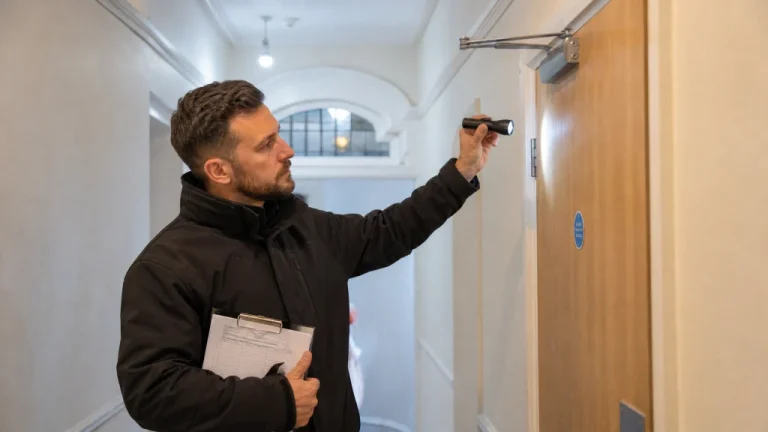
Whether you’re applying for a new HMO licence, renewing one, or your property falls under selective licensing, an inspecting officer will look at fire precautions even where they aren’t the headline requirement. Knowing what they’re checking for makes the difference between a smooth visit and a list of remedial works.
Every door onto an escape route in an HMO should be a proper fire door, fitted with intumescent strips, cold smoke seals where required, and a working self-closer that pulls the door fully shut from any open position. Officers routinely find self-closers that have been disconnected, painted shut, or fitted with a chain to stop them slamming, all of which defeat the point entirely.
An HMO typically needs a fire detection and alarm system that meets the relevant British Standard for the property’s layout and risk category, not just a handful of battery smoke alarms bought from a hardware shop. What’s adequate depends heavily on the number of storeys, the escape route layout and whether the kitchen is open-plan with a living space. A three-storey converted terrace with an inner kitchen and no separate escape route needs a materially higher category of system than a small two-storey house with a straightforward layout, and an assessor should specify which category applies rather than leaving you to guess.
Officers check that escape routes are kept clear of storage, bikes and general clutter, that final exit doors open freely without a key from the inside, and that any protected stairway or escape route without natural daylight has working emergency lighting.
Manchester’s HMO stock is heavily concentrated in student and young-professional areas, and the risk profile in a Victorian terrace converted into a six-bed let in Rusholme, Fallowfield or Withington often looks nothing like the risk profile of a newer purpose-built block in the city centre. We’ve covered the local picture in more depth in our piece on common fire risks facing Didsbury landlords, but the pattern holds across most of south Manchester’s shared housing: older building fabric, multiple escape route changes over decades of piecemeal conversion, and high tenant turnover that makes fire safety briefings easy to skip.
One risk factor climbing fast in every HMO fire safety conversation right now is lithium-ion battery charging, particularly e-bikes and e-scooters stored and charged in hallways, under stairs or in communal areas rather than in a single tenant’s own room. We go into the detail, including why thermal runaway makes this a different category of hazard to a standard electrical fire, in our guide to the lithium-ion battery fire hazard in UK properties. If your fire risk assessment predates this becoming a mainstream issue, it’s worth having it reviewed specifically for battery charging arrangements rather than assuming the original assessment still covers it.
Landlords weighing up a Manchester HMO investment need to budget for licensing fees and fire safety compliance as two separate lines, not one combined figure. Here’s how Manchester City Council’s current HMO licence fees break down by application type.
| Application type | Typical fee range | Notes |
|---|---|---|
| New HMO licence application | £1,321 to £2,721 | Scales with the size and occupancy of the property |
| Subsequent application | £1,271 to £2,671 | £50 discount applied to the standard new-application fee |
| Renewal application | £1,121 to £2,521 | £200 discount applied to the standard new-application fee |
| Fire risk assessment (typical market range) | Varies by property size and complexity | See our full fire risk assessment cost guide for current figures |
Every HMO licence fee quoted above includes a grant fee component set by the council on top of the administrative charge. Fees change periodically, so always confirm the current figure directly with Manchester City Council before budgeting a licence renewal.
The fire risk assessment cost sits outside the licence fee entirely and depends on your property’s size, layout and risk profile rather than a fixed council tariff. Treating it as a one-off cost to minimise is a false economy: a thin, generic assessment that misses a genuine risk is worth less than the paper it’s printed on if something goes wrong, or if an officer picks it apart during an inspection.
Licensing and fire safety failures are dealt with differently, and it’s worth understanding both tracks so you know what you’re actually exposed to.
A council can attach conditions to an HMO licence requiring specific fire safety improvements within a set timeframe, refuse a licence application outright where standards fall well short, or revoke an existing licence in serious cases. Operating a licensable HMO without a licence, or breaching licence conditions, can result in a civil penalty of up to £30,000 or prosecution with an unlimited fine.
Fire Safety Order enforcement runs on its own scale, separate from licensing penalties. Where GMFRS identifies a breach, it typically starts with informal advice and moves through non-statutory and then statutory enforcement notices, which give at least 28 days to put things right. Where the risk is judged serious enough that people could face death or serious injury in a fire, GOV.UK’s own enforcement and sanctions guidance confirms the case can go to prosecution, carrying an unlimited fine in the magistrates’ court or an unlimited fine and up to two years’ imprisonment in the Crown Court.
Failing to comply with an enforcement notice is a separate offence in its own right, on top of whatever triggered the notice originally.
An enforcement notice is not the fire service being difficult. It’s a document that tells you exactly what to fix and gives you a genuine window to fix it. Ignoring it is the expensive mistake, not receiving it.
An existing HMO licence doesn’t transfer automatically when a property changes hands, and it definitely doesn’t tell you anything reliable about the state of the fire risk assessment left behind by the previous owner. If you’re buying a tenanted HMO or taking over management of one, treat the fire risk assessment as a document you verify independently, not one you inherit on trust.
Ask for the current written assessment, the date it was last reviewed, and evidence that the action points from it were actually completed rather than just noted. A seller who can’t produce a written assessment at all, or one who “used to have someone look at it,” is telling you the property’s fire safety position is effectively unknown. Our 8-point fire risk assessment checklist is a useful yardstick to run through during due diligence, before you commit to the purchase or the management contract.
Before you submit an HMO licence application, renewal, or selective licensing application in Manchester, work through this in order. It’s the sequence that causes the fewest surprises during an inspection.
Most of the problems I see aren’t about landlords ignoring fire safety outright. They’re about landlords getting the sequencing or the scope wrong.
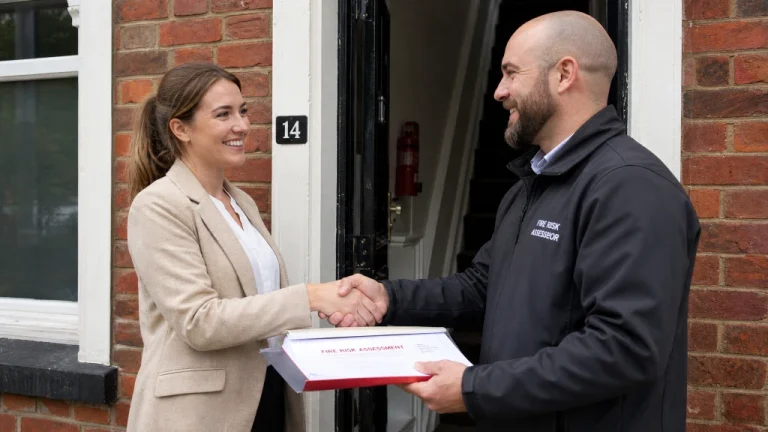
If you’re managing an HMO anywhere across Greater Manchester, from a licensed shared house in Rusholme to a smaller unlicensed let elsewhere in the city, the safest approach is the same: get a proper fire risk assessment done by someone who understands both HMO layouts and how Manchester’s licensing and enforcement bodies actually work together, then keep it current rather than treating it as a box ticked once and forgotten. If you’d rather have someone check your current position than second-guess it yourself, get in touch with our team and we’ll tell you plainly where you stand.
No. A licensing inspection checks fire precautions as part of a wider assessment of management and property standards, but it isn’t the same as a fire risk assessment carried out under the Regulatory Reform (Fire Safety) Order 2005. You need a separate, written, HMO-specific fire risk assessment regardless of your licensing status.
Not under mandatory licensing, which requires five or more occupants forming two or more households. Manchester currently has no additional licensing scheme extending the requirement to smaller HMOs, though the council retains the power to introduce one in specific areas. Your fire safety duties under fire safety law apply either way.
Selective licensing applies to any private rented property, not just HMOs, within a council-designated area, and focuses mainly on management standards and safety certification such as gas and electrical checks. HMO licensing is a separate regime specifically for shared houses meeting the mandatory occupancy criteria. A property in a selective licensing area that also meets the HMO threshold may need both.
GMFRS typically starts with advice and non-statutory guidance, then moves to a formal enforcement notice giving at least 28 days to fix the problem. Where the breach exposes people to a serious risk of death or injury, it can proceed to prosecution, which carries an unlimited fine and, in the most serious cases heard at Crown Court, up to two years’ imprisonment.
There’s no single fixed interval set in law, but it should be reviewed whenever the property, occupancy, or use changes, and at least annually as established good practice for higher-risk premises like HMOs. Treating it as a one-off document rather than a living record is one of the most common compliance gaps we see.
Most HMO landlords I talk to can rattle off their fire door requirements, their alarm grade, and their emergency lighting checks without missing a beat....

Most of the fire safety advice on this site assumes you already have a working HMO. This one is for the stage before that: the...