
Fire Safety Enforcement Notices: What Manchester HMO Landlords Need to Know
20/10/2026
In 2023, a landlady in Hounslow was fined £160,000 and ordered to pay £40,000 in prosecution costs after a fire tore through one of her houses in multiple occupation. Ten people lived there. One man died in the smoke-logged kitchen on the ground floor. The prosecution found four separate breaches of the Regulatory Reform (Fire Safety) Order 2005: no proper risk assessment, no adequate detection, no firefighting equipment, and no way for everyone to get out quickly and safely.
I bring that case up not to frighten anyone, but because it’s the clearest illustration of where this all leads if a fire safety enforcement notice gets ignored rather than acted on. Most Manchester landlords never get anywhere near a courtroom. But a growing number are getting letters from Greater Manchester Fire and Rescue Service, or from the council’s rogue landlord team, that they don’t fully understand and aren’t sure how urgently to treat. Manchester City Council has also been steadily widening landlord licensing, bringing 1,863 more privately rented homes under selective licensing in February 2025 alone, which means more properties are being looked at by someone with the power to act.
This guide sets out what a fire safety enforcement notice actually is, who can issue one and why HMOs attract more of them, what happened to real landlords who ignored one, and exactly what you should do if one lands on your doormat.
“Enforcement notice” gets used loosely, but under the Regulatory Reform (Fire Safety) Order 2005 it’s actually one of three distinct legal documents, each with a different trigger and a different level of urgency. The Order gives fire and rescue authorities the power to serve all three on the “responsible person” for a building, which for an HMO is almost always the landlord or managing agent. For the full picture of the Order itself, our guide to the Regulatory Reform (Fire Safety) Order covers the duties it places on you before any notice is ever served.
An alterations notice is the mildest of the three. It’s served under Article 29 when the authority thinks a property poses a serious risk, or could start posing one if changes are made to it. It doesn’t demand immediate remedial work. Instead, it requires you to tell the authority before making certain changes to the building, its services, or how it’s used, and it can require you to hand over a copy of your fire risk assessment first.
Think of it as the fire service keeping a watching brief on a property it has concerns about, without yet forcing your hand.
An enforcement notice is served under Article 30 when the authority believes you’ve actually failed to comply with the Order, such as not having a suitable fire risk assessment or not acting on one you commissioned. It must set out exactly what you’ve failed to do and give you at least 28 days to fix it. It can also specify the steps required, or offer you a choice of ways to put things right.
This is the notice most landlords will encounter first, typically after an inspection flags missing fire doors, absent detection, or an out-of-date risk assessment that was never reviewed.
A prohibition notice is the serious one. It’s served under Article 31 when the authority believes the risk to people using the building is so severe that its use should be restricted or stopped altogether until matters are fixed. If the authority judges there’s an imminent risk to life, the notice takes effect immediately, and tenants may need to be moved out that day.
Crucially for this audience, the Order specifically requires the fire authority to notify the local housing authority before serving a prohibition notice on an HMO, where that’s practicable. In other words, once a prohibition notice is on the table for a shared house, your council’s housing team is very likely to know about it too, and HMO licensing enforcement often follows close behind.
In Greater Manchester, it’s Greater Manchester Fire and Rescue Service that serves notices under the Fire Safety Order, through its business safety team. GMFRS keeps its own enforcement register and uploads notices to the National Fire Chiefs Council’s National Enforcement Register, a national database that lets anyone look up which properties and companies have had formal fire safety action taken against them. Notices go up around three weeks after they’re served, to allow time for an appeal, and stay listed for three years unless they’re withdrawn or still unresolved.
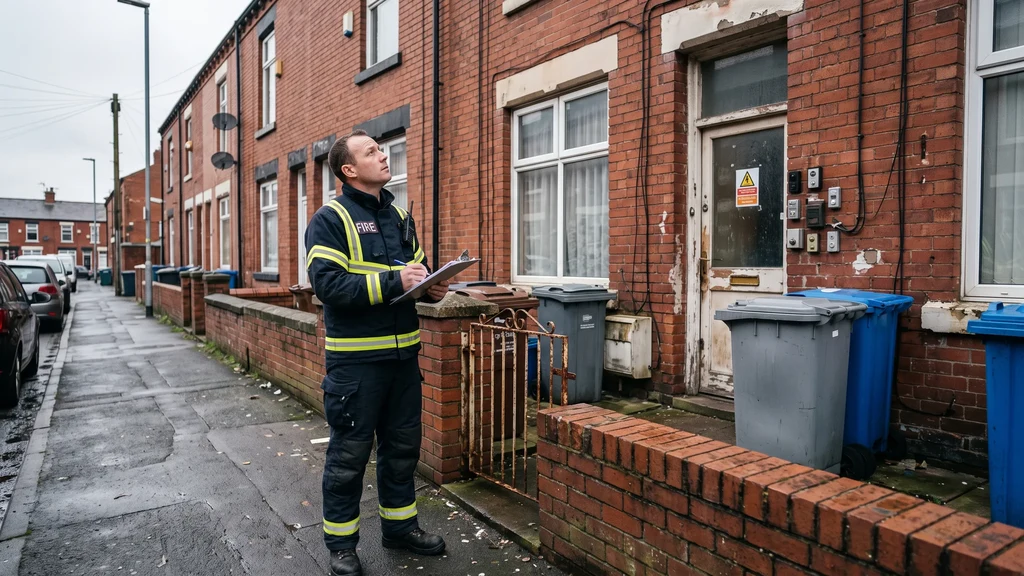
HMOs get disproportionate attention for a straightforward reason: more people sleeping under one roof, more shared circulation space, and more unrelated households means a fire that would be a nuisance in a single-family home can be fatal in a shared one. Inspectors know this, and HMOs with missing fire doors, blocked escape routes, or no working detection tend to get prioritised over lower-risk commercial premises when resources are tight.
I see the same pattern repeatedly across the HMOs I assess: the fire risk assessment exists somewhere in a drawer, but nobody’s looked at it since the last tenant turnover, let alone acted on its recommendations. That gap between having a document and actually being compliant is exactly what an inspection, and then a notice, exposes.
Using an agent doesn’t move the risk off your desk entirely. Under the Order, duties fall on the responsible person, but Article 5 extends the same duties to anyone else who has control over the premises, and a person who takes on a contractual obligation to maintain a property or keep it safe is treated as having that control for the parts they’re responsible for. In practice, that means you and your agent can both end up holding fire safety duties at once, each for the areas they actually control, and both can be pursued.
That’s exactly what happened on Dickenson Road in Manchester, where a letting agency, not the property owner, was issued a £21,500 civil penalty after a First Tier Tribunal found “systematic failings” including obstructed escape routes and no smoke alarms. If you hand day-to-day management to an agent, put it in writing exactly who’s responsible for arranging and acting on the fire risk assessment, and check they’re actually doing it rather than assuming they are.
The cases below aren’t hypothetical. They’re drawn from actual prosecutions and enforcement actions reported by fire services and industry press, and they show a consistent pattern: the initial notice was rarely the expensive part. Ignoring it was.
| Case | What happened | Outcome |
|---|---|---|
| Hounslow HMO landlady | Fatal fire in a 10-occupant HMO; no risk assessment, detection, firefighting equipment, or safe escape route | £160,000 fine plus £40,000 costs under the Fire Safety Order |
| Penwortham (Lancashire) landlord | Kept letting rooms in an HMO after a prohibition notice found no smoke alarms, no emergency lighting, and an unconverted attic bedroom reached by a ladder | Pleaded guilty to five Fire Safety Order breaches; judge noted immediate imprisonment was available as a sentence |
| Widnes leaseholder | Failed to fix fire door defects identified in an enforcement notice served by Cheshire Fire and Rescue Service, despite repeat visits | Found guilty at Warrington Magistrates’ Court; ordered to pay £3,924 |
| Manchester letting agency, Dickenson Road | HMO found with obstructed escape routes, doors that couldn’t be opened without a key, and no smoke alarms on first inspection | £21,500 civil penalty from Manchester City Council’s rogue landlord team, upheld on appeal |
Look at what links the first two cases. Neither started as a prosecution for not having a fire risk assessment. Both became serious once the responsible person either had nothing in place at all, or was served a notice and carried on regardless. The Penwortham landlord’s real offence, in the court’s eyes, wasn’t the original lack of smoke alarms. It was continuing to let rooms after being told in writing to stop. The Widnes case is smaller in scale, but it shows the same thing on a different axis: a fire door problem flagged in 2021 was still unresolved at later inspections, and failing to comply with the notice itself, not just the original defect, is what the leaseholder was actually convicted of.
The jump from “notice served” to “unlimited fine or prison” isn’t about the paperwork. It’s about what the responsible person does, or doesn’t do, in the weeks that follow.
One thing that catches Manchester landlords out is assuming fire safety and HMO licensing are the same enforcement system. They aren’t, and you can end up facing both at once.
Greater Manchester Fire and Rescue Service enforces the Regulatory Reform (Fire Safety) Order 2005 directly, through the three notice types covered above, with penalties of an unlimited fine in the magistrates’ court and up to two years’ imprisonment on indictment in the Crown Court. Manchester City Council, separately, enforces HMO licensing and the Management of Houses in Multiple Occupation (England) Regulations 2006 under the Housing Act 2004, and since the Housing and Planning Act 2016 it can issue civil penalties of up to £30,000 as an alternative to prosecution, alongside the possibility of a rent repayment order worth up to a year’s rent where an HMO was operating unlicensed.
| Route | Enforced by | Typical trigger | Maximum penalty |
| Fire Safety Order 2005 | Greater Manchester Fire and Rescue Service | No or inadequate fire risk assessment; missing detection, escape routes, or firefighting equipment | Unlimited fine; up to 2 years’ imprisonment on indictment |
| Housing Act 2004 / HMO licensing | Manchester City Council | Breach of licence conditions; unlicensed HMO; management regulation breaches | Civil penalty up to £30,000, or unlimited fine on prosecution; rent repayment order up to a year’s rent |
The Mecca Properties case on Dickenson Road is a good example of the council route in action, with a civil penalty rather than a fire service prosecution covering fire safety failings alongside unrelated issues like a missing gas safety certificate. A separate case in Rusholme saw a landlord fined £15,000 at Manchester Magistrates’ Court purely for operating an HMO with eight occupants without a valid licence, with no fire safety breach alleged at all, which shows the licensing route can bite on its own even when the fire risk assessment is in order. See our guide to HMO licensing in Manchester for how the two systems fit together, and what licensing conditions expect of your fire precautions specifically.
The practical point: a fire risk assessment that’s current, acted on, and kept on file protects you against both routes at once. It’s the primary evidence the fire service wants to see if they inspect, and it’s usually one of the first documents a council licensing officer asks for too.
Enforcement notices rarely come out of nowhere. They follow an inspection, and the same handful of issues come up again and again across the cases above. Knowing what’s actually being checked helps you close the gap before anyone in uniform turns up.
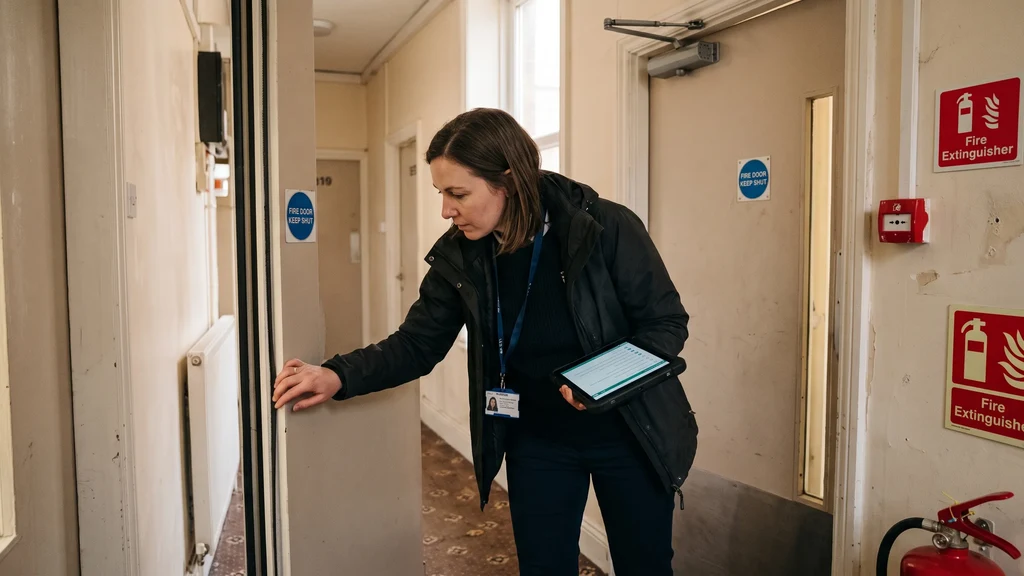
Fire doors that don’t close fully, have damaged intumescent strips, or are wedged open for convenience were a factor in both the Widnes enforcement notice and the Penwortham prohibition notice. Our separate guide to HMO fire door regulations goes into what’s actually required room by room, but the short version an inspector works to is simple: every door between a bedroom and an escape route needs to hold back fire and smoke for long enough to get everyone out.
No working smoke alarms was flagged in three of the four cases above, including the Dickenson Road civil penalty. Detection that’s missing, disconnected, or not interlinked properly across a shared house is one of the fastest routes from a routine inspection to a notice, because it goes directly to whether occupants get an early enough warning to escape.
An unconverted attic reached by a ladder, as in the Penwortham case, or doors that can’t be opened without a key in an emergency, as on Dickenson Road, both point to the same underlying failure: escape routes that depend on something going right under pressure. Inspectors walk the actual escape route a tenant would use at 3am, not the floor plan on paper, and that’s exactly what a proper fire risk assessment is supposed to test too.
If an enforcement or prohibition notice lands, the clock starts immediately. Under Article 35 of the Order, you have 21 days from the date of service to appeal to a magistrates’ court, which can cancel the notice, affirm it, or affirm it with modifications. For an enforcement notice, appealing within that window suspends it until the appeal is resolved. For a prohibition notice, appealing does not automatically suspend it. You’d need to separately ask the court to suspend it, and the court decides whether to grant that.

Appealing doesn’t mean ignoring the underlying problem while you argue the toss. Courts have cancelled notices where the authority’s own process was flawed, but they’ve also affirmed notices with modifications rather than throwing them out, which still leaves you with work to do. If you genuinely believe a notice was served wrongly, for example because the risk assessment it relies on was out of date or the inspection missed context, take proper advice before the 21 days run out rather than after.
Every one of the cases above traces back to the same root cause: a fire risk assessment that didn’t exist, wasn’t suitable, or wasn’t acted on. A proper assessment, reviewed regularly and genuinely followed up, is what keeps a notice from ever being served. If you’re still working from nothing at all, our guide to what happens if you don’t have a fire risk assessment sets out the baseline risk you’re carrying right now.
This is the single biggest difference between the landlords who get a quiet inspection with no action required and the ones who end up on the National Fire Chiefs Council’s register. It isn’t luck. It’s whether the assessment was real and recent.
Set the numbers side by side and the case makes itself. A fire risk assessment for a typical Manchester HMO costs a few hundred pounds. The Widnes fire door case cost £3,924. The Dickenson Road civil penalty cost £21,500. The Rusholme licensing fine cost £15,000 plus costs and a surcharge. The Hounslow case cost £200,000 in fines and costs, and a man his life.
None of those landlords planned to end up there. Every one of them had a cheaper, earlier point where a proper assessment would have changed the outcome.
If you’ve already had a notice served, or you’re simply aware your last assessment is gathering dust, the sensible move is the same: get a current, suitable fire risk assessment carried out by someone who’ll follow through on the findings, not just hand you a document and leave. That’s exactly what we do for HMO landlords across Manchester, and it’s considerably cheaper than any of the routes above. If you’d rather talk it through first, our team covers assessments right across the Manchester area, and you can get in touch for a quote directly.
An enforcement notice must give you at least 28 days to carry out the remedial steps it sets out. Separately, you have 21 days from the date it was served to lodge an appeal with a magistrates’ court if you want to challenge it. These two clocks run at the same time, not one after the other.
Only if the notice specifies restricted use rather than a full stop, and only within whatever limits it sets. Continuing to let rooms in breach of a prohibition notice, as happened in the Penwortham case, is itself a criminal offence and significantly worsens any eventual penalty.
For a prohibition notice on an HMO, the Order requires the fire authority to notify the local housing authority where practicable, so yes, in most cases they will. For enforcement and alterations notices there’s no equivalent statutory duty, but notices are published on the National Fire Chiefs Council’s register and councils do check it.
An enforcement notice comes from the fire and rescue service under the Fire Safety Order and deals specifically with fire risk. A civil penalty comes from the council under the Housing Act 2004 and can cover licensing breaches generally, which may or may not involve fire safety. You can receive both for the same underlying problem, as the Dickenson Road case shows.
Yes, but it needs to directly address every point the notice raises, not just repeat a generic checklist. A fresh, targeted assessment is usually the strongest evidence you can show the authority, or a court, that you’ve taken the notice seriously and acted on it.
Potentially, yes. Notices GMFRS serves are uploaded to the National Fire Chiefs Council’s National Enforcement Register around three weeks after service and stay listed for three years unless withdrawn, so a notice doesn’t just disappear once the immediate deadline passes. It can be visible to anyone who checks, including prospective tenants, buyers, or lenders.
Greater Manchester Fire and Rescue Service’s business safety team serves notices under the Fire Safety Order across Greater Manchester, including Manchester City Council’s area. HMO licensing enforcement sits separately with the relevant local council’s housing or rogue landlord team.
In August 2024, four tenants in a shared house on Camberwell New Road in Lambeth found out something their landlord had never told them: the...
In 2023, a landlady in Hounslow was fined £160,000 and ordered to pay £40,000 in prosecution costs after a fire tore through one of her...