

What is a Fire Risk Assessment? A Plain English Guide for UK Businesses and Landlords
22/12/2025
A fire risk assessment is not just a document; it is a practical, systematic review of your premises designed to identify fire hazards and ensure the safety of everyone within it. For business owners, landlords, and property managers in the UK, it is the legally required foundation of your entire fire safety strategy, essential for protecting people, property, and your business continuity.
This guide is for any ‘Responsible Person’ under UK law, including business owners, directors, landlords, and facilities managers. By the end, you will understand your legal duties, the steps involved in an assessment, and what you must do to comply with the law.
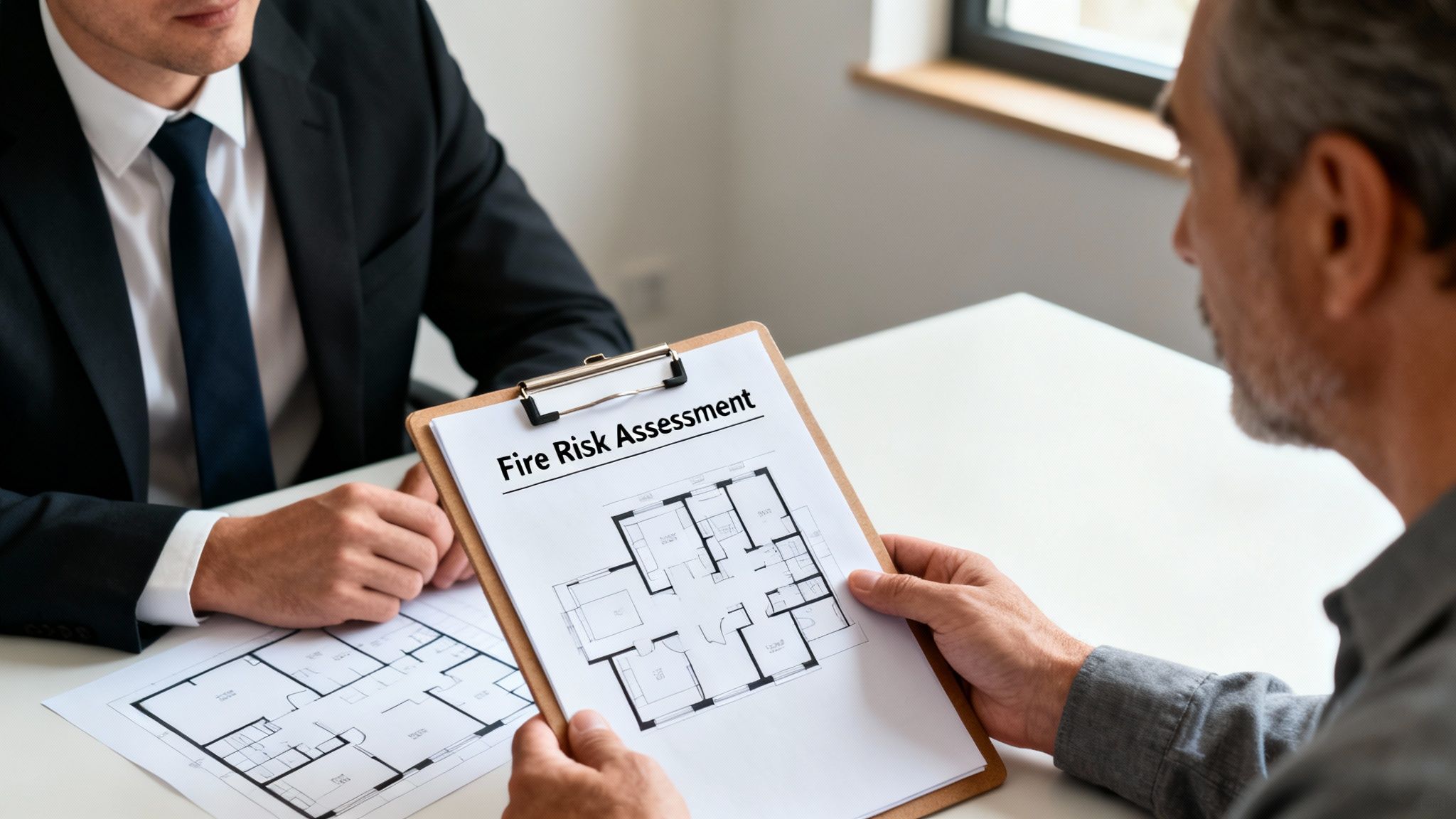
For anyone running a business or managing a property in the UK, understanding fire risk assessments is non-negotiable. The Regulatory Reform (Fire Safety) Order 2005 makes it clear: legal responsibility for fire safety rests with a designated individual or entity. This is not a box-ticking exercise but an active, ongoing process of risk management.
A professional assessment is your first and most critical line of defence. It saves lives, protects your building from damage, and prevents your business from being disrupted by a preventable fire or significant legal penalties. The process involves a competent expert methodically inspecting your premises, identifying potential fire sources, and evaluating whether your current safety measures are adequate and legally compliant.
The Fire Safety Order identifies a ‘Responsible Person’ who is legally accountable for fire safety. This is not just a title; it is a significant duty of care.
You are the Responsible Person if you are:
If a property has multiple occupants, such as a multi-tenanted office building, each business owner has a legal duty to cooperate to ensure the entire building is safe.
Your primary duty is to ensure a ‘suitable and sufficient’ fire risk assessment is completed and, crucially, acted upon. This involves identifying risks and implementing robust measures to protect everyone on-site. Unfortunately, many properties fall short of this standard.
In the year ending March 2023, Fire and Rescue Services in England conducted 51,020 fire safety audits. Worryingly, only 58% of audited premises had a satisfactory outcome. This highlights how widespread compliance issues are. You can review the official fire prevention and protection statistics on GOV.UK.
Failure to comply can lead to severe consequences, including enforcement action from your local Fire and Rescue Authority. A professional, properly documented assessment is therefore not just good practice; it is a critical business necessity.
| Responsibility | What It Means in Practice |
| Carry out a Fire Risk Assessment | Identify potential fire hazards and the people at risk. You must keep it up to date. |
| Implement Safety Measures | Put in place appropriate fire safety measures, like alarms, extinguishers, and clear escape routes. |
| Create an Emergency Plan | Have a clear, documented plan for what to do in case of a fire, including evacuation procedures. |
| Provide Information & Training | Inform staff, residents, or visitors about the risks and train them on what to do in an emergency. |
| Maintain Fire Safety Systems | Regularly check and maintain all fire safety equipment, including alarms, doors, and lighting. |
Ultimately, these duties are about taking proactive steps to prevent a fire from starting and ensuring that if one does, everyone can evacuate safely.
If you own a business or manage property, understanding the law is the first step. UK fire safety is governed by clear legislation that places specific duties on the ‘Responsible Person’. Fulfilling these duties is a legal obligation with serious consequences for non-compliance.
The cornerstone of modern fire safety is the Regulatory Reform (Fire Safety) Order 2005. This legislation consolidated over 70 separate fire safety laws into a single framework. Its primary purpose is to set a minimum standard of fire safety for all non-domestic buildings, which includes the shared communal areas of residential properties like blocks of flats and HMOs.
Under the Order, the Responsible Person must arrange for a “suitable and sufficient” fire risk assessment. They must also implement and maintain appropriate fire safety measures, establish a clear emergency plan, and ensure staff receive adequate training.
Fire safety legislation evolves. The Fire Safety Act 2021 was introduced to clarify and strengthen the 2005 Order, particularly for residential buildings containing two or more sets of domestic premises.
The main impact of the 2021 Act is its clarification of the scope of responsibility. It confirms that for these buildings, the Responsible Person’s duties now extend to:
In practical terms, this means a fire risk assessment for a block of flats must now legally include an evaluation of the risk of fire spreading via the building’s external structure. This was previously a grey area, but the Act establishes a firm legal duty on building owners to have these specific risks assessed and managed.
Ignoring these legal duties carries a heavy price. Local Fire and Rescue Services (FRSs) enforce the law and have the power to inspect premises to check for compliance. If they find significant failings, they will take formal action.
These are not recommendations; they are legally binding instructions. Depending on the severity of the fire safety deficiencies, an FRS inspector can issue several types of notices.
Alterations Notice: Used if the building is already high-risk, or if planned changes would make it so.
Enforcement Notice: The most common notice. It details exactly what is wrong and provides a deadline of at least 28 days to rectify the issues.
Prohibition Notice: The most serious action. If an inspector believes people are at immediate risk of serious injury from a fire, they can legally prohibit the use of part or all of the building until it is made safe.
Failure to comply with these notices can lead to prosecution. The penalties are severe, including unlimited fines and, in cases where lives are put at risk, a prison sentence of up to two years. Fines for corporate entities can be substantial, with some recent cases resulting in penalties exceeding £100,000.
Official data shows that enforcement is robust. In a single year, FRSs issued 2,972 formal notices following audits, a 5.3% increase on the previous year. This indicates a clear trend towards stricter enforcement and underlines the importance of a compliant, up-to-date fire risk assessment. You can see the full data on fire safety enforcement actions on GOV.UK.
A fire risk assessment is a logical, common-sense process. The entire procedure is structured around a nationally recognised five-step method, breaking a significant legal duty into a manageable safety plan.
By following these steps, a Responsible Person can systematically identify risks, determine how to protect people, and ensure their premises meet UK legal standards.
The first step is to locate what could start a fire. This is a methodical search for potential fire hazards, defined as anything that could ignite a fire or help it spread. The process examines the three elements of the ‘fire triangle’: ignition, fuel, and oxygen.
An assessor will conduct a site walk-through, identifying both obvious and hidden dangers.
Once the hazards are known, the next vital step is to identify who could be harmed. This is more than a simple headcount; it involves a critical assessment of where people are located and what factors might make them particularly vulnerable in an emergency.
The assessor considers everyone who might be in the building, including employees, visitors, contractors, the public, and residents. Special attention is given to anyone who might have difficulty evacuating quickly.
For example, this could include:
This step connects the hazards from Step 1 with the people from Step 2. The assessor evaluates the likelihood of a fire starting and the potential severity of the consequences. The goal is to determine if existing fire safety measures are adequate or if further action is needed to reduce the risk to an acceptable level.
This is where practical fire safety management is applied. Key control measures that are checked include:
If an audit reveals that these controls are inadequate, the enforcement process is clear and serious.
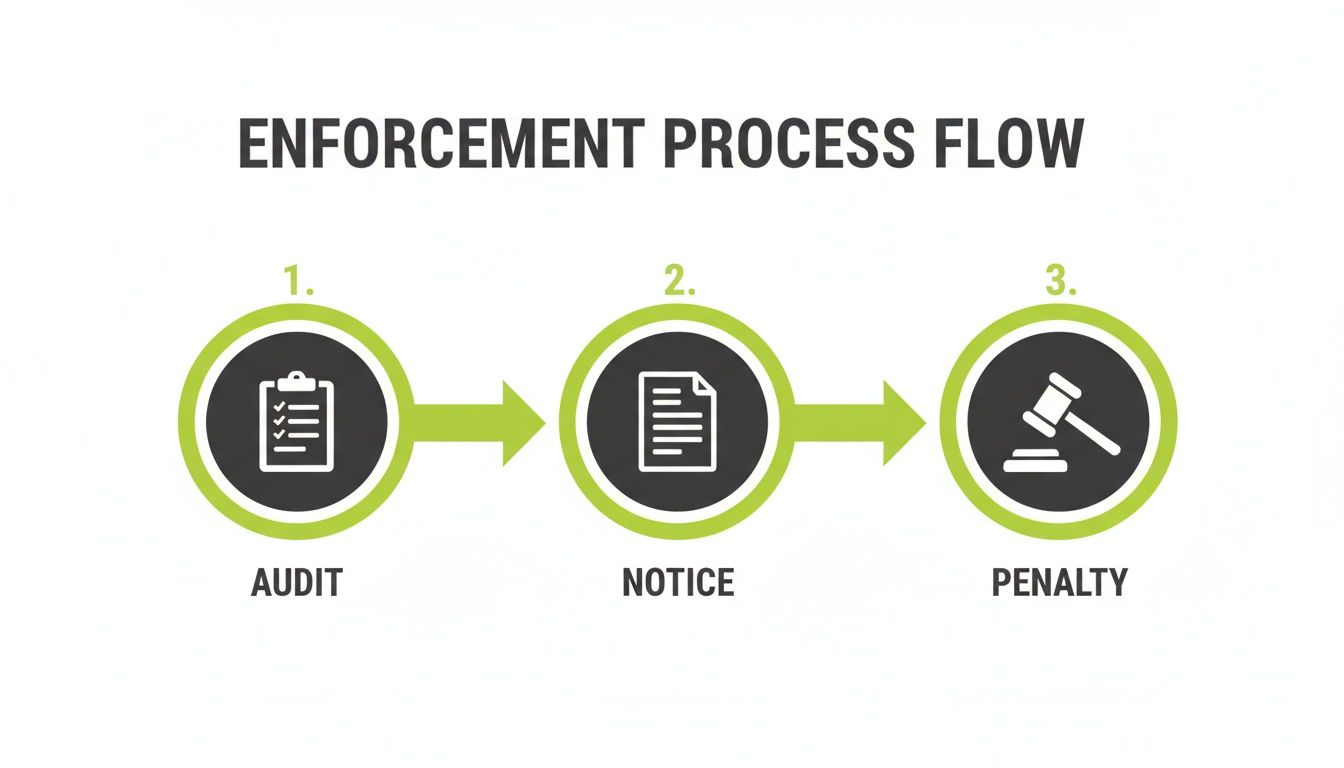
As shown, a failed audit leads directly to a formal notice. If that notice is ignored, it can result in significant legal penalties.
If your business has five or more employees, you are legally required to record the significant findings of your assessment in writing. This document is not merely for compliance; it is your live action plan for managing fire safety. It must detail the hazards identified, the people at risk, and the control measures you have implemented.
Your written record must also include your emergency plan. This sets out clear instructions on what to do if a fire breaks out, including how to evacuate, where to assemble, and who calls the emergency services.
This stage also focuses on training. Everyone on site needs to understand the emergency plan, know their escape routes, and be aware of the fire hazards in their work area. Appointing and training dedicated fire wardens is a crucial part of this. To keep things organised, using a detailed fire safety checklist for your business ensures no critical steps are missed.
Fire safety is an ongoing responsibility. The final step is to keep your fire risk assessment under regular review and update it whenever necessary. A review is legally required if there has been a significant change to the building, its occupants, or your operations.
Changes that should trigger an immediate review include:
Even if no major changes occur, it is best practice to review your assessment at least annually. This ensures it remains a relevant and effective management tool. This continuous cycle of review is the hallmark of a robust fire safety system.

Understanding the five steps in theory is one thing, but seeing them applied during an on-site visit is another. A professional on-site assessment is not a quick walk-through; it is a methodical examination of your building’s real-world fire safety.
When a competent assessor arrives, their purpose is to systematically inspect your entire premises. This is a hands-on process where everything is scrutinised, from the integrity of a fire door to the placement of an extinguisher. The goal is to build an accurate, comprehensive picture of your current compliance and identify any gaps that could endanger people or property.
The on-site visit is thorough, covering both active and passive fire protection measures. An assessor will physically inspect, test, and evaluate dozens of elements throughout your property to ensure that what is documented works in practice.
Key areas of focus include:
A significant part of the assessment involves checking your paperwork. An assessor needs to see documented proof that you are actively managing your duties under the Fire Safety Order.
Be prepared to present your key documents. This includes fire alarm and emergency lighting maintenance logs, fire extinguisher service records, and staff fire safety training records. This documentation provides the evidence that underpins your entire fire safety management system.
The assessor will also speak with the Responsible Person, facilities managers, or other key staff. They will ask practical questions to understand your emergency plans, how you manage hazards like flammable materials, and your procedures for evacuating vulnerable people. This human element is crucial for assessing how your plans would perform in a real emergency.
The entire process mirrors the rigour of formal fire safety inspections conducted by the authorities. This methodical approach ensures nothing is missed and your final report is both accurate and legally robust.
After the on-site visit, you will receive your fire risk assessment report. It is a mistake to view this document as a mere certificate for your files. It is your roadmap to a safer building—a practical tool for managing fire safety and protecting everyone inside.
A professional report is designed to be clear and actionable. It translates the assessor’s technical findings into a straightforward plan, explaining what needs fixing, why it is a problem, and the urgency required. This empowers you, the Responsible Person, to make informed decisions that improve safety and ensure legal compliance.
A well-structured report is easy to navigate. It typically begins with an executive summary, providing a high-level overview of your property’s compliance. It then delves into the specifics, covering everything from the condition of your fire doors to the adequacy of your emergency lighting.
For any Responsible Person, the two most critical sections are the Significant Findings and the Action Plan. This is the core of the report. Here, the assessor details every specific deficiency and provides clear, prioritised recommendations for remediation.
The approach to fire risk assessments in the UK has become significantly more stringent, particularly following major incidents. This has driven a greater focus on proven competency and high-risk buildings. Assessors now face mandatory competency checks via UKAS-accredited bodies, a change influenced by audits finding only 58% of 51,020 fire safety checks were satisfactory. You can learn more from the latest trends in UK fire prevention and protection statistics.
To help you focus on what matters most, the action plan will categorise each finding by a priority level. The terminology may vary slightly, but it is almost always based on a High, Medium, or Low risk rating.
This prioritisation system is invaluable. It prevents the list of tasks from becoming overwhelming and helps you allocate your time and budget for the greatest safety impact. A high-priority item represents a real and immediate threat to life, whereas a low-priority finding may be a best-practice recommendation to address when feasible.
Key Takeaway: The action plan is not a list of suggestions; it is a documented record of necessary improvements to make your property compliant with UK law. Ignoring these points, especially high-priority ones, leaves you legally exposed and your occupants at risk.
The table below illustrates how these priority levels function in a real-world context.
This is a typical example of how findings in a fire risk assessment report are prioritised to guide the Responsible Person’s actions.
| Priority Level | Description | Example Action |
| High | A serious breach of fire safety legislation that poses an immediate or significant risk to life. Requires urgent action. | Repair a final exit fire door that is broken and will not open, trapping people inside during an evacuation. |
| Medium | A non-compliance that could hamper fire safety measures or increase risk, but is not immediately life-threatening. | Replace missing fire action notices that fail to provide clear instructions to staff or residents during an emergency. |
| Low | A recommendation to improve standards and align with best practice. While not an immediate danger, it should be addressed. | Install a new key box for emergency access by the Fire and Rescue Service to improve their response time. |
By using these priorities to structure your remedial works, you transform a simple document into a powerful safety management tool. It provides a clear path to compliance, reduces your building’s risk profile, and demonstrates that you are taking your duties as the Responsible Person seriously.
The law does not just require a fire risk assessment; the Regulatory Reform (Fire Safety) Order 2005 demands one that is ‘suitable and sufficient’. This phrase carries significant legal weight, and whether your assessment meets this standard depends on the competence of the person who conducts it.
Competence in fire safety is a specific combination of accredited training, practical experience, and current knowledge of complex UK fire safety legislation. Without this, an assessment is merely a piece of paper. It can create a false sense of security while leaving your property, its occupants, and your business exposed to unacceptable risk.
An inadequate assessment is a serious liability, whether conducted by an unqualified provider or a well-intentioned but ill-equipped Responsible Person. It can easily miss critical hazards, recommend inappropriate safety measures, or fail to identify vulnerable people. This not only endangers lives but also leaves you legally defenceless in the event of a fire or an inspection by the Fire and Rescue Service.
A DIY attempt on a complex commercial property or multi-occupancy building is particularly high-risk. While you are permitted to do it yourself if you are competent, the reality is that without deep expertise, it is almost impossible to produce a legally robust document.
Recognising the risks of inconsistent standards, the fire safety industry has moved towards formal, third-party accreditation. This provides Responsible Persons with a clear and reliable benchmark for competence.
Professional bodies and UKAS-accredited certification schemes now offer a verifiable way to check an assessor’s credentials. This shift ensures the expert you hire has been independently vetted and has proven they have the knowledge and experience to produce a ‘suitable and sufficient’ assessment that will stand up to scrutiny.
Appointing a proven, accredited professional is not an optional extra; it is the most reliable way to fulfil your legal duties. It elevates your fire safety from guesswork to a documented, expert-led process.
Ultimately, hiring a competent fire risk assessor is a critical investment. It is an investment in the safety of your staff or residents, the protection of your property, and the resilience of your business. The cost of a professional assessment is insignificant compared to the potential for unlimited fines, prosecution, or the devastating human cost of a fire.
By choosing an expert, you are not just buying a report. You are gaining assurance that your legal obligations have been met correctly, your risks have been properly identified, and you have a clear, actionable plan to keep everyone safe. It is the only way to achieve true compliance and genuine peace of mind.
Even after understanding the process, many practical questions arise for business owners, landlords, and property managers. Here are straightforward answers to the most common queries we receive, helping you manage your fire safety duties with confidence.
The law requires you to review your fire risk assessment ‘regularly’ to keep it up to date. While there is no rigid legal timescale, fire authorities strongly recommend a formal review at least once every 12 months. This acts as an annual health check for your building’s fire safety.
However, you must conduct an immediate review if a significant change occurs. This could include altering the building’s layout, introducing new flammable materials, or a major change in the number of occupants. Our guide provides more detail on how often a fire risk assessment is required for different types of properties.
Yes, the Responsible Person can technically complete the assessment themselves, but with a critical caveat: you must be ‘competent’ to do so. Competence means having the necessary training, experience, and knowledge of fire safety principles to produce a ‘suitable and sufficient’ report.
For a very small, low-risk business, this may be feasible. However, for most commercial buildings, HMOs, or blocks of flats, the complexity and potential risks are too great. Appointing a qualified and accredited assessor is almost always the safest and most reliable route to legal compliance.
The cost of a professional fire risk assessment in the UK varies depending on the size, complexity, and use of your property. A small, single-floor retail unit will cost less than a multi-storey office block, an industrial site with complex processes, or a large HMO.
Any reputable provider will give you a tailored quote based on your specific building. It is vital to view this not as an expense, but as a critical investment in safety and compliance. The fee protects lives, property, and your business, and is a fraction of the potential unlimited fines for non-compliance.
If your local Fire and Rescue Service inspects your building and finds you do not have a suitable and sufficient fire risk assessment, they will take formal enforcement action. The severity of this action will depend on the level of risk they identify.
Potential outcomes include:
Failure to comply with these notices can lead to prosecution, which may result in unlimited fines and, in the most severe cases, a prison sentence.
A robust, professional assessment is the bedrock of your fire safety strategy. At HMO Fire Risk Assessment, our certified assessors provide clear, actionable reports to ensure you meet your legal duties and protect what matters most.
Book Your Fire Risk Assessment Today
In fire safety, there is one simple acronym everyone should know: PASS. It stands for Pull, Aim, Squeeze, and Sweep, and it is the universally...
As a landlord in the UK, you are legally responsible for ensuring your rental property is safe from fire. This is not just about fitting...