

What Is a Fire Strategy Report for UK Properties?
27/01/2026
A fire strategy report is the master blueprint for a building’s fire safety, created during the design or major refurbishment stage. It is a high-level document explaining precisely how a building is designed to prevent, detect, contain, and manage a fire, proving it meets UK Building Regulations from the ground up.
Think about your fire safety plan at home. You likely have smoke alarms, know your escape routes, and perhaps have a fire extinguisher in the kitchen. Now, apply that logic to a ten-storey block of flats, a hospital, or a sprawling office complex. The complexity explodes, and a standard fire risk assessment is not sufficient for the initial design phase. This is where a fire strategy report comes in.
This report is not an operational checklist for day-to-day management. It is a strategic document that sets out the entire philosophy behind the building’s fire safety measures. It answers the fundamental question for building control: “How does this building’s design ensure everyone can get out safely if a fire starts?”
A fire strategy report has several vital jobs, all aimed at creating a single, cohesive safety framework. It is the ‘why’ behind the ‘what’ of your building’s fire safety features.
Its main goals are to:
For any business owner, landlord, or facilities manager, the fire strategy report is the bedrock of all future fire safety management. Even though it is created at the design stage, its principles dictate how the building must be looked after for its entire life.
A robust fire strategy report is the cornerstone of a building’s safety integrity. It establishes the non-negotiable safety principles that the ‘Responsible Person’ must maintain, and upon which all future fire risk assessments are based.
Without this strategic blueprint, fire safety measures can easily become disconnected, ineffective, or non-compliant. For instance, if a later refurbishment creates an opening in a fire-resistant wall specified in the strategy, the entire evacuation plan could be fatally undermined. The report provides the essential reference point to prevent such critical failures, ensuring long-term safety and legal accountability. Understanding its contents is fundamental to fulfilling your duties under UK fire safety law.
For anyone managing a property, the difference between a fire strategy report and a fire risk assessment can feel a bit blurry. They sound similar, but they do completely different jobs and are needed at totally different times. Getting this right is crucial for staying compliant.
The easiest way to think about it is this: a fire strategy report is the architect’s blueprint for a building’s fire safety. It is created before a building is even built or undergoes a major overhaul. It maps out how the design itself will keep people safe.
On the other hand, a fire risk assessment is like a regular health check-up for an occupied building. It is a hands-on review that makes sure the safety systems designed in the blueprint are still working correctly day-to-day.
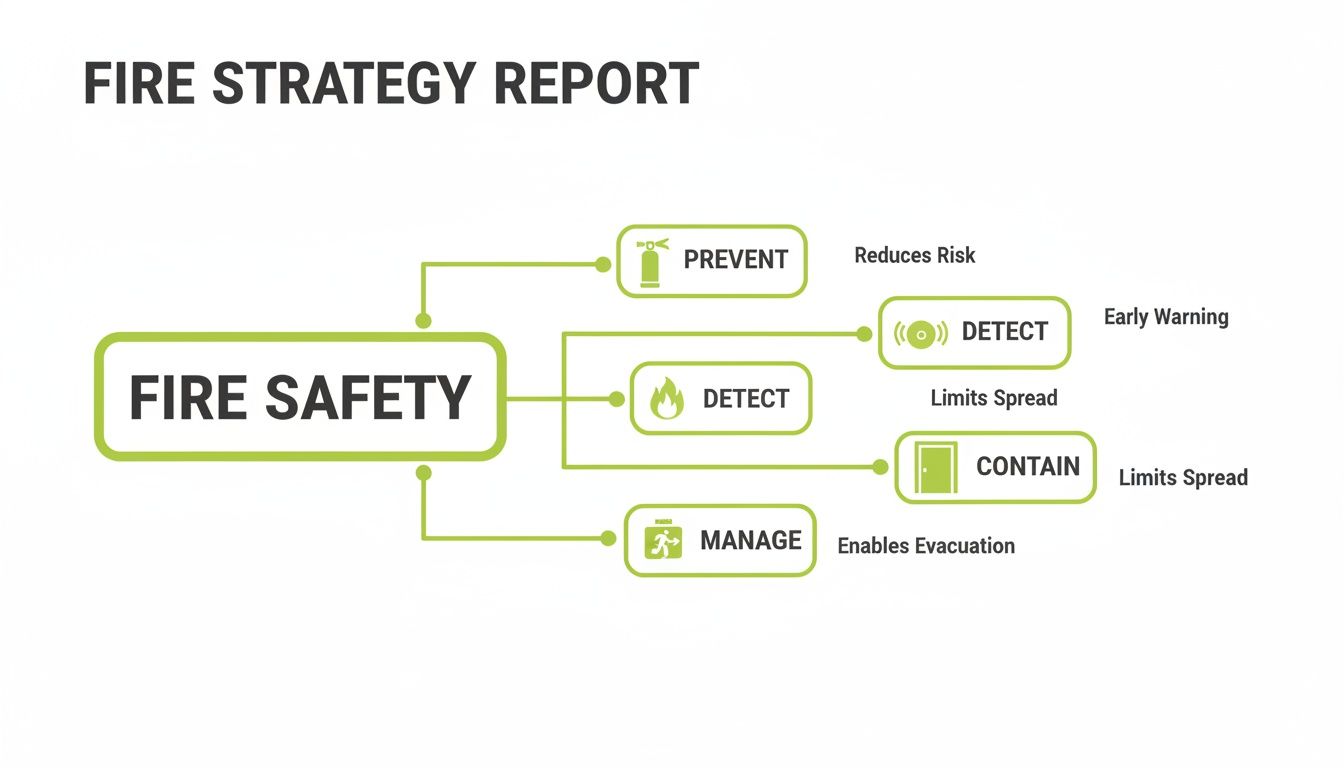
This blueprint—the fire strategy—sets out all the core principles for preventing, detecting, and managing a fire, creating the solid foundation that a fire risk assessment will later inspect.
A fire strategy report has one primary job: to prove a building’s design complies with the Building Regulations 2010, specifically Approved Document B. It is a proactive, theoretical document that must be approved by a building control body before any construction or major refurbishment can begin. It lays down the safety DNA for the building’s entire life.
A fire risk assessment, however, is a legal requirement for occupied, non-domestic buildings under the Regulatory Reform (Fire Safety) Order 2005. This is a practical, ongoing duty for the ‘Responsible Person’. It focuses on identifying real-world fire hazards in the building as it is today, assessing the risks, and confirming all safety measures are up to scratch. You can get a deeper understanding by reading our full guide on what a fire risk assessment is.
Timing is everything, and it is a key difference between the two. A fire strategy report is created at the design stage (RIBA Stage 3 or 4). You will need one for any new build, a major alteration or extension, or if you are changing the building’s use in a significant way—like converting an office block into flats.
In contrast, a fire risk assessment is for an existing, occupied building. The first one should be completed before anyone moves in. After that, it needs to be reviewed regularly to keep up with any changes to the layout, the people using it, or the activities happening inside. This is not a one-off task; it is a continuous legal duty.
A fire strategy sets the benchmark for safety at the design stage. A fire risk assessment verifies that this benchmark is being met and maintained throughout the building’s operational life. One designs the system; the other checks it.
This ongoing cycle of assessment is proven to work. The number of dwelling fires in the UK has fallen significantly over the last decade. This reduction is thanks to stronger regulations and the mandatory risk assessments that ensure hazards are identified and escape routes are kept clear.
The responsibility for commissioning each document also sits with different people. A developer, architect, or the building owner usually commissions the fire strategy report. They will hire a specialist fire engineer to produce it as part of the design and construction package.
The legal duty to arrange a fire risk assessment—and act on its findings—falls squarely on the ‘Responsible Person’. This could be an employer, the building owner, a landlord, or a managing agent. In short, it is whoever has control over the premises. Failure to have a ‘suitable and sufficient’ fire risk assessment can lead to enforcement action, including unlimited fines or even prison sentences.
To make the differences even clearer, here is a simple breakdown of how the two documents compare.
| Aspect | Fire Strategy Report | Fire Risk Assessment |
|---|---|---|
| Purpose | To demonstrate design compliance with Building Regulations | To identify and manage fire risks in an occupied building |
| Legal Basis | Building Regulations 2010 (Approved Document B) | Regulatory Reform (Fire Safety) Order 2005 |
| When It’s Done | During the design stage (pre-construction) | On an ongoing basis in an occupied building |
| Nature | Theoretical and design-focused blueprint | Practical, hands-on operational check-up |
| Who Commissions It? | Developer, architect, or building owner | The ‘Responsible Person’ (e.g., landlord, employer) |
| Who Creates It? | Qualified Fire Engineer | A ‘Competent Person’ in fire safety |
Ultimately, both documents are essential links in the chain of fire safety. The strategy designs the safe environment from the ground up, while the risk assessment ensures it stays safe for everyone using it, every single day.
It is one thing to know what a fire strategy report is, but another to know exactly when it becomes a non-negotiable legal requirement. For developers, landlords, and building owners, this is not just best practice; some projects simply cannot proceed without one.
This report is essential when standard, off-the-shelf fire safety guidance is not enough to prove a building’s design is safe. Its core purpose is to satisfy building control that you have a coherent and robust fire safety plan baked into the very fabric of the building, long before the first person steps inside.
So, when is a fire strategy mandatory?
This is the most clear-cut trigger. Every new commercial or multi-occupancy residential building in the UK must have a fire strategy report as part of the design and approval process. It is a foundational document submitted to building control to prove compliance with Approved Document B of the Building Regulations.
Put simply, without an approved strategy, your project will not be signed off. The report maps out everything from fire service access and means of escape to the structural fire resistance of walls and floors. It is the definitive safety blueprint for the new premises.
A fire strategy is not just for brand-new builds. You will also need one if you are planning major structural changes to an existing building, because these works can completely change the original fire safety design.
Common triggers include:
In these situations, the old fire safety plan is no longer fit for purpose. A new or updated fire strategy report is required to prove the altered building is still safe and compliant.
When a building’s purpose changes, its fire risks and the people inside it often change too. This is known as a ‘material change of use’, and it legally requires a fire strategy report. The safety design for a quiet office is worlds away from what is needed for a block of residential flats.
A classic example is converting a commercial office into apartments. The fire safety requirements shift dramatically, covering everything from evacuation plans (‘stay put’ versus simultaneous evacuation) to alarm systems and the fire separation between individual homes.
A change of use is a change of risk. Converting a low-occupancy warehouse into a bustling public venue, for example, introduces entirely new fire safety challenges that must be addressed through a formal fire strategy before the doors can open.
Some buildings are so large, complex, or house such vulnerable people that standard fire safety guidance simply does not apply. For these properties, a detailed fire strategy report, often involving sophisticated fire engineering, is essential.
This category typically includes:
The development of these strategies has had a real impact on safety. In the 2023/24 reporting year, there were 289 fire-related fatalities in England. While tragic, this figure has fallen significantly from over 500 annually in the early 2000s, reflecting huge improvements in fire safety design and regulation. You can explore these trends further by reading more about UK fire fatality statistics on Statista.com.
When a fire strategy report lands on your desk, it can feel intimidating. It is often a dense, technical document, but as the building’s responsible person, you need to know what you are looking at. Think of it as the definitive safety blueprint for your property. Understanding its key components means you can properly scrutinise the work and be confident that your fire engineer has covered all the bases.
A good report is not just a box-ticking exercise. It tells the complete story of how your building is designed to perform in a fire, leaving no room for guesswork. Each section should flow logically into the next, building a cohesive and robust safety plan.
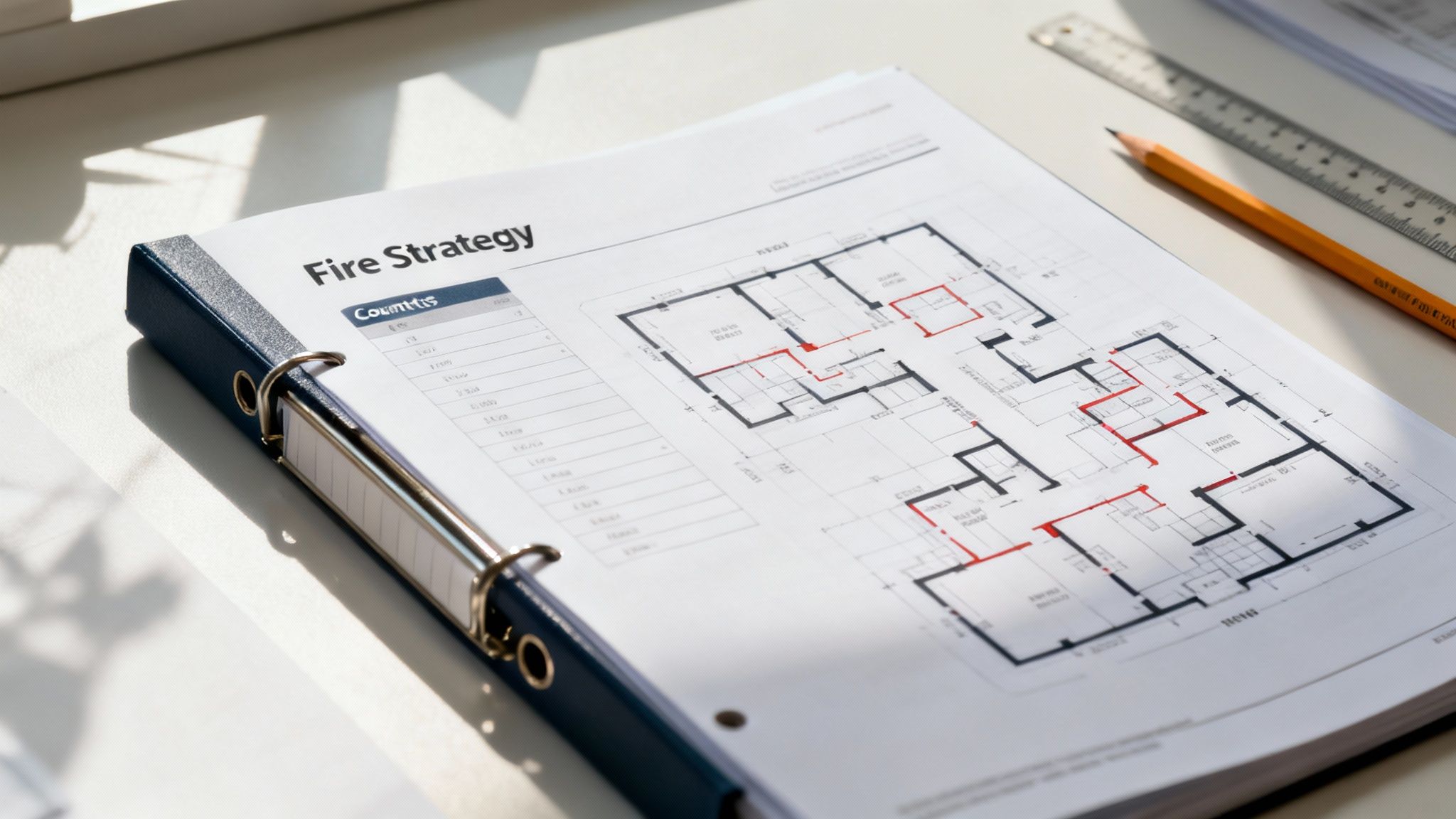
Let’s pull back the curtain and look at the essential elements you should always find inside.
First, the report must clearly define the building it is for. This section sets the scene, detailing the property’s size, height, construction materials, and its use. More importantly, it specifies who will be using the building and in what numbers.
This context is vital. The strategy for a low-occupancy warehouse will be worlds away from that of a high-rise block of flats or a primary school. The fire engineer uses these fundamental details to map out the specific risks and challenges the safety design needs to address from the outset.
This is the legal bedrock of the entire document. It explicitly lists the UK legislation and official guidance the fire strategy is built upon. You should see direct references to the Building Regulations 2010 and, crucially, Approved Document B (Fire Safety).
Depending on the building’s purpose, it might also cite other British Standards or specialised codes of practice. This section is your assurance that the design is not based on opinion but on established, legally recognised safety principles. It is the proof that your building’s design meets its statutory duties.
This is arguably the most critical part of the entire report—the plan for getting people out alive. The ‘means of escape’ section must be meticulously detailed, going far beyond just drawing arrows on a floor plan. It is a calculated, evidence-based approach to evacuation.
Key elements you will find here include:
Once the escape plan is solid, the strategy must explain how the fire itself will be contained. This is about two things: stopping fire from spreading inside the building, and preventing it from spreading to neighbouring properties.
The core principle here is compartmentation. This strategy cleverly divides a building into smaller, fire-resistant “boxes” using fire-rated walls, floors, and doors. The goal is to slow the spread of fire and smoke, protecting escape routes and buying precious time for occupants to leave.
This section will specify the required fire resistance ratings (e.g., 30 or 60 minutes) for key structural elements. It also has to detail how fire will be stopped from climbing up the building’s exterior via the façade—a major focus of UK regulations today. A huge part of this is specifying the right passive fire protection measures, which form the building’s built-in defence system.
A building’s safety plan does not stop once the occupants are out. It has to cater for the fire and rescue service arriving to tackle the blaze. A proper fire strategy report outlines exactly how firefighters will get to and into the building, and what facilities they have to help them.
This typically includes details on:
Finally, the report gets specific about the type of fire detection and alarm system the building needs. This is graded according to British Standard BS 5839, and the choice is justified based on the building’s use, size, and risk profile to guarantee an early warning.
You will see the system category specified (e.g., L2, L3, P1), along with the proposed placement of detectors, manual call points, and the type of alarm sounders needed to alert everyone effectively. For any responsible person, this provides the exact specification that must be installed, commissioned, and maintained.
Let’s be clear: creating a fire strategy report is not a job for a general builder or even a standard fire risk assessor. This is a highly complex engineering document that demands a deep, specialised expertise that goes beyond routine safety checks. Handing this task to someone unqualified is a massive legal and life-safety risk.
A fire strategy report must be developed by a qualified and competent fire engineer. This is a professional with specific academic qualifications and years of hands-on experience in fire science, structural engineering, and the intricate details of UK Building Regulations.
A fire engineer does more than just tick boxes on a checklist. They apply scientific principles to figure out exactly how a fire could start, develop, and spread through a building’s unique design. It is a role that requires a profound knowledge of multiple disciplines.
You are paying for expertise that includes:
This multi-faceted skill set is what makes a strategy robust and effective in a real emergency, not just compliant on paper.
A fire strategy report is an engineering document that provides a bespoke safety solution for a building. Appointing a qualified fire engineer is not just a recommendation; it is a fundamental requirement for ensuring the strategy is credible, compliant, and capable of protecting lives.
When you commission a fire strategy report, the responsibility to verify that the professional you hire is genuinely qualified falls squarely on you. Simply taking someone’s word for it is not good enough. You need to see clear, verifiable evidence of their competence and professional standing.
One of the most reliable indicators is membership with a recognised professional body, like the Institution of Fire Engineers (IFE). Look for membership at the Member (MIFireE) or Fellow (FIFireE) grade, as this demonstrates a peer-reviewed level of knowledge and a commitment to professional standards. You can also check for individuals or firms listed on third-party certification registers for fire risk management services.
The need for this specialist knowledge is starkly reflected in national trends. UK fire and rescue services attended 622,173 incidents in the year ending December 2023. Although fires now make up only 28% of these call-outs, the strategic shift towards prevention—driven by documents like fire strategies—has been instrumental in reducing fatalities and property damage. If you’re interested, you can discover further insights into UK fire statistics at chsg.co.uk.
Ultimately, choosing a qualified fire engineer is a critical investment in your building’s long-term safety and compliance. The cost of getting it wrong—both financially and, more importantly, in terms of human life—is immeasurable.
Throughout this guide, we have unpacked how a fire strategy report acts as the fundamental blueprint for your building’s safety. It is the one-off, architectural plan for fire safety. The fire risk assessment, on the other hand, is the ongoing, hands-on job of making sure that plan works day in, day out.
Think of it this way: the strategy is the constitution for your property’s fire safety, setting out the unbreakable rules.
For any new build, major refurbishment, or change of use, a professionally created fire strategy is non-negotiable. It is what you need to protect lives, satisfy building control, and get your project signed off legally. It is the master document that proves your design complies with UK Building Regulations right from the start.
The first thing to do is figure out where your property stands. Are you planning a project, or are you managing an existing, occupied building?
This is where the two documents really show how they work together:
A fire strategy report gives you the ‘what’ and ‘why’ of your building’s safety design. The fire risk assessment is the ‘how’—the continuous reality check ensuring those systems are still effective in the real world. You cannot have one without the other.
Of course, prevention is only half the picture. A complete fire safety plan also means being prepared for the worst by understanding the fire damage restoration process. Knowing what is involved after a fire only highlights how critical it is to get the strategy right from day one to minimise any potential damage.
Ultimately, as the person responsible, the buck stops with you to ensure every angle of fire safety is covered. For a deeper dive into your ongoing legal duties, our plain English guide to UK fire safety regulations is a great place to start.
Let’s tackle some of the most common questions that crop up when people start looking into fire strategy reports. These are the queries we hear all the time from business owners, landlords, and property managers, and the answers should clear up any lingering confusion.
This is the big one, and the honest answer is: it depends. The cost of a fire strategy report in the UK can range from a few thousand pounds to tens of thousands. The final price is dictated entirely by the building’s size, complexity, and its use.
A small, simple commercial unit will naturally sit at the lower end of that scale. On the other hand, a new high-rise residential block, a hospital, or a sprawling public venue will command a much higher fee. That is simply down to the sheer amount of intricate work involved.
A few factors that drive the price include:
Think of a fire strategy report as a ‘live’ document. It is tied directly to your building’s specific design and purpose at a single point in time. It stays valid for as long as the building’s structure, layout, use, and fire safety systems remain unchanged.
But the moment you make significant alterations, its validity is gone.
If you carry out a major refurbishment, change the building’s use (like turning an office into flats), or alter crucial escape routes or fire compartmentation, the report must be reviewed. A competent fire engineer needs to update the strategy to make sure it is still effective and compliant with the latest regulations.
In most cases, the answer is a straightforward no. While there is definitely some overlap in fire safety knowledge, the core skills needed for each document are fundamentally different. They are not interchangeable roles.
A fire risk assessor is a ‘competent person’ who evaluates an existing, occupied building against laws like the Fire Safety Order. Their job is to spot real-world hazards and check if the safety measures already in place are good enough.
A fire engineer designs fire safety solutions for new or altered buildings, using complex calculations and engineering principles to prove compliance with Building Regulations. A fire risk assessor inspects an occupied building to ensure those solutions are being properly maintained.
Unless your fire risk assessor also happens to be a qualified and accredited fire engineer—with the right degrees, experience, and professional memberships like the Institution of Fire Engineers (IFE)—they will not have the specific qualifications needed to produce a compliant and legally robust fire strategy report. The two roles are distinct specialisms. Using the wrong professional for the job can have serious consequences for your project’s compliance and the safety of everyone who uses the building.
Getting your head around the requirements for a fire strategy report is a massive step in making sure your building is safe, compliant, and legally sound from day one.
If you are managing an occupied property and need to fulfil your ongoing legal duties, HMO Fire Risk Assessment can help. We provide certified fire risk assessments to ensure your premises remain safe for everyone.
A fire risk assessment for flats is not just good practice; it is a mandatory legal requirement for any residential block with shared common areas...
Imagine the lights flickering and then cutting out completely during a power failure. In that sudden, disorienting darkness, a lit green exit sign is more...