

A Practical Guide to Fire Safety Regulations for Landlords
30/12/2025
As a landlord in the UK, fire safety is a responsibility you cannot afford to get wrong. It is not an optional extra or a box-ticking exercise; it is a fundamental legal duty designed to protect people in their homes.
The foundation of these rules is the Regulatory Reform (Fire Safety) Order 2005. This legislation places the legal responsibility squarely on you, as the landlord, to ensure your property is safe from fire. This process begins with a fire risk assessment and flows from there.
As a landlord in the UK, you are legally accountable for the safety of your tenants. Fire safety is a critical, non-negotiable part of that responsibility. The regulations may appear complex, but their purpose is simple: to save lives. Failure to comply can lead to severe consequences, including unlimited fines and, in the worst cases, a prison sentence.
This guide is for landlords, property managers, and managing agents who need a practical understanding of their obligations. We will cut through legal jargon, explain key legislation, and detail what you must do to keep your properties compliant and your tenants safe.
As the owner or manager of a rental property, you are almost always considered the ‘Responsible Person’ under fire safety law. This is not just a title, it is a role with specific legal duties you cannot delegate.
Your core duties involve:
A common and dangerous misunderstanding is that a tenant’s behaviour absolves the landlord of responsibility. While tenants have a duty to act responsibly, the legal obligation to provide a fundamentally safe building, equipped with all the correct fire protection, always remains with the Responsible Person.
By the end of this guide, you will have a clear roadmap for compliance. We will cover everything from the essentials of a fire risk assessment to the different rules for single-let properties, HMOs, and blocks of flats. Our goal is to give you the confidence to manage your portfolio knowing you are meeting all fire safety regulations for landlords, protecting both your investment and the people who live in your property.
To manage fire safety correctly, you must understand the laws that hold you accountable. UK fire safety legislation is a framework of interconnected regulations that have been updated significantly in recent years. Understanding this framework is the first step towards ensuring your properties are not just safe, but fully compliant.
The cornerstone of your legal duties is the Regulatory Reform (Fire Safety) Order 2005, often called the Fire Safety Order or FSO. This is the law that places responsibility for fire safety on a designated ‘Responsible Person’. In almost any rental situation, that person is you, the landlord.
The FSO legally requires you to carry out a fire risk assessment and then implement and maintain appropriate fire safety measures. It is crucial to know that it applies to the common areas of HMOs, blocks of flats, and maisonettes. It does not, however, apply to the inside of a single private dwelling once it is let to a tenant.
The FSO marked a major shift in fire safety management. Instead of providing a rigid checklist, it introduced a risk-based approach. This means the law expects you to assess the specific fire risks in your property and take reasonable, practical steps to address them.
Under the FSO, your main duties can be summarised in three key actions:
A common error for landlords is assuming the FSO only applies to large commercial buildings. Its reach is far wider. It covers the shared parts of any building containing two or more domestic premises, making it essential legislation for landlords of flats and HMOs.
The Fire Safety Act 2021 was introduced to clarify and strengthen the FSO, largely in response to the lessons learned from the Grenfell Tower tragedy. It is not a replacement for the FSO; it is an extension that makes it clear what landlords of multi-occupied residential buildings are responsible for.
The Act confirms that your fire risk assessment must now explicitly include:
This was a significant change. It officially clarified that the legal responsibility for flat entrance doors rests with the building’s Responsible Person, not the individual leaseholder or tenant.
The changes continued with the Fire Safety (England) Regulations 2022, which introduced another layer of specific duties for landlords of multi-occupied residential buildings. These rules focus on providing residents with better information and assisting the Fire and Rescue Service during an incident.
The 2022 Regulations introduced major new duties for buildings over 11 metres high, including stricter fire door inspection schedules and much clearer fire safety instructions for residents. For taller buildings (over 18 metres), requirements now include wayfinding signage and “premises information boxes” to give firefighters instant access to key building plans. These regulations underscore why this level of diligence is so necessary to protect lives.
The fire risk assessment is the foundation of your entire fire safety strategy. It is not just a document to be filed away; it is a live, practical tool that demonstrates you have systematically considered the fire risks in your property and taken reasonable steps to ensure safety. A ‘suitable and sufficient’ assessment is your legal duty, and getting it right is critical.
The process is designed to identify hazards, determine who is at risk, and implement measures to reduce that risk. It ensures you cover all bases, from physical dangers like faulty wiring to human factors, such as a tenant who may need assistance to evacuate.
The legislation in this area has become progressively stricter. What began with the Fire Safety Order 2005 has been built upon by the Fire Safety Act 2021 and subsequent regulations, placing greater responsibility on landlords.
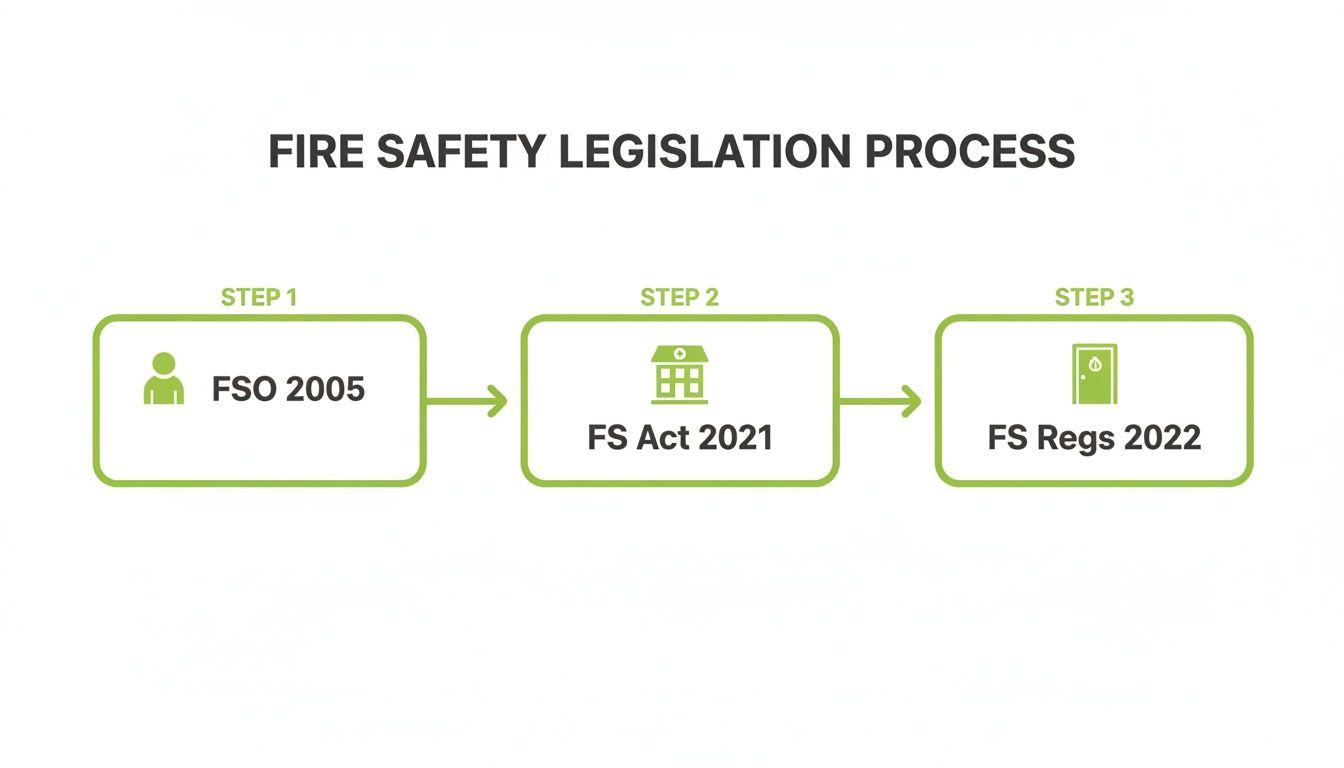
The trend is clear: greater accountability, particularly for buildings with shared spaces and multiple homes.
The Health and Safety Executive (HSE) promotes a straightforward, five-step approach that underpins any competent fire risk assessment. Following these steps helps ensure your evaluation is logical, thorough, and defensible.
A common question for landlords is whether they can conduct the assessment themselves or must hire an expert. The answer depends on the complexity of the property and your own competence.
For a simple, single-family dwelling, a diligent landlord may feel competent to carry out their own assessment using a suitable template. However, for more complex properties, the situation changes.
For Houses in Multiple Occupation (HMOs), blocks of flats, or buildings with mixed commercial and residential use, the law requires a ‘competent person’ to conduct the assessment. Competence means having the appropriate training, experience, and knowledge to identify the specific, and often hidden, risks these environments present.
Attempting to assess an HMO yourself without demonstrable expertise is a significant legal risk. A professional assessor understands the technical requirements for fire separation, compartmentation, and the relevant British Standards for alarms and emergency lighting. They will identify issues an untrained eye would miss, providing you with a report that will stand up to scrutiny. To understand the level of detail required, it is useful to review an example of a fire risk assessment.
For blocks of flats, different types of fire risk assessments are available to ensure the correct areas are inspected. There are four main types, and as the Responsible Person, you need to know which one your building requires.
Selecting the correct type is vital for compliance. For most landlords of flats, a Type 1 or Type 3 assessment will be required, but only a competent assessor can provide definitive advice based on your specific building.
Fire safety is not a one-size-fits-all matter. The measures you must implement depend on the type of property you let. A single-family house has very different risks, and therefore different rules, compared to a large, shared house or a block of flats. Applying the correct fire safety regulations for landlords for your specific property is essential.
Understanding these distinctions is key to protecting your tenants, your investment, and yourself. What is adequate for one property could be a serious compliance failure in another, exposing you to significant legal and financial risk. Let’s break down your duties for the most common types of rental properties.
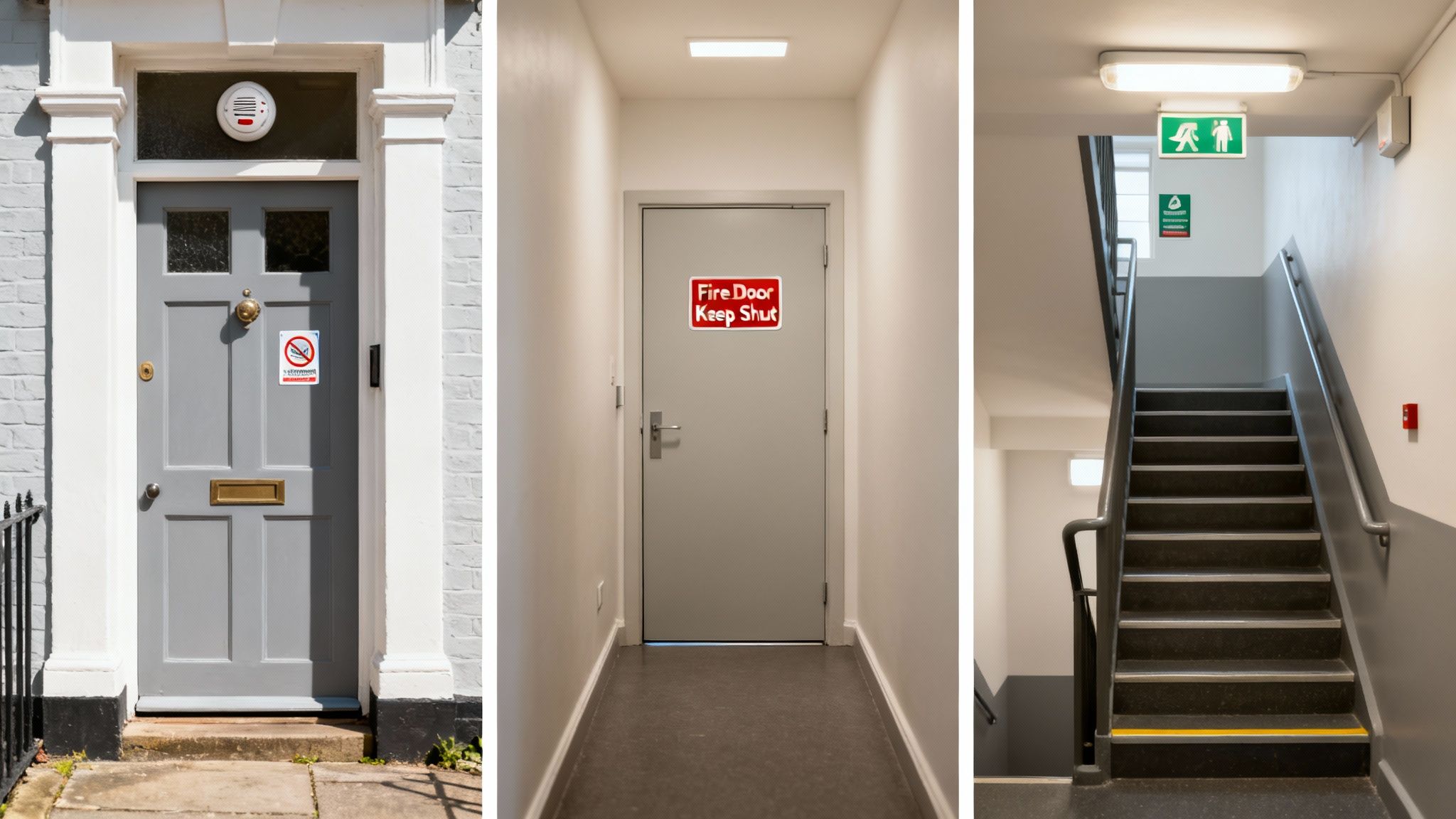
For a standard house or flat rented to a single person or family unit, the requirements are the most straightforward. Your main legal duties focus on providing an early warning if a fire starts.
Beyond these specific rules, you have a general duty of care. This means ensuring the electrical installation is safe and any supplied appliances are in good working order.
When a property is a House in Multiple Occupation (HMO), the fire safety requirements become much more stringent. An HMO is a property rented out by at least three people who are not from one ‘household’ but share facilities like a kitchen or bathroom.
Because unrelated tenants may not know each other and rely on shared escape routes, the risks are considered much higher. Your duties as a landlord expand significantly to create a protected environment.
This typically includes:
A common and extremely dangerous mistake in HMOs is allowing tenants to wedge fire doors open. A propped-open fire door is useless. It cannot hold back smoke or flames, rendering the protected escape route unsafe and placing every resident at extreme risk.
If you own an entire building or are responsible for the common parts of a block of flats, your focus shifts to the safety of those shared spaces. Under the Fire Safety Order, you are the designated Responsible Person for areas like entrance halls, corridors, stairwells, and plant rooms.
Your fire risk assessment must cover these common areas meticulously. Following the Fire Safety Act 2021, this assessment must also extend to the building’s external walls and the entrance doors to individual flats, as these are now recognised as critical barriers to fire spread.
Key landlord responsibilities here include:
Moving from legal duties to practical implementation, let’s consider the physical equipment your property needs. Your fire risk assessment will specify what is required, but certain fundamental systems form the backbone of good fire safety for landlords.
These are not optional extras; they are active and passive systems designed to save lives. Each piece of equipment plays a specific role, whether it is providing a warning, containing a fire, or illuminating an escape route. Your legal duty does not end with installation. You must ensure they are regularly tested, serviced, and working correctly, with records to prove it.
The first line of defence in a fire is an early warning. The type of alarm system you need depends entirely on the property’s size, layout, and overall risk level.
Your fire risk assessment will specify the exact grade and category of system your property needs to comply with British Standard BS 5839. This should not be a guess.
Fire doors are one of the most critical, and frequently misunderstood, components of fire safety. They are a “passive” protection measure, engineered to resist smoke and flames for a set period, usually 30 minutes (FD30). Their function is to protect escape routes, giving tenants the time they need to evacuate safely.
However, a fire door is completely ineffective if it is not installed and maintained correctly. Gaps, damaged seals, or a faulty closer mechanism render this vital safety feature useless.
One of the most common and dangerous compliance failures is the neglect of fire doors. A door propped open with a wedge or one that does not close properly into its frame offers no protection. This is a clear and serious breach of your duties under the Fire Safety Order.
If your building has common areas, regular inspections are non-negotiable. You need to check the intumescent strips (the seals that expand with heat), the smoke seals, and that the door closes flush into its frame every time.
In properties with shared hallways or staircases that have limited natural light, such as most HMOs and blocks of flats, emergency lighting is usually mandatory. This system activates automatically if the power fails, illuminating corridors, stairs, and exit doors.
Its purpose is to prevent panic and guide people to safety in darkness or smoke-filled conditions. These systems must be installed to British Standard BS 5266 and require regular testing. This involves a brief monthly functional check and a full annual duration test to ensure the batteries hold their charge.
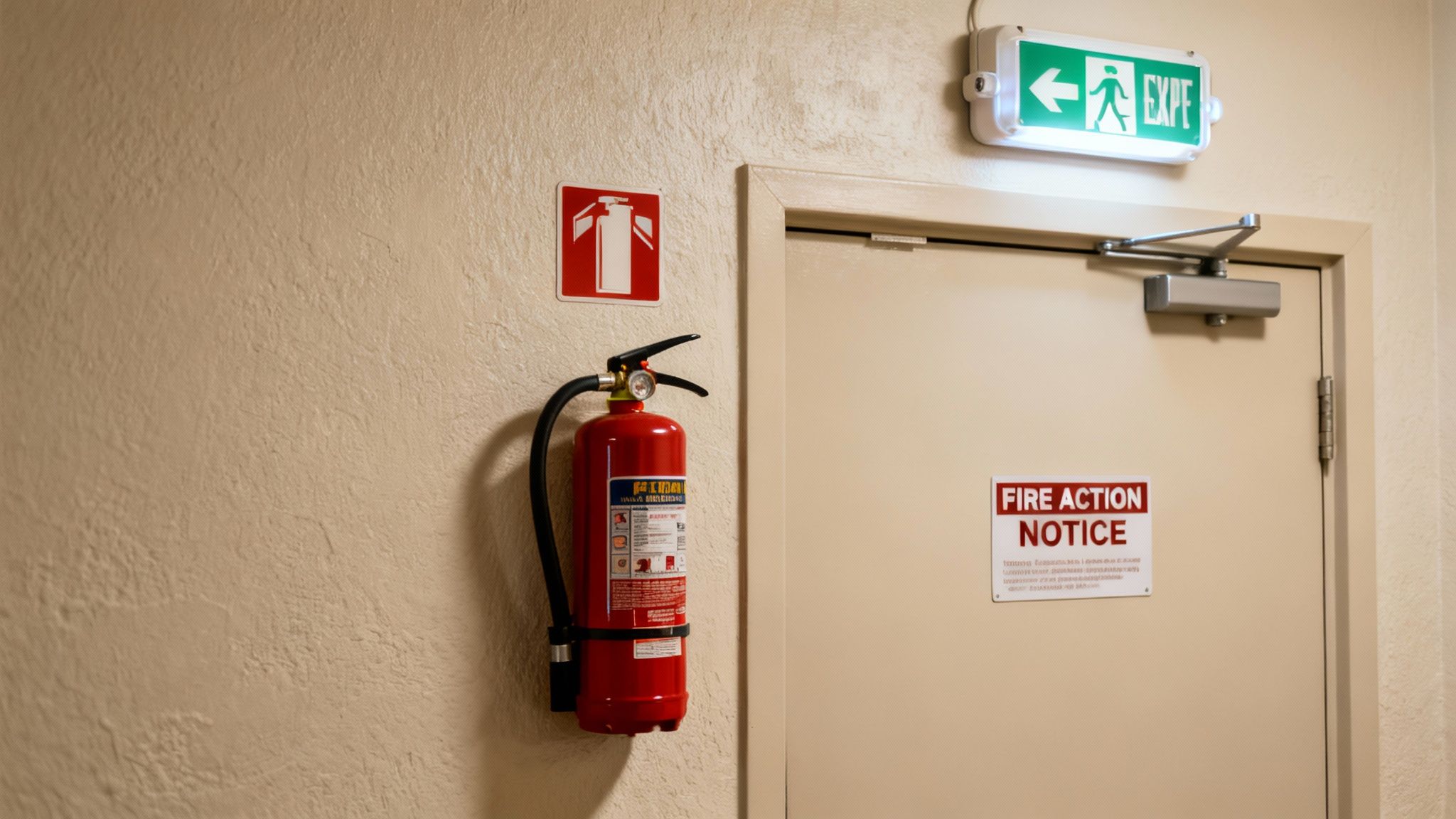
While the priority is always evacuation, having basic firefighting equipment available can allow a small, incipient fire to be tackled before it spreads. The most common requirement is for fire extinguishers.
Your fire risk assessment will specify the type and location of extinguishers needed. For instance:
You must ensure extinguishers are correctly mounted, clearly signed, and serviced annually by a competent person.
Clear, simple signage is a legal requirement. It plays a crucial role in guiding people to safety and providing clear instructions in an emergency.
Your building will need:
These notices must be displayed prominently in communal areas where every resident and visitor can see them. This ensures everyone is aware of the building’s emergency plan.
Ignoring your duties under fire safety regulations for landlords is a significant risk. The consequences are not just financial; they can be life-altering for you and your tenants. Local Fire and Rescue Services have considerable powers to enforce the law and use them readily.
It is important to understand how seriously breaches are taken. If an inspector identifies problems, they are legally required to take formal action to ensure residents are safe.
Fire authorities can issue several types of legal notices, each with increasing severity.
Failure to comply with these notices or committing a serious breach of the Fire Safety Order can lead to prosecution. The penalties are severe and can include unlimited fines and, for the most serious offences, a prison sentence.
In a recent UK case, a landlord received a fine of over £100,000 for multiple fire safety failures in an HMO. The issues included an inadequate fire alarm system and blocked escape routes. The court made it clear that putting tenants’ lives at risk for financial gain will not be tolerated.
The most effective way to avoid these severe consequences is to be proactive.
Your first and most important step is to commission a professional, ‘suitable and sufficient’ fire risk assessment from a competent person. This is not just a procedural task.
This document is your roadmap to compliance. It identifies the specific risks in your property, outlines the necessary control measures, and provides you with a clear action plan. A thorough assessment demonstrates that you have performed your due diligence and are committed to safety, forming the bedrock of your defence should an incident ever occur.
Ultimately, it is the best way to protect your tenants, your property, and your own peace of mind.
The details of fire safety compliance matter. Understanding the specifics can be challenging, but a few key questions arise frequently. Here are straightforward answers to the queries we hear most often from landlords.
The law does not specify a rigid timetable. Instead, it requires your Fire Risk Assessment to be kept “up to date.” In practice, what does this mean?
Best practice is to review it every 12 months to ensure nothing significant has changed.
A full, professional reassessment is generally recommended every three to five years for simpler properties. However, it should be done more frequently for higher-risk buildings like HMOs. You must also arrange a new assessment immediately following any major changes, such as building work, a new type of occupancy, or after a fire incident.
This is a common point of confusion, but the rules are now much clearer.
You are not responsible for the internal doors within a tenant’s private flat, such as the door between a bedroom and living room.
However, the Fire Safety Act 2021 made a critical clarification. For any building containing two or more sets of domestic premises, the Responsible Person (you) is now legally responsible for the flat’s main entrance door. This is because that door serves as a crucial fire barrier protecting the communal hallway or staircase, which is the escape route for everyone in the building. It is your responsibility to ensure it meets the required standard and is properly maintained.
A major change is on the horizon for landlords of taller buildings. New regulations, set to come into force on 6 April 2026, will introduce mandatory Personal Emergency Evacuation Plans (PEEPs).
These new rules, The Fire Safety (Residential Evacuation Plans) (England) Regulations 2025, will apply to all residential buildings 18 metres or higher. If you have a resident who cannot evacuate without assistance, you will need to collaborate with them to create a bespoke PEEP. This is not a generic plan; it is a detailed strategy tailored to their specific needs. You must then, with their consent, share this vital information securely with the local Fire and Rescue Service.
This is a significant change, and it is wise to prepare in advance. You can discover more insights about PEEPs for landlords and housing providers to understand the full scope of what is required.
A professional fire risk assessment is the single most effective way to navigate the complexity of legislation, meet all your legal duties, and, most importantly, keep your tenants safe.
At HMO Fire Risk Assessment, our certified assessors provide clear, actionable reports that give you a practical roadmap for compliance. Book your assessment today to protect your property and your peace of mind. Find out more at https://hmofireriskassessment.com.
In fire safety, there is one simple acronym everyone should know: PASS. It stands for Pull, Aim, Squeeze, and Sweep, and it is the universally...
As a landlord in the UK, you are legally responsible for ensuring your rental property is safe from fire. This is not just about fitting...