
Fire Risk Assessment HMO: A Landlord’s Guide to UK Compliance
23/01/2026
A fire risk assessment for an HMO is more than just a piece of paper; it’s a legal requirement and a fundamental part of keeping your tenants safe. Think of it as a professional, top-to-bottom evaluation of your property, designed to pinpoint fire hazards, identify who is at risk, and lay out the exact safety measures you need to put in place.
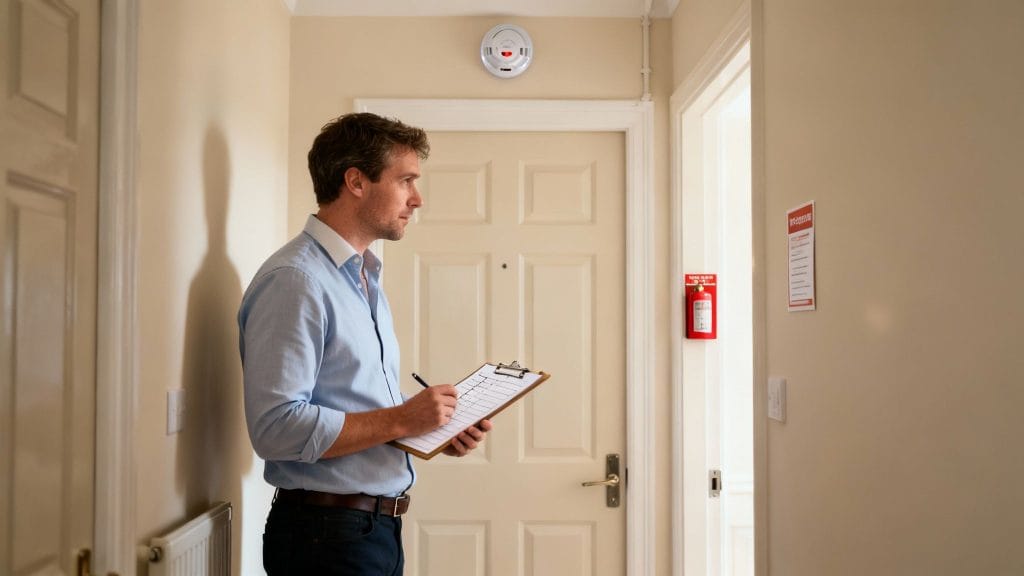
Managing a House in Multiple Occupation (HMO) comes with a much heavier burden of responsibility than a standard single-let property. With more people living under one roof, often in complex layouts with shared kitchens and hallways, the potential for a fire to start and spread quickly is significantly higher.
Because of this heightened risk, UK law is rightly very strict. Being proactive about fire safety isn’t just good practice for a landlord; it’s a non-negotiable legal duty designed to protect lives.
The Regulatory Reform (Fire Safety) Order 2005 is the key piece of legislation here. It states that the duty for fire safety falls to a designated ‘Responsible Person’. For an HMO, this is almost always going to be:
In short, if you have any degree of control over the premises, you are likely considered a Responsible Person. You cannot simply delegate this duty and forget about it. It is your job to ensure a “suitable and sufficient” fire risk assessment is completed by someone who is competent to do so.
The fire safety measures you would find in a typical family home do not cut it for an HMO. The assessment process is built to tackle the unique dangers of multi-occupancy living, where a small fire in one tenant’s bedroom can rapidly threaten everyone in the building.
A professional HMO fire risk assessment isn’t about ticking boxes on a generic checklist. It’s an active, in-depth process of identifying real-world hazards, evaluating the risk to people, and putting practical, effective safety measures in place to prevent a tragedy.
Do not underestimate the consequences of getting this wrong. Both local councils and the Fire and Rescue Service have serious powers to act. They can issue enforcement notices demanding immediate changes, prohibit the property from being used, or even pursue a prosecution. This can lead to unlimited fines and, in the worst-case scenarios, a prison sentence. This guide will give you a clear roadmap to help you navigate these critical responsibilities with confidence.
Navigating the legal side of HMO fire safety can feel complex, but it does not have to be. The law is not there to trip you up; it is a framework designed to protect tenants in properties that naturally carry a higher risk. At the heart of it all are two key pieces of legislation.
First is the Regulatory Reform (Fire Safety) Order 2005. This is the main piece of legislation for England and Wales. It moved away from a rigid, one-size-fits-all set of rules to a modern, risk-based approach. Crucially, it places the legal responsibility firmly on the shoulders of the ‘Responsible Person’ which, as the landlord or managing agent, is you.
More recently, the Fire Safety Act 2021 sharpened the focus of the 2005 Order. It made it crystal clear that fire risk assessments for any building with two or more domestic premises must now cover the building’s structure, its external walls (including cladding and balconies), and all doors that open onto communal areas.
What does this mean for you day-to-day? It means you must think proactively. Simply waiting for a problem to appear and then fixing it is not good enough. Your legal duties are ongoing, requiring you to adapt your safety measures whenever something changes.
Consider a common scenario: you decide to convert a loft into an extra bedroom for your HMO. That one change ripples through your entire fire safety setup. It could block or alter an escape route, increase the number of people in the house, and lengthen the distance someone has to travel to get out. Because of this, a new fire risk assessment would be legally mandatory to address these new risks.
It is not just about physical changes, either. A shift in who your tenants are can also trigger a review. If you start letting rooms to tenants with mobility issues, for instance, your assessment must question whether the current fire alarm and escape routes are still fit for purpose. The law expects you to protect those most vulnerable.
Letting these duties slide can have serious and expensive consequences. Local councils and Fire and Rescue Services have strengthened their enforcement powers and are more active than ever in inspecting HMOs. If they find your property is not up to standard, matters can escalate quickly.
These are not empty threats. Failing to meet your legal obligations can lead to:
The law does not see a missing or inadequate fire risk assessment as forgotten paperwork. It sees it as a direct endangerment to life. As a landlord, you have a fundamental duty of care to identify and manage fire risks for every single tenant.
The UK’s fire safety landscape has become increasingly stringent for HMO landlords. This legal obligation has driven compliance efforts, yet significant issues persist. In 2024-2025, enforcement data revealed 10,323 violations for fire door deficiencies alone. These doors are critical for preventing the spread of fire and smoke in multi-occupancy buildings, and their failure represents a major compliance gap.
Landlords should be aware of the specific requirements for properties like a newly built HMO licensed for students, as these often have unique layouts and occupancy patterns that require careful consideration in an assessment. Understanding these duties is the first step towards managing your properties responsibly and avoiding the common pitfalls that lead to non-compliance and serious risk. You can explore our guide to better understand the fire risk assessment legal requirements for more detailed information.
For landlords in Manchester, these duties often run alongside the council’s HMO licensing conditions. See our guide to HMO licensing in Manchester for how mandatory and selective licensing fit together with your fire risk assessment obligations.
When a professional fire risk assessor steps into your HMO, they are not just there to tick boxes. Their job is to see your property through a very specific lens of potential risk. They are trained to spot the subtle, often overlooked issues that could escalate into a tragedy, looking far beyond obvious problems.
A competent assessor brings a methodical approach, not a generic checklist. They need to understand how your specific property works, who lives there, and where the unique weak points are. This professional scrutiny is the only way to deliver the “suitable and sufficient” fire risk assessment that HMO landlords are legally required to have.
First, the assessor searches for anything that could start or fuel a fire. With a trained eye, they will scan every single room and communal space, from the basement to the loft conversion. They are looking for common HMO hazards that tenants and even landlords can easily miss during day-to-day life.
This is more than just spotting a misplaced lighter. The assessor will be systematically checking for things like:
Once the hazards have been mapped out, the focus shifts to the people inside. An assessor has to consider every single person who might be in the property, not just the tenants on the agreement. This includes their visitors, any contractors you hire, and even you as the landlord.
A crucial part of this stage is figuring out if anyone is especially vulnerable. The assessor will want to understand your tenant demographic. Are there tenants with mobility issues who would find stairs a major challenge in an emergency? What about residents whose first language is not English, which might affect how they understand fire safety signs? The assessment has to account for the safety of absolutely everyone.
This is where the assessor connects the dots between the hazards and the people. They will evaluate how likely it is for a fire to start and, more importantly, how severe the consequences would be. For instance, a frayed kettle wire in a busy communal kitchen (the hazard) poses a very high risk because multiple people (those at risk) use that space at all hours.
Based on that evaluation, the assessor will then scrutinise every fire safety measure you have in place to see if it is up to the job. This is easily the most detailed part of the on-site inspection.
A professional assessor’s job is to evaluate the effectiveness of your current fire safety measures against the specific risks present in your HMO. A fire door is useless if it is propped open, and a smoke alarm is no good if its battery is dead. It is about how the safety systems perform in the real world.
Here is a snapshot of some of the critical items an assessor will inspect during a comprehensive HMO fire risk assessment.
| Assessment Area | What is Being Checked | Common Failure Example |
|---|---|---|
| Escape Routes | Are hallways and stairs completely clear? Are exits unobstructed? | A tenant’s bicycle or a pile of delivery boxes left in the main corridor. |
| Fire Doors | Are they correctly installed FD30/FD60 doors? Do self-closers work? | A self-closing device is broken, or a tenant has wedged the door open for convenience. |
| Detection & Alarms | Is the alarm system interlinked? Are smoke/heat detectors correctly sited? | A Grade D system (battery-powered alarms) is installed where a Grade A mains-wired system is legally required. |
| Emergency Lighting | Is it installed along the escape route? Does it illuminate on test? | A light fitting fails to activate during a mains power test, leaving a staircase in total darkness. |
| Fire Equipment | Are extinguishers and blankets present (especially in kitchens)? Are they serviced? | A fire extinguisher in the kitchen has an out-of-date service label from two years ago. |
| Signage | Are fire exits clearly marked? Is a Fire Action Notice visible to all? | A generic “Fire Exit” sign is used instead of the legally required pictogram-style sign with a running man. |
Each of these checks is designed to ensure that if the worst happens, your tenants have the best possible chance of getting out safely.
The final steps are all about documentation. The assessor records every significant finding, both good and bad, in a detailed report. This is not just a piece of paper; it is your legal record, proving you have met your duties under the law.
The report will give you a clear, actionable plan, outlining what needs to be done and prioritising each action based on its risk level (e.g., high, medium, or low). Finally, the assessment will recommend a date for the next review. For an HMO, this is typically every 12 months or sooner if you make any significant changes to the property. This ensures your fire risk assessment remains a living document that genuinely protects your property and your tenants.
Not all fire risk assessments are created equal, and commissioning the wrong type for your HMO is a costly mistake that can leave you non-compliant. Getting to grips with the different levels of inspection is crucial for meeting your legal duties without paying for work you do not need.
The assessment types are numbered 1 to 4, with each one involving a different level of intrusion and scope. The right one for you depends on your property’s history, its construction, and how it is used. For most standard HMOs, a Type 1 assessment is the required starting point.
A Type 1 fire risk assessment is the standard for the vast majority of HMOs. It is a non-destructive inspection, meaning the assessor will not be making holes in walls. Instead, the focus is purely on the shared or communal areas of the property, such as hallways, staircases, landings, and any shared kitchens or lounges.
During a Type 1, the assessor will visually examine these areas to check the key fire safety measures:
This assessment works on the assumption that the original fire protection between private rooms and the common areas is satisfactory. It gives you a comprehensive evaluation of the day-to-day fire safety management in the parts of the building where risk is often concentrated.
This flowchart helps to visualise how an assessor moves from spotting potential hazards to evaluating the overall risk within an HMO.
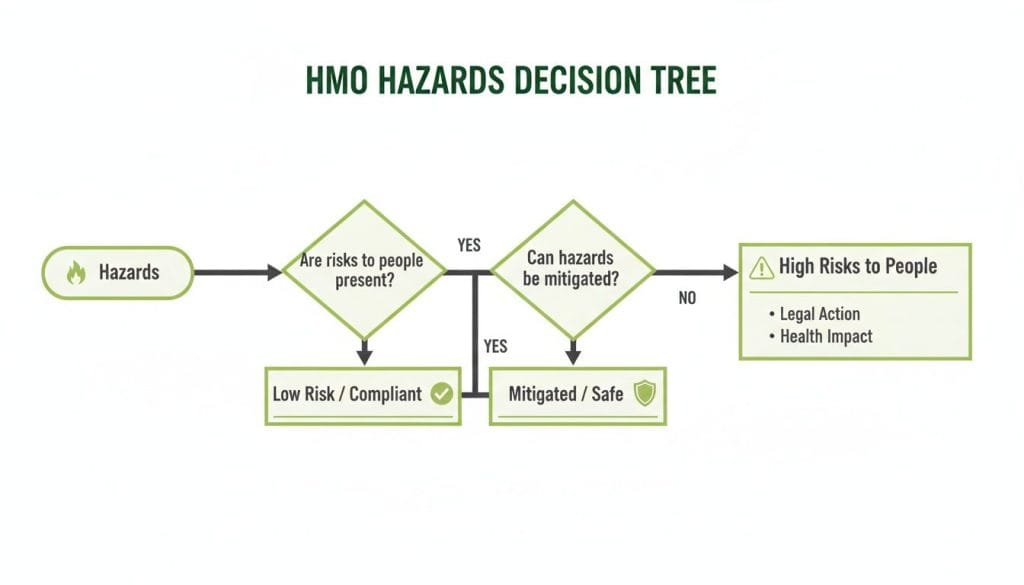
It shows the logical steps: identifying fire sources, considering the people affected, and using that information to decide on the necessary safety precautions.
While Type 1 is the standard, certain situations demand a more in-depth, intrusive inspection. This often comes up in properties that have been converted into HMOs rather than being purpose-built.
If there is any doubt about the fire integrity of the structure itself, a more detailed assessment becomes essential. This is particularly true in older buildings where previous construction work may not be properly documented or up to modern standards.
A Type 2 assessment includes all the same checks as a Type 1 but adds a destructive element. The assessor might need to physically check the integrity of structural fire protection, which could involve some intrusive sampling. It is usually only considered if there is a strong reason to suspect the building’s compartmentation is flawed.
A Type 4 assessment is the most comprehensive and intrusive of all. It involves opening up a significant number of areas to check the structural fire precautions throughout the entire building, including inside private rooms as well as the common parts. This level of inspection is rare and typically only required when serious structural fire safety concerns exist, for instance, after a major fire or when widespread construction defects are discovered.
For HMO landlords, the key is transparency. Giving your assessor the full picture, including the building’s history, details of any conversion work, and previous fire safety reports, will help them recommend the correct and most cost-effective assessment for your property. It is the best way to ensure you fulfil your responsibilities properly.
You can learn more about the specifics of the most common assessment in our detailed guide on the Type 1 fire risk assessment.
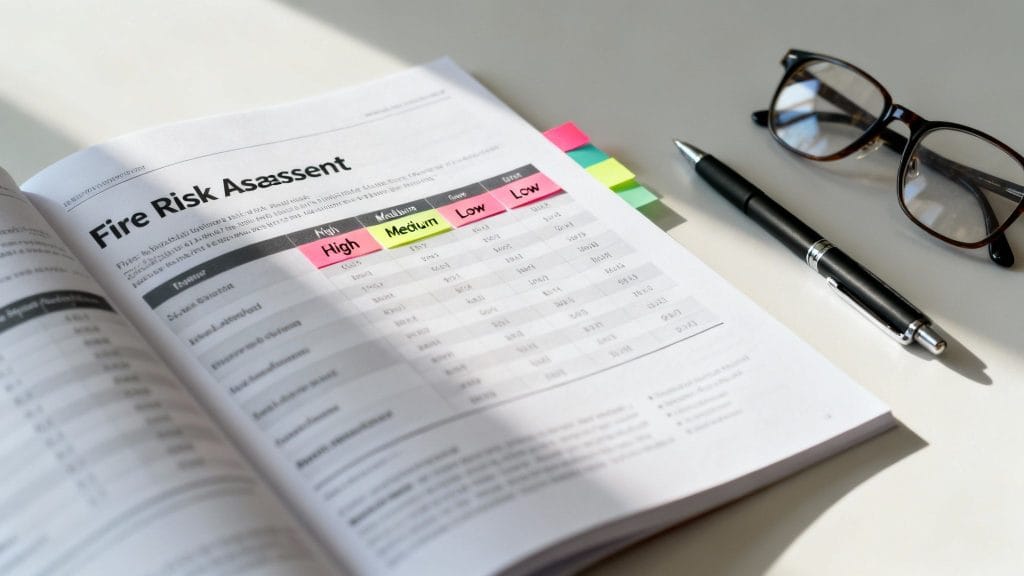
After the assessor has finished their inspection, you will receive a detailed written report. Think of this document as more than just paperwork; it is your legal record and, more importantly, your action plan. As the Responsible Person, knowing how to read it and act on the findings is one of your most critical duties.
A good report will cut through the jargon, translating the assessor’s on-site observations into a clear, structured format. It should pinpoint the fire risks they found and give you practical, straightforward instructions on what you need to do to fix them and get your property compliant.
Your fire risk assessment report is not just a long list of problems; it is a prioritised guide designed to help you focus on what matters most. The findings will be organised by risk level, pointing you straight to the most urgent issues.
This is usually broken down into a simple priority system:
This system lets you build a logical plan of action. You can tackle the most dangerous deficiencies first, then schedule the less critical work for a later date. To get a feel for how these findings are laid out in a real-world document, it is worth looking at an example of a fire risk assessment report.
The action plan in your report will list specific, tangible tasks. For an HMO, these recommendations are often directly linked to the unique risks that come with multi-occupancy living.
Here are a few common examples of what you might see:
Each recommendation should be clear enough for you to understand exactly what is needed and to instruct a competent contractor to carry out the work. The report gives you the ‘what’ and ‘why’; your job is to manage the ‘how’ and ‘when’.
The cost of a professional fire risk assessment is a direct reflection of its importance. For HMOs, assessments typically range from £250 to £450, a small price when you weigh it against the consequences of getting it wrong. Prosecution for inadequate fire safety can lead to crippling fines and reputational damage that far outweigh the assessment fee.
Ultimately, it is crucial to see the assessment not as a cost, but as a vital investment. It is an investment in protecting your tenants’ lives, safeguarding your property from fire, and securing your legal position as a responsible landlord.
Knowing your duties is one thing, but taking action is what really counts. A professional fire risk assessment is not just a good idea; it is a legal must-have under the Regulatory Reform (Fire Safety) Order 2005. Getting one organised is the final, crucial step to secure your compliance, protect your tenants, and safeguard your property.
Your first job is to find a competent assessor. You are putting a critical safety function in their hands, so do not be afraid to check their credentials. Always ask for proof of qualifications and professional indemnity insurance. A credible assessor will have no problem providing this.
When you are choosing someone to carry out your HMO fire risk assessment, you need to look beyond the price tag. Competency is everything.
A competent assessor should have:
Appointing a competent person is a legal duty for the Responsible Person. This means choosing an assessor based on their expertise and credentials, not just their price, is a fundamental part of fulfilling your obligations.
Once you have found a provider you trust, the process is usually straightforward. It starts with a brief discussion about your property, followed by the on-site visit where the assessor gets to work. Afterwards, you will receive a detailed, actionable report with their findings and recommendations.
This professional report bridges the gap between general safety advice and legally enforceable standards. Worryingly, Fire and Rescue Services data for the year ending March 2025 shows that out of 51,020 fire safety audits, only 58% of premises were found to be satisfactory, the lowest figure since 2011. This really highlights why a professional fire risk assessment for your HMO is so vital for staying on the right side of the law and keeping your tenants safe. You can read more in these fire prevention and protection statistics.
Even after you understand the basics, it is natural to have a few specific questions about your responsibilities as an HMO landlord. We hear the same queries time and again, so here are some straight answers to help you manage your property’s fire safety with total confidence.
Legally, your assessment must be kept up to date under the Regulatory Reform (Fire Safety) Order 2005. While the law does not specify a hard expiry date, best practice for a higher-risk building like an HMO is to get a professional review done annually.
You will also need an immediate review if anything significant changes. This is not optional; it is a legal requirement. Consider things like:
The law says the assessment must be “suitable and sufficient” and carried out by a competent person. So, while you can legally do it yourself, the real question is: are you truly competent? Do you have the specialist knowledge, training, and experience to spot hidden dangers and understand complex fire safety principles?
With HMOs, the stakes are incredibly high. Given the complexity and the serious consequences of missing something, the only sensible and reliable approach is to hire a qualified, insured professional. It is the clearest way to show you have taken your duties seriously and done everything possible to keep your tenants safe.
Every property has its unique characteristics, but the kitchen is almost always the number one danger zone in an HMO. It is the perfect storm: you have heat, electricity, and flammable cooking oils, all in a shared space used by multiple people with different habits and levels of care.
Other major risks we see all the time are faulty electrical items that tenants bring in, overloaded extension leads daisy-chained together, and escape routes in hallways and on stairs being used for storage. These are exactly the kinds of real-world hazards a professional assessor is trained to spot instantly.
A fire risk assessment for an HMO is not just about listing potential hazards. It is about connecting the dots. A professional connects that faulty tenant-owned toaster to the potential impact on every single person living in the building.
Yes, absolutely. Think of the recommendations in your report not as friendly suggestions, but as a mandatory to-do list to make your property legally compliant. The actions will be prioritised, helping you fix the most dangerous problems first.
Ignoring these required actions means you are knowingly leaving fire safety risks unresolved. This puts you in direct breach of the law and could lead to enforcement action from the council or fire service, including substantial fines or even prosecution, especially if a fire occurs.
At HMO Fire Risk Assessment, we specialise in certified, no-nonsense fire risk assessments for HMOs. Our expert assessors do not just identify hazards; they give you a clear, practical action plan to make your property safe and compliant. Protect your tenants and your investment by booking a professional assessment today. Learn more and get a straightforward quote at https://hmofireriskassessment.com.
Most HMO landlords I talk to can rattle off their fire door requirements, their alarm grade, and their emergency lighting checks without missing a beat....
Most of the fire safety advice on this site assumes you already have a working HMO. This one is for the stage before that: the...