

UK Fire Regulations for Rental Properties: A Landlord’s Guide
01/04/2026
As a landlord in the UK, you are legally responsible for ensuring your rental property is safe from fire. This is not just about fitting a smoke alarm and hoping for the best; it means actively assessing risks, putting protective measures in place, and maintaining a safe environment for your tenants. These duties are all defined under key legislation, primarily the Regulatory Reform (Fire Safety) Order 2005.
This guide is for UK landlords, property managers, and managing agents who need to understand their legal obligations for fire safety. By the end, you will have a clear understanding of what is required, who is responsible, and the practical steps needed to ensure your properties are compliant.
Understanding your legal duties is the first step toward compliance. The law is not there to catch you out; it is a framework designed to protect lives and property. For any landlord renting out a property in the UK, these obligations are not optional extras; they are a fundamental part of operating as a landlord.
The main piece of legislation you need to know is the Regulatory Reform (Fire Safety) Order 2005. It governs fire safety in all non-domestic premises, which for landlords, includes the shared parts of blocks of flats and all Houses in Multiple Occupation (HMOs). The order places the legal duty squarely on a designated ‘Responsible Person’.
In almost every rental property scenario, the landlord or the managing agent is the Responsible Person. This role legally requires you to take general fire precautions to ensure the safety of your tenants and anyone else who might be on the premises.
This is an active role, not a passive one. It means you must proactively manage fire safety, which breaks down into several key actions:
The legal framework is comprehensive, and compliance is monitored. The Fire Safety (England) Regulations 2022, for instance, introduced new duties for Responsible Persons in multi-occupied residential buildings.
The cornerstone, however, remains The Fire Safety Order. A recent survey from the Regulator of Social Housing highlights how seriously this is taken, showing that of 16,990 relevant social housing buildings, 99.9% had undergone fire risk assessments. This figure shows the sector-wide expectation of compliance, and private landlords are held to the same standard.
This infographic shows the continuous process you need to follow to meet your obligations.
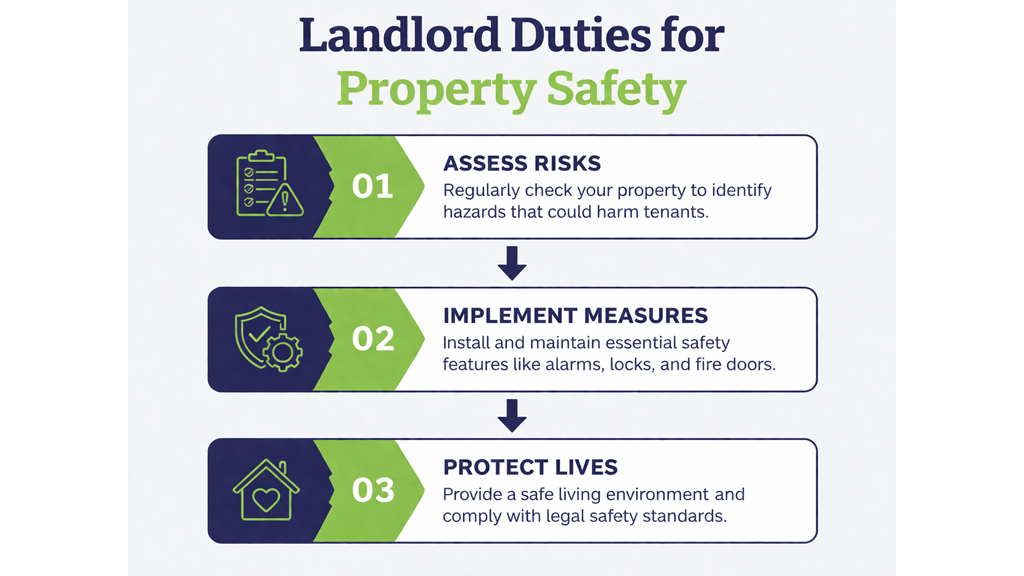
As you can see, fire safety is not a one-off task. It is a constant cycle of assessment, action, and ongoing management to keep your tenants safe.
Ignoring these duties can have devastating consequences. It puts your tenants’ lives at risk, will almost certainly void your insurance, and can lead to unlimited fines or even a prison sentence.
Consider this scenario: a landlord of a flat in a converted building in Manchester might believe their duties are minimal. But if that flat’s front door is defective and not a compliant fire door, it compromises the safety of the entire building, making the landlord liable. This is why understanding the specific requirements of the Fire Safety Order is absolutely essential for every landlord. Learn more about the Regulatory Reform (Fire Safety) Order in our detailed guide.
A fire risk assessment is the heart of your legal duties under the Fire Safety Order. It is not just a box-ticking exercise; it is a practical, methodical examination of your property to spot fire hazards and ensure you have done everything reasonably practicable to keep tenants safe. Get this right, and all other fire safety measures will fall into place.
Think of it as moving beyond legal jargon to create a clear, step-by-step safety plan. As the Responsible Person, you must ensure this assessment is carried out by someone competent to do the job properly.
The Health and Safety Executive (HSE) and local fire and rescue authorities lay out a straightforward five-step process. Following these stages is the best way to ensure your assessment is logical, thorough, and covers everything it needs to.

As official guidance makes clear, the assessment must be a documented, planned, and regularly reviewed process. Anything less will not be considered compliant.
While the five steps tell you how to do an assessment, the type of property you own dictates how deep you need to go. For buildings with flats or multiple tenancies, assessments are broken down into four main types.
For landlords of blocks of flats, understanding the difference between a Type 1 and Type 3 assessment is crucial. A Type 1 assessment covers common areas only, whereas a Type 3 also includes a sample inspection of the flats themselves, which may be necessary depending on the building’s risk profile.
For a simple house rented to a single family, a knowledgeable landlord might be able to handle their own assessment. However, for any HMO or block of flats, the complexity almost always demands a professionally qualified assessor. An inadequate assessment done by someone without the right expertise offers zero legal protection and can lead to severe penalties if a fire occurs.
To fully understand your obligations, read more about the steps of a fire risk assessment and make sure your property is fully compliant.
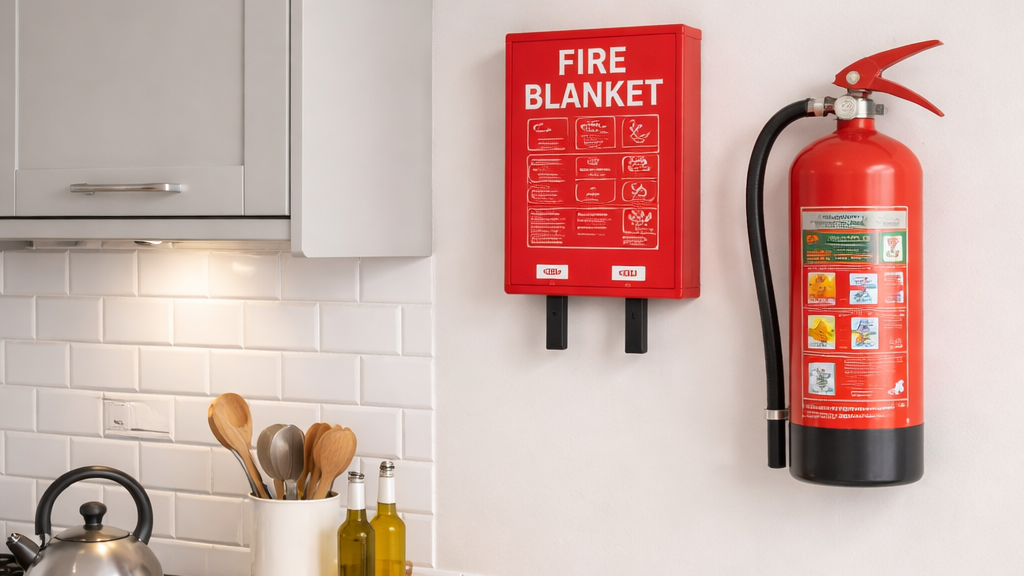
Think of your fire risk assessment as a personalised action plan for your rental property. Topping that list will almost certainly be the installation and upkeep of specific fire safety equipment.
These devices are not just ‘good practice’; they are a legal requirement and your primary line of defence in protecting your tenants and your investment.
As the landlord, the responsibility lies with you. You are responsible for making sure all the right equipment is in place and working correctly from day one of every tenancy, and that it stays that way through regular checks and maintenance.
The rules for fire safety equipment can seem confusing, as they change depending on the type of property you are letting. What is required for a simple family home is very different from a large, shared house.
To make things clearer, here is a quick summary of the typical requirements.
| Safety Measure | Single-Family Let (England) | Small HMO (3-4 Sharers) | Large HMO (5+ Sharers) |
|---|---|---|---|
| Smoke Alarms | Minimum one per storey | Mains-powered, interlinked system throughout | Mains-powered, interlinked system (often a more advanced grade) |
| Heat Alarms | Not mandatory, but recommended for kitchens | Mains-powered, interlinked alarm in kitchens | Mains-powered, interlinked alarm in kitchens |
| Carbon Monoxide Alarms | Required in rooms with a solid fuel or new gas appliance | Required in rooms with a solid fuel or new gas appliance | Required in rooms with a solid fuel or new gas appliance |
| Fire Extinguishers | Not mandatory, but highly recommended | Required, typically Water/Foam on each floor and CO2 near electrical risks | Required, specific types and locations determined by the Fire Risk Assessment |
| Fire Blanket | Not mandatory, but highly recommended for kitchens | Required in all shared kitchens | Required in all shared kitchens |
| Fire Doors | Not typically required | Required for high-risk rooms (e.g., kitchens) and escape routes | Required on all rooms opening onto the escape route (e.g., corridors, stairs) |
| Emergency Lighting | Not required | May be required depending on layout and council rules | Almost always required for escape routes |
| Fire Safety Signage | Not required | May be required depending on council rules | Required for escape routes and equipment identification |
This table is a general guide. Your property’s specific layout, age, and local council licensing scheme can all introduce extra requirements, which is why a professional fire risk assessment is so crucial.
Smoke and carbon monoxide alarms are the absolute bedrock of fire safety in any home you rent out. Getting their installation and maintenance right is completely non-negotiable under UK regulations.
At a minimum, every rented home needs at least one smoke alarm on each storey that is used as living accommodation. You will also need a carbon monoxide alarm in any room with a solid fuel-burning appliance, like a log burner. Since 1st October 2022, this rule expanded to include rooms where any new fixed combustion appliance, such as a gas boiler, is installed.
For landlords who want to dig deeper into the specifics, our guide on UK smoke alarm regulations covers placement, types, and legal standards in much more detail.
Remember, placement is everything. Alarms need to be fixed to the ceiling in circulation spaces like hallways and landings, where they can effectively detect smoke and be heard throughout the property.
Whether you need to provide fire extinguishers and blankets comes down to your property type and the specific hazards identified in your fire risk assessment. They are not a legal must-have in single-let properties, but we strongly recommend them, especially in the kitchen.
For Houses in Multiple Occupation (HMOs), it is a different story. The rules are much stricter, and you will almost certainly need to provide the right kind of fire extinguishers. A common, effective setup includes:
Simply buying the equipment is not enough. You must ensure it is the right type for the risks, positioned correctly, and serviced regularly by a competent person.
A Common Misunderstanding: Placing an incorrect extinguisher in a hallway can create more danger than it prevents. Using a water-based extinguisher on an electrical fire, for example, could be catastrophic. Your fire risk assessment is designed to prevent this by specifying exactly what type you need and where it should go.
Fire doors are one of the most critical parts of a building’s fire safety design. Their job is to hold back fire, smoke, and heat for a set amount of time, usually 30 minutes (FD30), protecting escape routes and giving people precious time to get out. They are a legal requirement in all HMOs and in blocks of flats.
A door only acts as a fire door if it is correctly installed and maintained. You should get into the habit of checking for:
Just as important are the escape routes themselves. Hallways, stairs, and exits must be kept completely clear at all times. Items like bicycles, prams, or rubbish bags left in a communal hallway can easily block an escape path, turning a safe property into a death trap and putting you in serious breach of fire safety law.
While every rental property is bound by fire safety law, Houses in Multiple Occupation (HMOs) are held to a much higher standard. This is not just bureaucracy. The fundamental nature of an HMO, with several unrelated people living separate lives under one roof, creates a higher risk profile. That is why the regulations for these properties are so much more demanding.
Understanding whether your property is an HMO is the first, most crucial step. It is a common misconception that an HMO is only a large student house. The legal definition is far wider.
Your property is an HMO if at least three tenants live there who form more than one household, and they share a toilet, bathroom, or kitchen. A household is either a single person or members of the same family. This means even a small flat rented to three unrelated friends is officially an HMO.
The law goes a step further, splitting HMOs into two distinct categories: standard HMOs and ‘large’ HMOs. Large HMOs face mandatory licensing and even stricter fire safety rules.
The logic behind the increased risk is straightforward. More people means more cooking, more electrical gadgets, and more potential for simple accidents. It also means more wear and tear on crucial safety features like fire doors.
The core reason for these enhanced rules is simple: in an HMO, a fire in one person’s bedroom or the kitchen becomes an immediate threat to everyone else. In a single-family home, an alarm will likely wake the whole family. In an HMO, you need a system that guarantees a fire on the ground floor will wake a tenant sleeping two storeys up.
To manage these higher risks, HMO fire regulations demand a superior grade of equipment and structural fire protection. A professional fire risk assessment will lay out the exact requirements for your specific property, but you should expect to install the following as a bare minimum.
Standard battery-powered smoke alarms are not sufficient in an HMO. The law demands a far more robust system to ensure every single person is alerted the moment a fire is detected, no matter where it starts.
This means installing a system of alarms that are wired directly into the building’s main electricity supply, with a battery backup in case of a power cut. Crucially, all alarms must be interlinked. When one sounds, they all sound.
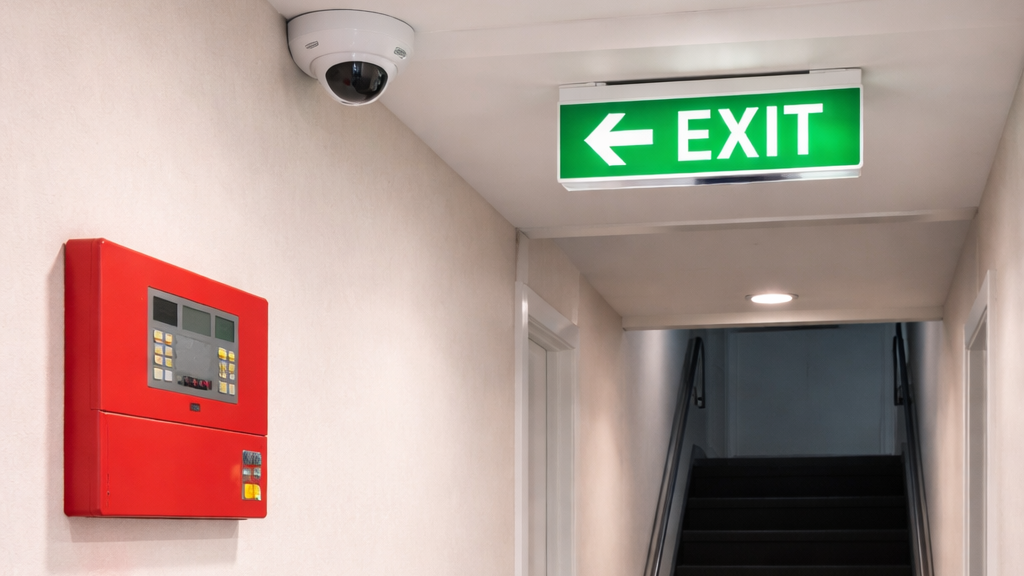
Imagine a fire causes a power cut in a large, complex HMO. The escape routes are suddenly plunged into total darkness, causing confusion and panic. This is why emergency lighting is a standard requirement for all large HMOs and many smaller ones. These lights have their own backup power and instantly illuminate corridors and stairways if the mains electricity fails.
Working alongside the lighting, you need clear, compliant signage. This includes the familiar green “Fire Exit” signs to point people along the escape route and the blue “Fire Door Keep Shut” signs that must be fixed to all fire doors.
These measures are not optional extras or ‘best practice’ tips; they are non-negotiable legal duties. Getting this wrong can lead to your HMO licence being revoked, unlimited fines, and even prison time. They are a direct, necessary response to the heightened risk to life that comes with multi-occupancy living.
Fire safety law is never static. It is constantly updated to address gaps, manage new risks, and ultimately keep tenants safer. For any UK landlord, keeping on top of these changes is not just good practice; it is a legal necessity to avoid significant fines and remain compliant.
Two major changes are on the horizon for 2026, and they are set to reshape how landlords manage evacuation plans and deal with urgent safety hazards. The direction is clear: the law now expects more proactive, decisive action from every Responsible Person.
The first big change is the arrival of the Fire Safety (Residential Evacuation Plans) (England) Regulations 2025, which take effect on 6th April 2026. This is not a minor tweak; it is a new legal duty for landlords of certain residential buildings to create detailed, building-specific evacuation plans.
The idea is to move beyond a one-size-fits-all ‘stay put’ policy. Instead, landlords will need to assess their building and its occupants properly to map out the safest and most practical way to get everyone out in an emergency.
This new rule is a direct result of lessons from major fire tragedies. It forces the Responsible Person to think ahead, document a clear plan, and have it ready to share with both residents and the Fire and Rescue Service when it matters most.
At the same time, changes to the Health and Safety at Work etc. Act 1974 are putting landlords on a much shorter leash when it comes to fixing critical safety issues. This update particularly affects landlords in the social housing sector by introducing a non-negotiable deadline for resolving serious problems found during inspections.
With fire and rescue services tackling roughly 90-95 house fires every day in Great Britain, it is easy to see why this is happening. Under the new rules, landlords must fix certain reported hazards, such as a faulty fire door, within a rapid 15-day timeframe. You can get the full rundown of these updates by reading about the key changes coming in 2026.
Think about what that means. A broken fire door, a critical weak point in your building’s fire defence, cannot be put on the back burner anymore. It has to be repaired or replaced in just over two weeks.
These new rules are a clear signal that fire safety management needs to be dynamic and responsive. For landlords, this has some very real, practical consequences:
Ignoring these changes is not an option. These regulations are becoming the new legal standard for fire safety in rental properties, and you will be expected to be compliant from day one.
When it comes to fire safety, it is the practical, day-to-day questions that often cause the most confusion. Even the most informed landlords can find themselves wondering about the specifics.
Let’s clarify some of the most common queries we hear, giving you straightforward answers to help you stay compliant and keep your tenants safe.
The Fire Safety Order uses the word “regularly” when it comes to reviewing your fire risk assessment, which can feel vague. In practice, however, fire authorities and industry standards have set a clear expectation for landlords.
For any HMO or building with shared communal areas, an annual review is the accepted standard. In a simple, single-let property with the same tenants for years and no changes, a review every two years might be acceptable, but you must document why you have made that decision.
A review becomes mandatory immediately after any significant change. This includes:
Think of your fire risk assessment as a live document. An out-of-date report is worthless in the eyes of an inspector and offers you zero legal protection. Always log every review, even if nothing has changed.
This is where many landlords encounter problems. The law says the ‘Responsible Person’ (you, the landlord) must ensure the assessment is done by a ‘competent person’.
What does ‘competent’ mean? It means someone with the necessary training, experience, and knowledge to properly identify fire hazards and evaluate the risks.
If you own a very simple, single-family house and feel you genuinely understand the legislation, the risks, and the safety measures needed, you might be able to do it yourself.
However, the moment your property has shared communal areas, like an HMO or a block of flats, the risk and complexity increase significantly. It is extremely difficult for an untrained person to be considered ‘competent’ in this scenario. An inadequate assessment, even one done with the best of intentions, leaves you vulnerable to large fines and even prosecution.
For anything more complex than a single-family let, hiring a professional and accredited fire risk assessor is the only reliable way to meet your duties. It provides a defensible position and gives you an impartial, expert-led action plan to become compliant.
The penalties for failing to comply with fire safety regulations are severe and can be life-changing. Local Fire and Rescue Authorities hold significant power under the Regulatory Reform (Fire Safety) Order 2005 and they use it.
The consequences you could face include:
If a fire leads to a fatality, you could be prosecuted for gross negligence manslaughter. The stakes are incredibly high, which is why treating fire safety as a top priority is non-negotiable.
This is a frequent point of confusion for landlords owning a flat within a larger building. The answer is that responsibility is split, and you must know where your duties start and end.
The ‘common parts’, such as the main entrance, shared hallways, stairs, and the roof, are the responsibility of the building’s freeholder or a Residents’ Management Company (RMC). They are the ‘Responsible Person’ for these areas and their fire risk assessment will cover them.
However, as the owner of an individual flat, you are the Responsible Person for everything inside your flat’s four walls. Your duties include:
You also have a duty to cooperate with the building’s main Responsible Person. If their assessor needs access to check your flat’s front door, for example, you are legally required to assist. A coordinated effort is the only way to keep the entire building safe.
Ensuring your rental property is fully compliant with fire safety regulations is a major responsibility, but it is not something you have to figure out on your own. A professional fire risk assessment is the clearest and most effective way to understand your duties and get a solid plan for compliance.
At HMO Fire Risk Assessment, our accredited assessors deliver clear, practical reports designed for your specific property. We help you protect your tenants, your investment, and yourself. If you need expert guidance on the fire regulations for rental properties, our team is here to help.
In fire safety, there is one simple acronym everyone should know: PASS. It stands for Pull, Aim, Squeeze, and Sweep, and it is the universally...
As a landlord in the UK, you are legally responsible for ensuring your rental property is safe from fire. This is not just about fitting...