

A Guide to UK Fire Extinguisher Inspections
06/02/2026
Regular fire extinguisher inspections are a non-negotiable legal duty for UK businesses, landlords, and property managers. These checks are all about making sure this critical, life-saving equipment will actually work when you need it most. Getting this wrong could lead to severe legal and financial consequences.
In the UK, the law is crystal clear on fire safety. The main piece of legislation is the Regulatory Reform (Fire Safety) Order 2005, often just called the FSO. This law shifts the focus from box-ticking and certificates to a risk-based approach, making one person accountable for keeping everyone safe.
The FSO is very direct: all fire safety equipment, including your extinguishers, must be maintained in an “efficient state, in efficient working order, and in good repair.” This is not a friendly suggestion; it is a legally binding command.
The law identifies a ‘Responsible Person’ who carries the weight of legal responsibility for fire safety. This is not a title you can ignore. You are likely the Responsible Person if you are:
If you fit into one of these roles, the buck stops with you. It is your job to ensure fire extinguisher inspections and maintenance are done correctly and on time. Claiming ignorance is no defence. The role demands that you commission a suitable fire risk assessment and, crucially, act on its findings which always includes providing and maintaining the right fire-fighting gear.
These legal requirements are not just red tape. They are designed to achieve three critical goals that any sensible property manager or business owner should care about:
Failing to meet your legal duties can have very serious repercussions. The local Fire and Rescue Service is the enforcing authority, and they have the power to inspect your premises at any reasonable time. If they find your extinguishers have not been maintained, they will not hesitate to take formal action.
Enforcement can start with an informal warning but can quickly escalate to a formal Enforcement Notice, which legally forces you to fix the problems by a set date. If there is a serious and imminent risk to life, they can issue a Prohibition Notice, which could shut down part or all of your premises until it is made safe.
Breaching fire safety law is a criminal offence. If prosecuted, the Responsible Person can face unlimited fines and, in the worst-case scenarios, a prison sentence of up to two years.
Consider a landlord of a House in Multiple Occupation (HMO) who skips their maintenance duties. If a fire breaks out and someone is hurt or killed because an extinguisher failed, that landlord could face prosecution. This highlights a crucial point: it is not enough to just have extinguishers; you must ensure they are inspected and ready to go at a moment’s notice.
To keep your fire extinguishers compliant and ready for action, UK regulations require two very different types of inspections. Think of it like owning a car: you do the basic weekly checks yourself, like looking at the tyres and oil, but you leave the annual MOT to a qualified mechanic. Fire extinguisher inspections work on the same principle, blending routine vigilance with expert technical servicing.
Getting the rhythm of these two checks right is fundamental to a solid and compliant fire safety strategy. One is a quick visual scan, and the other is a deep dive into the extinguisher’s mechanics. Each has a distinct purpose, a different set of tasks, and specific rules about who can carry it out.
This is your first line of defence. The monthly check is a simple visual inspection that a trained member of your staff, a landlord, or a facilities manager can do without any specialist kit. The idea is to catch any obvious problems that could make an extinguisher useless in between its professional services.
This regular once-over should confirm that the extinguisher is:
The annual service is a much more thorough examination that, by law, has to be done by a ‘competent person’. This is not just a vague term. It means a certified technician with the proper training, hands-on experience, and specialist equipment to do the job right. They carry out a detailed internal and external check to certify that the extinguisher is safe and works as it should, following the British Standard BS 5306.
This service goes far beyond what you can see. The technician will check the operating mechanisms, verify the weight of the contents, and replace certain parts according to the manufacturer’s schedule. Once they are done, a dated service label is stuck to the unit, and you get a certificate for your fire safety records. This paperwork is your legal proof of compliance.
Skipping this essential service not only puts you in breach of the Fire Safety Order but also dangerously compromises the safety of everyone in your building.
To make the differences crystal clear, let’s break them down side-by-side.
| Aspect | Monthly Visual Inspection | Annual Service by Competent Person |
|---|---|---|
| Who Does It? | Designated staff, landlord, or manager | Certified, trained technician |
| Frequency | At least once per month | Every 12 months |
| Purpose | Spot obvious external faults quickly | Certify the unit is safe and functional |
| Key Tasks | Check location, accessibility, pressure, seal, damage | Detailed internal/external checks, weighing, component testing |
| Tools Required | None – it is purely visual | Specialist tools and weighing scales |
| Legal Proof | Logbook entry | Service label on unit and official certificate |
In short, the monthly check is about maintaining readiness, while the annual service is about ensuring reliability and legal compliance. Both are non-negotiable parts of a responsible fire safety plan.
The monthly visual check is one of the most fundamental parts of your fire safety routine. It is a straightforward but absolutely essential task that the Responsible Person can carry out themselves or delegate to a competent member of staff, like a site manager. The whole point is to spot obvious faults early, making sure your extinguishers are ready to go between the more thorough annual services.
Think of it as a quick health scan for your fire safety gear. Just a few minutes each month can stop a small, manageable issue from turning into a critical failure when you can least afford it. This proactive habit is not just good practice; it is a legal requirement and a true cornerstone of effective fire risk management.
This visual guide breaks down the essential workflow, from the simple in-house monthly check to the full annual service carried out by the professionals.
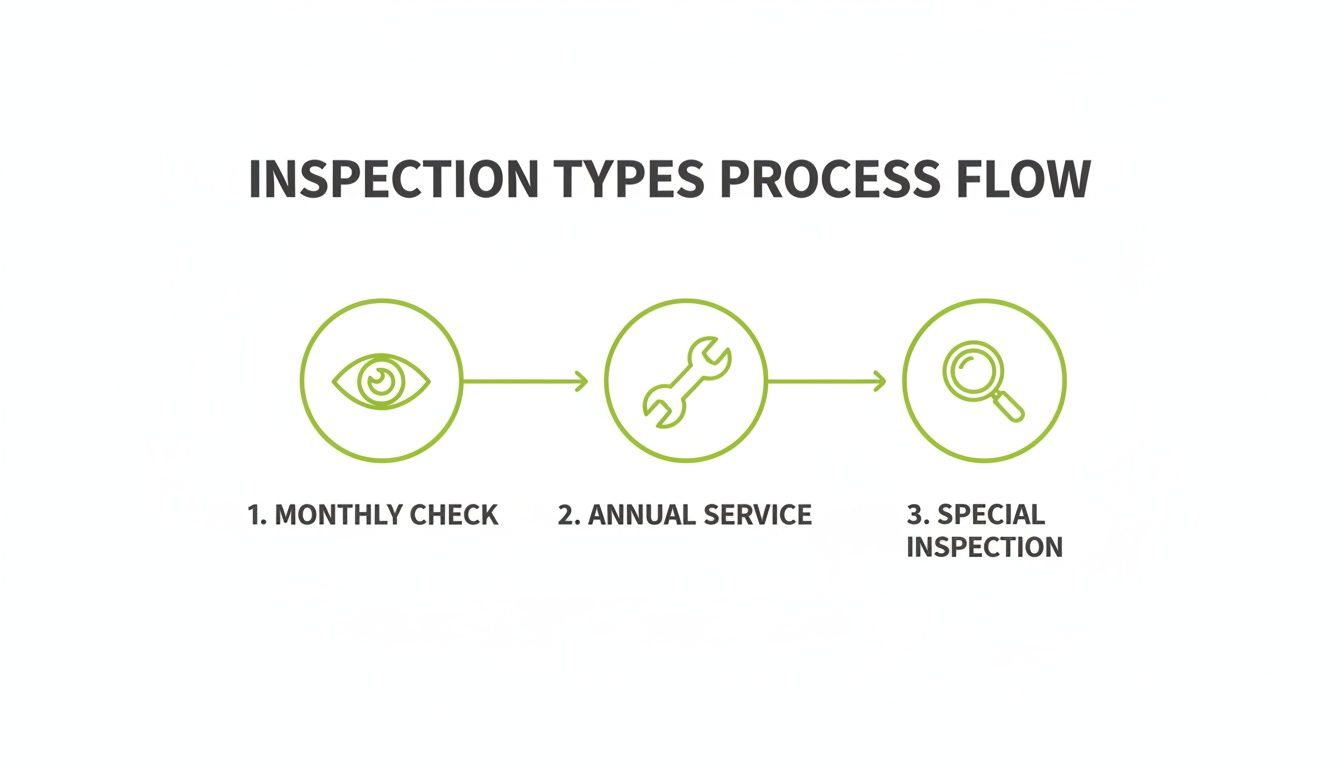
This flow clearly separates the quick monthly once-over from the mandatory annual service performed by a competent technician, helping you stay compliant at every stage.
First things first: is the extinguisher actually where it is supposed to be? Your fire risk assessment will have identified the best strategic spots for your equipment, usually near specific fire risks and along escape routes.
Most fire extinguishers have a small pressure gauge that acts as a vital sign of the unit’s health and readiness. The only common exception is CO2 models, which have to be checked by weight instead.
The needle must be pointing squarely in the green zone. If it has crept into the red, the extinguisher is either undercharged (and will not work properly) or, less commonly, overcharged (which could be dangerous). Any unit with a gauge outside the green zone needs to be taken out of service immediately and looked at by a professional.
Every extinguisher has a pin to stop it from being set off by accident. Holding that pin in place is a small plastic tamper seal. This little seal is your proof that the extinguisher has not been used or tampered with.
If the tamper seal is broken or missing, you have to assume the extinguisher has been used, even if only for a second. It needs to be professionally recharged or replaced right away. Even a tiny discharge can cause it to slowly lose all its pressure over time, rendering it useless.
A common compliance failure is assuming an extinguisher is fine just because it looks full. A broken tamper seal is a clear red flag that requires immediate action to ensure your equipment is reliable.
Now, give the extinguisher a quick but thorough visual once-over, from top to bottom. You are on the lookout for any signs of physical damage or decay that could compromise its safety or stop it from working.
Pay close attention to these areas:
Finally, and this is crucial, you must record every monthly check in your fire safety logbook. From a legal standpoint, an unrecorded inspection simply never happened.
Your log entry can be simple but must be clear. Note the date, the extinguisher’s unique ID or location, the initials of the person who did the check, and any faults found or actions taken. This documentation is not just red tape; it is your legal proof of compliance and shows the Fire and Rescue Service that you are actively managing your fire safety duties. Consistent records build a history of due diligence, which is invaluable during any official audit.
While your monthly visual checks are great for catching obvious problems, the annual service carried out by a competent technician is a different beast altogether. This is not just a quick once-over; it is a detailed, legally required procedure that digs deep into the mechanical health of your equipment, making sure it is fully compliant with British Standard BS 5306.
Knowing what a proper service involves helps you understand its real value. It is your main guarantee that an extinguisher will actually work when you need it most, turning hopeful reliance into certified confidence.
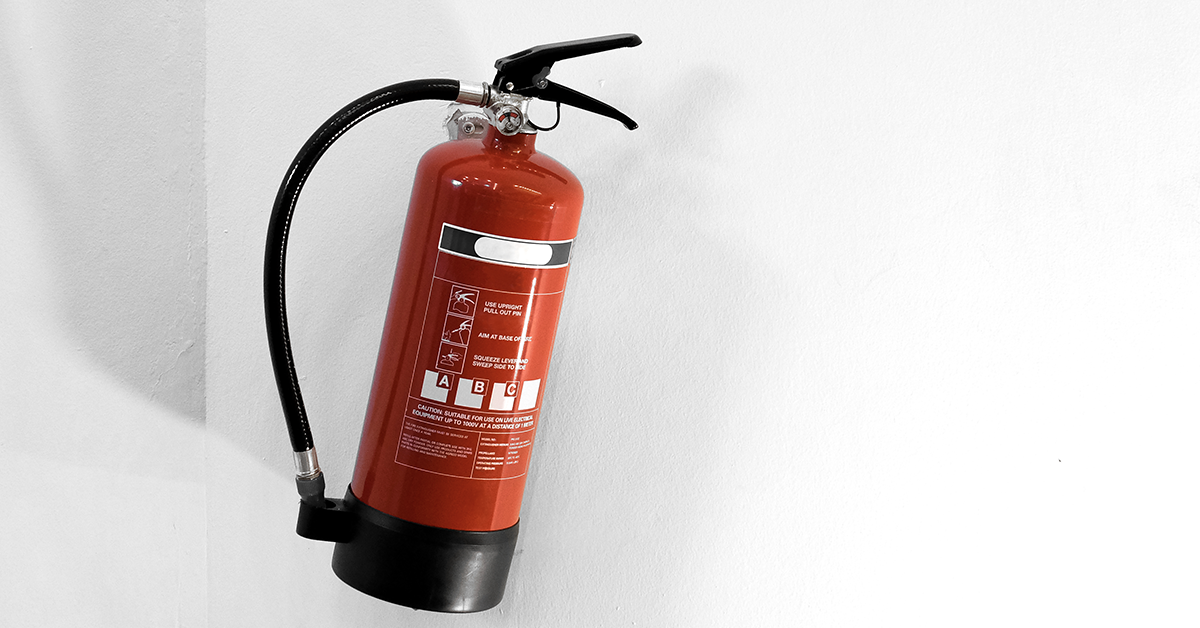
A certified technician will perform a series of specific checks that go far beyond what you can see from the outside. This is all about making sure the internal mechanics and the extinguishing agent itself are in perfect working order.
Here is what they will be doing:
Beyond the yearly check-up, extinguishers need a more thorough “extended service” at set intervals. Think of it as a major service for your car. It is designed to guarantee the unit’s long-term reliability.
The extended service is the ultimate health check. It usually involves a test discharge, a full internal examination, and a professional recharge. It is the only way to be 100% certain that every component, including the valve and internal parts, works correctly under real-world pressure.
These deeper inspections are scheduled based on the type of extinguisher:
Once the service is done, the technician completes two final, vital tasks. First, a service label is fixed to the extinguisher itself. It clearly shows the service date, the technician’s details, and when the next service is due.
Second, you will receive a certificate of inspection to go in your fire safety logbook. This piece of paper is your official proof that you have met your legal duties under the Regulatory Reform (Fire Safety) Order 2005. It confirms a competent professional has serviced your equipment. If the Fire and Rescue Service ever comes knocking, that certificate is one of the first things they will ask for. Without it, you simply cannot prove you are compliant.
Spotting a problem during a fire extinguisher inspection is one thing; knowing exactly how to sort it out is another. An effective check is not just about ticking boxes. It is about proactively finding the faults that could make an extinguisher useless in a real emergency. As the Responsible Person, dealing with these issues swiftly and correctly is one of your core duties.
Knowing what to look for helps you shift from a reactive to a preventative fire safety mindset. Even something that looks minor could lead to a failed audit from the Fire and Rescue Service or, much worse, an extinguisher that lets you down when you need it most.
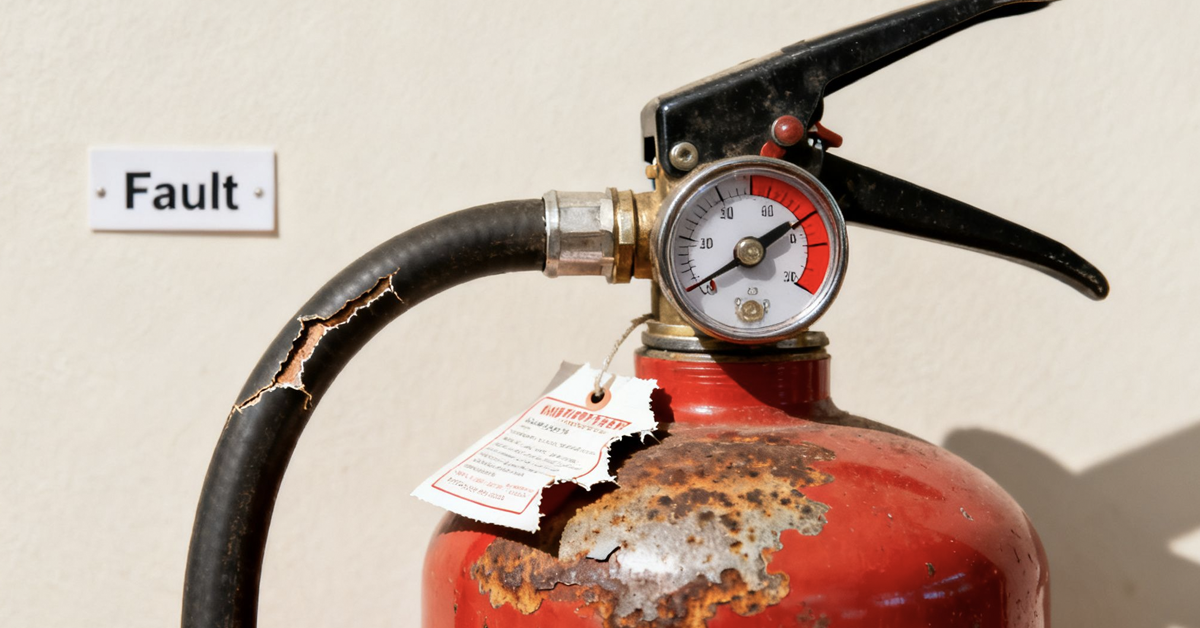
One of the most common failures you will find during your monthly checks is a faulty pressure gauge. For the extinguisher to be effective and compliant, that needle needs to be sitting squarely in the green zone.
Think of the hose and nozzle as the delivery system. If there is any damage or a blockage here, the extinguisher is completely compromised and cannot fight a fire.
That little plastic tamper seal is a simple but vital indicator. It is your visual confirmation that the extinguisher has not been used or tampered with since its last professional service.
A broken tamper seal is a non-negotiable red flag. Even a one-second discharge can cause the unit to lose pressure over time, rendering it completely useless when you finally need it.
The physical state of the extinguisher cylinder is crucial for its safety and performance. Do not dismiss rust and dents as just cosmetic issues; they can seriously weaken the structural integrity of what is essentially a high-pressure vessel.
In the eyes of UK fire safety law, an unrecorded inspection is as good as one that never happened. Meticulous record-keeping is not just about being organised; it is a non-negotiable legal requirement under the Regulatory Reform (Fire Safety) Order 2005. Think of your fire safety logbook as your primary evidence of due diligence, proving you are actively managing your responsibilities.
When the Fire and Rescue Service shows up, well-maintained records are your best defence against enforcement action. They demonstrate that you take your role as the Responsible Person seriously and have a structured system for looking after life-saving equipment.
Every time an extinguisher is checked, whether it is your quick monthly once-over or the full annual service, your logbook must be updated. This creates an unbroken chain of evidence showing your commitment to compliance. Each entry needs to be clear, concise, and contain all the crucial details.
A compliant logbook entry for a monthly visual check should include:
For the annual service, simply note the date it happened and file the certificate provided by the competent technician. That certificate is a critical legal document, so keep it safe.
In the year ending March 2025, Fire and Rescue Services in England conducted 51,020 fire safety audits, with only 58% achieving a satisfactory outcome. A major reason for failure is poor maintenance records, which can easily lead to formal enforcement. You can discover more insights about these UK fire safety audit statistics on GOV.UK.
Your fire safety logbook and all its related certificates must be kept on the premises, ready for inspection at a moment’s notice. If a Fire and Rescue Service officer arrives for an audit, they will ask to see these records immediately. Fumbling around trying to find them or presenting an incomplete log creates a terrible first impression and will likely trigger deeper scrutiny.
Beyond just having the paperwork, knowing how to manage it effectively is key. Getting familiar with document retention policy best practices can help keep everything organised and compliant. The solution is simple: keep everything in one designated, clearly labelled place. This makes the whole process straightforward, ensuring you can confidently present your compliance history whenever required.
Even with the best guidance, it is natural for business owners, landlords, and property managers to have questions about their day-to-day fire safety duties. Here are our answers to some of the most common queries we get about fire extinguisher inspections, designed to give you a bit more clarity and help you stay on the right side of the law.
This is a great question. Fire extinguishers do not have a strict “expiry date” like food, but they do need to be replaced or completely overhauled at set intervals. This process is called an extended service, and it involves a full discharge test to make sure the unit is still sound.
As a rule of thumb, this is required:
Of course, this is just a guideline. Any extinguisher that gets damaged, starts to corrode, has been used (even for a second), or fails an inspection needs to be replaced straight away, no matter how old it is.
The short answer is no. While the monthly visual check is something any competent staff member can and should do, the official annual service is a job for a professional. Legally, it must be performed by a ‘competent person’, someone with the right training, qualifications, and experience as laid out in British Standard BS 5306-3.
In the real world, this means a certified fire extinguisher technician. Using a professional not only gets the job done correctly but also provides you with the official certification you need for your fire safety records. This paperwork is your proof of compliance. For a bit more on this, check out our guide on using fire extinguishers correctly and safely.
If the Fire and Rescue Service finds your inspections are not up to scratch during an audit, they will take action. How serious that action is really depends on the level of risk your non-compliance creates.
An initial discovery might just lead to an informal chat and a chance to sort it out. But for more serious problems, you will get an official Enforcement Notice, which legally requires you to fix everything by a set deadline.
If the situation poses a significant risk to life, they can issue a Prohibition Notice, which could restrict access to parts of your building or even shut the whole place down until it is safe. Ignoring these notices is a criminal offence, and the Responsible Person could face unlimited fines or, in the worst cases, a prison sentence.
Keeping your fire extinguishers professionally inspected and serviced is not just box-ticking; it is a fundamental part of your legal and moral duties. HMO Fire Risk Assessment provides certified extinguisher servicing and maintenance to help you meet your obligations, reduce risk, and keep everyone in your building safe. https://hmofireriskassessment.com
Regular fire extinguisher inspections are a non-negotiable legal duty for UK businesses, landlords, and property managers. These checks are all about making sure this critical,...
If you’re a UK property manager, landlord, or business owner, getting to grips with the different types of fire alarm systems is one of your...