

A Landlord’s Guide to UK Fire Door Regulations
28/01/2026
If you are responsible for a property in the UK, understanding fire door regulations is not just good practice—it is a legal obligation you cannot afford to ignore. The primary legislation, the Regulatory Reform (Fire Safety) Order 2005, makes it clear: a designated ‘Responsible Person’ must ensure every fire door is fit for purpose, from specification and installation to ongoing maintenance. This guide is for business owners, landlords, and property managers who need to understand their duties and ensure their buildings are safe and compliant.
It is a common mistake to think of fire doors as just heavy internal doors. They are engineered life-safety systems designed to save lives by creating fire-resisting compartments within a building. Their job is to hold back fire and smoke, keeping escape routes clear and giving occupants time to evacuate safely. Underestimating their role or neglecting maintenance is a major compliance failure with potentially tragic consequences.
Your legal duties are established by several key pieces of legislation. As a landlord, business owner, or property manager, the law requires you to understand and follow these rules.
Your responsibilities are primarily defined in two critical pieces of legislation:
These laws are not about ticking boxes; they establish a direct line of accountability. If a fire door fails during a fire because of neglect, the legal responsibility will fall squarely on the person or company in control of the building. For a detailed breakdown, you can learn more about the specific fire safety regulations for landlords in our dedicated guide.
The term ‘Responsible Person’ is the cornerstone of the Fire Safety Order. It is not a vague concept but a legally defined role. You are the Responsible Person if you are:
The duty of the Responsible Person is absolute. It involves taking all reasonably practicable fire precautions to keep employees and any other relevant persons safe. This duty explicitly includes ensuring every fire door is fit for purpose and working correctly.
Translating legal duties into real-world action is what compliance is about. It means you must actively manage every fire door on your property, ensuring they are not just present but fully operational. Adhering to UK Fire Door Regulations is a critical aspect of your overall safety management. To ensure your team is aware of their responsibilities and to mitigate risks, it is wise to explore actionable compliance training best practices.
Ignoring these responsibilities can lead to enforcement action from the local Fire and Rescue Service, substantial fines in the tens of thousands of pounds, and, in the worst cases, a prison sentence. The law’s focus is clear: to protect lives through diligent, proactive management of fire safety systems.
A fire door is not just a heavy slab of wood; it is an engineered life-safety system. Every single component, from the hinges to the seals, must work together perfectly. Understanding this is the first step to meeting UK fire door regulations, because a failure in one small part can render the entire door useless in a fire.
Think of it as a chain: the system is only as strong as its weakest link. From its core construction to the smallest screw, each element is tested and certified to hold back fire for a specified period. The entire assembly is a crucial piece of your building’s what is passive fire protection, designed to contain a fire and keep escape routes clear.
The terms you will encounter most often are FD30 and FD60. These are not random numbers; they indicate the minimum time, in minutes, that the door assembly can prevent a fire from spreading.
Crucially, this rating applies to the entire assembly—the door leaf, frame, hardware, and seals. You cannot simply install an FD30 door in any old frame and consider it compliant. Doing so would make its fire rating meaningless.
Often overlooked, the seals fitted around the edge of the door or frame are absolutely critical. When exposed to heat, intumescent strips expand significantly, swelling up to seal the gap between the door and the frame. This action physically blocks flames and superheated gases.
Many fire doors also have cold smoke seals—the small brush or rubber fin-like strips. Their job is to stop the spread of toxic smoke, which travels much faster than flames and is the biggest killer in a fire.
A fire door without correctly fitted and intact intumescent seals is fundamentally compromised. Even a tiny gap can allow smoke and hot gases to pour through, making an escape route impassable in minutes.
Every piece of metalwork fitted to a fire door, known as ironmongery, must be fire-rated and fully compatible with that specific door set. Using standard, off-the-shelf components is a common and incredibly dangerous mistake.
Key hardware includes:
This infographic shows how the Responsible Person’s duties are underpinned by specific legislation.
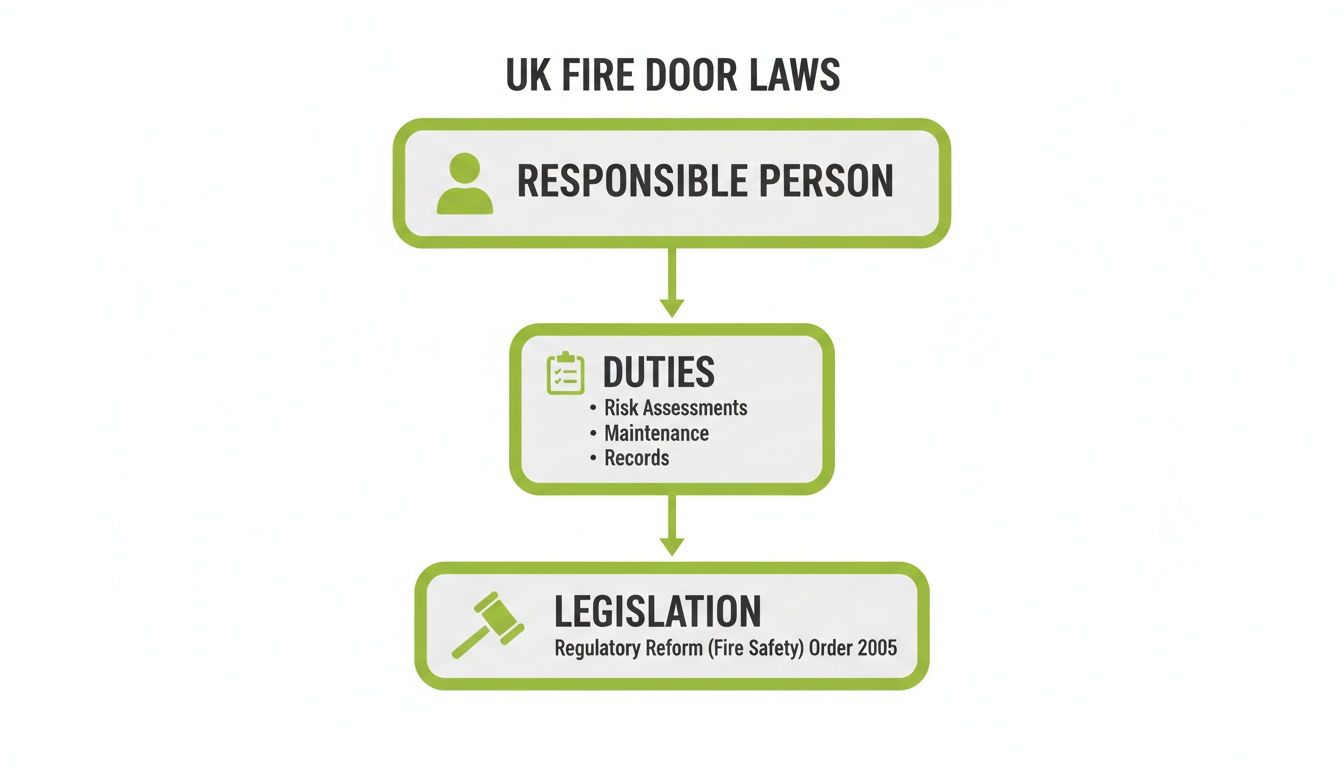
This visual hierarchy reinforces that legal compliance flows directly from the actions and decisions made by the duty holder.
How can you be sure a door or its components are compliant? Look for certification marks. A common sign of a compliant fire door in the UK is a label or a small plastic plug, usually on the top edge of the door, from a third-party certification scheme like BWF-Certifire. This mark is your proof that the door has been manufactured to the correct standard and has passed rigorous fire tests.
From the core of a certified door, like a Ply Flush FD30 Fire Door, to the hinges and closers, every part must have evidence of its fire rating. If you cannot find certification, you must assume the component is non-compliant until proven otherwise.
It is a sobering thought, but a correctly functioning fire door is often the exception, not the rule. Many property managers and business owners assume their doors are compliant, but the data paints a very different and dangerous picture. Understanding why these vital safety systems fail is the first step to fixing the problem and making your building safe.
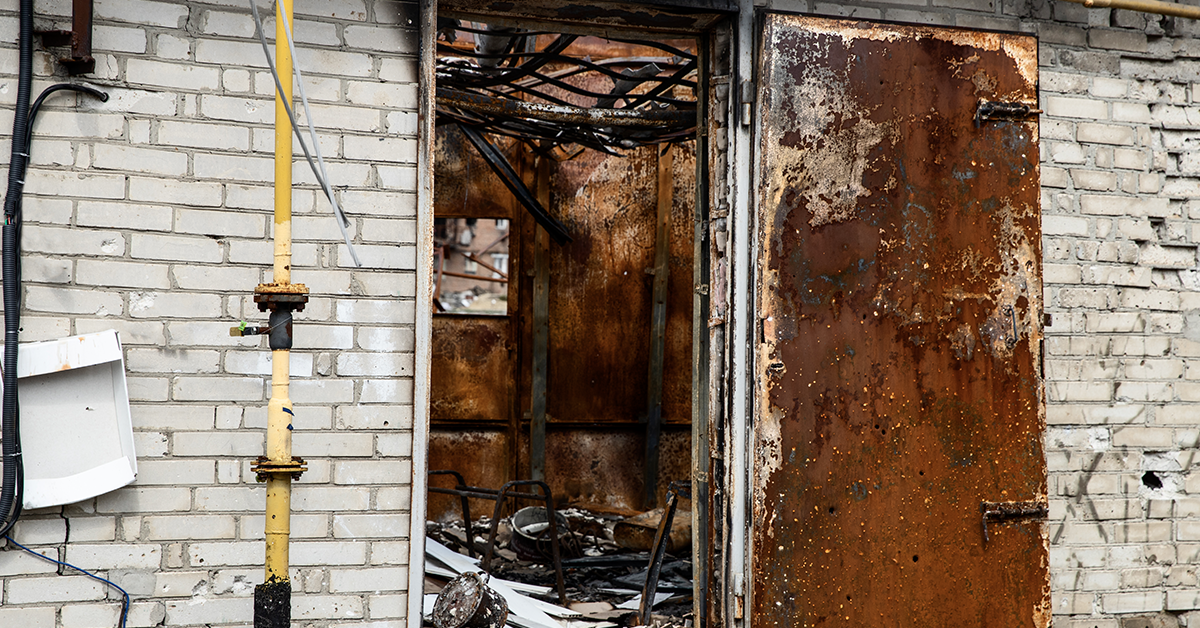
Shocking data from the Fire Door Inspection Scheme (FDIS) reveals that a staggering 75% of UK fire doors do not meet the required standards. Even worse, 31% are improperly installed from the outset. This is not just a statistic; it is a massive wake-up call for anyone managing a property, especially landlords of Houses in Multiple Occupation (HMOs).
These doors are your first line of defence, designed to hold back flames and deadly smoke, buying precious minutes for people to escape. But when they are badly fitted, with large gaps around the frame or missing intumescent seals, they become a liability instead of a lifesaver. You can discover more about these critical safety statistics and what they mean for property managers.
One of the most common failures is a gap between the door and its frame that is simply too large. UK fire door regulations are incredibly strict on this, for good reason.
A wide gap is an open invitation for fire and, more importantly, the toxic smoke that kills most people in a fire. Smoke will pour through, making the door useless long before its official fire rating is reached. As a rule of thumb, the gap should be around 3mm, and certainly no more than 4mm. A pound coin is about 3mm thick, so it is a handy tool for a quick visual check. If you can easily slide it through the gap, you have a problem.
A fire door is not just a slab of wood; it is a complete, engineered system. Every single component, from the hinges to the handle, must be fire-rated. Fitting standard, off-the-shelf ironmongery is a classic mistake that instantly voids the door’s certification.
Every piece of hardware is critical. Trying to save a few pounds by using non-rated parts is a false economy that puts lives at risk.
A fire door is only effective if it is closed. Propping or wedging a fire door open is one of the most dangerous and common breaches of fire safety. It completely neutralises the door’s purpose and can lead to rapid fire spread throughout a building.
Doors get knocked about in daily use. It is inevitable. But on a fire door, even minor damage cannot be ignored. This is why regular inspections are so important—they catch small issues before they become life-threatening failures.
Common problems include:
These might seem like minor defects, but in a fire, every weakness will be exploited. A proactive maintenance schedule, guided by UK fire door regulations, is not just good practice—it is a legal duty for any Responsible Person. Ignoring these common failures is a direct breach of that duty.
Knowing why fire doors fail is one thing, but proactively preventing those failures is another. Regular, documented inspections are not just a good idea under UK fire door regulations; for many buildings, they are a legal requirement. This shifts your role from simply reacting to problems to actively managing risk, making sure your doors will work when they are needed most.

The Fire Safety (England) Regulations 2022 are very clear on this. For multi-occupied residential buildings, the Responsible Person must ensure communal area fire doors are checked at least every three months. The entrance doors to individual flats need checking annually.
While this schedule is specific to residential blocks, it sets a solid benchmark for best practice in all commercial premises. Remember, doors in high-traffic areas will need checking more often.
This checklist is designed for the Responsible Person to carry out routine visual inspections. It is a great way to spot common issues early, but it is no substitute for a detailed survey by a competent fire door inspector.
A key principle of fire safety is compartmentation: containing a fire in the room where it starts. A fire door with damaged seals or excessive gaps breaks this principle, allowing a small incident to escalate into a building-wide emergency.
Here is a simple table you can use to guide your regular checks. It covers the most common failure points and explains why each one is so critical for safety.
| Check Area | What To Look For | Why It Is Important |
|---|---|---|
| Certification | Look for a label, plug, or marking on the top edge of the door. This confirms it is a certified fire door from a scheme like BWF-Certifire. | No certification means no proof the door meets performance standards. If there is no label, you must assume it is not a fire door. |
| Gaps & Clearances | Check the gap between the door leaf and the frame. It should be consistently around 3mm. Use a £1 coin as a rough guide; if it fits easily, the gap is probably too big. | Large gaps let smoke and hot gases pour through, compromising the escape route long before the door’s 30 or 60-minute rating is reached. |
| Seals & Strips | Inspect the intumescent and smoke seals around the frame or door edge. They must be intact, without damage, and not painted over. | These seals are designed to expand in heat to block fire and, just as importantly, stop the spread of deadly smoke. If they’re damaged, they will fail. |
| Hinges & Hardware | Make sure there are at least three hinges and all screws are tight. Check that the door latch clicks securely into place every single time it closes. | Loose or incorrect hinges can cause the door to drop and warp in a fire. A door that does not latch properly cannot create the seal needed to hold back flames. |
| Self-Closing Devices | Open the door fully and let it go. It must close firmly and securely into the frame on its own, overcoming the latch every time. Check it is not damaged or leaking oil. | A fire door is useless unless it is closed. The self-closer is a non-negotiable component that ensures the door does its job automatically. |
| Door Condition & Glazing | Examine the door leaf and frame for any damage like large chips, cracks, or holes. If there is glass (glazing), make sure it is intact and has a fire-rated mark (e.g., GWPP). | Damage creates weak points for fire to exploit. Non-rated glass will shatter almost instantly in a fire, rendering the door ineffective. |
These simple but frequent checks are the foundation of good fire door maintenance. By catching these issues early, you are not just ticking a compliance box—you are actively maintaining a life-saving piece of equipment. If you want to learn more about the crucial role of closers, check out our guide to self-closing doors.
Modern UK fire door regulations were not conceived in a committee room. They were forged in the fire and smoke of real-world disasters that cost people their lives. Understanding this history is crucial because it reminds us that compliance is not just about ticking boxes—it is a profound moral and legal duty. These laws were written in the hard lessons learned from preventable tragedies.
For decades, fire safety legislation in the UK was a confusing patchwork of different rules for different buildings. This fragmented approach created dangerous gaps in protection and left too much to chance. It took a series of devastating events to force a complete rethink of how we approach fire safety.
Disasters like the 1956 Eastwood Mills fire in Keighley, which claimed eight lives, were pivotal. That fire directly influenced the Factories Act 1961, which brought in fire certificates covering escape routes and fire separation. But even then, with nearly 80 separate pieces of fire legislation in place by the early 2000s, the system was dangerously complicated.
The real turning point came with the Regulatory Reform (Fire Safety) Order 2005. This landmark law swept away the old, fragmented rules. You can explore the history of these crucial safety components to understand how fire door legislation evolved.
Instead of a rigid checklist, the 2005 Order put the legal responsibility squarely on a designated ‘Responsible Person’. Their job was to assess the specific risks in their building and implement the right safety measures. This was a monumental shift. It made the proactive management of fire safety, including the proper maintenance of fire doors, a direct legal obligation.
The Grenfell Tower tragedy in 2017 was another watershed moment. It exposed catastrophic failures in building safety, forcing the nation to confront the deadly consequences of getting it wrong. The inquiry that followed led to a complete overhaul of existing guidance and the introduction of much stricter laws to ensure a similar disaster could never happen again.
This led directly to new, tougher legislation:
The legal landscape today is a direct response to preventable deaths. It underscores a simple truth: correctly specified, installed, and maintained fire doors are not an optional extra. They are a fundamental part of a building’s life-support system.
Knowing this history makes the importance of your duties crystal clear. Every regulation, every inspection, and every bit of maintenance is part of a legacy of learning, aimed at ensuring such tragedies are never repeated. Compliance is your part in upholding that legacy.
Ignoring your legal duties under UK fire door regulations is a gamble you cannot afford to take. The consequences are not just about fixing building defects; they spiral into severe legal, financial, and human costs that can permanently damage your business and reputation. The law places a heavy responsibility on the Responsible Person, and enforcement is taken very seriously.
Failing to maintain compliant fire doors is a direct breach of the Regulatory Reform (Fire Safety) Order 2005. When local Fire and Rescue Services find non-compliance during an inspection, they have significant powers to act.
Inspectors will not hesitate to use their legal powers if they find deficient fire doors are putting lives at risk. Their actions are always proportionate to the level of danger they discover.
These actions typically fall into several categories:
Where breaches of the Fire Safety Order are particularly serious, or if they lead to a fire that causes injury or death, the Fire and Rescue Authority will prosecute. The penalties upon conviction are designed to be a powerful deterrent.
The courts have the power to issue unlimited fines for significant breaches of fire safety law. For individuals, such as directors or landlords, a custodial sentence of up to two years in prison is a realistic possibility, especially in cases of gross negligence.
These penalties are not theoretical. Every year, UK businesses and individuals are successfully prosecuted for fire safety failings, with faulty fire doors frequently cited as a key factor.
Beyond legal penalties, the reputational damage, rocketing insurance premiums, and potential for civil claims from tenants or employees can be financially devastating. Ultimately, the gravest consequence is the preventable loss of life—a stark reminder that these regulations are fundamentally about protecting people.
We get asked many questions about fire doors. To help you understand your responsibilities, here are some straight answers to the most common queries we hear from business owners, landlords, and property managers across the UK.
Yes, but you must be very careful. It is generally acceptable to apply a few thin layers of standard paint to the face of the door and the frame.
However, you must never paint over the intumescent seals, hinges, latches, or any part of the self-closing device. Doing so can clog them and stop them from working correctly when you need them most.
This depends on the type of building you manage. The Fire Safety (England) Regulations 2022 are very specific for residential buildings with shared areas. Fire doors in these common parts must be checked at least every three months, while individual flat entrance doors need an annual check.
For other commercial buildings, best practice points to a check at least every six months. If a door is in a high-traffic area, like a busy office corridor, you will want to check it much more frequently.
The ‘FD30’ part means the door offers 30 minutes of fire resistance, holding back flames and heat.
The ‘s’ at the end is crucial. It means the door is also fitted with smoke seals to stop the passage of cold smoke. This is a vital feature, as smoke spreads far faster than flames and is often the biggest danger to life in a fire.
Unless you are a certified and competent installer, you absolutely should not fit a fire door. It is a highly skilled job where even the smallest mistakes can cause the entire door set to fail in a fire.
Tiny errors in the gaps, alignment, or the fitting of the hardware can render it useless. Always use a qualified installer who can provide certification for their work. It is the only way to be sure you are compliant with fire door regulations uk.
Ensuring your fire doors are fully compliant is not just a box-ticking exercise; it is a non-negotiable part of your legal duties as a Responsible Person. If you are unsure about the state of your doors or need a professional evaluation, our team can provide the expert guidance you need.
HMO Fire Risk Assessment provides expert, certified fire risk assessments to help you meet your obligations and protect your property and the people inside it. Learn more about our services at HMO Fire Risk Assessment.
In fire safety, there is one simple acronym everyone should know: PASS. It stands for Pull, Aim, Squeeze, and Sweep, and it is the universally...
As a landlord in the UK, you are legally responsible for ensuring your rental property is safe from fire. This is not just about fitting...