

A Guide to UK Fire Alarm Systems Categories L1-L5, P, and M
13/01/2026
Navigating the world of fire alarm systems can feel complex, but for any UK business owner, landlord, or property manager, it’s a language you must understand. These categories, laid out in the British Standard BS 5839-1, are not just industry jargon; they are legal benchmarks that have a direct impact on the safety of your people and the continuity of your business.
This guide is for any ‘Responsible Person’ who needs to understand their legal duties and make informed decisions about fire safety. By the end, you will have a clear, practical understanding of each fire alarm category and what it means for your property.
If you are the designated ‘Responsible Person’ under the Regulatory Reform (Fire Safety) Order 2005, the responsibility for fire safety in your premises rests with you. It is your legal duty to ensure your building has suitable and sufficient fire safety measures in place, and this is a serious legal obligation, not a box-ticking exercise. A critical part of this is choosing and maintaining the right fire alarm system for the specific risks within your property.
Selecting the correct system is never a one-size-fits-all task. The decision must be driven by the findings of a professional fire risk assessment. A competent assessor will evaluate everything from your building’s size and layout to its use and occupancy. The assessment will determine the level of protection required, which in turn points you to the appropriate category of system: L, P, or M.
The law exists to ensure a minimum standard of safety for everyone. Installing a non-compliant system can lead to severe penalties, including unlimited fines and, in the most serious cases, prison sentences. It can also invalidate your building’s insurance, leaving you financially exposed if a fire occurs. To get a clearer picture of your duties, you can explore our guide to UK fire safety regulations.
So, what do these different categories actually mean in practice? They can be broken down simply:
Making an informed choice starts with understanding what each category delivers. This guide will demystify these classifications, helping you meet your legal duties and protect what matters most.
When it comes to fire safety, the primary priority is always protecting people. This is the sole purpose of Category ‘L’ fire alarm systems. They are designed to give occupants the earliest possible warning of a fire, providing crucial time to evacuate safely and calmly.
These systems are not designed to save the building; they are designed to save lives. The different levels, from L5 up to L1, represent an increasing scale of automatic detection. Each step up adds another layer of coverage, creating a more comprehensive safety net to ensure nobody is left in danger.
The chart below shows how the main fire alarm system categories are structured under the primary UK standard, BS 5839-1.
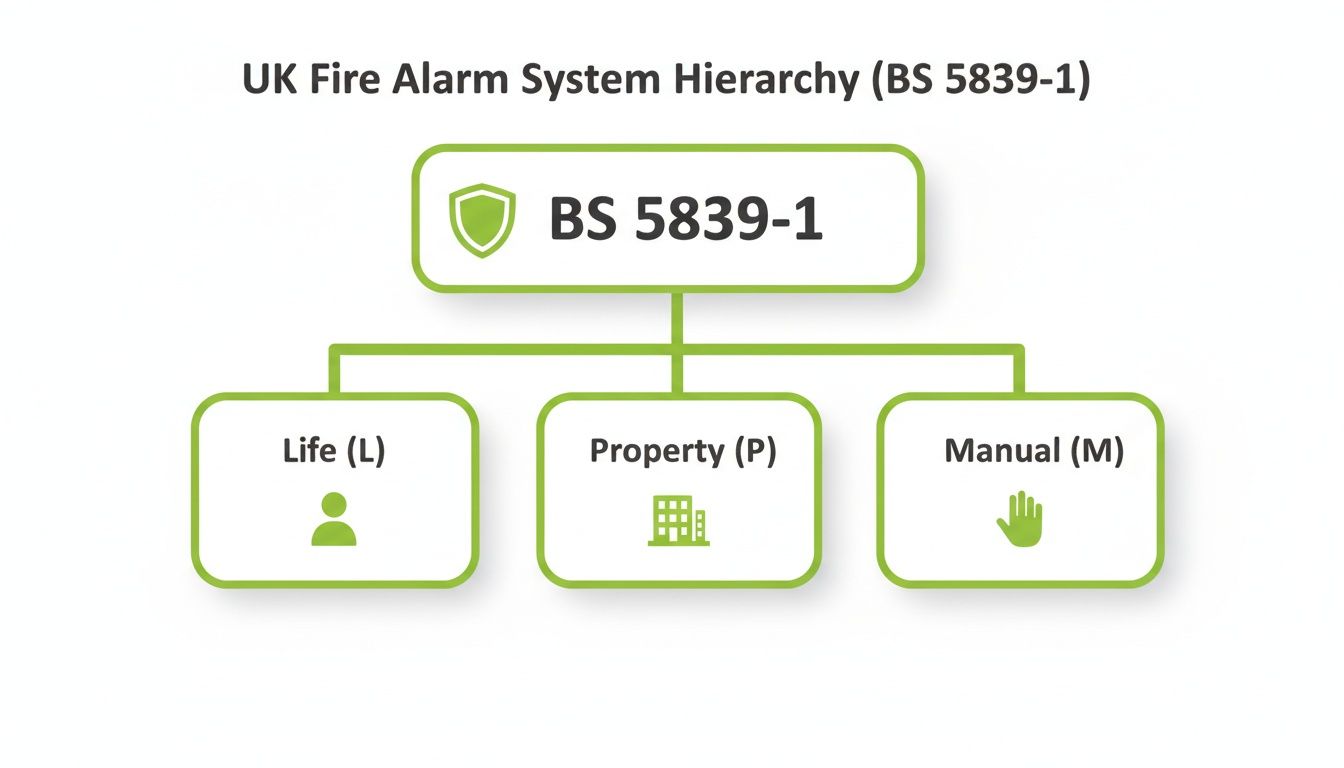
This hierarchy makes it clear that the choice of system is driven by its main objective, separating those designed for Life (L), Property (P), and Manual (M) operation.
A Category L5 system is the most targeted type of automatic life protection. It is not designed to cover the whole building. Instead, it focuses only on specific, high-risk areas identified in the fire risk assessment.
The purpose is to detect a fire where it is most likely to start, such as a boiler room or a commercial kitchen, providing a localised but very early warning. For public areas where clear audio warnings are essential, integrating components like EN54-certified pendant speakers can be a crucial part of the design.
Moving up a level, a Category L4 system places automatic detectors, such as smoke alarms, along all escape routes. This means covering corridors, stairways, and any other circulation spaces people would use to exit the building.
The logic is straightforward: protect the pathways to safety. This level of protection is common in lower-risk office buildings or small shops, where a fire blocking an escape route is the most significant immediate threat to evacuation. For a deeper dive into how these standards fit into the bigger picture, it is worth understanding the wider context of building regulations fire safety.
A Category L3 system builds on the protection of L4. As well as having detectors on the escape routes, it also requires them in every room that opens directly onto those routes.
This is a significant step up in safety. It means a fire starting in an office or meeting room will be detected before it can spread into a critical corridor and fill it with smoke, giving people on that floor a much greater chance of escape.
A typical example of an L3 system is a standard multi-floor office building. If a fire starts in a meeting room, the alarm sounds long before smoke compromises the main corridor, giving everyone a vital head start on evacuation.
A Category L2 system includes all the coverage of an L3 system but adds another layer of protection. Automatic detectors are also installed in any specifically identified high-risk areas of the building, even if they do not open onto an escape route.
These high-risk zones are pinpointed by the fire risk assessment and could include places like server rooms, storage cupboards with flammable materials, or workshops with specialised equipment.
Finally, Category L1 provides the highest possible level of life protection available. With an L1 system, automatic fire detectors are installed in all areas of the building.
This means every room, corridor, large cupboard, and even void spaces where a fire could potentially start are covered. This comprehensive approach is reserved for properties where the risk to life is greatest. This typically includes buildings where people sleep, such as hotels, care homes, and large Houses in Multiple Occupation (HMOs).
The consequences of getting this wrong can be severe. A £20,000 fine was issued to a landlord in 2022 for inadequate fire detection in a shared house, a stark reminder of the legal duty to install the correct system in high-risk residential properties.
To help you quickly compare these systems, here is a simple table summarising their objectives and typical applications.
| Category | Objective | Typical UK Application |
|---|---|---|
| L5 | Localised automatic detection in specific high-risk areas. | Boiler rooms, commercial kitchens, plant rooms. |
| L4 | Automatic detection on all escape routes. | Low-risk offices, small commercial premises. |
| L3 | Detection on escape routes and in all rooms opening onto them. | Multi-floor office buildings, larger commercial sites. |
| L2 | Same as L3, plus detection in all identified high-risk areas. | Buildings with designated high-risk zones (e.g., flammable storage). |
| L1 | Automatic detection in all rooms and areas of the building. | Hotels, care homes, large HMOs, hospitals. |
As you can see, the right choice depends entirely on the building’s use, its occupants, and the specific risks identified. Getting it right is not just about compliance; it is about ensuring everyone has the best possible chance to get out safely.
While the main focus of fire safety is rightly on protecting people, the financial and operational fallout from a fire can be devastating for a business. This is where Category P fire alarm systems come in. Their sole purpose is to protect property, assets, and business continuity.
These systems are not designed to give people an early warning to evacuate. Instead, their job is to automatically send a signal directly to an alarm receiving centre, which then alerts the fire and rescue service immediately. This ensures the fastest possible professional response to contain a fire and minimise damage, often long before anyone in the building is aware of a problem.
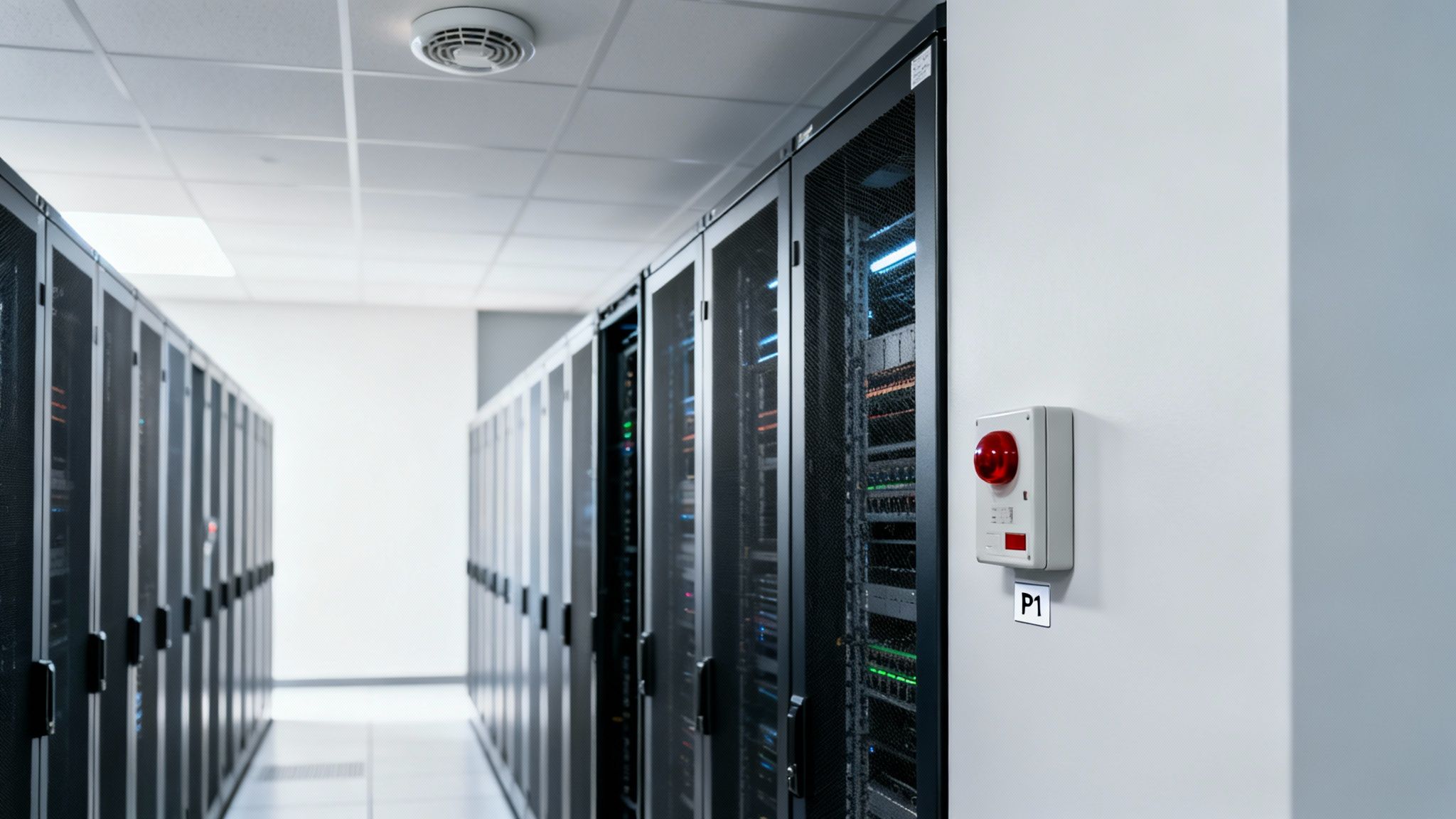
This approach is critical for preventing catastrophic financial loss and operational disruption. The choice between the two sub-categories, P1 and P2, is determined by the specific risks to your assets, as identified in your fire risk assessment.
A Category P1 system provides the highest level of property protection. It requires installing automatic fire detectors in all areas of the building, leaving no corner unchecked. This comprehensive coverage ensures that a fire is detected no matter where it might start.
This level of protection is specified where the consequences of a fire would be particularly severe, either financially or operationally. This includes buildings that house irreplaceable items or mission-critical infrastructure.
In these situations, the goal is simple: get the fire service on-site at the earliest possible moment to give them the best chance of extinguishing the blaze before significant damage is done.
A Category P2 system takes a more targeted approach to protecting property. It does not require detectors everywhere. Instead, automatic detection is installed only in specific parts of the building that have been identified as having a high fire risk or being vital to your business operations.
A classic example is an office building with a dedicated server room. While the main office spaces might not need property protection, the server room itself is a high-risk, high-value asset. A P2 system would place automatic detectors just inside that room to protect it.
Other common applications include boiler rooms, plant rooms, or areas with critical machinery. Choosing a P2 system is a pragmatic decision, balancing the cost of installation against the specific, identified risks to your property.
Beyond automated detectors lies the most basic setup: a Category M system.
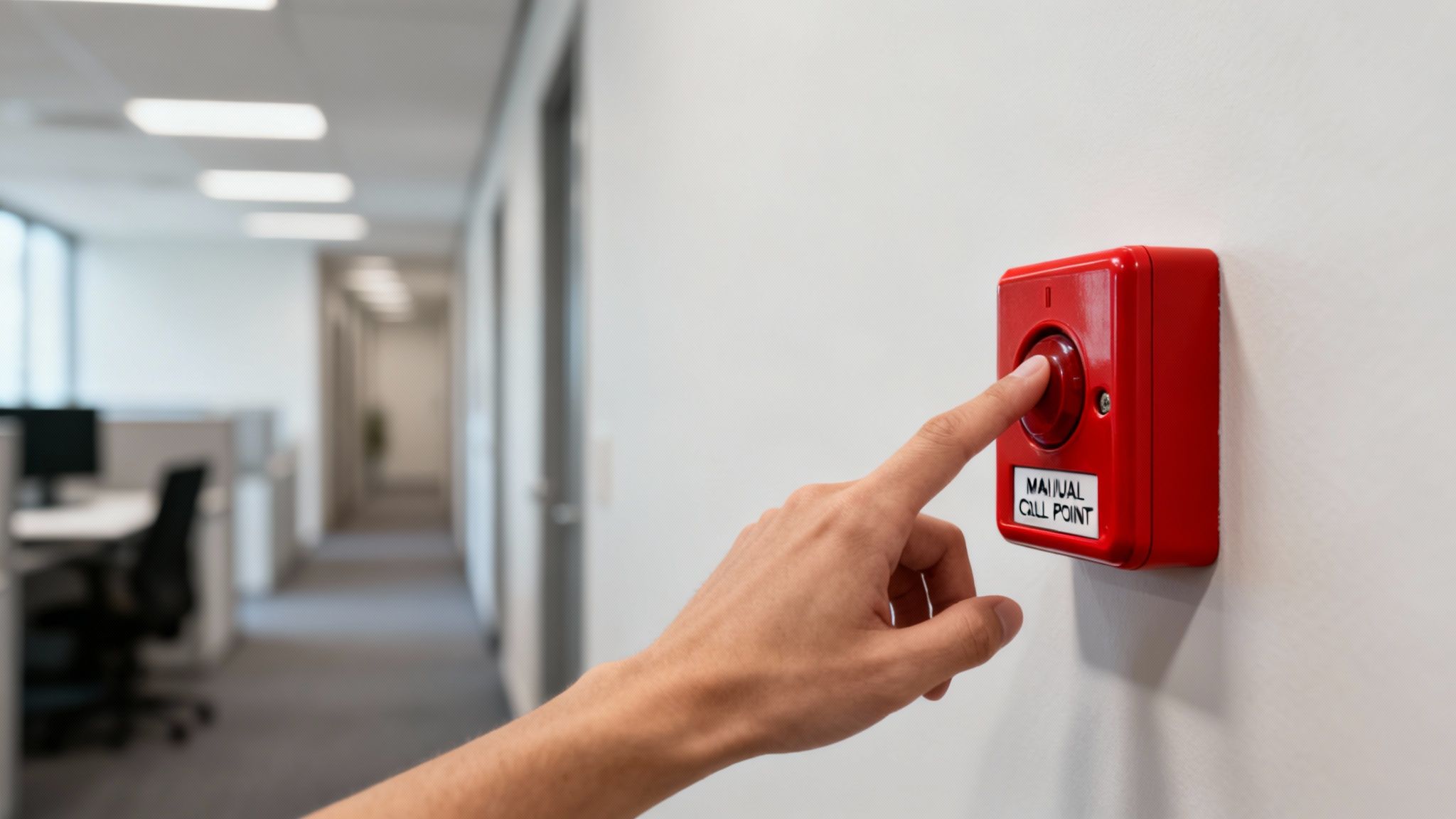
This is a purely manual system. There are no smoke or heat detectors anywhere in the building. It relies entirely on a person spotting a fire, activating a manual call point (the red ‘break glass’ unit on the wall), and setting off the alarm themselves.
Because it is completely dependent on human intervention, a Category M system is only suitable for very specific, low-risk environments. This might include small, single-storey workshops or offices where a fire would be immediately obvious to occupants. The moment you introduce multiple floors, hidden rooms, or sleeping occupants, a Category M system on its own will not be sufficient.
Regardless of the category, the technology that powers the system is just as crucial. The three main types you will encounter are conventional, addressable, and wireless.
A conventional system is like a simple lighting circuit for an entire floor. The building is divided into broad detection ‘zones,’ and all the detectors in one zone are wired together on a single circuit.
If a detector activates, the control panel will indicate a fire in, for example, Zone 3. The drawback is that it will not tell you which specific device was triggered.
This makes them a cost-effective choice for smaller properties like a local shop or a small workshop. In a larger building, however, having to search an entire floor to find the source of the alarm wastes precious time. That lack of precision also makes finding faults during maintenance challenging.
An addressable system represents a significant advance in technology. Every single device, whether it is a smoke detector, heat alarm, or manual call point, has its own unique digital ‘address’.
When a device is triggered, the control panel instantly displays its exact location, such as, ‘Smoke Detector – First Floor – Meeting Room 3’. This pinpoint accuracy is invaluable, directing people straight to the source of the fire and making it incredibly easy to identify faults. They are the standard for larger, more complex buildings like offices, hospitals, and large blocks of flats.
Wireless systems perform the same function as their wired counterparts but use secure radio signals to communicate between the detectors and the control panel. This eliminates the need for disruptive and often expensive cabling work.
They are an excellent solution for buildings where running new wires is impractical or prohibited. Typical examples include:
While the initial hardware cost can be higher, the savings on installation labour and redecoration often make them a very competitive option. Of course, managing these systems correctly is vital, and that includes having a clear process for your weekly fire alarm test to remain compliant.
Choosing the wrong fire alarm system, or failing to maintain it, is not just a technical error; it is a failure of your legal duty. The consequences go far beyond a malfunctioning panel, creating a cascade of legal, financial, and operational risks that fall squarely on the shoulders of the Responsible Person.
It is a common misunderstanding to view a compliant fire alarm system as an expense. In reality, it is a non-negotiable investment in safety and business survival.
Under the Regulatory Reform (Fire Safety) Order 2005, the penalties for non-compliance are severe. Fire and rescue authorities have the power to issue enforcement notices, legally compelling you to rectify any failings. If a breach is serious enough, you could face unlimited fines. For individuals found responsible, this can even mean a prison sentence of up to two years.
Beyond the direct threat of legal action, a poorly designed or neglected system creates another significant problem: false alarms. These are not a minor inconvenience. They bring your business to a halt, cause significant losses in productivity, and, most dangerously, breed complacency. When people stop trusting the alarm, they may not react when it matters.
The scale of this issue is substantial. In the year ending June 2023, fire and rescue services in England attended 246,581 false alarms, the highest figure since 2011. These incidents accounted for a staggering 42% of all call-outs and are estimated to cost the UK economy over £1 billion annually. You can review the data in the official government report on fire and rescue incidents.
The constant drain on resources has led some fire and rescue services to start charging for repeated false alarm call-outs. A business in London, for example, could be billed over £350 for the third false alarm in a 12-month period, with fees increasing thereafter.
This sends a clear message to every Responsible Person. Investing in a professionally specified and properly maintained system, based on the correct fire alarm systems categories, is not optional. It is the only reliable way to ensure you are legally compliant, avoid crippling costs, and fulfil your absolute duty to protect lives.
You now have a solid grasp of the different fire alarm categories. But knowledge is one thing; action is another. So, what is next?
The single most important takeaway from this guide is that you cannot simply pick a fire alarm category from a list. The only way to determine the correct system for your premises is with a professional, site-specific fire risk assessment.
There is absolutely no room for guesswork here. Choosing a system based on perceived ease or cost is a recipe for non-compliance and, potentially, disaster.
First, locate your current fire risk assessment and read it thoroughly. Does the alarm category it specifies still make sense for how the building is used today? Buildings evolve, tenants change, and layouts are altered. Your fire safety measures must keep pace.
If your assessment is more than a year old, or if you do not have one at all, commissioning a new one is not just good practice—it is a critical legal priority.
A proper fire risk assessment is not just a document to satisfy the authorities. It is your practical roadmap. It provides clear, actionable steps to meet your legal duties and, more importantly, genuinely protect the people within your building.
If you fail to act on its recommendations or operate without a valid assessment, the legal responsibility falls squarely on you as the Responsible Person.
Understanding the difference between fire alarm systems categories is an important start, but applying that knowledge correctly is a specialist skill. A competent fire risk assessor will not just tick boxes; they will analyse your specific circumstances and provide advice that works for your property.
If you need professional guidance on what your building truly requires, our team of qualified assessors is here to help. We can ensure you have the right systems in place to protect people, secure your property, and meet your legal obligations with confidence.
It is natural for property managers and business owners to have questions about the technical side of fire alarm systems. Here are some of the most common queries.
The only correct answer is: it depends entirely on your fire risk assessment. For a small, single-storey shop with one exit where a fire would be immediately obvious, a purely manual system (Category M) with call points and sounders may be sufficient.
However, the moment you add a second floor, a hidden stockroom, or any higher-risk activity, an automatic detection system becomes almost inevitable. The law requires you to implement appropriate fire safety measures based on the specific risks in your building. Your fire risk assessment is the official, documented process for determining exactly what is needed.
BS 5839-1 sets out clear requirements for this. The designated Responsible Person should carry out a weekly test. This involves activating at least one manual call point, rotating through different points each week to ensure the entire system is checked over time.
Beyond this, a comprehensive service by a competent fire alarm engineer is required at least every six months. It is also a legal requirement to keep a detailed logbook of every test, service visit, and any identified faults. Incomplete or missing logbooks are one of the most common compliance failures identified by fire and rescue services during inspections.
In short, no. Fire alarm systems are critical life-safety installations. They must be designed, installed, and commissioned by competent, qualified professionals who work to the standards in BS 5839-1.
An incorrect installation could result in the system failing to operate in a real fire or, almost as bad, causing constant false alarms. It would almost certainly invalidate your building’s insurance and, most importantly, place you in breach of fire safety law, leaving you open to prosecution.
Understanding the categories is one thing, but knowing how to handle day-to-day issues is another. For help with other questions, such as why an alarm might be activating for no obvious reason, our guide on common fire alarm malfunctions is a useful resource.
A compliant fire alarm system is a non-negotiable part of your legal duties. For expert guidance based on a thorough on-site evaluation, book your assessment with HMO Fire Risk Assessment today. Visit https://hmofireriskassessment.com to secure your property and protect your occupants.
As a landlord or property manager in the UK, getting smoke alarm compliance right is not a box-ticking exercise - it is a non-negotiable legal...

A fire assembly point is far more than just a sign on a post; it is the designated place of safety that represents the final,...