
Flats Fire Risk Assessment: A Guide for Responsible Persons
09/02/2026
A fire risk assessment for a block of flats is a legal requirement covering the communal areas of any residential building with two or more homes in the UK. It is a professional evaluation of your building’s fire safety, designed to identify potential fire hazards and ensure the measures protecting residents are compliant and effective.
This is not a responsibility that can be ignored; it falls directly to the building’s designated Responsible Person. This guide explains what is required, who is responsible, and the consequences of getting it wrong.
In the UK, fire safety in residential blocks is a strict legal obligation, not an optional extra. The foundation of this duty is the Regulatory Reform (Fire Safety) Order 2005, a key piece of legislation that requires a “suitable and sufficient” assessment of fire risks to be carried out and regularly reviewed.
This is an active, ongoing process, not a one-off task. You must identify what could cause a fire, determine who is at risk, and implement practical, sensible measures to keep them safe. Failure to do so can lead to serious penalties, including unlimited fines and, in the most severe cases, a prison sentence.
The Fire Safety Order clearly defines who holds this legal duty. For a block of flats, the Responsible Person is the individual or company with control over the premises, which is typically:
Crucially, if multiple parties have a degree of control, they all have a duty to cooperate. You cannot assume someone else has taken care of it. This principle of shared responsibility is common in property management.
The legal landscape changed significantly with the introduction of the Fire Safety Act 2021. This Act clarified that the scope of a fire risk assessment for blocks of flats extends beyond the internal hallways and staircases.
A fire risk assessment for a block of flats must now explicitly include an evaluation of the building’s structure, external walls (including cladding and balconies), and all flat entrance doors.
This was a direct and necessary response to the Grenfell Tower tragedy. It ensures that the risk of fire spreading across the building’s exterior and the ability of flat front doors to resist fire are properly scrutinised. The Act makes it clear that these elements are critical to the safety of everyone in the building.
If your current assessment does not cover these areas, it is no longer legally compliant. You can find out more in our detailed guide on fire risk assessment legal requirements.
Not all fire risk assessments are the same. Commissioning the wrong type is a common and costly mistake for property managers and landlords. The assessment your block of flats needs depends on its construction, age, and perceived risk level. Understanding the differences is vital for legal compliance and ensuring resident safety.
For most purpose-built blocks of flats and conversions, a Type 1 fire risk assessment is the industry standard. This is a non-destructive inspection focused solely on the shared parts of the building: the hallways, stairs, and lobbies that everyone uses.
The primary purpose of a Type 1 survey is to check the fire safety measures within these landlord-controlled areas. You can get the full picture by reading our detailed guide on what a Type 1 fire risk assessment involves. It is by far the most common type of assessment carried out in UK blocks of flats.
This decision tree gives a visual breakdown of the core duties, from identifying who is responsible to managing the risks.
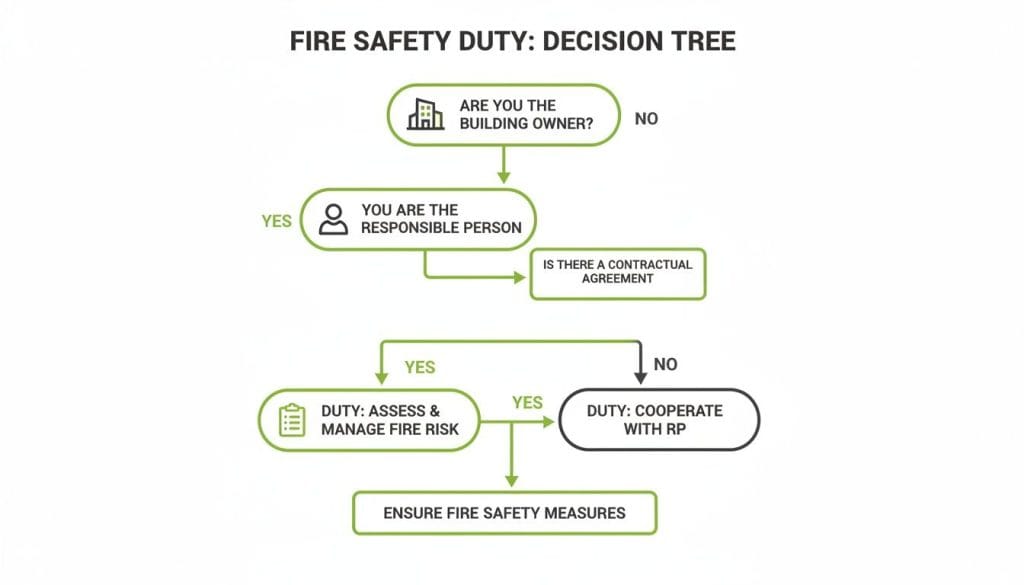
As you can see, the path is clear: the Responsible Person has a direct legal duty to commission a fire risk assessment and act on its findings.
While a Type 1 is suitable for many buildings, some situations require a deeper investigation. These typically arise when there is reason to suspect that the fire protection between individual flats and the common areas may be compromised.
This is where more detailed assessments, Types 2, 3, and 4, come in. These are progressively more intrusive and are not carried out as a matter of routine. A competent fire risk assessor would only recommend one if a Type 1 inspection flagged serious concerns.
For example, a Type 2 assessment covers everything a Type 1 does but adds a “destructive” element. This means the assessor may require contractors to carefully open up a small section of a wall or ceiling to check the hidden compartmentation. This is only done if there is clear evidence pointing to a potential structural problem.
The most comprehensive inspections are the Type 3 and Type 4 assessments. These are reserved for situations where there is a serious concern about fire safety measures across the entire building, including within the flats themselves.
A Type 3 assessment goes beyond the communal areas to examine the escape routes and fire detection inside a sample of the flats. It assesses the building’s entire fire safety system, checking how measures inside private homes integrate with those in the shared spaces.
A Type 4 assessment is the most thorough of all. It involves a destructive survey of both the common parts and a sample of the flats. This level of inspection is rare and is typically only necessary if a significant threat to life is suspected, such as major concerns over poor compartmentation throughout the block.
Choosing the correct assessment type is crucial. It ensures you meet your legal duties without incurring unnecessary costs or disruption. An experienced assessor can advise on the appropriate level of inspection for your property.
To clarify, the table below breaks down the key differences between each assessment type, helping you understand what they cover and when they might be needed. This should provide the confidence to make an informed decision for your property.
| Assessment Type | Scope of Inspection | Level of Intrusion | Typically Required For |
|---|---|---|---|
| Type 1 | Common parts only (e.g., hallways, stairs, lobbies, plant rooms). | Non-destructive. Purely visual inspection. | Most purpose-built and converted blocks of flats where structural fire protection is assumed to be adequate. |
| Type 2 | Common parts only, but includes destructive sampling. | Destructive. Involves opening up construction to check compartmentation where there is a justifiable concern. | Buildings where a Type 1 assessment has raised serious doubts about structural fire integrity. |
| Type 3 | Common parts and the means of escape from flats (e.g., corridors within flats, detection systems). | Non-destructive. Assesses the interaction between common and private fire safety measures. | High-risk buildings or where there is uncertainty about the fire separation between flats and escape routes. |
| Type 4 | All areas covered by a Type 3, but with destructive sampling in common parts and flats. | Fully destructive. The most intrusive assessment, involving sampling in both shared areas and private dwellings. | Buildings with a suspected high fire risk and serious structural deficiencies where a comprehensive evaluation is essential. |
When a competent fire risk assessor inspects your block of flats, they are not just ticking boxes. They are viewing the building through a specialist lens, systematically identifying how a fire could start, where it might spread, and how everyone can escape safely. It is a methodical, on-site process rooted in current UK fire safety regulations.
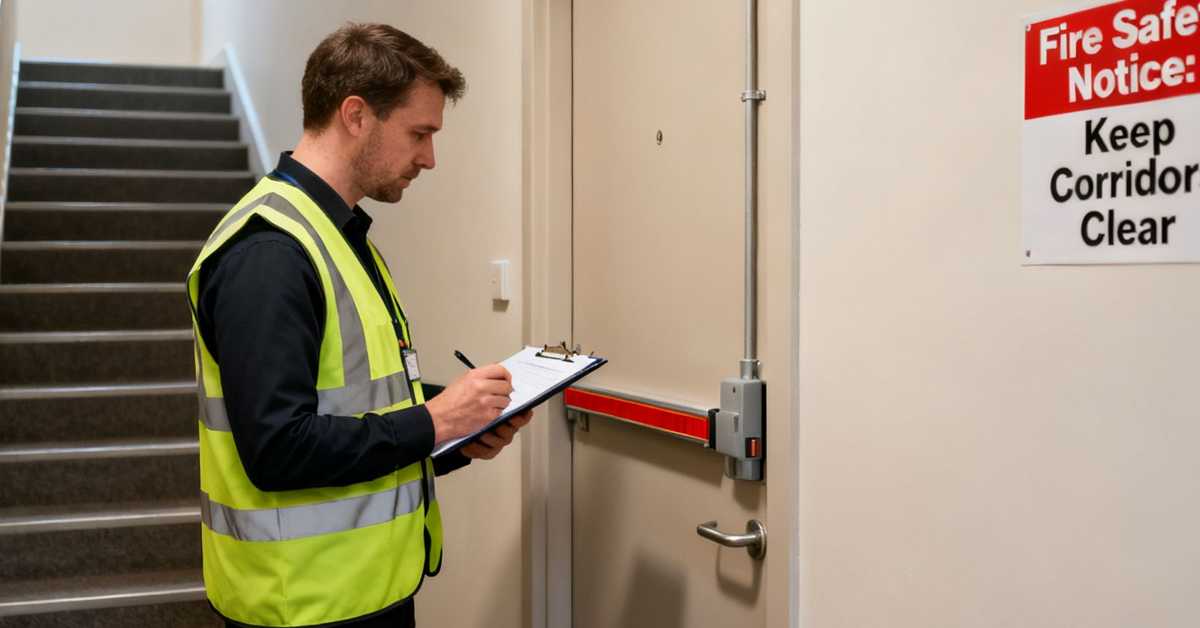
The inspection involves a detailed physical walk-through of all the common parts of the building. Let’s break down exactly what they will be scrutinising to give you a real sense of what a professional flats fire risk assessment covers.
The absolute priority for any assessor is ensuring a clear, protected path for residents to escape in an emergency. They will walk the entire route, from a top-floor flat door down to the final exit leading to a place of safety outside.
During this inspection, they are looking for problems such as:
Fire doors are one of the most vital pieces of fire safety equipment in a block of flats. They are engineered to hold back flames and toxic smoke for a specified time (usually 30 or 60 minutes), keeping escape routes clear and buying precious time for residents to escape.
An assessor will examine fire doors with an expert eye, checking for:
A fire door propped open is one of the most common and dangerous failures, rendering all its protective features useless.
The building’s active fire safety systems are as important as its structure. An assessor will confirm that the fire alarm system in the common areas is suitable for the building and is properly maintained. They will ask to see a logbook as proof of regular testing and servicing.
Emergency lighting is another critical life-safety system. If the power fails during a fire, these lights must activate to illuminate the escape routes. The assessor will check that they are installed in the correct locations and have been regularly tested to ensure their batteries are functional.
A fire risk assessment is not just a snapshot in time; it is a review of your ongoing fire safety management. An assessor will expect to see evidence, such as a logbook, demonstrating consistent testing and maintenance of your fire safety systems.
Compartmentation is a core fire safety principle. It involves dividing the building into a series of sealed, fire-resistant boxes using special walls, floors, and fire doors. The goal is to contain a fire to the “box” where it started, slowing the spread of smoke and flames and protecting everyone else.
An assessor will look for any breaches in these compartments. This is a common problem, especially in older buildings or where contractors have cut corners.
They will be on the lookout for weak points, such as:
Maintaining these compartments is absolutely critical for resident safety. You can see how these issues are documented by looking at an example of a fire risk assessment report.
Clear signage is essential. In a stressful evacuation, people need to know where to go without hesitation. The assessor will check that fire exit signs are present, correctly placed, and easy to see. They will also inspect any equipment provided for the fire and rescue service, such as dry risers, to ensure it is accessible and appears to be in good working order.
After conducting hundreds of flats fire risk assessments, you start to see the same failings repeatedly. While every building is unique, a handful of dangerous and non-compliant issues appear time and again.
Learning to spot these common failures in your own property is a significant first step towards better risk management and protecting your residents.
Often, these recurring problems arise from a lack of awareness or simple complacency. But in a fire, even a small oversight can have catastrophic results. By addressing these issues proactively, you can significantly reduce risk before an assessor even arrives.
A properly working fire door is a lifesaver, designed to hold back smoke and flames. It is astonishing how often they are rendered completely useless. The single most common and dangerous failure is wedging them open. This completely defeats their purpose, allowing a fire to spread through escape routes in minutes.
Other frequent door-related problems include:
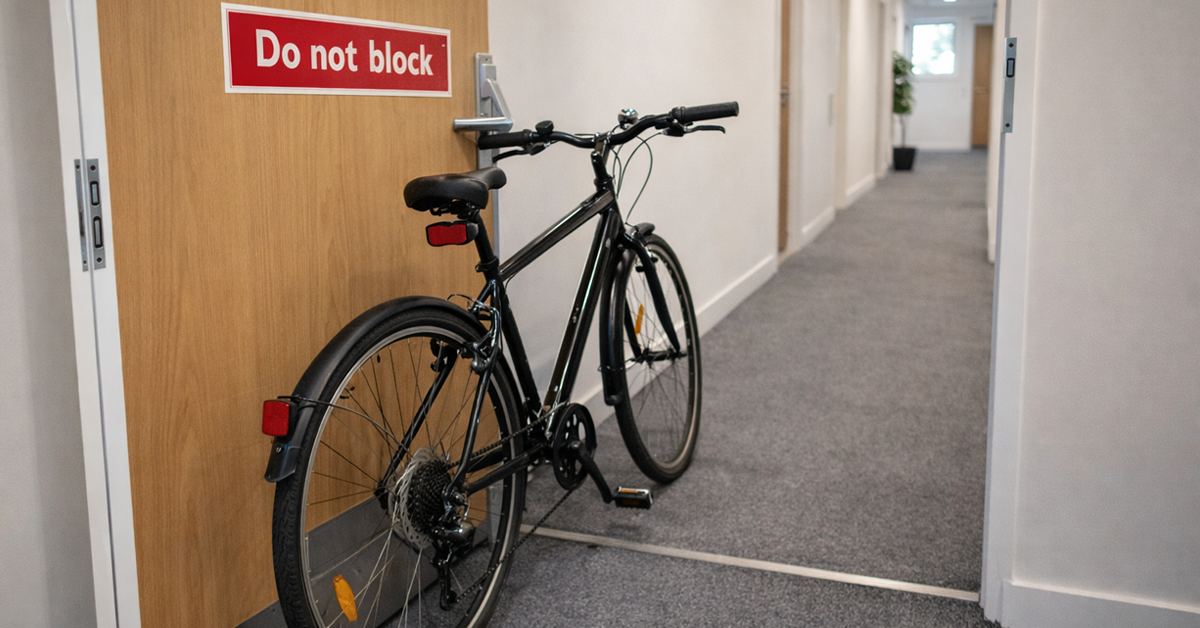
It is a simple rule: escape routes must be kept completely clear. Yet, hallways and stairwells frequently become unofficial storage areas. We regularly find bicycles, pushchairs, furniture, and rubbish cluttering these vital spaces. Not only are they a trip hazard, but they also provide a ready source of fuel for a fire.
Another critical hazard is the misuse of service cupboards. Electrical intake cupboards or riser shafts are often found dangerously filled with flammable items like cleaning supplies, old paint tins, or tenants’ belongings. Storing combustible materials next to a building’s main electrical services is an obvious recipe for disaster.
Houses in Multiple Occupation (HMOs) present a different set of challenges. Their higher density of unrelated tenants creates a unique fire safety risk profile. Statistically, the risk of a fire starting is greater, and the complex layouts can amplify the potential for rapid spread.
Because of these elevated risks, HMOs are subject to more stringent fire safety standards than standard rental properties. This includes requirements for more robust fire detection systems, specific types of fire doors on high-risk rooms like kitchens, and clearly defined escape routes.
It is vital to understand the specific compliance requirements when you are evaluating HMOs and Serviced Accommodation. While UK house fires have fallen significantly over the last two decades, multi-occupancy buildings remain a key area of concern for fire and rescue services. For landlords, this reinforces the absolute necessity of a thorough and regular fire risk assessment.
Receiving a fire risk assessment report for your block of flats can feel overwhelming. It is often a dense, technical document filled with observations, legal references, and a long list of actions. However, a good report is not just for compliance; it is your practical roadmap to making the building safer. The key is knowing how to break it down and turn the findings into a clear, manageable plan.
The first step is to go straight to the ‘Significant Findings’ or ‘Action Plan’ section. This is the heart of the report, where the assessor translates their inspection into a prioritised list of recommendations. It cuts through the technical detail and tells you exactly what to do, why it is important, and how urgently it needs to be addressed.
To help you prioritise, assessors use a straightforward risk-rating system. The exact terminology may vary, but the logic is always the same: to separate urgent legal breaches from best-practice improvements.
A typical system will look something like this:
This rating system is your most important tool for organising your response. It ensures you tackle the life-critical issues first, which is exactly what the Fire and Rescue Service expects to see.
Your fire risk assessment is a live document. Your legal duty as the Responsible Person is not just to have the assessment done, but to actively manage and remedy the risks it identifies in a timely manner.
Once you understand the priorities, the next step is to create a formal action plan. This document turns the report’s recommendations into a concrete schedule of works, assigning responsibility and tracking progress. It is also a crucial piece of evidence demonstrating active fire safety management.
Your action plan should clearly document:
For example, a task on your action plan might look like this:
| Finding | Required Action | Priority | Responsibility | Target Date |
|---|---|---|---|---|
| Fire Door (Flat 23) | Adjust self-closing device to ensure door closes fully onto its latch from any angle. | High | Property Manager | 28/11/2024 |
This structured approach transforms the report from a list of problems into a dynamic management tool. It not only ensures that vital safety work gets done but also creates an invaluable audit trail, proving you have taken your responsibilities seriously.
The law is clear: your flats fire risk assessment must be carried out by a ‘competent’ person. As the building’s Responsible Person, the responsibility rests with you to ensure the individual or company you hire has the appropriate experience, skills, and knowledge for the job.
It can be tempting to choose the cheapest quote, but this is a high-risk strategy. You could receive a non-compliant report and be left with an unsafe building. A genuinely competent assessor provides a robust legal defence if something goes wrong and gives you practical advice to protect lives and property. You are not just buying a document; you are investing in expertise.
Your first step should be to check for third-party accreditation from a recognised professional body. This is the clearest indicator of an assessor’s credibility and commitment to high standards, proving they have been independently vetted.
Look for membership or certification with organisations such as:
While these credentials are not legally mandatory, they demonstrate a level of professionalism that separates a competent assessor from the unqualified.
Before you appoint an assessor, you must do your due diligence. A true professional will welcome these questions and provide confident answers. Be wary of anyone who is evasive or cannot provide clear evidence to support their claims.
Ask any potential assessor for evidence of their Professional Indemnity and Public Liability insurance. This is non-negotiable. It is your protection if there is an error or omission in their assessment.
Here are the crucial questions you should be asking:
If you are a landlord or property manager, understanding the rules for fire risk assessments can be daunting. To help clarify, here are some straight answers to the questions we are asked most often.
This is a common question. While the law does not set a rigid deadline, the Fire Safety Order 2005 states that you must review your assessment ‘regularly’ to keep it up to date.
In practice, best practice and the expectation of the fire and rescue service is an annual review. A new, full assessment by a professional is typically recommended every 1 to 3 years, depending on the building’s risk profile. You will also need a new assessment immediately if you make any significant changes to the building, its layout, or its residents.
Usually, no. A standard Type 1 fire risk assessment, which is the most common for blocks of flats, focuses only on the communal areas like hallways, stairwells, and lobbies.
It does not cover the private living spaces inside the flats. However, the assessor will pay very close attention to the flat entrance doors, as these are critical for preventing fire spread. More intrusive assessments that do involve inspecting inside flats are only carried out in specific, high-risk situations.
Ignoring this legal duty is not an option. Failing to have a suitable and sufficient fire risk assessment is a criminal offence, and the consequences are serious.
The local Fire and Rescue Service can issue enforcement notices, compelling you to comply. If a breach is serious enough to put lives at risk, they can prosecute the Responsible Person. This can lead to unlimited fines and, in the worst cases, a prison sentence. Furthermore, it can invalidate your property insurance, leaving you personally liable for any damage or injuries.
High-rise buildings in the UK face intense scrutiny, particularly since the Grenfell tragedy. New reforms mandate much stricter checks on external walls and fire doors for flats and HMOs. The unique challenges of high-rise buildings, such as vertical fire spread and complex evacuations, contribute to a higher fatality rate, even though they experience fewer fires. You can learn more from the latest fire and rescue incident statistics.
Ensuring your property is fully compliant is not just about meeting a legal requirement; it is about protecting the people who live there.
Most HMO landlords I talk to can rattle off their fire door requirements, their alarm grade, and their emergency lighting checks without missing a beat....
Most of the fire safety advice on this site assumes you already have a working HMO. This one is for the stage before that: the...