
Is a Risk Assessment a Legal Requirement in the UK?
09/02/2026
Yes, a risk assessment is a mandatory legal requirement for the vast majority of businesses and non-domestic properties across the United Kingdom. This is not just best practice or helpful guidance; it is a fundamental duty written into law, designed to protect people from harm. Getting this wrong can lead to serious legal consequences.
This guide is for business owners, landlords, facilities managers, and anyone designated as a ‘Responsible Person’ for a non-domestic property in the UK. By the end, you will understand the specific laws that make risk assessments a requirement, who is legally responsible, and what happens if you fail to comply.
Staring at regulations can feel overwhelming, but the core legal duties are actually quite clear. Your responsibility to carry out a risk assessment comes from key pieces of UK legislation that govern safety in different, but often overlapping, contexts.
Understanding these is the first step towards ensuring you are compliant.
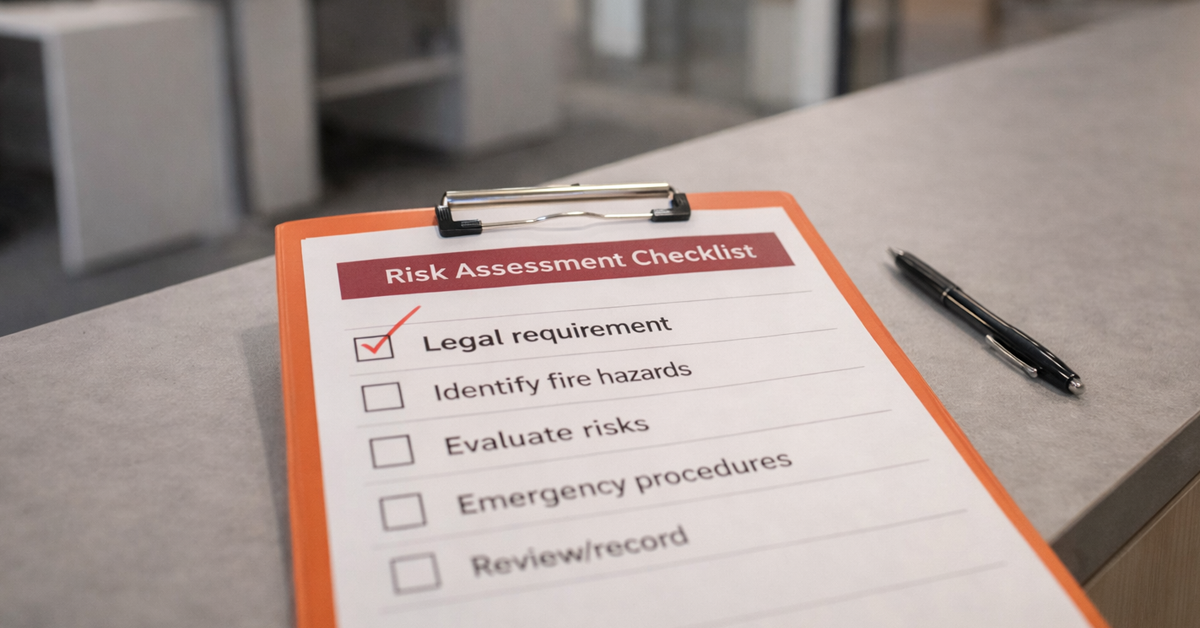
These laws place the duty squarely on a designated ‘Responsible Person’ or ‘Duty Holder’. It is their job to ensure a ‘suitable and sufficient’ assessment is carried out to identify potential hazards and put sensible control measures in place.
Think of the law here as having two main pillars holding up your safety obligations:
The table below breaks down exactly who is responsible and where these laws apply, giving you a clear snapshot of your duties.
| Area of Risk | Governing UK Legislation | Who is the ‘Responsible Person’ or ‘Duty Holder’? | Applies to Which Premises? |
|---|---|---|---|
| Fire Safety | The Regulatory Reform (Fire Safety) Order 2005 | Employer, business owner, landlord, managing agent, or anyone with control over the premises. | All non-domestic premises, including workplaces, commercial properties, and the communal areas of residential buildings (e.g., blocks of flats, HMOs). |
| General Workplace Health & Safety | The Management of Health and Safety at Work Regulations 1999 | The employer. | All workplaces, regardless of size or industry. |
So, what does this mean in practice? Essentially, one law focuses specifically on the ever-present threat of fire, while the other takes a broader view of all workplace hazards, from slips and trips to chemical exposure.
Under the Fire Safety Order 2005, carrying out a fire risk assessment is a strict legal requirement for the ‘Responsible Person’ in all non-domestic buildings in England and Wales. It is a crucial point for landlords and property managers that this explicitly includes HMOs and the shared areas of residential blocks. You can explore the scope of these duties in more detail on the government’s website.
The bottom line is simple. If you are an employer or you manage any property that is not a single private home, you are almost certainly bound by the duties in one or, more likely, both of these regulations.
The law does not just say a risk assessment must be done; it is very specific about who is accountable for getting it done. This legal duty falls to a designated individual or company known as the ‘Responsible Person’ under the Fire Safety Order, or a ‘Duty Holder’ in broader health and safety language.
Getting this right is absolutely critical, because the responsibility is personal. Even if you hire an expert to carry out the assessment for you, the ultimate legal accountability still lands squarely on your shoulders.
Figuring out who the Responsible Person is can be straightforward, but it can be more complex in buildings with multiple occupants. As a rule, it is the person or entity with control over the premises, or at least a degree of control over certain areas.
Let’s look at a few common, real-world scenarios to make this clearer:
It is vital to remember that in buildings with multiple occupants, there can easily be more than one Responsible Person. The law expects all parties to cooperate and coordinate their efforts. This ensures there are no dangerous gaps in fire safety between the different areas of control.
This duty is not a vague corporate exercise; it carries real weight. Failing to identify the correct Responsible Person is often the first step towards non-compliance, simply because nobody takes ownership of this vital safety process. Clarifying this role in your organisation or property is the absolute first step to meeting your legal duties.
A proper risk assessment is far more than a box-ticking exercise. To stand up to legal scrutiny, it needs to be a practical, systematic process designed to keep people safe. UK regulators expect to see a clear, structured approach that proves you have methodically thought about the real-world risks in your building.
Simply going through the motions will not be enough. The law demands a thoughtful evaluation that leads to genuine safety improvements. It is all about moving from identifying a problem to putting a robust solution in place and keeping it that way.
This simple flow chart shows how the process works: it starts with a specific building, assigns a person with legal duties, and results in a formal compliance document.
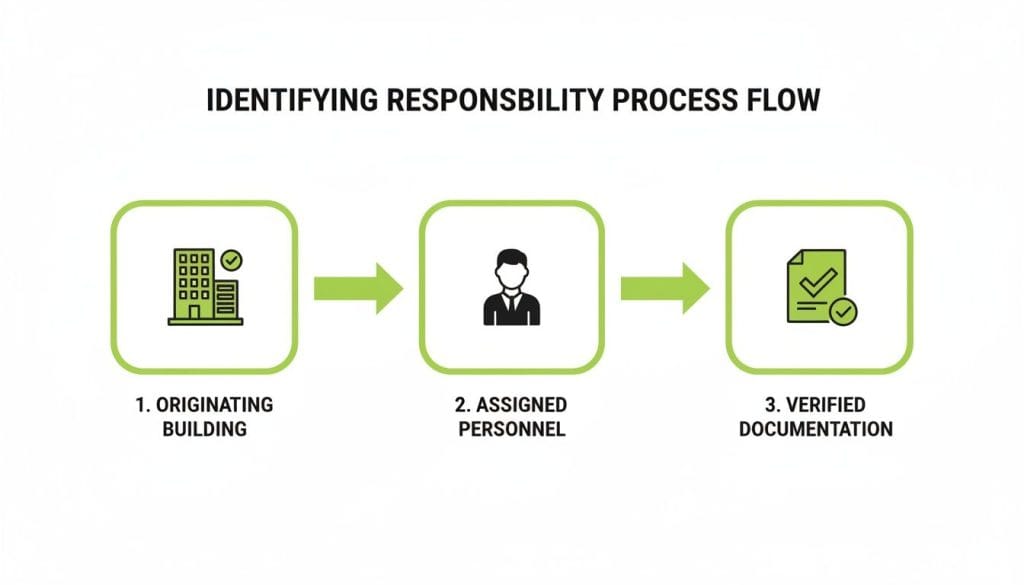
As you can see, legal responsibility is tied directly to a property. It is not an abstract concept; it is a duty that ends with a documented assessment.
To make sure your risk assessment is legally sound, it has to show evidence of these five key stages:
Identify the Fire Hazards: This means walking through the property. You are looking for two things: anything that could start a fire (ignition sources) and anything that could burn (fuel sources). A classic example is finding portable heaters placed dangerously close to a stack of cardboard boxes in an office stockroom.
Identify People at Risk: Next, think about who could be harmed and how. This is not just about your staff or residents; it includes visitors, cleaners, and contractors. You must give special consideration to anyone who might need extra help to get out, such as elderly people, young children, or individuals with disabilities.
Evaluate, Remove, or Reduce Risks: Once you know the hazards and who is at risk, you have to act. This is the crucial part. Your job is to implement control measures to either get rid of the risk completely or bring it down to an acceptable level. For instance, if you find fire doors are constantly being wedged open, a control measure would be to fit automatic closers and explain to everyone why keeping those doors shut is so important.
Record Your Findings, Plan, and Train: If you employ five or more people, the law says you must write down the significant findings of your assessment. This record needs to detail the hazards you found and the steps you have taken to control them. This document is also the foundation for your emergency plan and any staff training. You can see a detailed example of a fire risk assessment to get a better idea of what a finished report looks like.
Review and Update Regularly: A risk assessment is a living document, not something you do once and forget about. You need to review it regularly (best practice is once a year) and immediately update it if there are any significant changes to your building, its use, or the people in it.
One of the most common failings is treating the assessment as a one-off task. A dusty document filed away in a drawer offers zero legal protection if it does not reflect the current reality of your building.
Following this five-step framework gives you a clear path to compliance. It ensures you are not just meeting the letter of the law, but actively making your property safer for everyone and protecting your business from the devastating consequences of a fire.
Completing a risk assessment is a huge step towards compliance, but it is not the finish line. One of the most common and dangerous mistakes is to treat the assessment as a one-off task to be filed away and forgotten. In the eyes of the law, a risk assessment is a live document that must accurately reflect the current state of your property.
Under the Fire Safety Order, the Responsible Person is legally required to keep their assessment ‘under review’ to ensure it remains suitable and sufficient. This is not a vague suggestion; it is a core legal duty. Letting it gather dust invalidates the assessment and leaves you non-compliant.
While the legislation does not set a rigid timetable, established best practice, which is expected by Fire and Rescue Services, is to conduct a formal review of your fire risk assessment at least once every 12 months. An annual review provides a clear, defensible schedule and ensures that gradual changes or overlooked hazards are caught before they turn into serious problems.
Fire risk assessments must be reviewed regularly under Article 9(3) of the Regulatory Reform (Fire Safety) Order 2005. This is especially true after significant changes, like converting a property into an HMO or taking on more tenants. While there is no exact frequency written into law, industry experts strongly advise an annual review for most properties. You can explore official statistics related to fire prevention and protection in England.
Beyond your annual cycle, certain events legally demand an immediate review of your risk assessment. Think of these as ‘trigger events’ because they create a significant change that could introduce new hazards or alter existing risks. Waiting for your scheduled yearly review in these situations is not an option and would be considered a major compliance failure.
The moment something significant changes, you need to revisit your assessment. Below are the most common triggers that legally require you to review and, if necessary, update your document straight away.
| Trigger Event | Example Scenario for an HMO Landlord | Example Scenario for a Business Owner | Why a Review is Legally Required |
|---|---|---|---|
| Structural or Layout Changes | You build a small extension or add a new bedroom by splitting a larger room with a partition wall. | You knock down an internal wall to create an open-plan office or convert a storeroom into a new workshop. | Any alteration can affect escape routes, fire spread, and the effectiveness of fire doors and alarms. The assessment must be updated to reflect the new layout. |
| Changes in Occupants | You increase the number of tenants from four to six, or a new tenant has a known mobility impairment. | Your business hires 10 new staff members, or you start offering services to vulnerable client groups, like children or the elderly. | More people, or more vulnerable people, means evacuation plans and existing fire safety measures might no longer be adequate. The risk profile has changed. |
| New Hazards Introduced | A tenant starts storing flammable hobby materials (e.g., oils, paints) in a communal area. | The business installs new heat-producing machinery or starts storing flammable cleaning chemicals on site. | New ignition sources or fuel loads introduce risks that were not covered in the original assessment. These must be evaluated and controlled. |
| After a Fire or Near-Miss | A small pan fire in a shared kitchen is quickly extinguished, but it activates the smoke alarm. | A faulty piece of equipment sparks and smokes, causing a brief evacuation but no major damage. | A fire-related incident, no matter how small, is a critical warning. It proves a risk is real and legally requires a review to prevent it from happening again. |
Essentially, you must review and update your assessment as soon as you have reason to believe it is no longer valid. Keeping it current is not just about paperwork; it is a fundamental part of active, real-world risk management.
For a deeper dive into scheduling, you can read our guide which details how often a fire risk assessment should be conducted.
Failing to carry out a proper risk assessment is a serious breach of UK law. The authorities, from your local Fire and Rescue Service to the Health and Safety Executive (HSE), have significant powers to enforce the rules. They will not hesitate to use them if they find you are putting people at risk.
Ignoring this legal duty is a significant gamble with people’s safety, your property, and your business’s future. It is a risk no responsible business owner or landlord can afford to take.
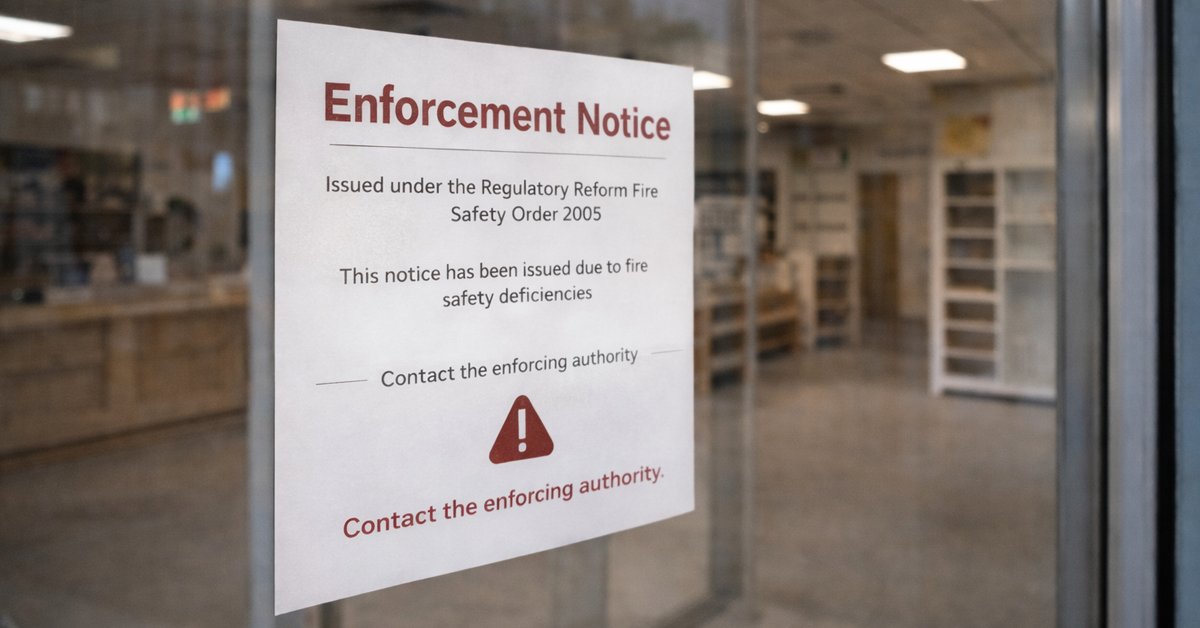
When an inspector visits your property and finds you have either failed to do a “suitable and sufficient” risk assessment or you have ignored its findings, they can take action. This usually comes in the form of a formal legal notice. It is not a suggestion; it is a legally binding order.
You could be handed one of three main types of notice:
The situation becomes much worse if a breach ends up in court. The legal system takes fire and workplace safety offences very seriously, especially when the root cause is a missing or inadequate risk assessment.
Penalties are not just financial. While fines can be unlimited and have been known to run into hundreds of thousands of pounds, the courts can also impose custodial sentences on the individuals deemed responsible.
In the most tragic cases, where the lack of a compliant risk assessment leads to a death or serious injury, company directors, managers, and landlords can face prison sentences of up to two years. It is vital to grasp that asking “is a risk assessment a legal requirement?” is a question with severe answers if you get it wrong. The only way to avoid these penalties is to be proactive and compliant.
You know a risk assessment is a legal necessity. Now it is time to turn that understanding into action. This is about making your property genuinely safe and keeping you on the right side of the law.
The first job is to formally identify your Responsible Person. Record it in writing. Who in your organisation or property portfolio holds that legal duty? Clarifying this removes any grey areas and gives someone clear ownership of fire safety.
With the Responsible Person identified, you need a plan for the assessment itself. This means having an honest conversation about who is going to do it. Do you genuinely have the skills, training, and experience to carry out a ‘suitable and sufficient’ assessment yourself? For a very simple, low-risk workplace, this may be possible.
However, for anything more complex, such as a large HMO, a multi-storey office block, or a building with unique hazards, the practical and safe option is to bring in a qualified and experienced fire risk assessor.
A professional assessment is not just about meeting the legal standard. It provides an impartial, expert view of your property’s risks, which is invaluable for preventing incidents and proving you have exercised due diligence.
Before the assessor arrives (or before you start), get your paperwork in order. You will want to have key documents ready:
Finally, you must act on the findings. Once the assessment is complete, create a clear action plan. Tackle the most significant risks first. This proactive approach is what truly keeps people safe and demonstrates you are serious about your legal duties. It is also vital to be aware of how regulations can differ, for example, understanding the legal shifts reshaping rental management highlights how quickly compliance requirements can change across different jurisdictions.
When it comes to risk assessments, there is a lot of confusion, especially for smaller businesses and landlords. Here are the straight answers to common questions.
Yes, absolutely. The law does not differentiate between having two employees or 200. If you are an employer, you have a legal duty to carry out a general health and safety risk assessment.
There is a small but important detail: you only have to keep a written record of it if you employ five or more people. However, it is best practice to write it down anyway. It is the simplest way to prove you have done your due diligence if an inspector calls.
When it comes to fire safety, the rules are even stricter. The Regulatory Reform (Fire Safety) Order 2005 applies to almost every workplace, so a fire risk assessment is a legal necessity.
This depends on the tenancy. If you are renting a standard house to a single family, that property is considered their home. The Fire Safety Order generally does not apply, so you do not need a formal assessment under this legislation.
However, the moment that property becomes a House in Multiple Occupation (HMO), the rules change completely.
For any HMO, even a small one shared by just a few tenants, a fire risk assessment for the communal areas (hallways, stairwells, shared kitchens) is a non-negotiable legal requirement. As the landlord, you are the designated Responsible Person, and it is your job to get it done and keep it up to date.
The law uses a simple but crucial word: ‘competent’. Whoever carries out the assessment must have the necessary skills, knowledge, and experience to do a proper job.
For a very simple, low-risk business, such as a small office with no hazardous materials, you might feel confident enough to do it yourself using official guidance.
However, as soon as the property becomes more complex, doing it yourself is a significant risk. For properties like large HMOs, commercial buildings with public access, or businesses with specific fire hazards, bringing in a qualified external assessor is the most sensible path. It is the most reliable way to ensure your assessment is ‘suitable and sufficient’ and that you have properly fulfilled your legal duties.
Most HMO landlords I talk to can rattle off their fire door requirements, their alarm grade, and their emergency lighting checks without missing a beat....
Most of the fire safety advice on this site assumes you already have a working HMO. This one is for the stage before that: the...