

A Practical Guide to the Types of Fire Alarm Systems in the UK
05/02/2026
If you’re a UK property manager, landlord, or business owner, getting to grips with the different types of fire alarm systems is one of your most fundamental legal duties. Choosing the right system is not just about ticking a box; it is a critical decision that directly impacts life safety, property protection, and your compliance with UK fire safety law.
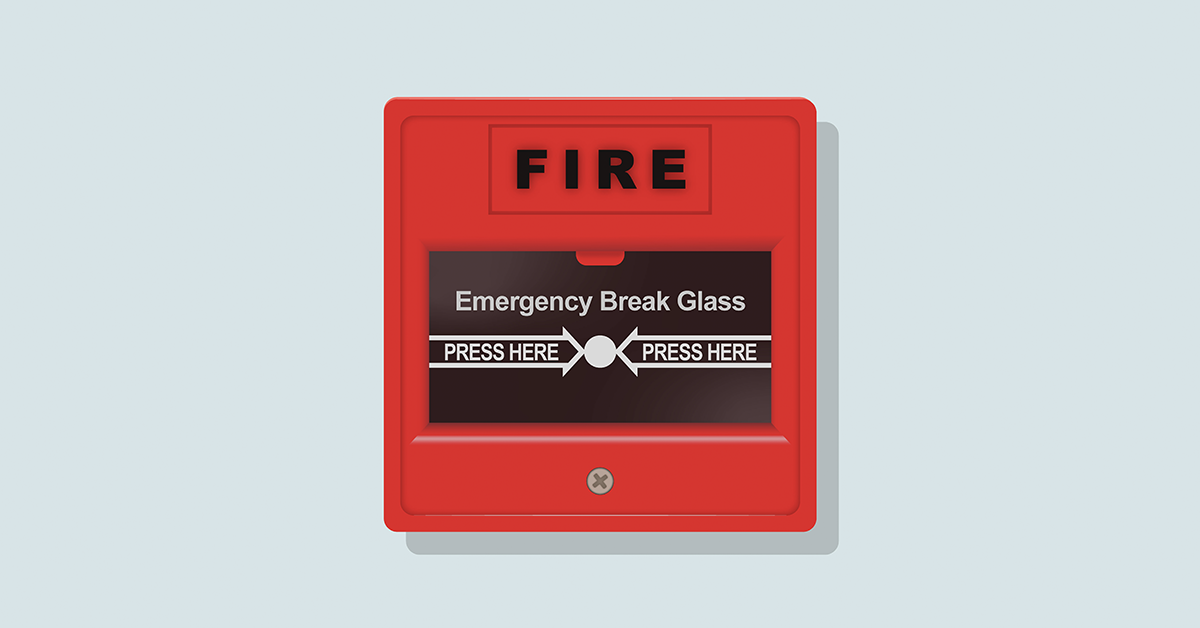
For any ‘Responsible Person’, selecting a fire alarm for your commercial premises or residential block is one of the most important jobs you will face. The decision is governed by law, guided by your property’s specific risks, and absolutely essential for ensuring people can get out safely.
Make the wrong choice, and you could face enforcement action, find your insurance is invalid, or, worst of all, fail to protect people during an emergency. This guide gives you a clear, practical breakdown of the main systems on the market, helping you make a sound and compliant decision. We will cut through the jargon and explain the ideal uses for each, from small shops and HMOs to large, complex buildings.
Under the Regulatory Reform (Fire Safety) Order 2005, the Responsible Person must have adequate fire detection and warning measures in place. This is not a one-size-fits-all rule. The right system for your property hinges on a few key factors:
Choosing a fire alarm system is not an off-the-shelf purchase. It is a decision that must be based on a thorough risk assessment to ensure it is suitable and sufficient for the specific premises, satisfying your duties under UK fire safety legislation.
This article will walk you through the main types of fire alarm systems, giving you the clarity needed to meet your legal obligations.
Before choosing the hardware for a fire alarm system, it is vital to understand why it needs to be there in the first place. This is not about picking gadgets; it is about meeting a specific safety goal defined by British Standard BS 5839-1, the official code of practice for designing and installing fire alarms in non-domestic buildings. Think of it as the rulebook that ensures a system will actually do its job in an emergency.
So, how do you know which rules to follow? Your fire risk assessment is the document that dictates the category of system your property needs. This is not a random choice. It is a calculated decision based on how the building is used, who occupies it, and the specific fire risks identified. Getting this wrong means you are not just non-compliant, you are failing in your legal duty as the Responsible Person.
When you see an ‘L’ category, think Life. The number one job of an L-series system is to give people enough warning to get out of the building safely. The categories run from L1 (the most comprehensive) down to L5 (for specific, localised risks).
While L-series systems are all about getting people out, P-series systems focus on protecting the Property. Their goal is to detect a fire as early as possible to minimise damage to the building and its contents, giving the fire and rescue service the best chance to intervene.
It is crucial to remember that the category specified in your fire risk assessment is a legal requirement. The system must be designed, installed, and maintained to that standard to ensure it performs as expected in an emergency.
Under BS 5839-1:2017, these categories from M (Manual) up to P2 define the type of system needed for non-domestic properties like HMOs. For landlords, the L-categories are particularly important, with an L3 system being a very common requirement for HMOs.
For a deeper dive into how these categories apply to different properties, you can read our detailed guide on fire alarm system categories.
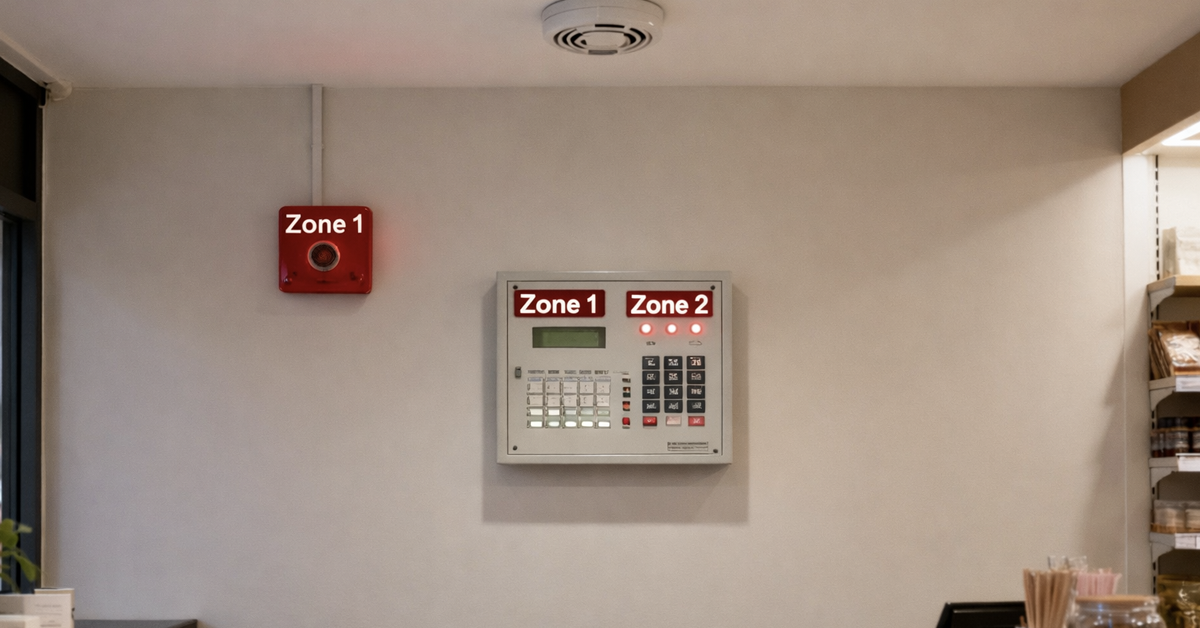
Conventional fire alarms are the traditional, non-addressable workhorses of the industry. You will often find them in smaller, less complex buildings where a straightforward, cost-effective solution is all that is needed.
Think of it like an old-fashioned lighting circuit. If a fuse blows, you know which circuit has tripped, say, the upstairs lights, but you do not know if it was the bedroom or the bathroom bulb that caused it. A conventional system works on the same simple principle, dividing a property into zones.
A building is split into several circuits, which we call zones. Each zone has a number of detectors and manual call points wired into it. When any device on that circuit is triggered by smoke or heat, the fire alarm control panel lights up to show which zone is in alarm.
For example, Zone 1 might cover the ground floor, while Zone 2 covers the first floor. If a fire starts somewhere on the ground floor, the panel will simply display ‘Fire in Zone 1’. This gives you the general area to investigate, but not the specific device that was activated. This method is the most basic classification of fire alarm system you will find in the UK; you can learn more about the broader market from this fire detection system research in the United Kingdom.
For the right type of property, a conventional system offers some clear benefits. Its simplicity is its main strength, leading to some practical advantages for the Responsible Person.
Despite these advantages, the simplicity of a conventional system is also its biggest weakness. For larger or more complicated buildings, these limitations can pose a serious risk to life safety and business continuity.
The main drawback is the lack of precise location information. In a large or cluttered zone, responders have to search the entire area just to find the source of the fire. This delay can be critical, allowing a small fire to grow and potentially block escape routes.
In an emergency, every second counts. The time spent physically searching a zone for the source of an alarm is time that could be spent evacuating occupants or tackling the fire at its earliest stage.
On top of that, fault finding can be a real headache. If a wiring fault occurs, the entire zone can be affected, and an engineer will need to trace the physical wiring to locate the problem, leading to longer system downtime.
A conventional system is typically a good fit for smaller, low-risk premises. It is ideal where a fire would be quickly and easily identifiable as soon as someone entered the zone.
Recommended for:
On the other hand, for larger buildings, multi-storey properties, or places with complex layouts like hotels or big residential blocks, the delay in pinpointing a fire’s location makes a conventional system unsuitable. In these cases, it would almost certainly be non-compliant with the findings of a thorough fire risk assessment.
Where conventional systems give you a general idea of a fire’s location, addressable fire alarm systems tell you exactly where the problem is. This makes them the go-to standard for larger, more complex properties where finding the source of a fire quickly is absolutely critical.
Think of it like a sophisticated computer network. Every single device, from the smoke detectors to the manual call points, has its own unique digital ‘address’. When a device is triggered, the control panel does not just show a vague zone; it displays the exact device and its precise location, for example, “Smoke Detector, Room 201, First Floor”.
This pinpoint accuracy dramatically speeds up investigation and response times. There is no need for staff or the fire and rescue service to waste time searching an entire floor. Instead, they can go straight to the source of the activation, saving precious minutes that could be the difference between a minor incident and a full-blown disaster.
For certain types of premises, this level of detail is not just a nice-to-have; it is the only suitable choice.
Addressable systems are ideal for:
Addressable systems have another major advantage hidden in their wiring. Unlike the simple radial circuits of conventional systems, devices are connected in a loop. This means the cable runs from the control panel, connects to all the devices in a circuit, and then returns to the panel.
The loop configuration provides a crucial layer of resilience. If a single break occurs in the cable, the system can continue to function normally, with power and data feeding the devices from both ends of the loop.
This built-in redundancy minimises the risk of a whole section of detectors failing due to a simple wiring fault, a common headache with older, conventional setups. This enhanced reliability is a key reason why they are specified for premises where system integrity is paramount.
It is true that the advanced technology and components mean addressable systems have a higher initial installation cost. The control panels are more sophisticated, and the devices themselves are more expensive than their conventional counterparts.
However, this initial outlay is often balanced by lower long-term running costs. Fault-finding is significantly faster and easier, as the panel can identify the exact device with the issue, reducing engineer time and call-out fees. The detailed information provided by the system can also help prevent unnecessary and disruptive evacuations caused by ambiguous alarm signals.
For any Responsible Person managing a larger property, an addressable system is not just a preference; it is a fundamental requirement for meeting their duties under the Regulatory Reform (Fire Safety) Order 2005.
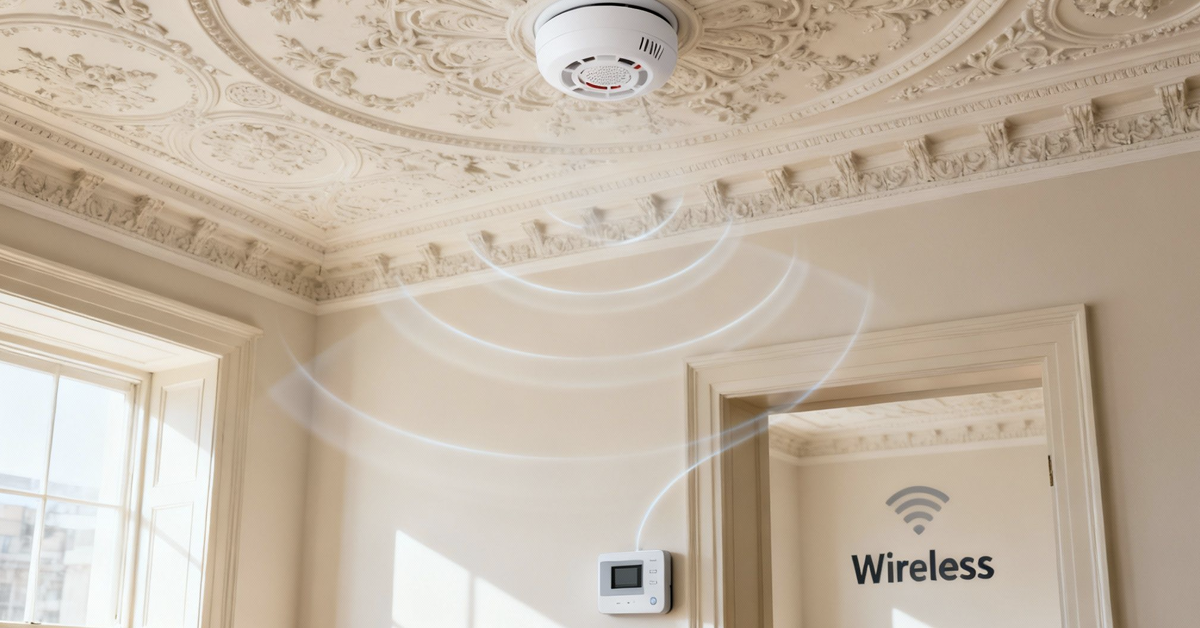
In some properties, running cables for a fire alarm system is not just difficult, it is impossible. Think of listed buildings with ornate plasterwork or busy hotels where shutting down entire floors for wiring work would be a commercial disaster. For these challenging environments, wireless and hybrid systems are the modern, reliable, and fully compliant answer.
Wireless fire alarms ditch the cables and instead use secure radio-frequency technology to connect everything. Each device, from the smoke detectors to the manual call points, is battery-powered and communicates with the main control panel wirelessly. The result is a system that offers the same pinpoint accuracy and reliability you would expect from a top-tier addressable system, just without the wires.
This technology is a game-changer for certain types of buildings where traditional installation would cause more problems than it solves.
A wireless installation often becomes the only logical choice when protecting the building’s fabric or maintaining business continuity is non-negotiable. As the Responsible Person, you might find a wireless system is the perfect fit for your fire safety strategy in a few key situations.
The real beauty of a wireless fire alarm system is its ability to provide total protection without intrusive building work. It preserves the aesthetic and structural soul of a property while ensuring you tick every box for fire safety compliance.
The “wired vs. wireless” debate is a big deal in the UK fire alarm market, especially when it comes to upgrading older properties. Wireless addressable systems are becoming the go-to for complex residential blocks and HMO conversions, with industry data showing they can slash installation times by 30-50%. You can learn more by exploring this research on the UK fire alarm and detection market.
So, what if you do not need to go fully wireless? A hybrid system offers a practical and often more cost-effective middle ground, blending the strengths of both wired and wireless technologies. Essentially, it allows you to add new wireless devices to an existing hardwired system, whether it is addressable or conventional.
This approach is perfect for building extensions or refurbishments. Imagine you own an office block with a perfectly functional wired, addressable system. If you decide to build a new wing, instead of facing the huge cost and mess of extending all the old wiring, you can simply install wireless detectors in the new area.
A special interface module acts as a bridge, allowing the new wireless devices to talk seamlessly to the original wired control panel. This creates one unified, fully compliant system without the expense of a complete rip-and-replace. This flexibility makes hybrid systems a smart, forward-thinking choice for growing businesses, ensuring your fire risk assessment requirements are met efficiently as your premises evolve.
Sometimes, your standard smoke and heat detectors just do not cut it. For certain buildings, a fire needs to be caught at the absolute earliest stage, often long before you can even see or smell smoke. This is where the more specialist systems come into play.
These advanced systems are designed for places where the consequences of even a tiny fire would be catastrophic. Think of high-value assets, critical business operations, or complex buildings where a standard evacuation would be chaotic. If you are the Responsible Person for a site like this, you have a legal duty to consider these options.
Imagine giving your building a highly sensitive nose. That is essentially what an Aspirating Smoke Detection (ASD) system does. You will often hear it called by its most common brand name, VESDA, which stands for Very Early Smoke Detection Apparatus.
Instead of waiting for smoke to drift into a detector, an ASD system actively samples the air. A network of small, discreet pipes is run throughout the protected area, constantly pulling air back to a central detection unit. Inside this unit, a laser analyses the air for microscopic smoke particles, the kind that are produced long before a fire becomes visible. This gives you a warning at the very first whisper of combustion.
This makes it the go-to choice for environments where downtime is simply not an option.
An ASD system provides the earliest possible warning of a potential fire. This buys you crucial time to investigate and act before serious damage occurs or a full-blown fire suppression system kicks in.
In big, busy venues like stadiums, shopping centres, or airports, a shrill bell or siren often creates more panic than it solves. A Voice Alarm (VA) system, which is governed by BS 5839-8, replaces those jarring noises with clear, spoken instructions.
Instead of a confusing alarm, people hear a calm, authoritative voice telling them exactly what to do. This is incredibly effective for managing complex evacuations, particularly phased ones where you need to clear different parts of a building in a specific order. The system can direct people away from danger and towards the safest exits, preventing panic and crushes.
A VA system is a fundamental part of the fire safety strategy for any large public space. To get a better picture of how these systems work alongside other safety measures, take a look at our guide on the requirements of fire suppression standards like BS EN 12845.
As we have seen, choosing between the different types of fire alarm systems is not a matter of personal preference. It is a critical decision dictated by your property’s size, its day-to-day use, and the specific fire risks identified in your legally required fire risk assessment.
Think of this assessment as the essential first step. It provides the professional judgement and hard evidence needed to determine the correct BS 5839 category for your premises. Without it, you are just guessing, and that is not a defensible position for any Responsible Person.
Failing to install an appropriate system is a serious compliance failure. It does not just endanger the lives of your tenants or staff; it also exposes your business to significant legal and financial penalties, including unlimited fines and potential prosecution under the Regulatory Reform (Fire Safety) Order 2005.
A professional and suitable fire risk assessment removes all the ambiguity. It provides a clear, documented road map to compliance, specifying the exact level of protection required to keep people safe and satisfy your legal duties.
The assessor will consider every relevant factor, from the building’s layout and who uses it to any specific fire hazards, and will finish with a clear recommendation for the minimum system required. This ensures your investment is both effective and fully compliant.
This infographic simplifies the decision-making process for more specialised, high-risk environments.
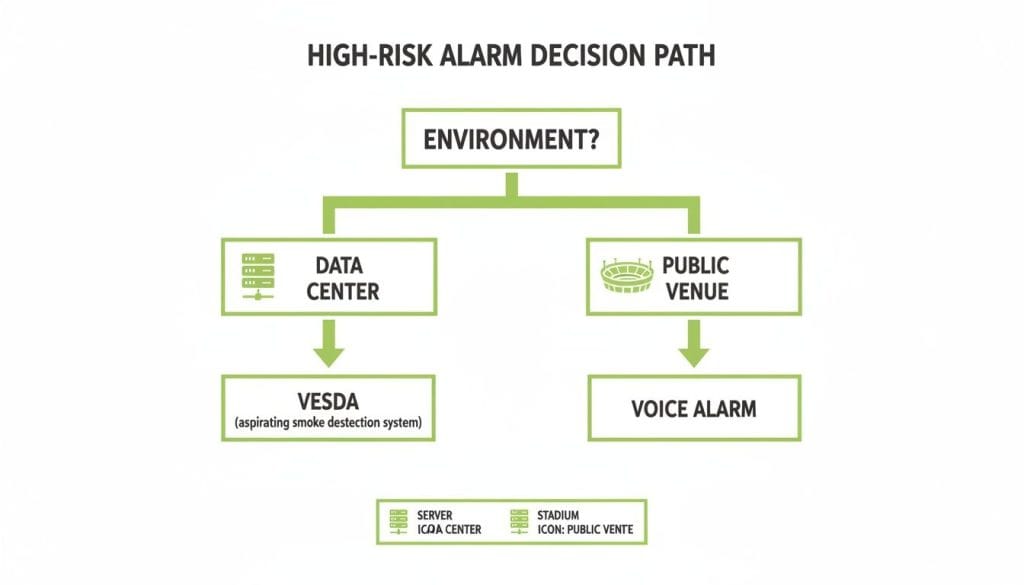
As the diagram shows, the specific use of a space dictates the need for advanced systems like VESDA or Voice Alarms to manage unique risks. Regular testing is also a mandatory part of your responsibilities, and you can learn more about the specifics of how to complete a fire alarm test in our dedicated guide.
Ultimately, a competent fire risk assessor will give you the clarity you need to protect your property and its occupants effectively.
As a property manager or business owner in the UK, getting to grips with your fire safety duties can feel overwhelming. This section cuts through the noise to give you clear, practical answers to the questions we hear most often about fire alarm systems and the law.
According to British Standard BS 5839-1, a competent person must inspect and service your commercial fire alarm system at least every six months. This is not just best practice; it is a non-negotiable part of your legal compliance.
On top of these professional checks, the designated ‘Responsible Person’ for the building must carry out weekly tests. This is a simple process of activating a manual call point to make sure the control panel registers the signal and the sounders work correctly.
Crucially, you must keep a detailed logbook of every single test, service visit, fault, and false alarm. This logbook is a legal document required under the Regulatory Reform (Fire Safety) Order 2005, and it is one of the first things a fire officer will ask to see during an inspection.
Absolutely not. For almost all commercial premises, Houses in Multiple Occupation (HMOs), and blocks of flats, a DIY installation is completely unacceptable and dangerous. The design, installation, and commissioning of a fire alarm system must be carried out by a ‘competent person’ to comply with BS 5839.
A competent person is defined as someone with the relevant training, qualifications, experience, and knowledge to do the job safely and effectively. In the real world, this means using a third-party accredited company, such as one with BAFE certification.
Trying to install a system yourself is a massive risk. It will almost certainly invalidate your building’s insurance, fail to meet the required legal standards, and, most importantly, could fail in a real fire, putting lives in jeopardy. Non-compliance can lead to severe penalties, including unlimited fines and even prison time.
This is a really common point of confusion, but the distinction is critical for landlords and property managers. A domestic smoke alarm, which falls under BS 5839-6, is usually a standalone unit you would find in a single family home. It might be battery-powered or wired into the mains, but it is designed to protect one dwelling.
A fire alarm system, covered by BS 5839-1, is a much more sophisticated setup. Think of it as a complete, interconnected network of detectors, manual call points, and sounders, all wired back to a central control panel.
These systems are designed for non-domestic premises, which, importantly, includes the common areas of HMOs, purpose-built flats, and converted apartment blocks. They provide a coordinated, building-wide warning, which is a fundamental requirement for commercial fire safety and protecting multiple occupants under one roof.
Most HMO landlords I talk to can rattle off their fire door requirements, their alarm grade, and their emergency lighting checks without missing a beat....

Most of the fire safety advice on this site assumes you already have a working HMO. This one is for the stage before that: the...