
A Guide to Maintained Emergency Lighting in UK Properties
02/02/2026
Imagine the lights flickering and then cutting out completely during a power failure. In that sudden, disorienting darkness, a lit green exit sign is more than just a light—it is a lifeline. A maintained emergency lighting system is designed for exactly this scenario. Unlike other systems, it stays on all the time, powered by the mains, and switches to its backup battery the instant the power fails. This guarantees that escape routes and fire safety equipment are always visible, which is a cornerstone of UK fire safety law.
For business owners, landlords, and anyone designated as the ‘Responsible Person’ for a UK property, understanding this system is not optional. This guide explains what maintained emergency lighting is, why it is legally required, and what you must do to ensure your system is compliant, functional, and ready for an emergency. By the end, you will have a clear, practical understanding of your legal duties and the steps needed to fulfil them.
When the main power to a building is lost, panic can set in fast. In unfamiliar spaces or total darkness, the risk of trips, falls, and confusion skyrockets. Maintained emergency lighting is the system designed to prevent this chaos. It cleverly serves a dual purpose: it functions as part of the building’s normal, everyday lighting but is also primed to deliver immediate, battery-powered light when an emergency strikes.
Think of it like the house lights in a theatre. They are on as you find your seat, but if the power were to fail mid-performance, they would stay lit using a backup source, making sure the audience can always see the way out. This is the complete opposite of non-maintained systems, which only light up after the power goes off. The constant “on” state of maintained lighting makes it absolutely essential in certain buildings.
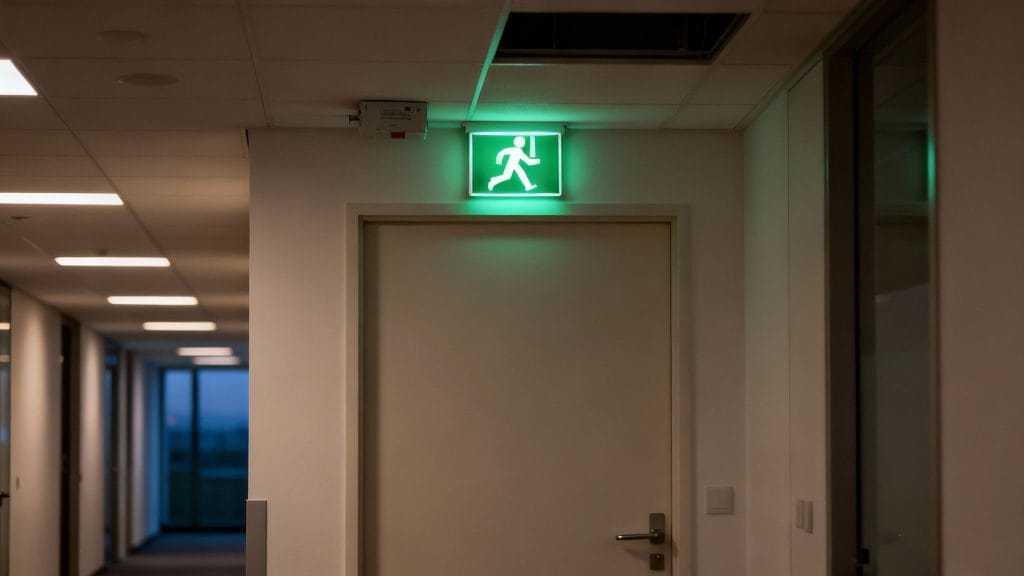
The defining feature is simple: the light is always on. But this single characteristic delivers several critical safety benefits, making it a legal must-have in many UK properties. The whole point is to ensure that, no matter what happens, occupants are never plunged into darkness in the most important areas.
Here is what that means in practice:
Getting your emergency lighting right is not just a good idea; the legal and commercial pressure to comply is stronger than ever. The UK emergency lighting market hit a value of £315 million in 2024 and is expected to climb to nearly £590 million by 2030. This growth is not just about technology; it is driven by strict regulations that hold property managers and business owners directly responsible for keeping people safe.
Developing a solid grasp of these duties is a bit like putting together an ultimate winter storm preparedness checklist. Just as you prepare for severe weather to protect against the unexpected, ensuring your emergency lighting is compliant and fully functional protects lives—and your business—from the devastating consequences of a fire or power cut.
Having correctly installed and working emergency lighting is not just a good idea for safety—it is a strict legal requirement here in the UK. Getting this right is not just about sticking a few lights on the ceiling. It is about understanding the specific laws and standards that dictate how they must perform, and being able to prove you have done your bit as a property owner or manager.
The main piece of law you need to know about is the Regulatory Reform (Fire Safety) Order 2005. This is the legislation that puts the legal duty for fire safety squarely on the shoulders of the ‘Responsible Person’. That could be you if you are a business owner, landlord, or managing agent. A massive part of this duty is making sure there is adequate emergency lighting along all escape routes.
And make no mistake, the authorities take this very seriously. Fail to meet these duties, and you can expect enforcement action from your local Fire and Rescue Service. They have the power to issue notices demanding you fix things, and if they find a serious risk to life, they can prohibit use of your building until you do.
While the Fire Safety Order tells you what you have to do legally, it is the British Standards that give you the technical “how-to” guide for getting it right. For maintained emergency lighting, the most important document is BS 5266-1, which is the Code of Practice for the emergency lighting of premises.
This standard is what turns your legal duties into practical, measurable actions. It lays out exactly what “adequate” lighting means, detailing everything from the required brightness and placement of fittings to how long they must stay on for.
Key Takeaway: Think of BS 5266-1 as the rulebook. It is the benchmark your system will be judged against during a fire risk assessment or an official inspection. Following its guidance is the clearest and most direct way to prove you have met your legal obligations.
BS 5266-1 gets into the finer details, but there are a few core requirements that every Responsible Person must get right. These are not just friendly suggestions; they are considered the minimum standard for keeping people safe.
Here are the key points you need to have covered:
For landlords and property managers, knowing the ins and outs of emergency lighting British Standards is not optional—it is a fundamental part of the job. These standards are what tell you exactly how to protect your tenants and stay on the right side of the law.
Ignoring these legal duties can have truly devastating consequences. Picture this: a small fire breaks out in a block of flats, tripping the power. If the emergency lighting fails because it has not been maintained, tenants trying to escape in total darkness could easily fall down the stairs.
In that scenario, the Responsible Person could be prosecuted. Fines for breaching the Fire Safety Order are unlimited and can run into tens of thousands of pounds. Worse still, if a system failure leads to someone being injured or killed, a prison sentence is a very real possibility. The whole point of these rules is to prevent that from ever happening by being proactive and legally compliant from day one.
A maintained emergency lighting system is only as good as its last test. It is one thing to have the gear installed, but UK fire safety law demands you prove it works through rigorous, documented maintenance. This is not just a suggestion; it is a legal duty that lands squarely on the shoulders of the Responsible Person.
Think of it this way: without a consistent schedule of checks and tests, your emergency lights offer a false sense of security. The whole point of maintenance, as laid out in standards like BS EN 50172, is to catch problems before they can compromise safety. This could be anything from a single failed bulb to a degrading battery that will not last when you need it most.
This chart breaks down the legal framework behind your maintenance duties, showing the path from the law itself to the technical standards and the very real consequences of getting it wrong.
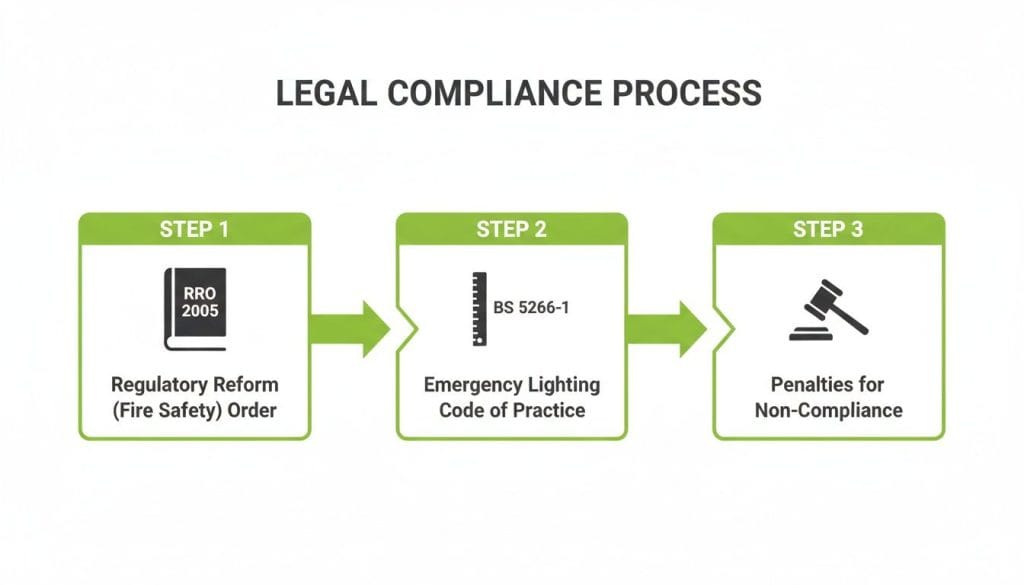
As you can see, the Fire Safety Order sets the legal obligation, the British Standards provide the technical “how-to,” and the fire authorities enforce it all.
Often called the ‘flick test’, this is your quick, simple, once-a-month check-up. The idea is to simulate a momentary power cut to make sure every single emergency light fitting switches over to its battery supply correctly.
This test does not check how long the battery will last, just that it kicks in when needed. It is a vital health check for the system. If any light fails to come on, it needs investigating and fixing right away, with both the fault and the repair noted down.
This is the big one. Once a year, your maintained emergency lighting system has to prove it can go the distance. For most commercial and residential buildings in the UK, that means lasting for its full rated duration, which is typically three hours.
The test involves cutting the mains power to the emergency lighting circuit and letting the batteries run down completely over the required time. It is the only way to be absolutely certain the batteries have enough charge to see you through a genuine, lengthy power outage or evacuation.
One of the most common—and dangerous—compliance failures is assuming a light that works for five minutes will automatically work for three hours. Battery life degrades over time, and only a full duration test will expose it.
While daily visual checks or even the monthly flick test can often be handled by a designated, properly trained member of your own staff, the annual duration test is a different beast. It requires a much deeper knowledge of electrical systems to perform the test safely, assess the results accurately, and diagnose any underlying faults.
For this reason, it is always recommended that the annual test is carried out by a qualified electrical engineer or a specialist fire safety company. Their expertise is crucial. Understanding the full scope of emergency lighting testing requirements is essential for anyone taking on this responsibility.
Every test, every fault, and every repair must be meticulously recorded in a fire safety logbook. This is not just for your own reference; it is the first piece of evidence a Fire and Rescue Authority inspector will ask to see to confirm you are meeting your legal duties.
Your logbook must contain:
An incomplete or missing logbook is a huge red flag for inspectors. It suggests a poor approach to safety management and can lead directly to enforcement action.
When a competent fire risk assessor turns up at your property, your emergency lighting system is going right under the microscope. This is not just about a quick check to see if the lights switch on. It is a detailed, methodical audit to make sure your system is genuinely fit for purpose, legally compliant, and has been properly looked after. The whole point is to find any weak spots that could put lives in danger during a real evacuation.
One of the first things an assessor does is walk the building just like someone trying to escape in a panic. They will trace the entire escape route, from the most distant room all the way to the final exit door. This walkthrough is vital because it helps them judge whether the lights have been installed in a logical and effective way.
But the assessment goes much deeper than a simple visual check. The assessor will be scrutinising your entire system against the strict requirements of British Standards, especially BS 5266-1. They are not just looking for lights; they are checking that the right lights are in all the right places.
A huge part of the audit is confirming that all the legally required “points of emphasis” are properly lit up. This is one of the most common areas where we find compliance gaps, particularly in older buildings or properties with quirky, complex layouts.
The assessor will be looking specifically for correct luminaire placement at:
If an assessor spots a long, gloomy corridor or a darkened stairwell, that is going to be flagged as a significant finding straight away. These are precisely the kinds of situations that lead to disorientation and tragedy during an actual emergency.
After checking the physical installation, the assessor will ask to see your fire safety logbook. Think of this document as your primary evidence of due diligence. An experienced assessor can learn a huge amount about your overall fire safety management just by flicking through your records.
They will be looking for a complete and consistent history of all your tests. That means logged entries for the monthly “flick” tests and, crucially, the annual full-duration discharge test. Gaps in the records, missing signatures, or a failure to note down what you did about any faults are all major red flags.
A brand-new, perfectly installed lighting system is almost meaningless to an inspector if there is no logbook to prove it has been consistently tested and maintained. The logbook is the legal proof that shows you are taking your duties as the Responsible Person seriously.
All the assessor’s findings are then brought together in a formal fire risk assessment report. This document will not just list problems; it gives you clear, prioritised, and actionable recommendations. For example, it might say something like, “Install an additional emergency luminaire at the top of the rear stairwell to meet BS 5266-1 standards” or “Implement a formal system for recording monthly emergency lighting tests immediately.” This whole process, which you can read more about by understanding what a fire risk assessment is, transforms a complex audit into a straightforward action plan for you to follow, helping you fix critical safety issues and get compliant.
The days of dealing with flickering, unreliable fluorescent tubes in your emergency light fittings are numbered. For property managers and business owners, the shift to modern, energy-efficient LED lighting is no longer just a good idea—it is an essential upgrade driven by both technology and UK regulations.
This move is far more than a simple compliance exercise. It is a smart investment in safety, sustainability, and long-term operational resilience. Outdated fluorescent lighting is not just inefficient; it contains hazardous materials, which has prompted major regulatory changes that directly impact anyone responsible for a maintained emergency lighting system.
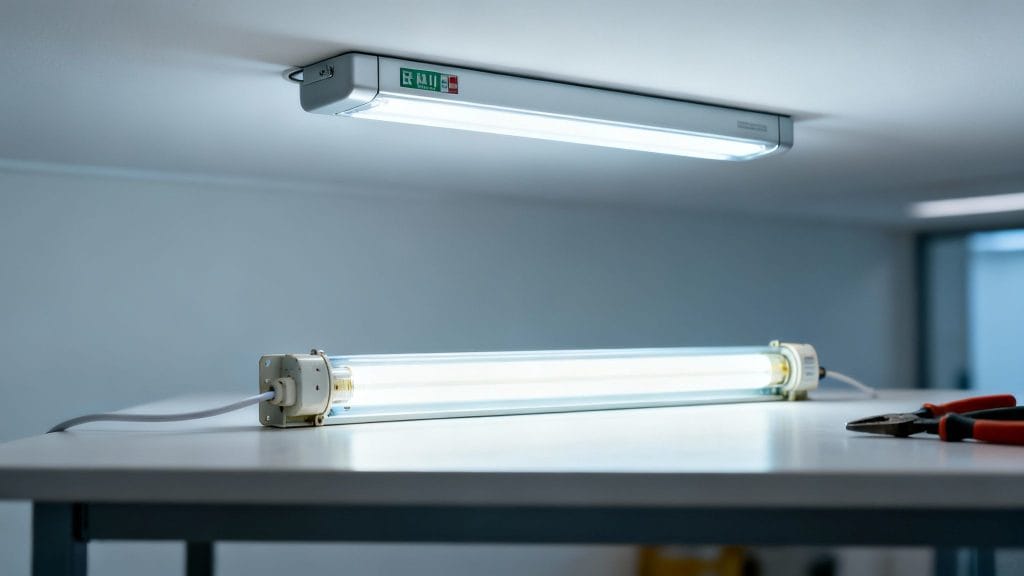
A pivotal moment arrived for UK properties in February 2024 with the full enforcement of the RoHS (Restriction of Hazardous Substances) directive. This legislation effectively banned the sale of fluorescent lamps containing mercury, forcing a widespread move to superior LED alternatives.
Since these older lamps are 80-90% less energy efficient, the regulation has simply accelerated a necessary technological transition for commercial premises and residential blocks alike. In practice, this change means that replacing failed fluorescent tubes is becoming increasingly difficult and costly. Sticking with an obsolete system is no longer a viable long-term strategy.
Moving to LED emergency lighting delivers substantial advantages that go far beyond just meeting new rules. The business case for making the switch is exceptionally strong, offering tangible returns through reduced running costs and enhanced reliability.
Key benefits of an LED upgrade include:
An LED upgrade should be viewed not as a compliance cost, but as a strategic investment. It lowers your property’s carbon footprint, cuts ongoing expenditure, and provides a more dependable safety system that protects occupants and your assets.
When upgrading your emergency lighting, a practical guide to selecting the right LED replacement light fixtures can ensure both energy efficiency and long-term reliability for your facility. Choosing the correct fittings is crucial for maximising these benefits and ensuring your system remains fully compliant with British Standards for years to come.
Getting your emergency lighting right is not a one-off job; it is an ongoing commitment. As the Responsible Person, you have legal duties under the Regulatory Reform (Fire Safety) Order 2005 to keep managing it properly. This is about more than just ticking boxes—it is about protecting lives, ensuring your business or property can keep running, and steering clear of hefty fines or enforcement action from the fire service.
The whole process really boils down to three key pillars: a correctly designed and installed system, a strict testing schedule, and keeping meticulous records. If you let any one of these slide, your efforts could be worthless in the eyes of an inspector. Worse, your system could fail when people are relying on it most. The best way to think about it is as a continuous cycle: assess, act, and document.
This approach shifts you from simply reacting to faults to proactively managing safety. By understanding the law, following the technical guidance in BS 5266-1, and keeping detailed records, you build a solid safety framework that will stand up to any scrutiny.
To give you a head start, here is a practical checklist covering the essentials a fire risk assessor or a Fire and Rescue Service inspector will be looking for. Run through these points for your own premises—it is a great way to spot any gaps.
Key Takeaway: This is not just a simple to-do list. Think of it as a tool for proactive risk management. Answering ‘no’ to any of these questions flags up a significant compliance gap that needs your immediate attention.
Looking after your maintained emergency lighting is a fundamental part of your legal duties. It protects the people in your buildings and shields your business from the severe legal and financial fallout that comes with non-compliance.
If you are unsure about any part of your system or just need some expert guidance, our team is here to help. We provide comprehensive fire risk assessments that give you a clear, actionable path to getting everything sorted. Contact HMO Fire Risk Assessment today to make sure your property is safe, secure, and legally sound.
When it comes to maintained emergency lighting, it is easy to get tangled up in the technical details. Here are some straightforward answers to the questions we hear most often from landlords, business owners, and property managers across the UK.
In the UK, the standard requirement outlined in BS 5266-1 is a three-hour duration. This is the standard for most properties, especially where an evacuation might take time or where people might need to get back inside soon after the power returns. Think of cinemas, large offices, or complex residential blocks.
That said, a one-hour duration is sometimes acceptable. This typically applies to smaller, simpler buildings that can be emptied out quickly and will not be reoccupied until the mains power is safely back on. The definitive answer for your specific property will always be in your fire risk assessment, as it considers your building’s size, use, and the people inside.
It really depends on your level of competence and which test you are doing.
Day-to-day visual checks and the monthly ‘flick’ tests can usually be handled by a designated, competent member of staff (or the Responsible Person themselves). The key is knowing exactly what you are looking for and, just as importantly, recording your findings properly.
The annual full-duration test, however, is a different matter. This involves running the batteries completely flat to make sure they last for the required one or three hours, then checking they recharge correctly. Because of its technical nature, we strongly recommend leaving this to a qualified electrical engineer or a specialist fire safety firm. This guarantees it is done safely and the results are logged correctly, giving you solid proof of compliance if the authorities come knocking.
The key difference is simple: it is about whether the light is on or off during normal, day-to-day operation.
A maintained emergency light stays lit all the time. It works as a regular light fitting but has a backup battery that kicks in instantly if the power fails. You will find these in places that need to be constantly illuminated for safety, like theatres, nightclubs, or busy public corridors.
A non-maintained emergency light stays switched off until it is needed. It only springs to life when the mains power cuts out. These are perfect for most standard workplaces or residential common areas where people are familiar with the layout and just need a lit path to get out safely in an emergency.
Ultimately, your fire risk assessment will determine which type is right for your building based on how it is used day-to-day.
Ensuring your property is fully compliant with UK fire safety law is a critical responsibility. HMO Fire Risk Assessment provides expert fire risk assessments to give you a clear, actionable path to safety and legal compliance. Contact our team today for professional advice and support.
Most HMO landlords I talk to can rattle off their fire door requirements, their alarm grade, and their emergency lighting checks without missing a beat....

Most of the fire safety advice on this site assumes you already have a working HMO. This one is for the stage before that: the...