
A Guide to the Steps of Fire Risk Assessment in the UK
26/01/2026
Before considering the practical side of a fire risk assessment, it’s crucial to grasp one key point: this is a legal requirement for most non-domestic UK properties, not just a recommendation.
This duty falls squarely on a designated ‘Responsible Person’, who is legally accountable for the safety of everyone using the premises. Ignoring this is not just a compliance oversight; it is a serious offence with severe consequences, including unlimited fines and, in the most serious cases, imprisonment.
The entire framework for fire safety in England and Wales is built on the Regulatory Reform (Fire Safety) Order 2005. This legislation shifted the focus from old, prescriptive rules to a modern, risk-based approach. In practice, this means the legal burden now sits firmly with the person or people in control of a property.
This is not an optional title; it is a specific legal definition. You are the Responsible Person if you are:
If multiple people share control, such as a landlord and a managing agent for a block of flats, you must cooperate to fulfil your legal duties. You cannot assume someone else is handling it. The law demands clear communication and shared responsibility to ensure nothing is missed.
The Fire Safety Order applies to almost all non-domestic premises in England and Wales. This includes the common parts of multi-occupied residential buildings, such as the hallways and staircases in a block of flats.
Put simply, if your property is not a single private home occupied by one family, an assessment is almost certainly required.
This infographic breaks down the relationship between UK fire law, the Responsible Person, and the property they manage.
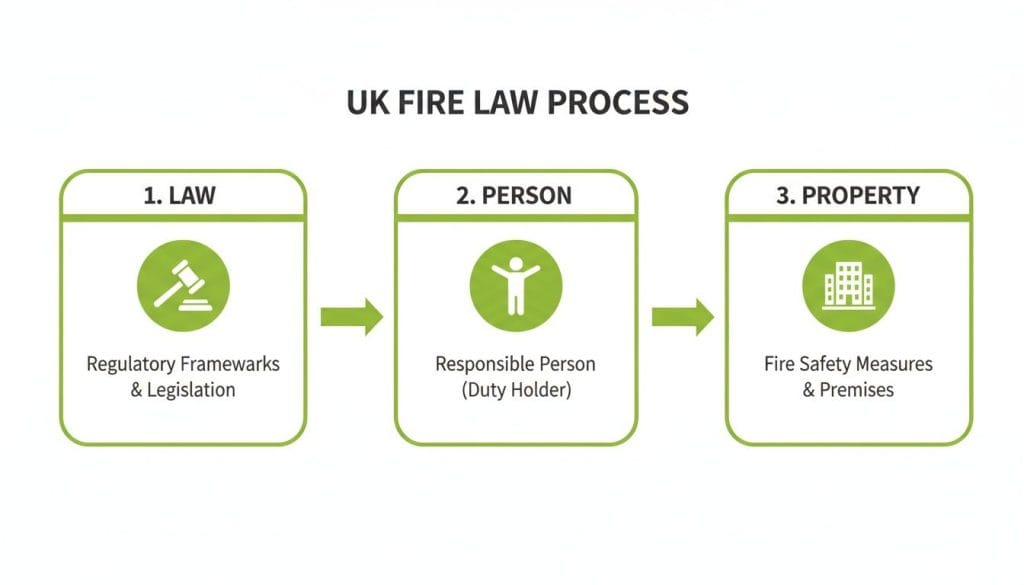
As you can see, legal compliance starts with identifying who holds the duty. Only then can an effective assessment of the physical building begin.
Failing to carry out a suitable and sufficient fire risk assessment is a criminal offence. The penalties should not be taken lightly.
Local Fire and Rescue Services can issue enforcement notices, forcing you to make specific improvements by a strict deadline. They can also serve prohibition notices, which can shut down all or part of your building until it is made safe. Ultimately, non-compliance can lead to prosecution, resulting in unlimited fines and, in the worst-case scenarios, a prison sentence.
Understanding the full scope of your obligations is non-negotiable. That is why we have created a separate, detailed guide covering the specific fire risk assessment legal requirements.
This knowledge transforms the assessment from a procedural chore into a vital pillar of responsible property management, one that protects lives, livelihoods, and your business.
Identifying fire hazards is where your legal duty as the Responsible Person moves from paperwork to the practical reality of your building. It is the first hands-on step in any fire risk assessment, and it demands a sharp eye and a methodical approach.
You need to start thinking like a fire. Look for the three things it needs to start and spread: a source of ignition, fuel to burn, and oxygen. This is not just a quick walk-through; it is a critical inspection of how your property is used every day, uncovering both obvious dangers and hidden risks in human habits, ageing wiring, and overlooked corners.
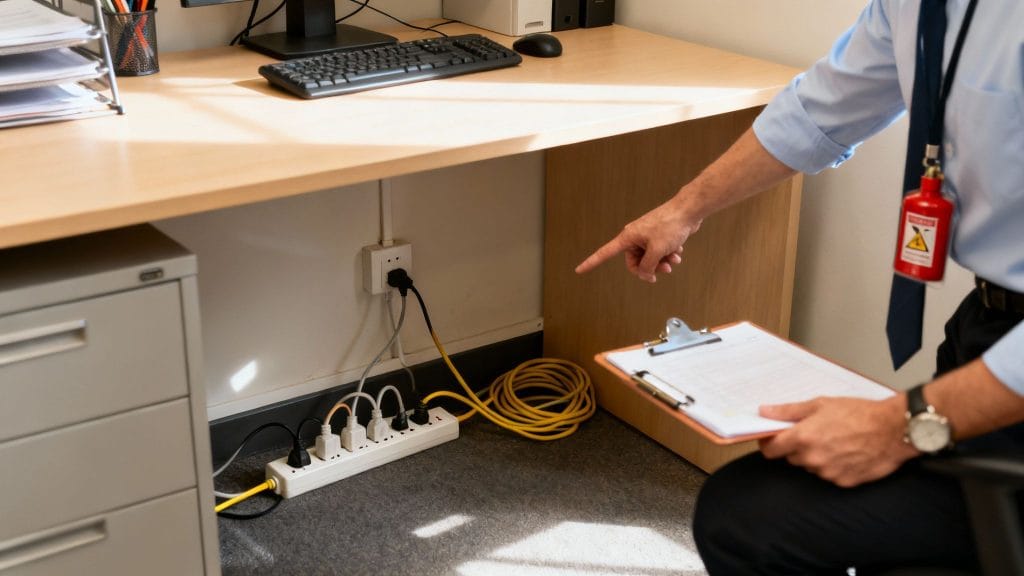
Ignition sources are the sparks that can start a fire. They are often everyday items that become major hazards when they are faulty, used incorrectly, or left in the wrong place. When inspecting the property, you must be systematic.
Keep an eye out for these common culprits:
The first critical step in any fire risk assessment, as required by the Regulatory Reform (Fire Safety) Order 2005, is identifying fire hazards. This means searching for things like faulty electrics, overloaded sockets, or discarded cigarettes, especially in HMOs where multiple tenants live in close quarters.
UK fire statistics show that cooking appliances were the cause of a significant proportion of accidental dwelling fires. While total incidents have fallen over the long term, unattended cooking remains a major risk, particularly in shared kitchens where responsibility can become blurred.
Once a fire has a spark, it needs something to burn. Fuel is any combustible material, and you will find it in places you might not expect. Your job is to spot what could burn and determine how it could help a fire spread through the property.
Consider these common sources of fuel:
A classic and incredibly dangerous scenario we often see is flammable junk stored in a boiler cupboard within a block of flats. Residents may use it to stash old furniture, paint tins, or cleaning chemicals, turning a small, enclosed space with a built-in ignition source into a serious hazard.
Different properties have different risks. A restaurant kitchen faces different challenges to an office block. Knowing what to look for based on your building type helps you focus your inspection where it matters most.
| Property Type | Common Ignition Sources | Common Fuel Sources |
|---|---|---|
| HMOs / Blocks of Flats | Unattended cooking, overloaded sockets in bedrooms, portable heaters, faulty tenant appliances | Personal belongings in corridors, stored items in cupboards, upholstered furniture |
| Offices | Faulty computer equipment, overloaded extension leads, kitchen appliances (kettles, microwaves) | Paper waste, cardboard boxes, office furniture, stored stationery |
| Retail Shops | Faulty lighting (especially display lighting), electrical equipment, arson | Cardboard packaging, textiles and clothing, plastics, high-density stock |
| Warehouses | Forklift truck charging stations, faulty machinery, smoking in unauthorised areas | Palletised goods, plastics, chemicals, packaging materials |
| Restaurants/Cafes | Cooking appliances (deep fat fryers), faulty extraction systems (grease build-up), gas leaks | Cooking oils, flammable cleaning chemicals, linens, paper goods, gas cylinders |
This table is not exhaustive, but it highlights the kind of specific hazards you should be actively looking for during your walk-around. Thinking in these terms makes your assessment much more effective.
To do this properly, you need to be thorough. Do not just stick to the main corridors. Check every room, cupboard, and external area you are responsible for. That includes plant rooms, lift motor rooms, and even roof voids where hazards can go unnoticed for years.
For a more structured walk-through, our comprehensive fire risk assessment checklist can be a huge help in guiding your inspection and ensuring you do not miss anything.
As you go, ask yourself critical questions. What happens in this area? How do people behave here? If a small fire started by accident, could it quickly become a large, uncontrollable one? Adopting this mindset is what separates a genuine, effective hazard identification process from a simple box-ticking exercise.
Once you have methodically pinpointed the fire hazards in your property, the next crucial step is to determine who could be harmed and, most importantly, why. It is a common mistake to simply do a headcount of employees or tenants. A legally sound fire risk assessment goes much deeper, forcing you to focus on vulnerability and specific circumstances.
This part of the process is about the people, not just the building. You need to consider everyone who might be on the premises: staff, residents, visitors, contractors, and even the public if your property is accessible. The goal is to understand how a fire would affect different people in different ways.
Certain groups of people are naturally at greater risk during a fire. As the Responsible Person, it is your legal duty to give them special consideration. These groups often need tailored safety measures that go beyond standard procedures.
Think about individuals who might struggle with:
The second pivotal step in UK fire risk assessments is evaluating risks to people, determining who might be endangered and how fires could spread in premises like HMOs or residential blocks. Under the 2005 Order, this involves mapping occupant vulnerabilities, such as elderly tenants or disabled residents, against escape challenges. Statistics highlight the danger: smoking-related fires, often starting in bedrooms, remain a leading cause of fire fatalities in the UK.
To truly understand the risks people face, you need to move beyond a simple checklist and start thinking in real-world scenarios. This is what separates a tick-box exercise from a proper assessment. An experienced assessor asks practical, probing questions to test how your safety plans would hold up when things go wrong.
In an office block, for instance:
The questions shift slightly for a residential block of flats or an HMO:
A critical question for any landlord or managing agent is: ‘If a fire starts in a ground-floor flat, what specific challenges does that create for the elderly resident living on the top floor?’ This thinking forces you to connect a specific hazard to a vulnerable person and evaluate the adequacy of your escape route.
Thinking through these situations helps you spot the weaknesses in your current fire safety strategy. It might reveal that a standard audible alarm is useless for some residents, or that a key escape route becomes blocked under certain conditions. For more practical illustrations, you may find it helpful to look at some real-world examples of fire risk assessments.
By carefully considering who is at risk and the specific reasons why, you ensure your fire safety measures are truly fit for purpose. You are protecting the actual people in your building, not just ticking boxes on a form. This human-centric approach is fundamental to fulfilling your legal and moral duties.
Once you have a clear picture of the hazards in your building and the people who might be affected, it is time to take a hard look at the fire safety measures you already have in place. This is not just a tick-box exercise to see what exists; it is about making a judgement on whether these measures are good enough to protect people if a fire breaks out.
You are essentially weighing up your defences against the risks you have just identified. The goal is to find any gaps between what you have and what UK fire safety law demands. A small weakness here can have devastating consequences in an emergency.
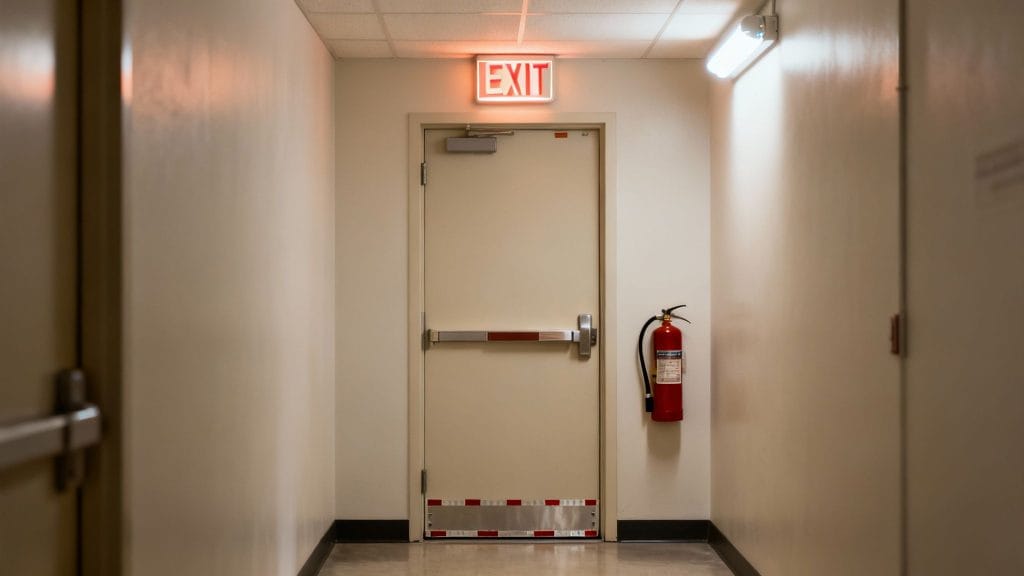
The number one priority of your fire safety plan is to ensure everyone can get out of the building safely and quickly. This means your escape routes must be clear, unobstructed, and suitable for the number and type of people in the building.
When walking the site, you need to be ruthless in checking the following:
A common failure I see regularly is a fire exit in a restaurant’s stockroom blocked by boxes of supplies. It might be convenient for staff, but it makes the escape route completely useless and leaves the business owner liable for prosecution.
How will anyone know there is a fire? A reliable detection and warning system is critical, especially in larger properties or buildings where people sleep. Your assessment must confirm that your system is suitable for the level of risk.
You need to look at both the system’s design and its current state:
While getting everyone out is always the priority, having the right firefighting equipment allows trained people to tackle a small fire before it gets out of control. This can prevent a minor incident from becoming a major disaster.
Your evaluation must confirm that the equipment provided is correct for the types of fire hazards present. For example, placing a water extinguisher next to a large electrical intake cupboard is not just useless; it is actively dangerous.
Check that:
If a fire causes the main power to fail, the sudden darkness can cause instant panic. Emergency lighting and clear signage are essential to guide people safely towards an exit.
Your review must verify:
Finally, you need to look at the building’s passive fire protection. These are the built-in features designed to contain a fire and stop it spreading, buying everyone precious time to escape.
The most important of these is the fire door. A good, properly maintained fire door can hold back smoke and flames for 30 to 60 minutes. Unfortunately, they are one of the most commonly abused safety features. Check that every fire door is:
A thorough check of these five key areas will give you a solid understanding of whether your current safety measures are adequate. If you find significant problems in any of them, they must go straight to the top of your action plan.
A fire risk assessment does not end when you leave the property. The on-site inspection is the information-gathering stage; the real work starts when you turn your notes and observations into a formal, legally sound record and a practical plan for improvement. This is where your assessment becomes a tool for creating genuine change.
If you have five or more employees, keeping a written record of your fire risk assessment is a direct legal requirement under the Fire Safety Order 2005. Even for smaller businesses or landlords, it is simply good practice. Without a written document, you have no way to prove you have fulfilled your duty if a Fire and Rescue Service inspector visits.
Think of this document as your evidence. It shows you have systematically looked for hazards, considered who is at risk, and properly evaluated your existing safety measures. Most importantly, it demonstrates you have a clear plan to fix what is wrong.
A good record is much more than a simple list of problems. It needs to be a clear, logical document that anyone, including an external authority, can pick up and understand. It should detail all your significant findings, giving proper context to each one.
Your written assessment must include:
Recording and reviewing your findings is the crucial third step in any UK fire risk assessment. This process produces an actionable document that satisfies Article 9 of the 2005 Order, something property managers and HMO freeholders need to prove their diligence. Robust documentation is vital for managing persistent fire risks and demonstrating compliance.
Once your findings are documented, the next job is to create an action plan. This is your to-do list for making the premises safe. But just listing the issues is not enough; you must prioritise them based on risk.
A blocked fire exit is a high-priority, life-threatening issue that demands immediate action. In contrast, a faded fire safety sign, while still a compliance failure, can be scheduled for replacement within a reasonable timeframe. This risk-based approach shows an inspector that you understand the difference between an urgent danger and a necessary improvement.
A simple prioritisation system makes your plan much more effective:
For every action point, assign a realistic completion date and name the person responsible for getting it done. This creates accountability and turns your assessment from a static report into a living, working management tool. As you put your plan together, learning how to create a step-by-step guide can help ensure your instructions are clear and easy for your team to follow.
This documented plan is your roadmap to compliance and, more importantly, to a safer building for everyone inside.
Completing your first fire risk assessment is a huge step forward, but your legal duties do not stop there. Think of your assessment as a live document, not a one-off task to be filed away and forgotten. Under UK law, the Responsible Person has an ongoing duty to review it regularly, ensuring it always reflects the reality of the premises.
This is about maintaining compliance and protecting lives. Buildings are not static; things change, and your assessment must keep pace.

As a rule of thumb, an annual review is considered best practice. It is what enforcing authorities like the local Fire and Rescue Service expect to see. This regular check-up ensures nothing significant has been missed over the past twelve months.
However, you cannot just wait for the annual review date if something significant changes. The law requires an immediate review following any major alteration to the building or its use.
Key triggers for an immediate review include:
A fire risk assessment that is out of date is not a valid defence. If an incident occurs and your assessment does not reflect the current state of the premises, it will be deemed inadequate. This leaves you exposed to enforcement action and even prosecution.
Even with a solid plan, it is natural to have some questions. Landlords, business owners, and property managers across the UK often run into the same queries, so let us clear them up.
The law does not specify a rigid timetable, but best practice, and what the Fire and Rescue Service expects to see, is a formal review at least annually.
That said, you cannot just wait for the anniversary to roll around. You are legally required to conduct a fresh assessment immediately if there is a significant change to your property. This could be building alterations, a new use for the premises, or an increase in the number of occupants. An out-of-date assessment is not a compliant one.
Technically, the legislation says the assessment must be done by a ‘competent person’. This means someone with the necessary training, experience, and knowledge to identify risks and recommend sensible safety measures.
For a very small, simple space with low risks, such as a single-room office, the Responsible Person might feel confident enough to handle it. However, for most properties, that is not the case. If you are managing an HMO, a block of flats, or a commercial building with specific hazards, appointing a professional assessor is by far the safest route to compliance.
A common pitfall is underestimating the complexity involved. A professional assessor brings an objective eye and deep regulatory knowledge that is difficult to replicate. They ensure your assessment is genuinely ‘suitable and sufficient’ in the eyes of the law, not just a box-ticking exercise.
If the Fire and Rescue Service inspects your property and decides your fire risk assessment is not up to scratch, they will take enforcement action.
This could start with informal advice and a list of improvements. But it can quickly escalate to a formal Enforcement Notice, which is a legal demand to fix specific failings by a strict deadline. In situations where there is a serious risk to life, they can issue a Prohibition Notice, shutting down part or all of your building on the spot. Failing to comply can lead to prosecution, unlimited fines, and even a prison sentence.
Navigating UK fire safety is a major responsibility, and there is a lot at stake. At HMO Fire Risk Assessment, our certified assessors provide the expertise and clarity you need to protect your property and its occupants. Ensure your assessment is thorough, compliant, and gives you a clear plan of action. Book your certified fire risk assessment today.
For real worked examples, see our guide to practical examples of fire risk assessments.
Most HMO landlords I talk to can rattle off their fire door requirements, their alarm grade, and their emergency lighting checks without missing a beat....
Most of the fire safety advice on this site assumes you already have a working HMO. This one is for the stage before that: the...