
How Often Should Fire Extinguishers Be Serviced? A UK Compliance Guide
25/01/2026
For landlords, property managers, and business owners, understanding fire extinguisher maintenance is not just a box-ticking exercise. It’s a legal duty under the Regulatory Reform (Fire Safety) Order 2005. Getting this wrong does not just put people at risk—it can lead to serious legal and financial consequences.
The good news is that the schedule itself is straightforward. It is all about a simple rhythm of regular checks and professional servicing. This guide explains what is required, who is responsible, and why it matters for your UK business or property.
Think of your servicing schedule like owning a car. You do the quick, simple checks yourself—like checking the tyres and oil—but you leave the annual MOT and service to a qualified mechanic. Fire extinguishers work in much the same way.
This timeline breaks down the routine duties you need to follow to keep your extinguishers compliant and ready for action.
As you can see, the routine is split between frequent, simple checks that anyone on your team can handle, and the less frequent but much more technical servicing that must be done by a professional.
To make this even clearer, here’s a quick summary of what’s required.
This table breaks down the minimum legal requirements for fire extinguisher checks in UK non-domestic properties, including HMOs and commercial buildings.
| Frequency | Type of Check | Who Performs It | Purpose |
|---|---|---|---|
| Monthly | Visual Inspection | The ‘Responsible Person’ or designated staff | To spot obvious issues like damage, low pressure, or obstructions. |
| Annually | Basic Service | Competent Person (e.g., BAFE-certified engineer) | An in-depth inspection of all parts to ensure it functions correctly. |
| Every 5 Years | Extended Service | Competent Person (e.g., BAFE-certified engineer) | A full discharge test and internal inspection for most extinguishers. |
These intervals are the minimum required to stay compliant. Now, let’s look at what each of these checks actually involves.
The first layer of defence is a quick visual check that needs to be done at least once a month. You do not need an engineer for this. The ‘Responsible Person’ for the building—or someone they’ve trained and delegated the task to—can easily do it.
The whole point is to catch obvious problems before they turn into critical failures during an emergency.
During these checks, you are just making sure that:
It is absolutely vital to record every monthly check in your fire safety logbook. This creates a paper trail that proves you are fulfilling your duties, which is invaluable if the Fire and Rescue Service ever pays a visit. For a deeper dive, you can learn more about fire extinguisher maintenance requirements in our detailed guide.
The second, and legally mandatory, part of the schedule is the annual service. This must be carried out by a ‘competent person’—which in plain English means a qualified and certified fire safety engineer.
This is a much more thorough inspection than the monthly look-over and must be done every 12 months. A BAFE-certified engineer will methodically assess the extinguisher’s mechanical parts, check its weight is correct, look for any internal corrosion, and replace small service parts to ensure it fully complies with British Standard BS 5306-3.
Knowing how often to service your fire extinguishers is one thing. But understanding why it is your legal responsibility is far more important. In the UK, the law that governs this is the Regulatory Reform (Fire Safety) Order 2005, and it places the burden of fire safety firmly on the shoulders of a designated ‘Responsible Person’.
This is not just some vague bit of jargon. It refers to a specific person or company. If you are a business owner, an HMO landlord, a company director, or a managing agent for a block of flats, there is a very good chance that person is you. If you have control over any non-domestic property, the law sees you as the Responsible Person.
The law is clear on this. The Responsible Person is whoever has control over the premises. That typically means:
This is not an optional role you can delegate away. It is a legal appointment that comes with real weight and direct accountability for the safety of every single person in that building. A huge part of that duty is making sure all fire-fighting equipment is maintained “in an efficient state, in efficient working order and in good repair.”
Put simply, if an extinguisher fails during a fire because it was not serviced, the legal responsibility lands squarely with you. This is not just a maintenance slip-up; it is a serious breach of the law with potentially life-changing consequences.
The legislation makes it clear that neglecting these duties is a serious offence. Fire and Rescue Authorities have the power to show up and inspect your premises and your records at any time. If they find you have failed to maintain your equipment, they can issue enforcement notices, legally compelling you to fix the problems immediately.
Ignoring your duties can lead to severe penalties. If a fire breaks out, a poorly maintained extinguisher could be the difference between a minor incident and a disaster. That failure could lead to prosecution, with courts handing out unlimited fines and, in the worst cases, prison sentences.
Under the Regulatory Reform (Fire Safety) Order 2005, landlords and HMO managers are legally required to have their fire extinguishers serviced every 12 months. This is not a job for a handyman; it has to be done by a qualified, third-party accredited engineer, as laid out in British Standard BS 5306-3. You can check out a plain English guide to UK fire safety regulations for more on what is expected of you.
This annual ‘basic service’ is there to make sure every extinguisher is ready to go, with checks on pressure gauges, seals, and safety labels to prevent it from failing when it’s needed most. To get the full picture, it helps to understand the wider landscape of compliance and safety standards, which can vary by region. Ultimately, keeping up with the servicing schedule is not just about ticking a box for compliance; it is a fundamental part of protecting lives, your property, and your business.
While the annual service needs a certified engineer, the monthly visual check is a hands-on legal duty that falls squarely on the shoulders of the Responsible Person. Think of it as your first line of defence. It is a simple but vital part of your fire safety routine, designed to spot obvious problems before they turn into critical failures in an emergency. The best part? It takes minutes and requires no specialist tools.
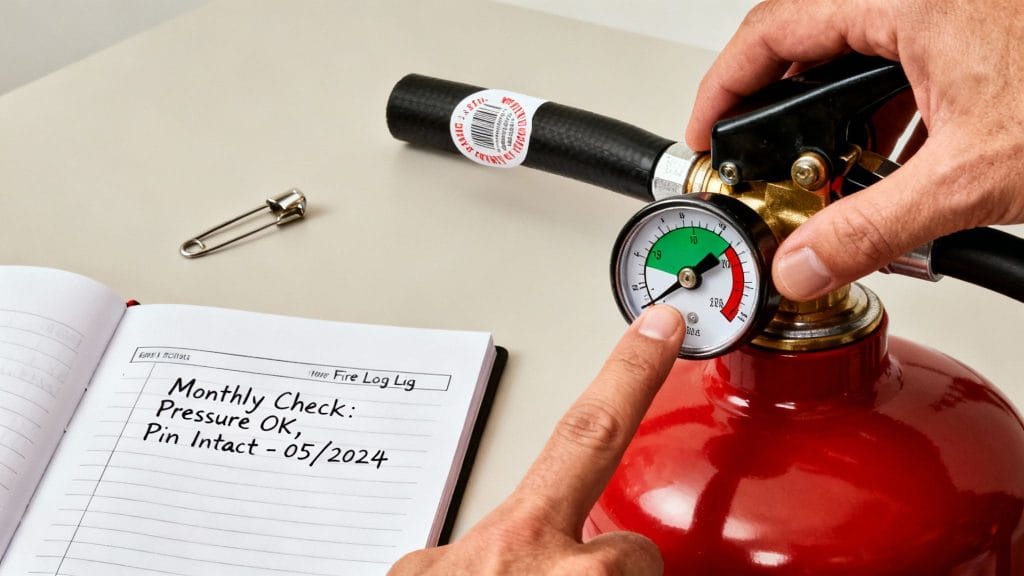
The whole point is to make sure every extinguisher is where it should be, is easy to get to, and looks ready for immediate use. Documenting these checks in your fire logbook is non-negotiable—it creates a clear, auditable trail for the Fire and Rescue Service if they ever come calling.
Running through these checks is incredibly straightforward. Just follow these five simple steps for every single extinguisher on your premises, and you will be meeting your obligations.
Proper record-keeping is not just good practice; it is a legal requirement. After finishing your visual inspections, you must write down the details in your fire safety logbook. This entry should include the date, the name of the person who did the check, and a note of any issues you found.
This simple monthly routine, combined with the annual service from a certified engineer, forms the backbone of UK fire extinguisher maintenance under BS 5306-3 and the 2005 Fire Safety Order. This is especially critical for HMO managers juggling compliance across several properties. To learn more about building a robust safety process, check out our detailed guide on how to maintain a compliant fire safety checklist.
While your monthly visual checks are a great first line of defence, the mandatory annual service is a different beast altogether. This is a deep dive into the health of your extinguisher, and it legally must be carried out by a competent person. We are not talking about a general handyman here; British Standard BS 5306-3 requires a qualified engineer with the right training, specialist tools, and in-depth knowledge to sign off an extinguisher as safe and ready for action.
This annual inspection goes way beyond a quick glance. It is a proper mechanical and safety MOT for your fire equipment, designed to guarantee it will work perfectly under the extreme pressure of a real fire. Just looking at the pressure gauge is not enough to know if it will hold up when you need it most, which is precisely why the law demands this professional check-up.
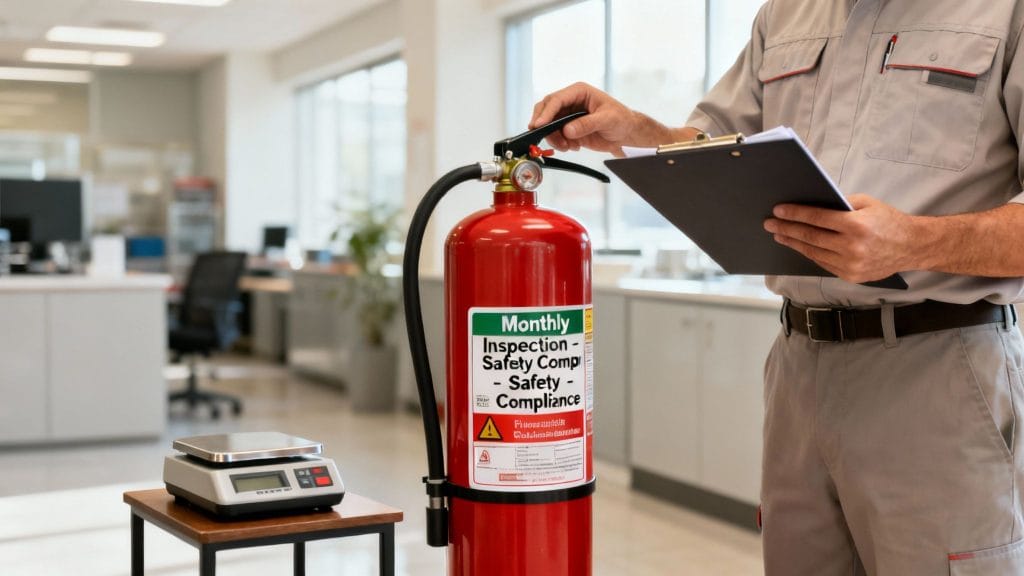
When a certified engineer arrives on site, they follow a standardised, systematic process for every single unit. This is not just about ticking boxes; it is a methodical approach that ensures no detail is overlooked and every part is checked against strict safety regulations.
Here’s a snapshot of what their inspection involves:
This is where choosing the right professional really matters. Opting for a third-party accredited technician, like one certified by BAFE (British Approvals for Fire Equipment), is crucial. This accreditation is your independent proof that the engineer knows their stuff, works to the correct British Standards, and has all the proper tools for the job.
Once the service is complete, the engineer will fix an updated service label to the extinguisher. This label is your evidence, clearly showing the service date, the engineer’s details, and when the next service is due. It creates a clear, visible audit trail for your fire safety logbook and any inspections by the Fire and Rescue Service.
This rigorous annual service has a proven track record of saving lives. Data reveals that the effectiveness of fire extinguishers in tackling fires has climbed from 80% in 2003 to 93% in 2021—a success story directly linked to proper maintenance standards. This improvement prevents an estimated 1,629 injuries and 24 deaths every single year, highlighting the life-saving value of professional servicing. You can learn more about the impact of regular extinguisher servicing on fire safety outcomes.
Beyond the yearly check-up, your fire safety plan needs to account for the less frequent but equally critical maintenance known as extended servicing and overhauls. It is easy to forget about these, but doing so can lead to surprise costs and serious compliance gaps that put people at risk. These deeper inspections are a mandatory part of BS 5306-3 and are designed to confirm the long-term integrity of the extinguisher itself.
Think of it this way: an annual service is like a regular MOT for your car, checking all the working parts. An extended service, however, is more like a full engine strip-down. It is the only way to be sure the cylinder is structurally sound after years of being under constant pressure.
For the most common types of extinguishers, a much more intensive service is required every five years. This is a crucial milestone in the life of the unit and goes far beyond the basic annual once-over.
This process is the only way to be absolutely certain that the internal lining has not failed and that the unit will work safely and powerfully after half a decade on the wall.
Carbon dioxide (CO2) extinguishers are a different beast altogether because they hold gas at incredibly high pressure. Because of this, they have a separate, more rigorous requirement when they hit the ten-year mark.
A CO2 extinguisher must undergo a hydraulic pressure test, often called a “stretch test,” every 10 years. This involves sending the cylinder to a specialist test centre where it is safely filled with water to an extreme pressure to ensure the metal has not weakened over time.
Honestly, the cost and hassle of this test often make it more economical to simply replace the CO2 unit with a brand new one. Factoring this ten-year replacement cost into your long-term budget is a smart move that avoids nasty surprises down the line. Planning for these five and ten-year events means you can manage your costs smoothly while keeping your properties fully compliant and, most importantly, safe.
Doing the right thing is only half the battle in fire safety. The other half is proving you have done it. If the Fire and Rescue Service ever inspects your property, your records are the first thing they will ask for. Without them, all your hard work is practically invisible, and you cannot demonstrate you are meeting your legal duties under the Fire Safety Order 2005.
Think of it this way: your records are the evidence that shows you take your responsibilities seriously. They are not just admin; they are a critical part of your entire fire safety strategy.
Your fire safety logbook is the central hub for everything fire-safety-related. It should be a complete history of every check, service, fault, and fix for all the fire-fighting equipment on your premises, especially your extinguishers.
A well-maintained logbook is your best friend during an inspection. It gives the inspector a clear, chronological story of your maintenance activities, making it dead simple for them to tick the compliance box.
For every single check or service, your logbook must detail:
After every annual service, the engineer will stick a maintenance label onto the extinguisher. This little label is a quick, at-a-glance record right on the unit itself and is a crucial piece of your compliance puzzle.
Think of the service label as the MOT certificate for your extinguisher. It provides essential information at a glance, confirming when it was last professionally serviced and when the next one is due.
Typically, this label shows the date of the last service, the engineer’s details, and what kind of service was done (e.g., basic or extended). It provides instant visual proof that the extinguisher is up to date, which is invaluable for your own peace of mind and for any inspecting authorities. Together, the logbook and the service label create a solid, verifiable record of your fire safety diligence.
Even with a clear schedule in front of them, landlords and business owners always have practical questions about getting their fire extinguishers serviced. That is perfectly normal. Getting the right answers is key to feeling confident that you are doing everything right and meeting your duties as the Responsible Person.
Let’s walk through some of the most common queries we hear every day.
No, you cannot. While you are expected to carry out and log the monthly visual checks yourself, the law is very clear that the mandatory annual service must be done by a ‘competent person’.
In the real world, this means a BAFE-certified engineer or someone with a similar third-party accreditation. They are trained to the BS 5306 standards and know exactly what to look for. Trying to service them yourself will not satisfy legal requirements, could easily invalidate your property insurance, and would leave you completely exposed if a fire ever broke out. It is a false economy that is just not worth the risk.
If a certified engineer finds a serious fault they cannot fix—like deep corrosion or a major pressure loss—they will immediately label the unit as ‘condemned’. This means it has to be taken out of service right there and then.
It then becomes your responsibility as the Responsible Person to get it replaced without delay. Leaving a gap in your fire-fighting equipment puts the building and its occupants at risk, and means your premises are no longer compliant with the Fire Safety Order.
Yes, they absolutely do. A new extinguisher needs what is called a ‘commissioning service’ the moment it is installed. This is not just unwrapping it from the box; it is a vital check carried out by a competent person.
They will confirm the extinguisher is the right type for that specific location, make sure it was not damaged during delivery, and check that it has been assembled and installed correctly. Once commissioned, it officially enters the normal maintenance cycle: your monthly visual checks, followed by its first full annual service 12 months later.
The cost of servicing is a predictable and manageable business expense, though it can vary a bit depending on where you are and which company you use.
As a rough guide, a standard annual service for a single extinguisher typically costs between £15 and £25. Most providers will have a minimum call-out charge to cover the engineer’s visit.
The more in-depth 5-year extended service, which involves a full test discharge and refill, is naturally a bit more expensive. You can expect this to be somewhere between £35 and £75 per unit. The best advice is to always ask for a clear, itemised quote from a certified provider so you know exactly what the costs will be upfront.
At HMO Fire Risk Assessment, we provide BAFE-certified fire extinguisher servicing to help you meet your legal obligations with confidence. Our experienced engineers ensure your equipment is compliant, effective, and fully documented. Get in touch to arrange your fire extinguisher maintenance.
Most HMO landlords I talk to can rattle off their fire door requirements, their alarm grade, and their emergency lighting checks without missing a beat....

Most of the fire safety advice on this site assumes you already have a working HMO. This one is for the stage before that: the...