
How often should fire risk assessments be reviewed: A UK Responsible Person’s Guide
21/01/2026
In the UK, the accepted industry standard is clear: a fire risk assessment should be formally reviewed at least every 12 months. While the law itself asks for a 'regular' review, this annual check has become the benchmark for keeping your building compliant and your safety measures effective.
This guide is for business owners, landlords, facilities managers, and anyone designated as the 'Responsible Person' for a UK property. By the end, you will understand your legal duty to review your assessment, the key events that trigger an immediate review, and the practical steps needed to remain compliant.
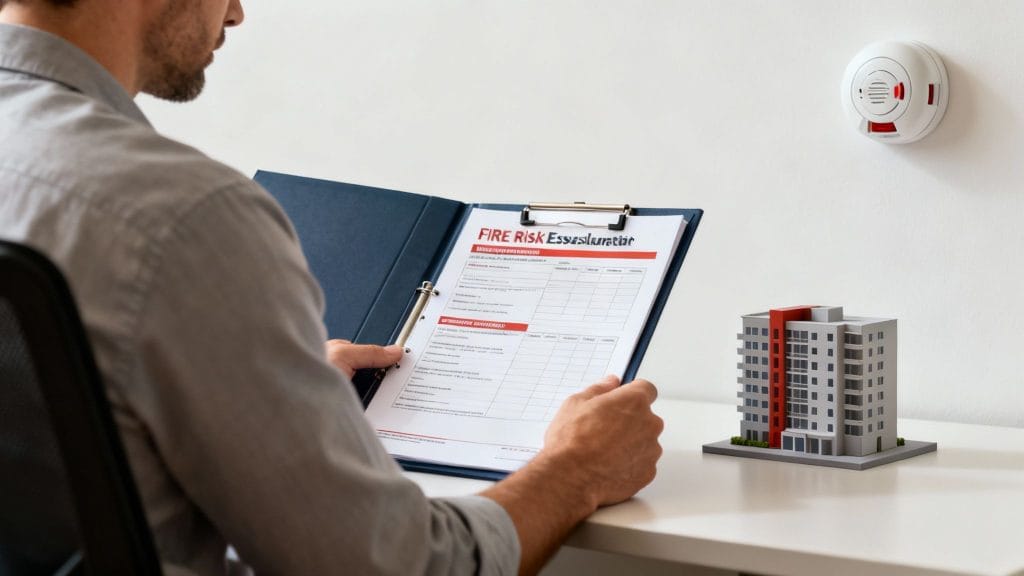
It is crucial to understand the legal requirements first. A fire risk assessment is not a document you complete once and file away. Think of it as a live document that must always reflect the real-world conditions of your property.
This ongoing duty falls squarely on the shoulders of the Responsible Person. This is a specific legal role that applies to anyone with control over non-domestic premises. This could be you if you are a:
The purpose of a review is to ensure the assessment remains ‘suitable and sufficient’. In plain English, that means it must continue to identify hazards and keep people safe.
The primary legislation is the Regulatory Reform (Fire Safety) Order 2005. It states that assessments must be reviewed 'regularly' but does not specify an exact timeframe like "every 365 days."
The 12-month rule has emerged from decades of best practice and official guidance from fire authorities and professional bodies. Today, an annual review is the recognised standard expected by the Fire and Rescue Service, insurance companies, and competent assessors across the UK. Sticking to an annual schedule ensures your fire safety measures keep pace with the small, gradual changes that happen in any building over time.
Treating your fire risk assessment as a living document is a fundamental legal requirement. An outdated assessment is a direct compliance failure that can lead to serious consequences. It fails to account for changes that could introduce new fire hazards or render existing safety measures ineffective.
An annual review demonstrates due diligence. It provides documented proof to enforcement authorities, such as the local Fire and Rescue Service, that you are actively managing your fire safety responsibilities and taking the protection of life seriously.
This duty is non-negotiable. It keeps you compliant with the law, ensures your building’s insurance policy remains valid, and, most importantly, provides real, ongoing protection for employees, residents, and visitors. To get a full picture of what’s required, it’s worth understanding the core fire risk assessment legal requirements.
To stay on top of your legal duties, many landlords and property managers find that using dedicated software can make a significant difference. The best property management apps can be useful for tracking important deadlines and keeping all your compliance documents in one place, so nothing gets missed.
While the annual review provides a solid, predictable schedule, it is a significant mistake to think of it as a fixed appointment you can simply set and forget. Your fire risk assessment is a dynamic safety tool, not a static document. Certain events can completely change the risk profile of your property overnight, making your existing assessment dangerously out of date.
As the Responsible Person, you have a legal duty to identify these triggers and act immediately, regardless of when your last review took place. Waiting for your next scheduled check after a major change is a serious compliance failure. It creates a dangerous gap where new hazards are unaccounted for, potentially voiding your insurance and, most importantly, putting lives at risk.
Any structural or layout alterations can introduce new fire risks or interfere with the safety measures you already have in place. These changes demand an immediate review of your fire risk assessment to ensure your protective measures are still adequate.
Common examples include:
Consider a new mezzanine floor in a warehouse. It does not just add another level requiring protection; it might also obstruct the smoke detectors and sprinklers below, preventing them from working effectively.
How your building is used has a major impact on its fire risk profile. When the people using the building or the activities they carry out change, your assessment needs to be updated to reflect that new reality.
Consider these scenarios:
The introduction of vulnerable persons is a particularly critical trigger. If your premises begins to accommodate elderly people, young children, or individuals with disabilities, your entire fire safety strategy, especially your evacuation plan, must be reviewed urgently to ensure their specific needs are met.
Even a small, quickly contained fire or a "near miss" is a clear warning that your current fire safety measures may have failed. These events are crucial learning opportunities and legally require an immediate review of your fire risk assessment. A fire, no matter how small, proves that a potential ignition source found a fuel source. Your review needs to investigate why this happened and what must change to prevent it from happening again.
Likewise, a near miss, such as finding a fire door wedged open or an emergency exit blocked during a routine check, reveals dangerous weaknesses in your day-to-day safety management. Ignoring these red flags is negligent. The purpose of the review is to find the root cause of the failure and implement robust corrective actions, reinforcing the assessment as a proactive tool for reducing risk, not just a reactive measure after a disaster.
A common mistake is assuming fire safety follows a simple, one-size-fits-all calendar. It does not. The law, specifically the Regulatory Reform (Fire Safety) Order 2005, demands that your review schedule matches the real-world risk in your building.
Simply ticking a box with an annual review might be sufficient for a small, quiet shop, but it would be dangerously negligent for a block of flats with vulnerable residents or a busy HMO. The goal is to create a sensible, defensible review frequency that stands up to scrutiny from the Fire and Rescue Service and your insurers.
For straightforward, low-risk properties, a professional review every 12 months is a solid and widely accepted baseline. These are premises with few staff, simple layouts, and no significant fire hazards.
Examples include:
Even in these simple settings, the Responsible Person should still be conducting regular, informal walk-arounds. A quick check to ensure fire exits are not blocked or fire doors are not wedged open can make all the difference.
When the building becomes larger, busier, or more complex, the risk level naturally increases. For these medium-risk properties, your annual professional assessment should be supported by more frequent and formalised in-house checks.
This category typically covers:
Here, a designated competent person should carry out documented checks every three to six months. This helps you stay on top of issues caused by higher foot traffic and day-to-day operational changes, bridging the gap between your annual assessments.
High-risk properties demand the most stringent review schedule. In these buildings, the potential for a fire to start and spread is far greater, and the consequences can be catastrophic. An annual review is the absolute legal minimum, but best practice and common sense indicate a formal review every six months.
A high-risk designation is not just about the building itself; it is about the people inside. The moment you introduce sleeping accommodation or have vulnerable occupants, the risk profile increases dramatically.
Properties that fall squarely into this high-risk category include:
The cost of getting this wrong, both financially and in human terms, is immense. Data has previously shown that large fires in UK commercial properties can cause millions of pounds in damages, highlighting that a casual approach to fire safety in high-risk buildings is not an option.
The flowchart below shows the key events that should trigger an immediate, unscheduled review of your fire risk assessment, regardless of your property’s risk level.
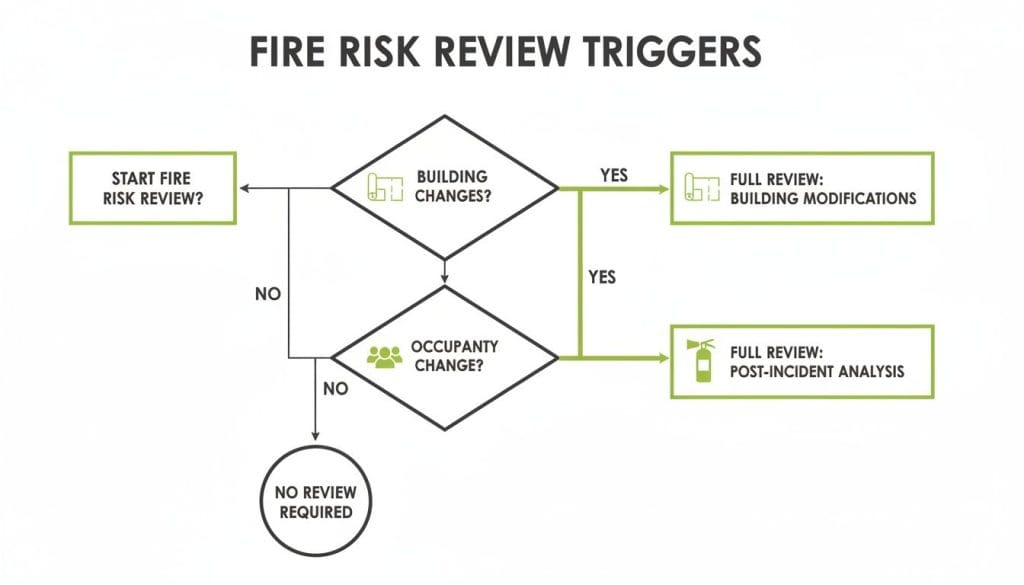
This makes it clear that your review schedule cannot just be a fixed date in the diary. It has to be a dynamic process, ready to react instantly to changes in the building, its occupants, or any new safety information.
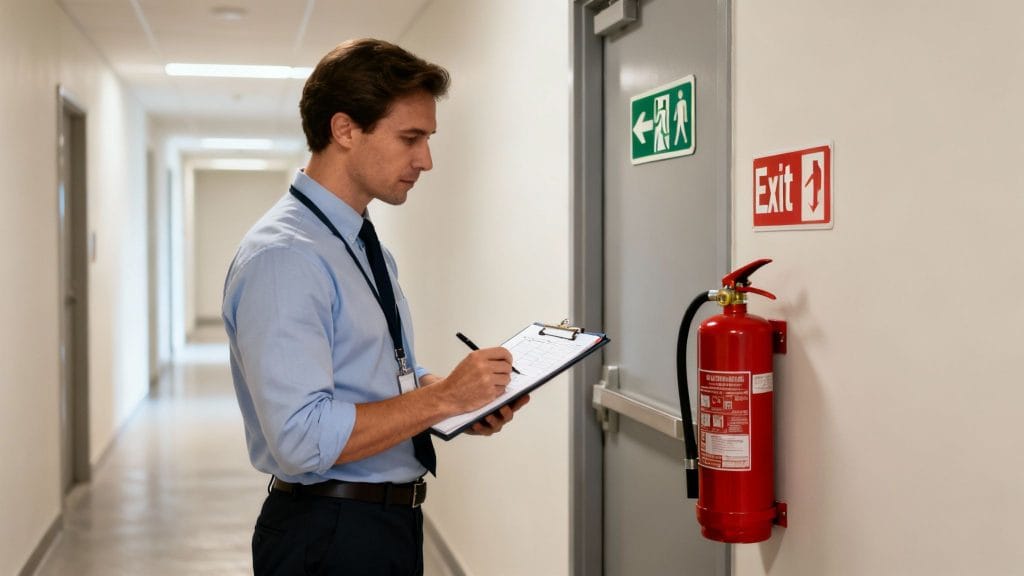
Knowing when to review your fire risk assessment is one thing. Understanding what that review actually involves is equally critical. It is far more than a quick glance over an old document. A proper review is an active, hands-on process to confirm your fire safety measures are still fit for purpose.
A thorough review ensures your assessment is a true reflection of your property as it stands today, not as it was a year ago. For any Responsible Person, getting this right is fundamental to staying compliant and keeping people safe. Let’s walk through the key steps.
Your first task is a physical tour of the entire building. This is non-negotiable, as you are looking for any changes, big or small, that have occurred since the last assessment was completed.
You need to look for physical alterations such as:
This physical check grounds your assessment in reality, ensuring it is not just a paperwork exercise.
Your last fire risk assessment likely included a list of "significant findings" or an action plan. A crucial part of any review is to confirm that those actions were completed and are still working as intended.
For instance, if the last report recommended installing new fire safety signs, you need to physically check that the correct signs are now in place and are still easily visible. If it required a faulty fire door to be repaired, you must verify the work was done properly and the door now functions correctly. This is about closing the loop on previous findings.
A review is not just about spotting new problems; it is about making sure old ones were properly fixed. Failing to act on previous recommendations is a major red flag for any inspector and indicates a serious breakdown in safety management.
Your fire logbook is the diary of your building's safety. It provides clear evidence that your systems are being managed day-to-day and that procedures are being followed.
During a review, you or your assessor will need to examine the records for:
Gaps in these records are a clear sign that essential safety duties are being missed, which automatically increases your building’s risk profile. A well-maintained logbook is one of the best indicators of a well-managed, safe property.
To help you stay on track, we have put together a simple checklist. This can serve as a step-by-step guide to ensure you cover all essential bases during your review process.
| Review Step | Action Required | Common Oversight to Avoid |
|---|---|---|
| Physical Walk-Through | Tour the entire premises, comparing its current state to the last assessment. Note all changes. | Forgetting to check "out of the way" areas like basements, lofts, or plant rooms. |
| Previous Actions | Refer to the action plan from your last FRA. Verify that every single point was completed and remains effective. | Assuming a task was done correctly without physically checking the work. |
| Logbook & Records | Scrutinise your fire logbook for complete and consistent records of all tests, drills, and maintenance. | Ignoring small gaps in the records. Consistent omissions suggest a systemic problem. |
| Occupancy & Use | Consider if the number of people, their mobility, or how the building is used has changed. | Not accounting for new tenants or staff members who may be more vulnerable (e.g., lone workers). |
| Update Documentation | Amend your fire risk assessment document to reflect all new findings, changes, and actions. | Simply filing the old document away. The review must result in an updated, current record. |
By working through this checklist, you create a robust and defensible review process. It ensures your fire risk assessment remains a dynamic, living document that genuinely protects your property and its occupants.
Treating a fire risk assessment review as just another piece of administrative paperwork is a dangerous mistake. Under UK law, failing to keep it current is not a minor oversight; it is a serious compliance failure with consequences that can affect your business, your finances, and the people you have a duty to protect. An outdated assessment means you are effectively operating without a valid safety plan.
Your local Fire and Rescue Service is responsible for enforcing the Fire Safety Order. If they inspect your building and find your assessment is old, inadequate, or has not been updated after significant changes, they have a range of legal powers.
These are not suggestions; they are legal directives you cannot ignore.
Ignoring your duty to maintain a current fire risk assessment can lead to prosecution, particularly if that failure contributes to a fire or injury. The courts take these breaches very seriously.
As the Responsible Person, you could face unlimited fines. In the worst-case scenarios, where a blatant disregard for safety has put lives at risk, a prison sentence is a real possibility. These penalties apply equally to individual landlords, small business owners, and company directors.
An outdated fire risk assessment can also invalidate your building’s insurance policy. If a fire occurs and your assessment is found to be non-compliant, your insurer could refuse to pay out, leaving you to cover the catastrophic costs of rebuilding and business interruption yourself.
Beyond the legal and financial consequences, the most devastating outcome of an outdated assessment is the human one. At its heart, a fire risk assessment is a life-saving tool. It identifies hazards, confirms escape routes are clear, and ensures fire alarms will provide that crucial early warning.
When an assessment becomes obsolete, so do these protections. New partitions might block a once-clear escape route. Altered layouts could create blind spots your fire alarms no longer cover. New hazards can emerge and go completely unmanaged. This is how preventable tragedies happen. Keeping your assessment up to date is a fundamental part of your duty to ensure your employees, residents, and visitors are safe.

While the Responsible Person should manage regular in-house checks, UK fire safety law is clear on one point: the person who carries out the fire risk assessment must be competent. This is especially true for your formal annual review.
Engaging a professional fire risk assessor is a critical investment in your legal protection, risk reduction, and business continuity. An expert brings a fresh, objective, and highly trained eye to your property. They are skilled at spotting hidden hazards and subtle compliance gaps that an in-house team, due to familiarity with the environment, might easily overlook.
A competent external assessor provides far more than just another pair of eyes. They bring a current, working knowledge of complex legislation, such as the Fire Safety Act 2021, and understand the practical expectations of local Fire and Rescue Authorities.
This independent verification is invaluable. It demonstrates to insurers and enforcement bodies that you have taken your duties seriously by seeking an impartial, professional judgement on your property’s safety. Should an incident ever occur, this significantly strengthens your legal position.
A professional review offers peace of mind. It confirms that your fire safety strategy is not only compliant on paper but is also robust, defensible, and genuinely effective in practice.
The report you receive from a qualified assessor is not just a list of problems; it is a clear, prioritised action plan. This allows you to direct your resources to the most critical issues first, ensuring your efforts have the greatest impact on reducing risk and protecting lives.
Ultimately, understanding how often fire risk assessments should be reviewed is about maintaining a constant state of safety and compliance. A professional partnership ensures this process is thorough and meets the high standards the law demands.
The assessment becomes a tool for proactive management rather than just a reactive compliance document. This professional oversight helps secure your business against enforcement action, ensures your insurance remains valid, and most importantly, builds a truly safe environment for everyone in your building.
If you're a landlord, managing agent, or business owner, having your annual review conducted by a competent professional is the single most effective way to fulfil your legal duties. It shifts your fire safety management from a position of uncertainty to one of confidence and control.
For expert guidance and a thorough, compliant review of your fire risk assessment, the team at HMO Fire Risk Assessment is here to help. We provide the clarity and professional support you need to protect your property and its occupants effectively.
Here are some of the most common questions we get from business owners, landlords, and property managers about keeping their fire risk assessments up to date.
While a diligent person can handle interim checks in a very simple, low-risk building, the law is clear: the assessor must be ‘competent’. This means they must have the relevant training, experience, and knowledge of fire safety principles.
For anything more complex, such as a block of flats, an HMO, or a commercial site with specific hazards, engaging a qualified external assessor is essential. A professional provides an unbiased, expert view that aligns with current legislation. That impartial report is invaluable if the Fire and Rescue Service ever inspects your property or after an incident.
The law requires you to keep a written record of your fire risk assessment and all its reviews if your business has five or more employees, your property requires a licence (like an HMO), or an alterations notice is in place.
However, it is best practice for everyone to keep these records. They should clearly show the review date, who carried it out, what was found, and a straightforward action plan. These documents serve as your proof of due diligence and show the Fire and Rescue Service you are actively managing your responsibilities.
Keeping meticulous records is not just about ticking a compliance box. It is about creating a clear audit trail that proves your commitment to safety. This documentation can be your best defence, demonstrating you are on top of your duties.
Yes, absolutely. A new tenant can completely change the fire risk profile by introducing new activities and hazards that make your old assessment irrelevant. Imagine an accountancy firm moving out and being replaced by a workshop using flammable chemicals; the risks are entirely different.
The Responsible Person, usually the landlord or building manager, has a duty to review the fire risk assessment immediately. This ensures that the existing fire safety measures are still fit for purpose given the new tenant's operations.
Ensuring your fire risk assessment is regularly reviewed and updated is a critical part of your legal responsibilities. For professional, compliant assessments that give you complete peace of mind, trust the experts at HMO Fire Risk Assessment.
Most HMO landlords I talk to can rattle off their fire door requirements, their alarm grade, and their emergency lighting checks without missing a beat....

Most of the fire safety advice on this site assumes you already have a working HMO. This one is for the stage before that: the...