
How Often Should Fire Risk Assessments Be Reviewed? A UK Guide
21/01/2026
For anyone responsible for a property in the UK – whether you're a landlord, business owner, or property manager – one of the most common questions is: "How often should I review my fire risk assessment?"
UK law states you must review your assessment regularly, but it deliberately avoids setting a rigid deadline. This flexibility acknowledges that a small village shop has very different risks to a high-rise block of flats. However, this lack of a specific date can leave people confused and, worse, non-compliant.
So, what is the practical answer? Across the board, the industry best practice is a formal review at least once every 12 months. This is the standard that fire authorities, insurance companies, and professional bodies expect to see. An annual review is the simplest, most reliable way to ensure your assessment is still fit for purpose and that you are meeting your legal duties.
The law that governs this is the Regulatory Reform (Fire Safety) Order 2005. It places the duty on the "Responsible Person" to keep their fire risk assessment under review and update it whenever necessary. While this sounds straightforward, its ambiguity can create compliance headaches.
The practical reality is that an annual review has become the gold standard. It is a clear, defensible schedule that shows you are taking your responsibilities seriously. If your fire safety measures are ever questioned, being able to produce a history of annual reviews demonstrates proactive and diligent management.
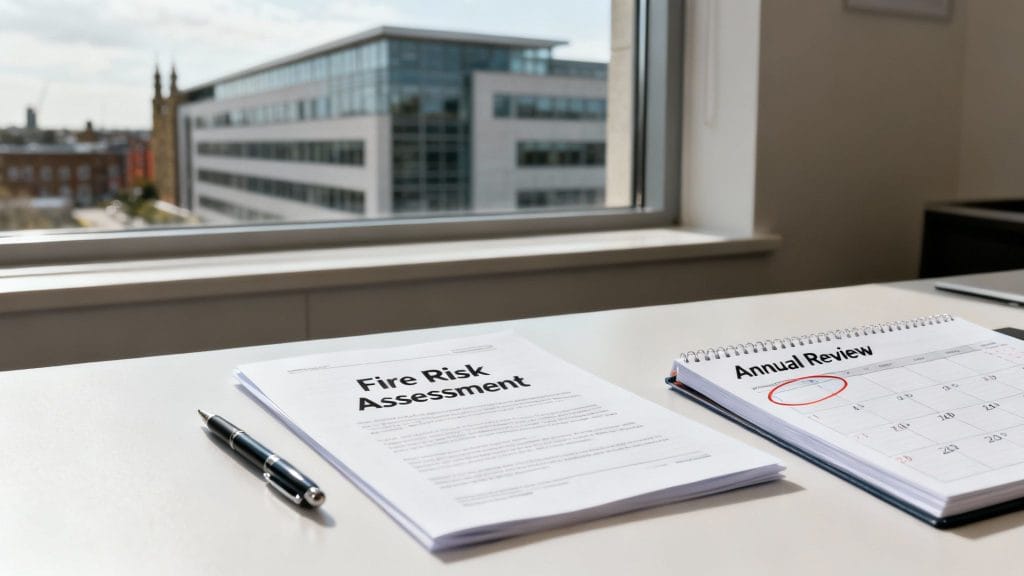
Confusion around review timelines has led to widespread compliance issues. Fire and Rescue Service statistics reveal that a significant number of businesses do not have a suitable and sufficient fire risk assessment, often because owners are simply unsure how often it needs checking. Adopting an annual schedule removes this guesswork. It provides a clear, manageable framework to stay on the right side of the law.
Think of it like an MOT for your car. The law says your car must be roadworthy, but the annual MOT is the official checkpoint that proves it. Your fire risk assessment is no different.
It is a common mistake to see the annual review as just another box to tick once a year. Your fire risk assessment is a living document. It needs to accurately reflect the reality of your building at all times.
The annual check-in is your formal, scheduled review, but the duty to manage fire safety is ongoing. Being "regular" in the eyes of the law means paying constant attention to any changes that could affect fire risk, a topic we will cover next. This approach transforms fire safety from a once-a-year chore into a fundamental part of your daily operations. A complete fire safety strategy also means staying updated on other critical details, like the latest emergency exit signage requirements, to ensure every aspect of your building is safe and compliant.
To understand why reviewing a fire risk assessment is a legal imperative, you first need to know who is ultimately accountable. In UK fire safety law, that duty falls squarely on the shoulders of one individual or entity: the Responsible Person. This is not just a title; it is a legal role that comes with serious personal and professional obligations.
The term is officially defined in the Regulatory Reform (Fire Safety) Order 2005. Pinpointing who this is for your property is not optional; the law automatically assigns this role based on who has control over the premises.
You can delegate the task of carrying out an assessment to a competent person, but the legal responsibility always stops with you.
The Responsible Person changes depending on the building, but it is always the person or company with the most control. Let's break it down with a few real-world examples:
Put simply, if you own the building, manage its upkeep, or employ people inside it, there is a very high chance you are the Responsible Person.
The job of the Responsible Person goes far beyond commissioning a one-off assessment. You are legally required to manage fire safety as a continuous, ongoing process. This includes:
Failing in these duties has severe consequences. The Fire and Rescue Authority can issue an Enforcement Notice, forcing you to make improvements. If you do not comply, you could face unlimited fines. In the most serious cases, where people's lives are put at risk, you could face prosecution and a prison sentence.
An outdated or ignored fire risk assessment is not seen by the courts as a simple administrative error. It is viewed as a direct failure of your legal duty. The review process is your primary method of proving you are taking your responsibilities seriously.
Fire safety is not a passive, tick-box exercise. It is an active management responsibility that demands constant attention. Regularly reviewing your fire risk assessment is the cornerstone of this entire process, ensuring your property, its occupants, and your business remain protected and compliant with UK law.
It is a common and dangerous mistake to think your fire risk assessment is a "set it and forget it" document, valid for another 12 months after its annual review. The truth is, your assessment is a live document. It must mirror the real-world conditions of your premises right now. When things change, that assessment can become worthless overnight, leaving people, property, and your organisation exposed.
Certain events are so significant they override the annual schedule and demand an immediate review of your fire safety. Waiting for the next planned review is not an option; the risks have changed, and the old plan may no longer apply. The Responsible Person is legally bound to identify these triggers and act quickly.
Any physical alteration to your property, no matter how small it seems, can impact your fire safety plan. These changes can introduce new hazards or undermine the safety measures you thought you had in place. An immediate review is essential.
Common structural triggers include:
Think of your fire safety plan as a detailed map for escaping a fire. If you build a new wall, you have just blocked a main road on that map. A review is needed to redraw it so everyone can still find a safe way out.
How your building is used, and who uses it, is fundamental to its risk profile. A fire risk assessment is calibrated for a specific set of circumstances. When those change, the assessment must be revisited.
Key triggers related to who is in the building include:
An assessment for a quiet office of 10 people is worlds apart from one for a bustling co-working space of 50. The presence of vulnerable individuals, in particular, places a much heavier duty of care on the Responsible Person, a fact that absolutely must be reflected in an updated assessment.
The final group of triggers involves bringing new processes or materials into the building that could increase the chance of a fire starting or spreading.
You need to act immediately if you have:
Ignoring these triggers is not just complacent; it is a serious breach of your legal duties. It creates a dangerous gap in your fire safety management and demonstrates that you have failed to keep your assessment "suitable and sufficient," as the law demands.
There is no single, rigid rule for how often you should review a fire risk assessment. The real world does not work like that. The risk profile of a quiet, two-person office is completely different from a bustling high-street shop or a residential block with elderly occupants. UK fire safety law understands this, which is why the Responsible Person must tailor their review schedule to the specific nature of their building.
Applying a one-size-fits-all approach is not just impractical; it is non-compliant. The frequency of your review has to be directly proportional to the level of risk. A low-risk environment might be fine with the annual best practice, but for many properties, that is just the starting point for a much more active safety management schedule.
For most standard commercial properties like offices or retail units, an annual review is generally considered a robust and sufficient baseline. These places typically have predictable footfall and well-defined escape routes. But even here, complacency is your biggest enemy.
A review is needed much sooner if you introduce new high-risk elements. This could include:
Houses in Multiple Occupation (HMOs) present a unique and elevated risk profile. You have a mix of unrelated households, high tenant turnover, and the potential for unauthorised alterations; a combination that makes them a key focus for fire and rescue services. For this reason, a simple annual review is often not enough.
While a formal, comprehensive assessment should still be carried out annually, the high tenant turnover in many HMOs means new occupants might not know where the escape routes are or how the fire alarm works. This dynamic environment demands more frequent internal checks. Many diligent landlords and managing agents conduct quarterly inspections to ensure fire doors are closing properly, escape routes are clear, and alarm systems are in good working order. Understanding your legal duties here is critical, and our guide on the fire risk assessment for an HMO breaks down everything you need to know for this complex property type.
This flowchart shows the key triggers that demand an immediate review of your fire risk assessment, regardless of your property type or its annual schedule.
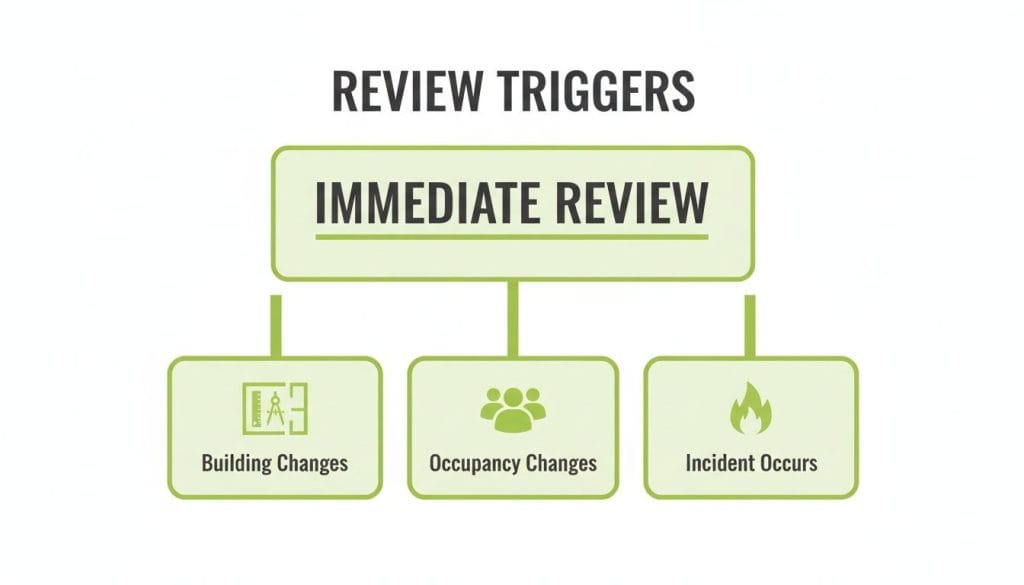
As you can see, significant changes to the building, its occupants, or an actual incident are non-negotiable triggers for an immediate update to your fire safety plan.
For premises housing vulnerable individuals, such as schools, hospitals, and care homes, the standard annual review is the absolute bare minimum. The duty of care in these environments is significantly higher, as occupants may not be able to evacuate quickly or without help. Because of this, fire safety management must be far more rigorous and frequent.
Schools and care homes often back up their formal annual assessment with termly or even quarterly internal safety audits to ensure standards never slip. The statistics tell you why this is so critical. There have been numerous high-profile fires in such premises, with severe consequences, highlighting the importance of vigilant fire safety oversight in these high-risk settings.
You know your fire risk assessment needs a regular review. That is the first step. The next, and arguably more important one, is understanding what that review actually involves.
A common mistake is thinking a review means starting from scratch with a brand new assessment every year. While that can sometimes be necessary, a review is about methodically checking that your existing document is still ‘suitable and sufficient’.
Think of it as an MOT for your fire safety plan. It is a systematic check to confirm that the assessment you have on paper still matches the reality of your building and its fire risks. This is not just a box-ticking exercise; it is an active, on-the-ground process to test whether your fire safety measures are still up to the job. A competent assessor will use your original document as a baseline to scrutinise every part of your fire safety management.
This approach gives you a clear framework, whether you are preparing for a professional to visit or conducting an interim check yourself.
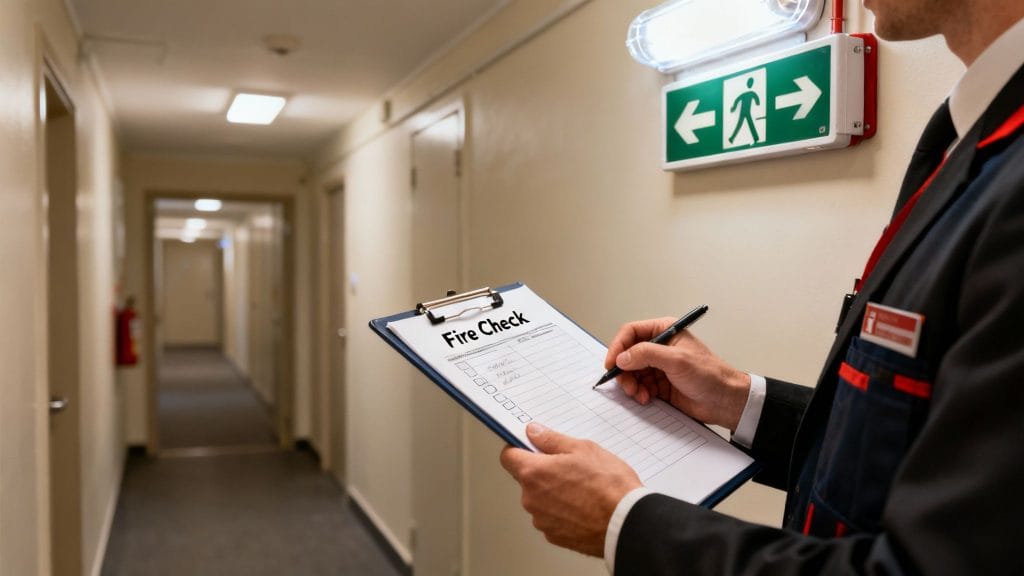
Any good review starts by looking back at the last assessment's action plan. Were all the recommendations completed? A competent assessor will want to see proof, checking that you did not just file the report in a drawer and hope for the best. This part is critical for showing you are taking a proactive approach to compliance.
Next, they will inspect the premises for any of those triggers we discussed earlier. Have new partition walls gone up? Has a storeroom been turned into an office? These physical and operational changes are then cross-referenced against the existing assessment to see if its findings are still valid.
A proper review is not something you can do from a desk. It involves walking the premises to physically test the core components of your fire safety strategy.
A typical physical check includes:
A fire risk assessment review is essentially an audit of your fire safety reality versus your fire safety plan. If the plan on paper does not match the situation on the ground, the document is no longer compliant, and lives are at risk.
Proving you are compliant to a fire authority is not just about having the right equipment; it is about proving you maintain it. A huge part of the review is digging into your logbooks and records. An assessor will expect to see a clear, up-to-date audit trail for all your fire safety systems.
This documentation check will typically cover:
Meticulous record-keeping is non-negotiable. It is your primary evidence to a fire and rescue service inspector that you, as the Responsible Person, are actively managing your duties. An incomplete or missing logbook is one of the biggest red flags during any inspection.
Treating a fire risk assessment as just another document in a filing cabinet is a dangerous mistake. An outdated assessment is not just paperwork; it is a serious legal and financial blind spot. For the person responsible for the building, letting that assessment gather dust is a direct failure of your legal duties, leaving you exposed to consequences that are anything but theoretical.
These are not empty threats. Fire and Rescue Services have real powers to enforce the law, designed to protect people and hold property managers accountable. Understanding what they can do is the first step to realising why keeping your assessment current is not just best practice; it is non-negotiable.
When a Fire and Rescue Service inspector audits your premises and finds an outdated or inadequate assessment, they have a range of legal tools they can use. The action they take depends on how serious the safety failings are.
These actions can include:
Ignoring these notices is a fast track to unlimited fines. In the worst-case scenarios, where people’s lives are actively endangered, the Responsible Person could face prosecution and a prison sentence.
The financial impact from a neglected assessment can be crippling. It goes far beyond fines. An outdated fire risk assessment can invalidate your building's insurance policy.
Imagine a fire breaks out. Your insurer could argue that you failed to take reasonable steps to manage the risk, and on that basis, refuse to pay out. That would leave you personally liable for everything, from the cost of rebuilding to lost income during the downtime.
And do not think you will fly under the radar. Each year, Fire and Rescue Services in England carry out thousands of fire safety audits. With a large proportion of these audits flagging some form of non-compliance, it is crystal clear that just having an assessment is not enough. It has to be accurate and up to date. You can explore national fire safety statistics on the official government website.
The most critical consequence is the one the law was written to prevent in the first place: the tragic loss of human life. An outdated assessment means your escape routes might be blocked, your fire alarms could be faulty, and your emergency plan is likely useless. It is what turns a containable incident into a catastrophe.
When it comes to fire safety, the assessment is just the beginning. Think of it as a living document, not a one-off task you can file away and forget. Keeping your property, tenants, or staff safe means building a simple but solid routine around your fire safety management.
The annual review is your absolute baseline; a scheduled, formal check-in to make sure nothing has slipped through the cracks. But you cannot just wait for that date to come around. Any significant change to your building, from structural alterations to a change in how it is used, can make your current assessment invalid almost overnight. As the Responsible Person, the buck stops with you.
To keep all this organised and ensure nothing gets missed, many managers use tools like Field Service Management Software to track jobs and schedule reviews. A structured approach is not just about ticking boxes; it is about protecting lives and proving you have done everything required of you.
If you are unsure whether your current assessment is still valid or it is simply time to book your next review, HMO Fire Risk Assessment is here to help. Our assessors provide the no-nonsense advice and clear, actionable reports you need to get fully compliant with UK fire safety law.
Do not leave it to chance. Contact us today to get your property protected. Visit https://hmofireriskassessment.com to book your assessment.
Most HMO landlords I talk to can rattle off their fire door requirements, their alarm grade, and their emergency lighting checks without missing a beat....

Most of the fire safety advice on this site assumes you already have a working HMO. This one is for the stage before that: the...