
A Plain English Guide to Fire Extinguisher Maintenance Requirements
20/01/2026
Maintaining your fire extinguishers is not just a good idea—it is a non-negotiable legal duty under UK law. The Regulatory Reform (Fire Safety) Order 2005 is crystal clear: all fire safety equipment, including your portable extinguishers, must be kept in efficient working order and good repair. This means sticking to a strict schedule of monthly visual checks and a full professional service once a year.
This guide is for business owners, landlords, facilities managers, and anyone designated as the ‘Responsible Person’ for commercial or multi-occupancy premises in the UK. By the end, you will understand your specific legal duties, the required maintenance schedule, and the consequences of getting it wrong.
If you own a business, manage a property, or have control over any commercial or multi-occupancy premises in the UK, the law sees you as the ‘Responsible Person’. This is not just a title; it comes with significant legal duties for fire safety, and claiming ignorance will not hold up if things go wrong. A core part of this duty is making absolutely sure all fire-fighting equipment is correctly maintained and ready to go at a moment’s notice.
This is not a recommendation from a manual; it is a legally binding requirement. The Fire Safety Order places the obligation squarely on your shoulders to protect everyone on your premises. Proper fire extinguisher maintenance is fundamental to this. It ensures that in those critical first moments of a fire, people have a reliable way to clear an escape route or tackle a small, manageable blaze.
In the real world, the Responsible Person is usually one of the following:
Essentially, if you are in control of the premises, you are responsible for fire safety compliance within it. This is a duty you cannot delegate away. Even if you hire a specialist company to carry out maintenance, you remain accountable for making sure the work is done correctly and on schedule. To get to grips with your role, it is vital to be familiar with the broader fire safety regulations that govern all fire protection measures in a building.
British Standard BS 5306 is the official code of practice for fire extinguishing installations and equipment on premises. Following this standard is the recognised way to meet your legal obligations for extinguisher maintenance under the Fire Safety Order.
Cutting corners on these duties can have severe consequences. A fire and rescue service inspector can issue enforcement notices, forcing you to fix any problems. More serious breaches can lead to prosecution, resulting in substantial fines or, in the worst-case scenario, even imprisonment. You can learn more about your specific obligations in our complete guide to UK fire safety regulations. Ultimately, this is not just about avoiding penalties; it is about protecting lives, property, and your business.
While the annual service by a professional is a non-negotiable part of your legal duties, your most hands-on responsibility is the monthly visual inspection. This is a straightforward but absolutely essential check that the Responsible Person, or a suitably trained member of your staff, must carry out.
Think of it as a quick health check for your equipment. It is your chance to ensure every extinguisher is ready to perform at a moment’s notice.
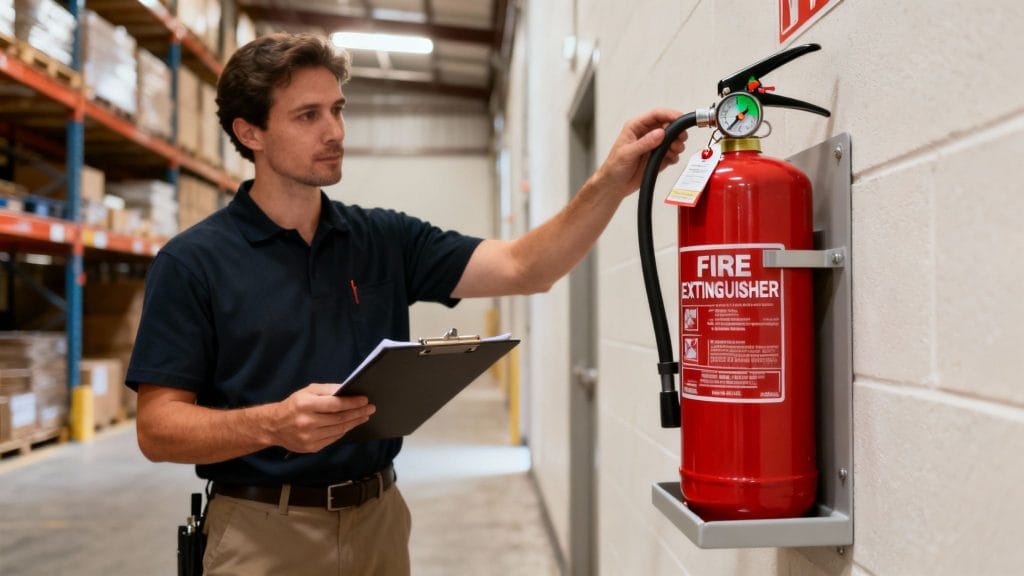
These routine checks are laid out in British Standard BS 5306-3 and are genuinely your first line of defence against equipment failure. The goal is simple: catch obvious problems early. After all, a blocked nozzle, a depressurised unit, or a missing safety pin can render an extinguisher completely useless in an emergency.
This simple task prevents small, easily fixed issues from becoming major compliance failures or, worse, a catastrophic failure when you need it most.
The good news is that you do not need any special tools for this—just a few minutes of focused attention per extinguisher. Your aim is to confirm four key things: visibility, accessibility, condition, and readiness.
Here is what your monthly check should cover:
A classic—and critical—failure is obstruction. In the hallway of a residential block, it is not uncommon to see prams, bicycles, or stored furniture blocking access to an extinguisher. Your monthly check ensures these life-saving devices remain immediately available when residents need them.
These regular inspections are far more than a box-ticking exercise; they are a fundamental part of your fire risk management. In the UK, the Regulatory Reform (Fire Safety) Order 2005 makes it a legal requirement for the Responsible Person to conduct these monthly visual checks. This duty applies whether you are a business owner, landlord, or HMO manager. Failing to do so is a direct breach of fire safety law.
Official statistics show just how common these oversights are. For the year ending March 2023, Fire and Rescue Services in England recorded a staggering 8,666 breaches of Article 17 (Maintenance). While this was a 12% drop from the previous year, it still accounted for 6% of all violations across the 35% of premises audited, proving that maintenance remains a persistent problem. You can find out more about how regular maintenance keeps businesses compliant by visiting Morgan Fire Protection.
Remember, every check must be recorded in your fire safety logbook. This creates an auditable trail that proves your diligence to any inspector who visits.
While your own monthly checks are an excellent first line of defence, they do not replace the absolute cornerstone of fire safety law: the mandatory annual service. This is a deep dive into the health of your extinguisher, a full inspection and maintenance procedure that must be carried out at least once every 12 months by a ‘competent person’.
Let us be clear, this is not a job for the in-house caretaker or a general handyman. The Regulatory Reform (Fire Safety) Order 2005 and British Standard BS 5306-3 are very specific here. This service requires specialist knowledge, calibrated tools, and proper certification. Attempting to “DIY” this is not just cutting corners; it is a serious compliance failure that could mean an extinguisher fails when you need it most.
The term ‘competent person’ is not just a suggestion; it has a specific legal meaning in the world of fire safety. It describes a technician with the right training, qualifications, and real-world experience to do the job correctly and safely. In the UK, this almost always means an engineer certified by an industry-recognised body.
When you are hiring someone, look for proof that they are:
Hiring a certified professional is the only way to be certain the service is done right and your legal duties are met. It gives you a clear, auditable paper trail proving your equipment’s condition has been expertly verified. You can find more detail on this topic in our article covering how often fire extinguishers should be serviced.
The annual service is so much more than a quick once-over. A competent engineer follows a meticulous, multi-point checklist to ensure every single part of the extinguisher is in perfect working order.
Here is a snapshot of what they do:
Think of this service label as a legal document. It clearly shows the date of the service, the technician’s details, and when the next one is due. Without it, you have no evidence that you are meeting your fire extinguisher maintenance duties.
This thorough process makes sure the extinguisher will perform safely and effectively under the incredible pressure it experiences during a discharge.
This annual service is a non-negotiable requirement for all portable fire extinguishers in UK businesses and landlord properties, as set out by BS 5306-3 and the Fire Safety Order 2005. Failing to comply can lead to serious penalties. In fact, official data shows that breaches of Article 17 (Maintenance) are still a persistent problem in 35% of audited premises in England. For more detailed information, you can explore insights on extinguisher servicing from HSQE Consultancy.
Beyond the essential annual service, British Standard BS 5306-3 sets out a much more intensive check-up called an ‘extended service’. This is not just a quick look-over; it is a full-strip-down overhaul designed to confirm the extinguisher is still structurally sound after years of sitting on a wall.
Think of it like the difference between a car’s annual MOT and a complete engine rebuild. The process is invasive, requiring the unit to be completely discharged, taken apart for an internal inspection, and then recharged by a competent technician. It is the only way to be certain there is no hidden corrosion or weakness inside.
But this level of work is not cheap, which raises a crucial question for any business owner or property manager.
How often this major overhaul is needed depends entirely on the type of extinguisher you have. Each one has a different lifespan and internal chemistry, which dictates the schedule.
Here are the standard timelines:
So, why the difference? CO2 units get a longer interval because their cylinders are seamless, high-pressure steel tubes – they are incredibly tough. In contrast, other extinguishers have welded seams and are more prone to internal corrosion over time, especially if they are in a damp or challenging environment.
The timeline below gives you a clear picture of an extinguisher’s maintenance journey from day one.
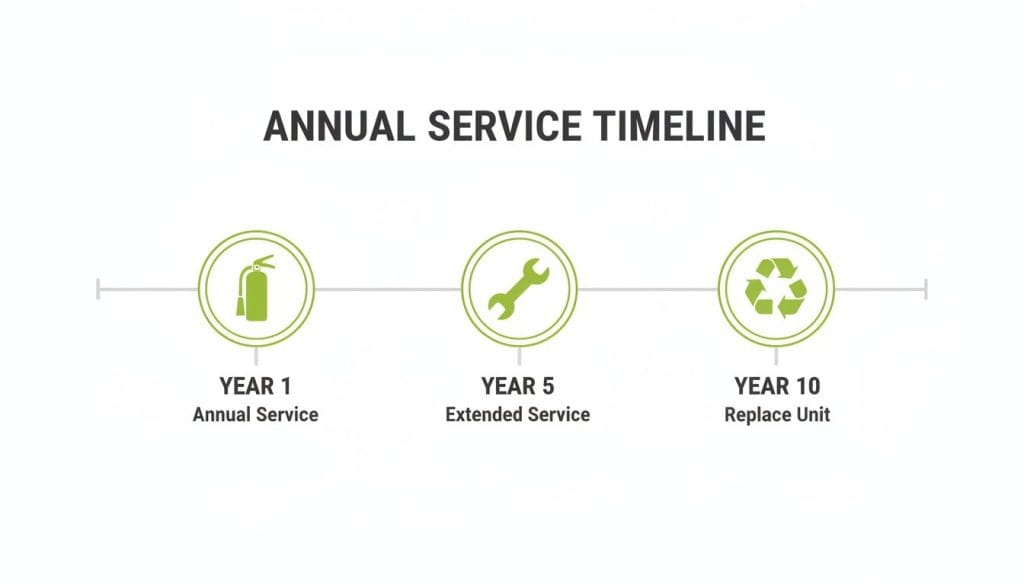
As you can see, the five and ten-year marks are critical decision points. Do you service, or do you replace?
To make things simpler, here is a quick summary of the key maintenance milestones you need to track for your fire safety equipment. This table breaks down what needs doing, when, and by whom, helping you stay on top of your legal obligations.
| Maintenance Type | Frequency | Performed By | Applies To |
|---|---|---|---|
| Visual Inspection | Monthly | Responsible Person (e.g., you) | All extinguishers |
| Basic Service | Annually | Competent Technician | All extinguishers |
| Extended Service | Every 5 years | Competent Technician | Water, Foam, Powder |
| Extended Service / Overhaul | Every 10 years | Competent Technician | CO2 extinguishers |
| Replacement | Every 10-20 years | Competent Technician | All types, depending on condition |
Keeping a clear schedule like this is the best way to manage your assets and ensure nothing gets missed. It is all about proactive management rather than reactive panic.
This is where practical asset management meets legal compliance. While an extended service is a perfectly valid option under the regulations, it is often more cost-effective to simply replace the unit altogether.
Think about it. The cost of an extended service can be a significant portion of the price of a brand-new unit. For that money, you are just patching up an old piece of equipment that has already been sitting around for five or ten years, exposed to whatever conditions your building throws at it.
A new extinguisher, on the other hand, comes with a manufacturer’s guarantee, a fresh lifespan, and the assurance of modern production standards. For most businesses, paying a little extra for a new unit is a smart investment in reliability and hassle-free compliance.
When your extinguishers hit their five or ten-year milestone, ask your fire safety provider for a side-by-side cost comparison. In the vast majority of cases, especially for standard water or foam models, replacement is the clear winner. It is a simple, logical choice that ensures you have the most reliable equipment and simplifies your budgeting. This is a key factor when deciding which fire extinguishers are the right fit for your premises, helping you stay compliant while managing your safety assets wisely.
Doing the maintenance is only half the battle; proving you have done it is the other. Under UK law, you are legally required to keep a detailed and up-to-date fire safety logbook. This is not just internal paperwork—it is a critical legal document that a Fire and Rescue Service inspector will ask to see the moment they walk through your door for an audit.
Forgetting about your logbook is one of the most common and easily avoidable compliance failures. To an inspector, a missing or messy logbook immediately suggests that fire safety is not being managed properly, and it completely undermines all the practical work you have put in. Think of it as your primary evidence of due diligence, proving you are meeting your fire extinguisher maintenance requirements.
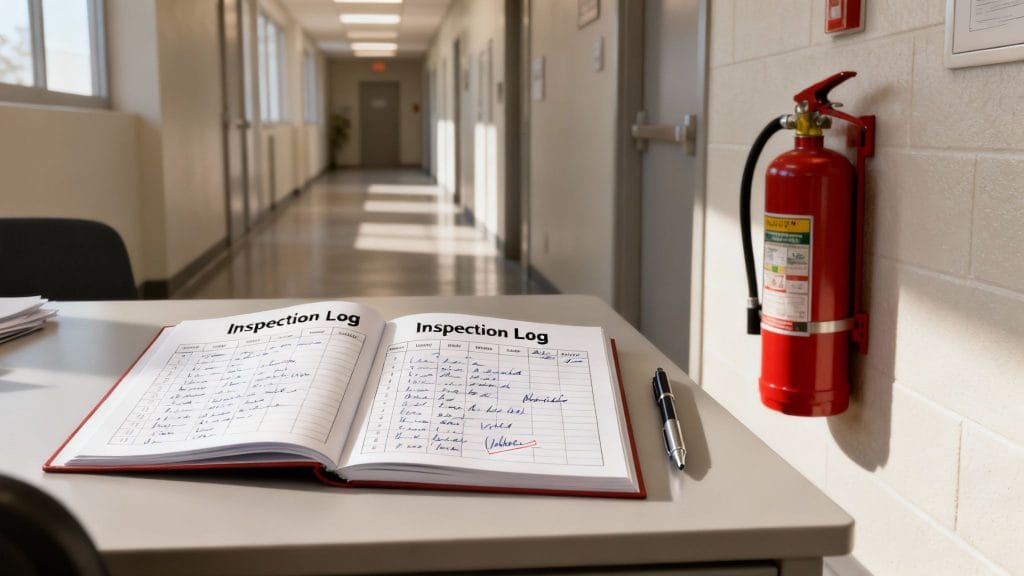
This record-keeping duty falls squarely on the shoulders of the Responsible Person. It provides a clear, chronological history of every piece of fire safety equipment on your premises, from alarms to emergency lighting and, of course, your fire extinguishers.
Accuracy and consistency are everything. A messy, incomplete logbook is almost as bad as having none at all. Each entry should be clear and concise, providing just enough detail to create an unambiguous record of your compliance activities.
Your records for each fire extinguisher must include:
The whole point of a logbook is to tell a story of compliance. An inspector should be able to pick it up and, within minutes, see a clear and unbroken chain of maintenance for every single extinguisher on site.
Maintaining your logbook does not need to be a headache. In fact, a simple, well-structured table is often the best way to keep your records organised and easy to follow.
Here is a straightforward template you can adapt for your own logbook:
| Extinguisher ID / Location | Check/Service Type | Date | Action Taken | Inspected By (Initials) |
|---|---|---|---|---|
| 001 / Main Corridor | Monthly Check | 01/06/2024 | Pressure OK, seal intact | AB |
| 002 / Office Kitchen | Monthly Check | 01/06/2024 | Pressure OK, seal intact | AB |
| 001 / Main Corridor | Annual Service | 15/06/2024 | Full service completed | C.D. (Engineer No. 123) |
| 003 / Warehouse | Remedial Action | 20/06/2024 | Replaced due to damage | AB |
This simple format ensures all the essential information is captured, giving you a robust defence during any inspection.
For businesses looking to make things even simpler, it is worth exploring how modern digital platforms can help. You can learn more about digital reporting for fire safety logs to see how technology is making this process much easier. Ultimately, keeping meticulous records is the best way to prove you take your role as the Responsible Person seriously and are committed to protecting people and property.
It is tempting to think of fire extinguisher maintenance as just another bit of administration, a box to tick on a long to-do list. But ignoring your responsibilities is far more than an oversight; it leaves your business, your tenants, and you personally exposed to some very real and entirely avoidable risks.
The consequences are not just abstract threats. They are tangible actions that Fire and Rescue Services are fully empowered to take under the Regulatory Reform (Fire Safety) Order 2005.
When you fail to maintain your extinguishers, you are not just bending the rules. You are walking a direct path towards enforcement action and failing in a fundamental duty of care.
When an inspector from the local Fire and Rescue Service visits and finds your maintenance records are missing or your equipment is out of action, they have a range of powers. How they respond depends entirely on how serious the breach is and the immediate risk to people’s lives.
These measures are designed to force you to comply. But for the worst-case scenarios, the consequences get much, much worse.
If a fire breaks out and it is proven that a poorly maintained extinguisher failed to work—directly contributing to injury, death, or major property damage—the Responsible Person can be prosecuted. This can lead to unlimited fines and, in the most severe cases, a prison sentence.
The legal penalties are just one side of the coin. The knock-on effects of non-compliance can be just as devastating for your business or property portfolio.
At the end of the day, proper maintenance is not about dodging fines. It is a core part of your responsibility to protect lives, secure your assets, and ensure your business can continue to operate. It is simply a non-negotiable part of being a Responsible Person.
As a business owner or property manager, getting to grips with the rules around fire extinguisher maintenance can throw up a few practical questions. It is completely normal. To help you out, here are some clear, straightforward answers to the queries we hear most often.
While you absolutely should be doing your own monthly visual checks, the official annual service is a job strictly for professionals. UK regulations are very clear on this: the work must be done by a ‘competent person’. This is not just a vague term; it has a specific legal meaning. It refers to a qualified technician, usually with a certification like BAFE SP101, who has the right tools, knowledge, and experience to work to British Standard BS 5306-3.
An annual service is far more than a quick once-over. The engineer uses calibrated scales to check the extinguisher’s weight, specialised tools to safely inspect internal parts, and has the know-how to replace critical seals and O-rings. Trying to do this yourself is not just a compliance breach—it could mean the extinguisher fails when you need it most.
Fire extinguishers do not last forever. Even with perfect annual servicing, the materials and components degrade over time, which is why manufacturers recommend replacing them after a certain period. Think of it as a planned retirement for a crucial piece of safety equipment.
For the most common types, here is what you can expect:
Once an extinguisher reaches the end of its recommended life, the cost and hassle of a major overhaul usually outweigh the price of a brand-new, fully guaranteed unit. Being proactive about replacement is just smart asset management that ensures reliability and makes your fire safety budgeting much more predictable.
If you find an extinguisher that has been used—even just for a second—or shows any signs of damage like dents, serious rust, or a broken pressure gauge, you need to act fast. Take the unit out of service immediately. The last thing you want is for someone to grab it in an emergency, only to find it does not work.
Do not just put it back on the wall hoping for the best. Your next move is to call a certified fire safety company to get it sorted.
A damaged or partially used extinguisher is not just useless; it is a liability. It creates a false sense of security and must be professionally recharged, repaired by a competent person, or responsibly disposed of and replaced.
This is exactly why your monthly visual checks are so important. They are your first line of defence, giving you the chance to spot these problems early and take swift action to keep your building properly protected. An extinguisher that is not 100% ready to go is a risk you simply cannot afford to take.
Ensuring your fire extinguishers are professionally serviced is a fundamental part of your legal duties. At HMO Fire Risk Assessment, our certified technicians provide thorough, compliant servicing to keep your premises safe and your logbook in order. Protect your people and your property by booking your service today. Find out more at https://hmofireriskassessment.com.
Most HMO landlords I talk to can rattle off their fire door requirements, their alarm grade, and their emergency lighting checks without missing a beat....

Most of the fire safety advice on this site assumes you already have a working HMO. This one is for the stage before that: the...