
How Often Should You Review Your Fire Risk Assessment in the UK?
18/01/2026
UK fire safety law does not specify a rigid, set-in-stone timetable for fire risk assessments. Instead, it requires your assessment to be kept ‘suitable and sufficient’, meaning it must be a live, accurate reflection of the risks in your building right now. In practice, this translates to a formal review at least once a year, or immediately if any significant changes occur.
This guide is for business owners, landlords, facilities managers, and anyone designated as the ‘Responsible Person’ for a UK property. By the end, you will understand your legal duties for regular reviews, the key triggers for an immediate reassessment, and how to maintain a compliant fire safety management system.
As the designated ‘Responsible Person’ for a property, the legal responsibility for keeping a fire risk assessment current and effective rests with you. This is a core duty under the Regulatory Reform (Fire Safety) Order 2005. One of the most dangerous mistakes is to treat your assessment as a one-off, tick-box exercise. It is a living document that must evolve as your property does.

This ongoing review process is your most important tool for keeping people safe, protecting your building, and demonstrating to the authorities that you are taking your responsibilities seriously. Pushing it to the bottom of your to-do list does not just put lives at risk; it leaves you open to significant fines and prosecution.
The law is clear: the Responsible Person is tasked with managing all fire safety duties, which absolutely includes regular reviews of the risk assessment. This person could be:
It is vital to understand the full scope of what is expected. You can get a deeper insight by reading up on the key fire risk assessment legal requirements.
Do not assume you will only hear from the Fire and Rescue Service if something goes wrong. They are increasingly proactive with their inspections. In the year ending March 2023, Fire and Rescue Services in England carried out 46,846 fire safety audits.
Even more concerning, only 58% of those audits resulted in a satisfactory outcome. That means thousands of properties were found to be non-compliant. This statistic alone should be a wake-up call, highlighting just how critical it is to keep your assessment updated to avoid becoming another number in that column.
When weighing up your legal duties, bringing in a professional fire safety consultancy can be invaluable. A competent assessor brings a fresh, expert pair of eyes, ensuring your review is thorough and you are compliant with ever-changing standards. A regularly reviewed assessment is your best defence, proving you are actively and responsibly managing your fire safety obligations.
While UK law uses the term ‘regularly review’, the gold standard among fire authorities, insurers, and competent assessors is a formal review at least every 12 months. This is not just about ticking a box; it is a fundamental health check for your property’s fire safety systems. Think of it as a critical benchmark to ensure your protective measures have not weakened over time.

A good analogy is a car’s MOT. Your car might feel perfectly fine on the daily commute, but the annual test is designed to spot hidden dangers, like worn brake pads or a slow leak, that could lead to catastrophic failure. In the same way, a building’s fire safety can degrade quietly and invisibly over a year.
An annual review is your chance to methodically catch this gradual decay. It proves to inspectors and insurers that you are proactively managing your duties, not just waiting for something to go wrong.
Over twelve months, dozens of seemingly minor changes can accumulate, each one chipping away at your fire defences. These small shifts are easy to miss during day-to-day operations but become glaringly obvious during a structured annual review.
Let’s imagine a typical small office block over a year. The risk profile is anything but static.
Individually, none of these seem like a major issue. But when combined, they create a chain of failures that could have devastating consequences in a real fire. The annual review is designed to find and break that chain before it becomes a threat.
A proper annual review is much more than a quick walk-through. It is a systematic process where your existing fire risk assessment is held up against the current reality of the building. It confirms the original findings are still valid and that your safety measures are still performing effectively.
A robust annual review should verify that your original assessment’s assumptions and conclusions still hold true. It is your primary method of demonstrating ongoing due diligence and is a cornerstone of responsible fire safety management.
The process involves checking if anything has changed that could alter the fire risk, including:
This yearly cycle is the single best way to ensure your fire safety measures keep pace with your business. It is a critical tool for business continuity and your strongest evidence of compliance if the fire and rescue authority ever inspects your premises.
Relying solely on your annual review date is a massive compliance blind spot. While that yearly check-up acts as a brilliant safety net, certain events can make your fire risk assessment obsolete overnight. As the Responsible Person, you must be able to spot these critical triggers and act on them immediately.
If you do not, your assessment is no longer ‘suitable and sufficient’ in the eyes of the law. That leaves your property, the people inside it, and your business wide open to risk. It is not about waiting for the next scheduled review; it is about responding to change the moment it happens.
Any physical alteration to your property is perhaps the biggest trigger for an immediate review. Structural changes have a direct, often huge, impact on your existing fire safety strategy and can completely invalidate your emergency plan.
Think of your escape routes as the arteries of your building’s safety plan. If you carry out any of the following, you are fundamentally altering how people escape in an emergency:
An immediate review is the only way to re-evaluate escape routes, check travel distances, and ensure all your fire signage is updated for the new layout. Without it, your evacuation plan is based on a building that no longer exists.
How you use the space inside your building is just as important as its physical layout. A change in purpose can introduce completely new fire hazards that your original assessment never considered, demanding an immediate rethink of the risks.
For example, turning a simple office into a small workshop brings in new ignition sources like soldering irons or machinery. Similarly, changing a storage cupboard into a small staff break room with a kettle and a microwave adds new heat-producing appliances and completely changes who uses that area and when.
A common compliance failure we see is overlooking the fire risk implications of ‘scope creep’. A room starts as a low-risk storage area, but over time it slowly fills with flammable materials or electrical equipment, silently transforming into a high-risk zone without any formal review taking place.
You must review your assessment if there is any significant change in:
Each of these actions requires a fresh look at the hazards, the people at risk, and whether your current safety measures are still fit for purpose.
One of the most powerful learning opportunities in fire safety comes from a near miss or even a small fire. These incidents are a flashing red light, warning you that your existing fire safety controls have failed or are simply not good enough. Treating it as a ‘lucky escape’ without taking action is a serious mistake.
An immediate, thorough review of your fire risk assessment is completely non-negotiable. This review needs to get to the bottom of some critical questions:
Failing to act on the lessons from a near miss shows a clear lack of due diligence. A fire authority inspector will expect to see hard evidence that you have not only reviewed your assessment but have also made real, tangible improvements because of the incident. This is what a proactive and legally robust fire safety culture looks like.
When it comes to fire safety, a ‘one-size-fits-all’ approach is not just ineffective; it is dangerous. The law demands that your fire risk assessment is ‘suitable and sufficient’ for your specific building. This means the timing of your reviews must match the real-world level of risk your property faces. After all, the dynamic environment of a busy retail shop is a world away from a quiet, stable office block, and your review schedule must reflect that reality.
Getting to grips with your property’s unique risk profile is the first step. You need to consider factors like the vulnerability of occupants, public access, the presence of flammable materials, and the building’s complexity. These all play a huge part in deciding how often you need to formally revisit your assessment beyond the standard annual check.
This flowchart gives you a simple visual guide to the core review process.
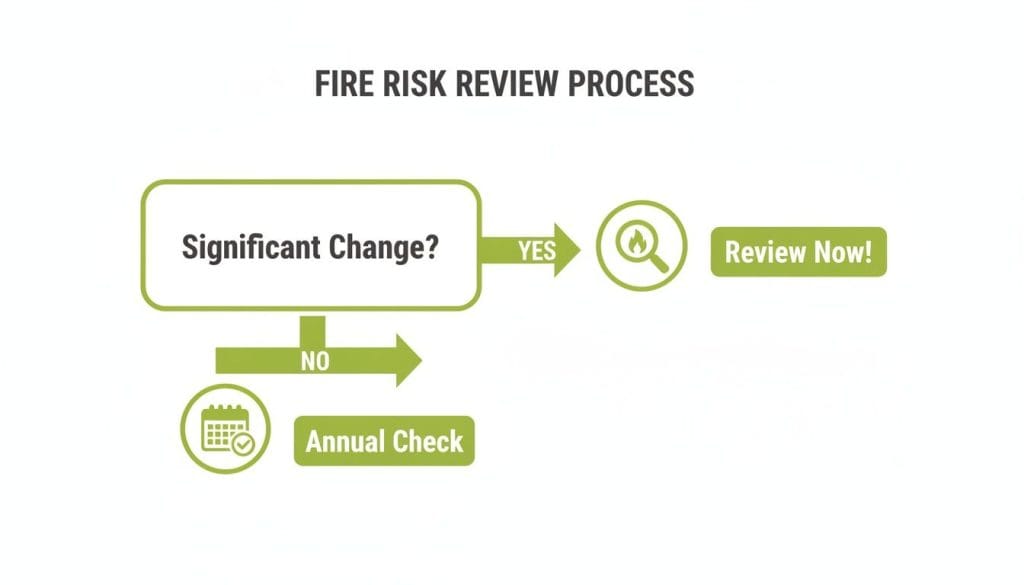
It boils down to a fundamental principle: any significant change triggers an immediate review, while the annual check acts as your routine safety net.
For most standard office environments, an annual review is generally considered sufficient, as long as no significant changes have taken place. These premises usually have a stable workforce, predictable daily routines, and a relatively low fire load compared to other commercial properties.
However, that does not mean the Responsible Person can relax. Even in a low-risk office, things can change. A major staff reorganisation that alters office layouts, or the installation of a new server room bringing in extra heat and electrical load, would absolutely be a trigger for an immediate review.
Retail environments are a different matter altogether, with a much higher and more fluctuating risk. The constant flow of the public means you have large numbers of people on-site at any given time who are completely unfamiliar with your building’s layout or emergency procedures. This transient population is a major risk factor in itself.
On top of that, stock levels are always changing, which can easily impact escape routes and the overall fire load. Imagine a delivery of highly flammable seasonal goods; that would demand an immediate re-evaluation of your storage and existing fire precautions. For this reason, many savvy retail managers carry out more frequent informal checks in between the mandatory annual review.
Managing fire safety in blocks of flats is a complex job, focusing mainly on the common areas like entrance halls, corridors, stairwells, and plant rooms. The Fire Safety Act 2021 made it crystal clear that these areas fall under the Fire Safety Order, placing a firm legal duty on the Responsible Person.
The risk is automatically heightened because people sleep on the premises, making them far more vulnerable in a fire. A robust annual review is the bare minimum. Key things to look out for include:
These issues demand active management and a diligent review schedule to keep everyone safe.
HMOs are at the top of the risk scale for residential properties. They demand the most rigorous approach to fire safety management. The mix of multiple, unrelated tenants, high occupant turnover, and shared facilities creates a unique and elevated risk profile that needs more frequent attention than a standard block of flats.
Due to their transient nature and complex occupancy, HMOs often require formal fire risk assessment reviews more frequently than the standard 12-month interval. A significant change in tenancy or any alteration to the property’s layout necessitates an immediate review to maintain compliance.
The high turnover of tenants means that fire safety awareness can quickly fade. New occupants might not know the emergency procedures or could introduce unsafe habits, like using portable heaters or overloading electrical sockets. For a detailed guide on these specific challenges, it is worth looking at the full requirements for a fire risk assessment for an HMO. A proactive landlord will often schedule reviews every six months or, at the very least, conduct a thorough check between tenancies to ensure all safety measures are still intact.
To help clarify these different requirements, the table below breaks down the typical review schedules and key risk factors for various property types across the UK. It is a useful starting point for figuring out what “suitable and sufficient” looks like for your specific building.
| Property Type | Standard Review Interval | Key Risk Factors Influencing Frequency |
|---|---|---|
| Commercial Offices | Annual (12 months) | Office layout changes, significant increase in staff numbers, introduction of new high-power electrical equipment (e.g., server rooms). |
| Retail Shops & Public Venues | Annual (12 months) with more frequent informal checks (e.g., quarterly or monthly). | High public footfall, seasonal stock changes (flammability), temporary displays obstructing routes, staff turnover. |
| Blocks of Flats | Annual (12 months) | Resident misuse of common areas, unauthorised alterations to flat doors, building works compromising fire stopping. |
| HMOs | 6-12 months, or upon significant tenant changeover. | High tenant turnover, vulnerable occupants, shared cooking facilities, increased risk of electrical overloading, lifestyle risks. |
| Industrial & Warehousing | 6-12 months, depending on the materials handled. | Storage of flammable liquids/materials, hot work processes (welding), complex machinery, large and confusing layouts. |
| Hotels & Guesthouses | Annual (12 months), with regular staff checks on escape routes and alarms. | Sleeping risk, high number of unfamiliar occupants, kitchen fire hazards, potential for blocked corridors. |
| Schools & Care Homes | Annual (12 months), but often with termly or quarterly internal safety audits. | High number of vulnerable occupants (children, elderly, infirm), complex evacuation needs, use of science labs or kitchens. |
While this table provides a solid guideline, remember that your property’s specific circumstances always take precedence. If you are ever in doubt, it is always better to err on the side of caution and conduct a review sooner rather than later.
An outdated fire risk assessment is not just a paperwork problem. It is a serious compliance failure, and the consequences can escalate quickly, moving from a formal warning to legal action that could shut down your business and put people’s lives in danger.
It is one thing to know the rules, but it is another to understand what actually happens when a fire safety inspector walks through your door and finds an assessment that is no longer fit for purpose. These are not theoretical legal threats; they are real enforcement actions taken by Fire and Rescue Authorities across the UK every day.
When a Fire Safety Officer inspects your premises and decides your assessment is no longer ‘suitable and sufficient’, they will not turn a blind eye. They have a range of legal powers at their disposal, and they will use them. The response typically follows a scale of severity, depending on how serious the risks are.
Here is how it usually plays out:
Falling foul of the law does not just disrupt your business; it can hit you hard financially. Breaching the Regulatory Reform (Fire Safety) Order 2005 can lead to severe financial penalties and even land the Responsible Person in court.
The courts take a very dim view of anyone who neglects their fire safety duties. Penalties can include unlimited fines, with the final figure reflecting the severity of the breach and the size of your business. In the worst-case scenarios, especially where a fire has caused injury or death, a prison sentence is a very real possibility.
It is a common myth that you only get prosecuted after a fire. Fire and Rescue Authorities are actively taking businesses to court for serious problems found during routine audits, even when no incident has occurred. Simply failing to maintain a suitable assessment is, in itself, a prosecutable offence.
Beyond the direct legal action from the fire authority, an outdated assessment opens you up to other catastrophic risks. These are the kinds of problems that people often ignore until it is far too late.
Think about these scenarios:
Ultimately, though, the most severe consequence is the one that truly matters: the risk to human life. A current, accurate fire risk assessment is the bedrock of your entire safety strategy. Failing to maintain it is a direct failure in your duty to keep people safe.
Your fire risk assessment is far more than just a compliance document; think of it as a live management tool for your property’s safety. Treating it as a file that just gathers dust on a shelf is a serious mistake and one that inspectors spot easily. Proper documentation creates a living record of your commitment to safety, giving you essential proof of diligence when it matters.
Under the Regulatory Reform (Fire Safety) Order 2005, if your business has five or more employees, you are legally required to record the significant findings of your assessment. Regardless of your size, keeping thorough records is a non-negotiable best practice that every Responsible Person should adopt.

This written record is your primary evidence. It is what shows a Fire Safety Officer that you have systematically thought through the risks and put sensible control measures in place. The whole document needs to be clear, easy to understand, and ready for inspection at a moment’s notice.
The best way to stay on top of your documentation is to keep a dedicated fire safety logbook. This becomes the central hub for everything fire safety-related, creating a clear, auditable trail that proves you are not just assessing risk, but actively managing it day-to-day. A logbook turns your assessment from a static report into the backbone of your entire safety culture.
Your logbook should be used to record every relevant action, giving you a chronological history of your compliance efforts. Essential entries include:
Your documentation must detail the ‘significant findings’ from your assessment. This means recording the hazards you have identified, who is at risk, and the actions you have taken to reduce that risk. For example, part of your checks might include ensuring all fire-rated components are compliant, which includes verifying the use of correct intumescent packs for concealed fire-rated hinges on fire doors.
A well-maintained logbook is your strongest defence during an inspection. It immediately shows an officer that you have a structured and serious approach to fire safety, moving the conversation from “Are you compliant?” to “Let’s review your effective system.”
This detailed record-keeping does more than just satisfy legal requirements; it gives you invaluable insight into the health of your safety systems. If you are looking for a clear template of what this all looks like in practice, reviewing a professional example of a fire risk assessment can provide excellent guidance on structure and content. An organised logbook is the mark of a truly competent and responsible property manager.
Knowing how often to review your fire risk assessment can feel confusing, but it does not have to be. Your duties often depend on the type of property you manage and how its use changes over time. Below are some clear, practical answers to the questions we hear most often from landlords and business owners across the UK.
Not a full, brand-new assessment, but it absolutely requires an immediate review of your current one. It is amazing how quickly a simple office rearrangement can create new dangers. Moving desks, adding a filing cabinet, or putting up a new partition wall can easily block a fire exit, cover an extinguisher, or obstruct a fire alarm call point.
The Responsible Person must check these changes, confirm they have not introduced any new risks, and document the review to prove that safety measures have not been compromised.
For high-risk buildings like care homes, blocks with vulnerable residents, or complex HMOs, an annual review should be seen as the absolute bare minimum. In these environments, fire safety management is a continuous, dynamic process, not a once-a-year tick-box exercise.
Any change, such as a resident’s mobility decreasing, new medical equipment being introduced, or even a change in staffing patterns, must trigger an immediate review of the relevant parts of the assessment. Many responsible managers in these settings carry out formal reviews far more often, sometimes every six months.
The law is clear: your assessment must remain ‘suitable and sufficient’ at all times. In a high-risk environment, this means you need to review it as often as the risks change.
Yes, you do. The legal duty under the Fire Safety Order to carry out and regularly review a fire risk assessment applies to nearly all non-domestic premises, no matter how many people work there.
The rule about having five or more employees relates to whether you must legally write down the findings. If you have fewer than five, you are not required to have a written record, but you must still be able to prove to a visiting inspector that you have a suitable assessment in place and that you are keeping it under review. It is always best practice to have it in writing anyway.
The review must be done by a ‘competent person’. This is officially defined as someone with enough training, experience, and knowledge to understand the fire risks in your specific building.
For a simple, low-risk workplace with no significant changes, the business owner or manager (the Responsible Person) might feel competent enough to handle the annual review themselves. However, for more complex buildings, HMOs, or after any major changes, it is always best practice to bring in a professional fire risk assessor. They can give you a thorough, objective, and fully compliant review that stands up to scrutiny.
Keeping your fire risk assessment up to date is not just a box-ticking exercise; it is a fundamental part of your legal and moral duties. At HMO Fire Risk Assessment, we deliver expert, certified assessments that help you stay compliant and keep everyone in your property safe.
Book Your UK Fire Risk Assessment Today
See our guide to how often fire risk assessments should be reviewed for the recommended review schedule.
Most HMO landlords I talk to can rattle off their fire door requirements, their alarm grade, and their emergency lighting checks without missing a beat....

Most of the fire safety advice on this site assumes you already have a working HMO. This one is for the stage before that: the...