
A Guide to Powder Fire Extinguisher Use in the UK
17/01/2026
If you own or manage a property in the UK, whether it’s a business, an HMO, or a commercial site, your responsibilities around fire extinguishers are a serious legal matter. They are governed by strict fire safety laws, and just having an extinguisher on the wall is not enough.
You have to make sure it’s the right type for the risks you actually have, that it’s properly maintained, and that your staff or tenants know exactly how—and when—to use it safely. Getting this wrong, especially with powder extinguishers indoors, can create massive hazards and leave you non-compliant.
As a business owner, landlord, or the designated ‘Responsible Person’, your duties for fire safety equipment are clearly set out in law. The Regulatory Reform (Fire Safety) Order 2005 puts the responsibility squarely on your shoulders to manage fire risks, and that includes providing and maintaining the right fire-fighting equipment.
Simply installing a powder extinguisher does not automatically mean you have met your legal obligations. Your fire risk assessment must specifically justify why it’s there and acknowledge its serious limitations. For instance, while a powder unit is excellent for outdoor areas where you might have flammable liquid risks, British Standards strongly discourage using them indoors. This is because the powder cloud instantly destroys visibility and creates a serious respiratory hazard.
Your legal duties go much further than just buying the equipment. You are legally required to ensure that:
Do not underestimate the consequences of failing to meet these obligations. If the Fire and Rescue Authority finds you non-compliant, you could face formal notices, hefty fines, or even prosecution. This is especially true if a fire breaks out and your equipment is found to be inadequate or poorly maintained.
Understanding these duties is the first step in creating a robust fire safety plan. To dive deeper into the legal side of things, check out our plain English guide to UK fire safety regulations, which breaks down the core requirements for property and business owners.
Powder fire extinguishers are often called ‘ABC’ extinguishers, a nod to how versatile they are. They can handle a huge range of fires, but this all-purpose nature comes with some serious drawbacks that every Responsible Person needs to understand.
Choosing the right extinguisher is not just about ticking boxes for different fire types; it’s about looking at the real-world environment where it might be used and thinking through the consequences.
The UK’s portable fire extinguisher market gives a clue to their popularity. Projections show the market, where dry powder units make up a large portion, is set to grow significantly. This is driven by better safety awareness and the legal pressures on property managers. For many, ABC extinguishers seem like a great value choice for handling the mixed hazards found in UK commercial properties.
So, why are they so common? Because powder units are incredibly effective against the most frequent types of fires, which is why they often become the default option.
Their capabilities cover:
Crucially, they are also safe to use on live electrical equipment because the powder itself does not conduct electricity. This broad capability makes them seem like a logical choice for places with lots of different risks packed into one area. To make an informed decision when selecting fire safety equipment, it is important to understand specific extinguisher types like ABC dry chemical extinguishers.
Before settling on a powder extinguisher, it is vital to know exactly where they shine and where they can cause more harm than good. This table breaks it down.
| Fire Class & Type | Suitability of Powder Extinguisher | Common UK Workplace Example | Important Considerations |
|---|---|---|---|
| Class A (Solid combustibles) | Suitable | Timber yard, paper storage, farm barn | Very effective, but the messy residue is hard to clean. Better alternatives (water, foam) exist for indoor office environments. |
| Class B (Flammable liquids) | Excellent | Vehicle forecourt, garage, paint mixing room | One of the best options for liquid fires, especially outdoors where ventilation is not an issue. |
| Class C (Flammable gases) | Excellent | Gas storage cage, boiler room (with ventilation) | Knocks down gas flames very quickly. The priority must always be to isolate the gas supply first. |
| Live Electrical Equipment | Safe to Use | Switchgear room, generator area | The powder is non-conductive but will destroy sensitive electronics. A CO2 extinguisher is the preferred choice for server rooms. |
| Enclosed Indoor Spaces | NOT Recommended | Office, residential corridor, HMO kitchen | Causes zero visibility and breathing difficulties. Discharging one indoors creates panic and hinders evacuation. |
| Commercial Kitchens (Class F) | NOT Suitable | Restaurant kitchen, takeaway, canteen | Powder is not effective on cooking oil fires (Class F). A Wet Chemical extinguisher is the legal requirement here. |
As you can see, context is everything. An extinguisher that’s perfect for a garage forecourt could be a disaster in an HMO corridor.
Despite their raw fire-fighting power, the use of powder extinguishers indoors is now strongly discouraged by British Standards. The reason is simple but absolutely critical: when you discharge one, it creates an immense, dense cloud of powder instantly.
Picture this happening in a confined space like an office, a narrow corridor, or a small workshop.
The consequences are severe. Visibility can drop to absolute zero in seconds, causing total disorientation and panic among people trying to escape a fire. On top of that, inhaling the fine powder can cause serious respiratory distress. A manageable situation can quickly become far more dangerous because of the extinguisher itself.
A powder extinguisher is an excellent choice for an outdoor fuel storage area, a vehicle forecourt, or a large, well-ventilated workshop with flammable liquids. It is an exceptionally poor choice for an office kitchen, a server room, or a residential corridor in an HMO.
Your formal fire risk assessment has to justify the placement of every single extinguisher. If you have powder units sitting in confined indoor spaces, any competent fire risk assessor will flag this as a major risk and insist you replace them with a safer alternative, like foam or CO2.
In these settings, the potential for harm caused by the extinguisher often outweighs its fire-fighting benefit. It’s a classic case of the cure being worse than the disease.
When a fire breaks out, panic is the enemy. Knowing exactly what to do can be the difference between a minor incident and a full-blown disaster, which is why staff and tenants must be trained to react confidently and correctly.
For powder extinguishers, the established method is the simple but highly effective PASS technique. It’s a four-step process designed to remove guesswork and provide a clear sequence of actions, forming the core of any practical fire extinguisher training.
The PASS method is a universally recognised acronym that guides a person through the essential steps of operating an extinguisher. Crucially, it’s easy to remember under pressure.
This flowchart gives a clear visual guide on deciding where a powder extinguisher is appropriate, highlighting the stark contrast between outdoor and indoor use.
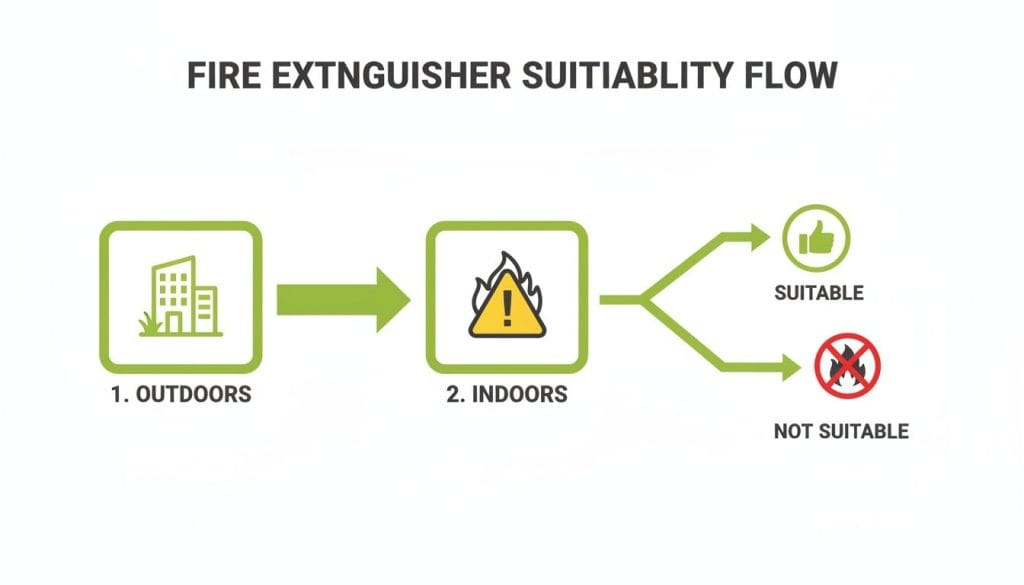
As the diagram shows, while these extinguishers are fine for open-air environments, using them in confined indoor spaces is highly hazardous and should be avoided.
Applying the PASS technique is vital, but it has to be done with personal safety as the absolute priority. Before you even think about tackling a fire, you need to make a rapid risk assessment.
First, always ensure your escape route is clear. Position yourself with your back to an exit. That way, you can retreat immediately if the fire grows, the smoke becomes too much, or the extinguisher runs out.
Keep a safe distance. A powder extinguisher has a decent range, so start from about 2-3 metres away. You can move closer, but only if necessary and as the fire diminishes. This keeps you away from the intense heat and blinding powder cloud.
Never turn your back on a fire, even if you think it’s out. Small, hidden embers can easily reignite. Back away from the area slowly, keeping your eyes on it for any signs of re-ignition.
Finally, remember that extinguishers are for small, early-stage fires only. If the fire is spreading rapidly, filling the room with smoke, or blocking your only way out, your one and only job is to evacuate. Close the door behind you and call 999.
For a broader overview, it is worth reviewing the fundamentals of using fire extinguishers to ensure everyone on your premises is fully prepared. As the Responsible Person, it is your legal duty to ensure that anyone expected to use an extinguisher has been properly trained to do so safely.
Putting the fire out is, of course, the number one priority. But once a dry powder extinguisher has been discharged, you’re left with a brand-new set of problems. The aftermath is not just a simple sweeping job; it demands careful management to prevent health risks and long-term damage to your property.
That fine, pervasive residue gets everywhere. It’s a serious respiratory irritant and, worse, it is corrosive.
Understanding these secondary risks is a critical part of your overall fire safety management. If you do not get the clean-up right, you could face significant business interruption, costly repairs, and even health complaints long after the fire is out. It really reinforces why choosing the right extinguisher in the first place, based on your fire risk assessment, is so important.
The powder consists of extremely fine particles that hang in the air, creating an environment that feels like a dust storm. Inhaling this can cause serious irritation to the nose, throat, and lungs. Because of this, anyone involved in the clean-up absolutely must wear the right Personal Protective Equipment (PPE).
At a minimum, this includes:
Opening windows and doors to ventilate the area is a good first step, but it will not be nearly enough on its own. The real goal here is to contain and remove the powder, not just shift it around the room.
Beyond the health risks, the chemical makeup of the powder poses a huge threat to your property and equipment. The residue is mildly corrosive, and this effect is amplified when it mixes with moisture from the air. For business continuity, this is a massive risk.
The powder can work its way into the tiniest gaps in electrical equipment. If you leave it there, it can cause short circuits, eat away at circuit boards, and lead to the eventual failure of sensitive electronics, control panels, and machinery. This can trigger unexpected and very expensive downtime.
Do not even think about using a standard vacuum cleaner. You’ll just force the finest, most damaging particles straight through the filter and back into the air, making everything worse. You need an industrial vacuum fitted with a HEPA (High-Efficiency Particulate Air) filter to trap the powder properly.
For any sensitive or high-value equipment like servers, manufacturing controls, or medical devices, it is strongly recommended to call in professional cleaning and restoration services. They have the specialised tools and expertise needed to prevent permanent damage.
An extinguisher that fails in an emergency is not just a faulty piece of kit—it’s a serious failure of your legal duties as a property manager or business owner. Under the Regulatory Reform (Fire Safety) Order 2005, you are the ‘Responsible Person’, and that means you have a non-negotiable legal duty to ensure all fire safety equipment is properly maintained and ready for use.
There is no grey area here. The maintenance schedules laid out in standards like BS 5306 are not just recommendations; they form a core part of your fire safety compliance. Ignoring them can lead to serious trouble with the Fire and Rescue Service and, far worse, a catastrophic equipment failure when someone’s life depends on it.
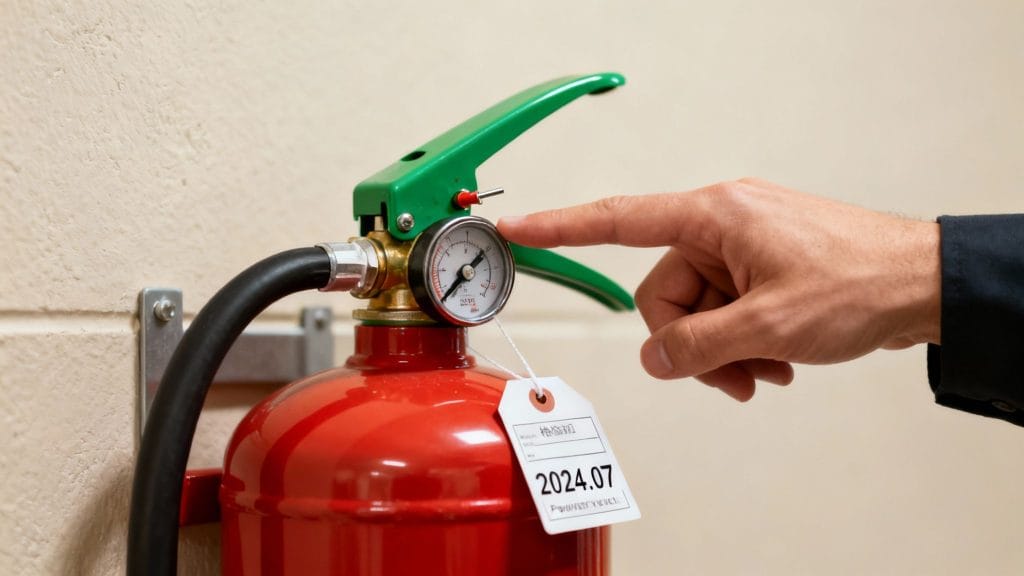
While a full service is a job for professionals, you or your staff should be carrying out quick visual inspections every single month. It only takes a minute for each unit, but it’s one of the best ways to catch obvious problems before they become a real danger.
Here’s what you’re looking for during your monthly check:
Every check needs to be logged in your fire safety logbook. This is not just good practice; it’s the first thing a fire officer will want to see to verify you’re managing your property diligently.
Beyond your own monthly check, UK law mandates a thorough annual service by a competent, qualified technician. This is a much deeper dive into the extinguisher’s health and functionality.
An annual service sees a certified engineer verify the extinguisher’s weight, check for hidden corrosion, test its operating mechanisms, and ensure every part is fit for purpose. They’ll then affix an updated service label on the unit, giving you a clear, legally compliant record of its maintenance history.
This professional servicing is non-negotiable for fire safety compliance. Skipping it leaves you wide open to massive legal and financial risks, not to mention the potential for tragedy. You can get into the details of the requirements with our guide on how often fire extinguishers should be serviced.
And do not underestimate just how critical this is. Research has shown that portable extinguishers are successful in putting out fires in commercial premises the vast majority of the time, preventing them from escalating into major disasters. This statistic alone shows how vital these devices are for protecting both people and property. Regular, professional maintenance ensures your extinguishers are ready to be part of that success story, not a liability.
Even with the best guidance, there are always those tricky, practical questions that come up about using powder extinguishers. As the Responsible Person for your property, getting these details right is crucial for keeping your fire safety strategy effective and, just as importantly, compliant.
Here are some of the most common queries we get from landlords, property managers, and business owners across the UK.
This is a big point of confusion, so let’s clear it up. While there is not a law that says “you absolutely cannot have a powder extinguisher indoors,” the official guidance in BS 5306-8 strongly advises against it in most enclosed spaces.
The reason is simple: safety. When you set one off, the powder creates a thick, blinding cloud in seconds. This total loss of visibility can cause panic and disorientation, making it incredibly difficult for people to find the exit in an emergency. On top of that, inhaling the fine powder can cause serious breathing problems.
A solid fire risk assessment will almost always recommend safer alternatives like foam or CO2 for places like offices, corridors, and the common areas of residential blocks.
Your responsibilities here are twofold.
First, there’s the monthly visual check. This is something you or your staff can do. It’s a quick look-over to make sure the pressure gauge is in the green, the pin has not been tampered with, and there’s no obvious damage.
Second, and this one is a legal requirement, you must have them serviced by a competent person—a certified technician—at least once a year. This annual service is mandated by the Fire Safety Order and has to be recorded in your fire safety logbook. There are no excuses.
Yes, a standard ABC dry powder extinguisher is non-conductive, meaning it is safe to use on fires involving live electrical equipment. But “safe to use” and “the best choice” are two very different things.
The powder leaves behind a residue that is incredibly corrosive and destructive to sensitive electronics. It will put the fire out, but it will almost certainly ruin the equipment in the process.
For this reason, a CO2 extinguisher is always the preferred option for protecting things like server rooms, electrical panels, or expensive office equipment.
A breach of the Regulatory Reform (Fire Safety) Order 2005 is a criminal offence. If an inspection reveals poorly maintained equipment, a Fire and Rescue Service can issue an enforcement notice. Following a fire, this failure could lead to prosecution, unlimited fines, and invalidate your building’s insurance, aside from the obvious risk to life.
Ignoring your maintenance duties is a serious compliance failure. It’s a direct violation of your legal obligations under the Regulatory Reform (Fire Safety) Order 2005.
If a fire officer finds out during an inspection, you can expect an enforcement notice demanding you fix the problem immediately.
But if a fire actually happens and your equipment fails because it was neglected, the consequences get far worse. You could be looking at prosecution and huge penalties, not to mention the potential for a tragic loss of life and property. It is a risk that is just not worth taking.
Making sure your fire extinguishers are the right type, in the right place, and properly maintained is a fundamental part of your legal duty. If you have any doubts about your current setup or need a professional service, HMO Fire Risk Assessment provides certified extinguisher maintenance and expert fire risk assessments to keep your property safe and compliant. Visit us at https://hmofireriskassessment.com to book a service or assessment.
Most HMO landlords I talk to can rattle off their fire door requirements, their alarm grade, and their emergency lighting checks without missing a beat....

Most of the fire safety advice on this site assumes you already have a working HMO. This one is for the stage before that: the...