
Which Fire Extinguishers Do I Need for My UK Property?
16/01/2026
Choosing the right fire extinguishers is not a one-size-fits-all decision. The correct choice depends entirely on the specific fire risks present in your property. There is no single “best” type; the key to compliance is matching a specific extinguisher to a specific class of fire, whether it’s burning solids like wood or a dangerous kitchen oil fire.
This guide is for business owners, landlords, facilities managers, and anyone designated as the ‘Responsible Person’ for fire safety in a UK commercial or residential property. By the end, you will understand your legal duties and be able to identify which fire extinguishers are required for your premises.
To meet your legal duties under the Regulatory Reform (Fire Safety) Order 2005, you must understand two things: the type of fire you might face and the type of extinguisher needed to tackle it. Getting this pairing wrong is not just ineffective; it can be extremely dangerous and make a small fire significantly worse.
This infographic provides a clear overview of the relationship between different fire classes and the extinguishers designed to tackle them.
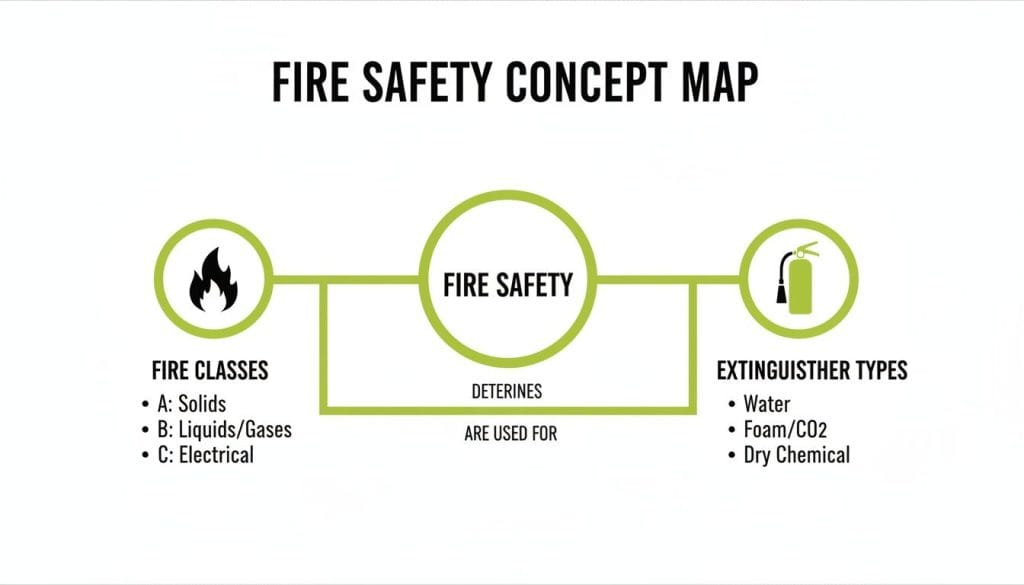
As you can see, proper fire safety starts by connecting the potential fuel sources in your building to the correct fire-fighting agent. This is the first critical step in any fire risk assessment and it dictates every equipment decision you make.
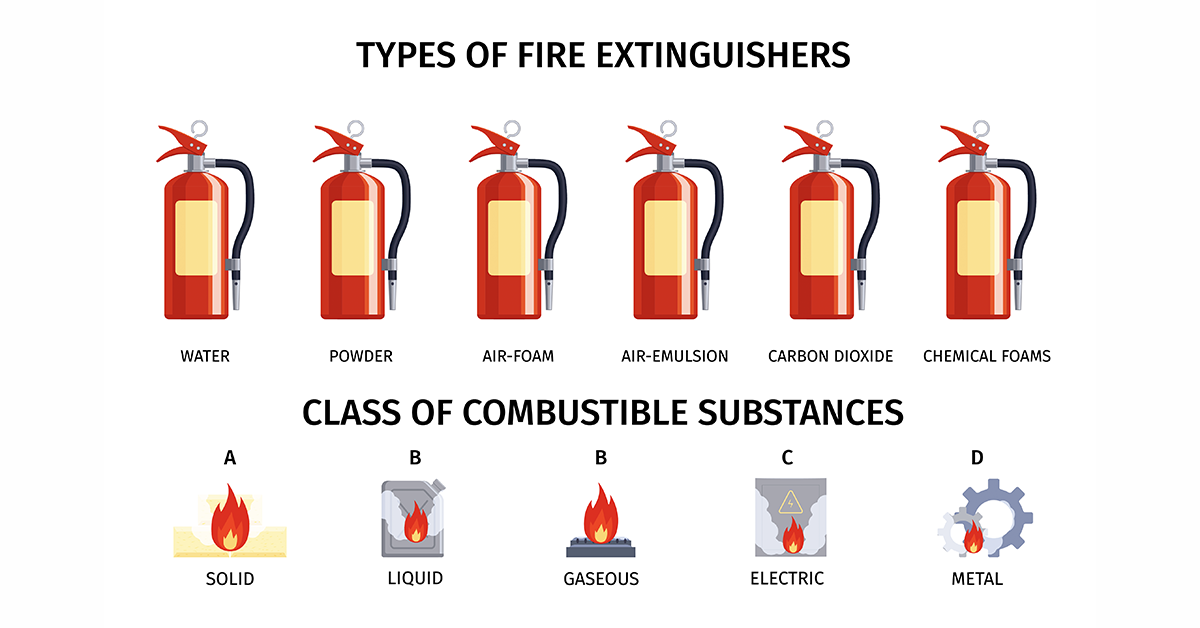
Not all fires are the same. In the UK, we categorise fires into six distinct classes based on the fuel source. Understanding these is the starting point for assessing the unique risks in your building.
A common compliance failure is assuming one type of extinguisher covers all scenarios. A standard water extinguisher used on a kitchen fire involving a deep-fat fryer is a recipe for disaster. The water will cause a violent, explosive reaction with the burning oil, spreading the fire instantly.
Once you have identified the potential fire classes on your premises, you can select the right tools for the job. Each extinguisher has a colour-coded band for quick identification and is engineered for specific types of fires.
1. Water (Signal Red Body)
These are the most common and cost-effective extinguishers, but they are only suitable for Class A fires. They work by cooling the burning material. Crucially, they must never be used on electrical or Class F fires.
2. Foam (Red Body with Cream Band)
Foam extinguishers are a versatile choice, effective on both Class A and Class B fires. The foam creates a blanket over flammable liquids, smothering the fire by cutting off its oxygen supply and preventing re-ignition. It is a popular option for offices and retail premises.
3. Dry Powder (Red Body with Blue Band)
Often called ‘ABC’ extinguishers, these are powerful against Class A, B, and C fires. However, British Standards strongly discourage their use indoors. The powder creates a thick cloud that severely reduces visibility and can cause breathing difficulties, making a safe escape much harder.
4. Carbon Dioxide (CO2) (Red Body with Black Band)
CO2 extinguishers are the primary choice for fires involving live electrical equipment. They work by displacing oxygen to starve the fire and leave no residue, making them ideal for server rooms or areas with sensitive electronics.
5. Wet Chemical (Red Body with Yellow Band)
These are purpose-built for Class F fires. A wet chemical extinguisher releases a fine mist that rapidly cools burning oil and creates a soap-like barrier on the surface, preventing the fire from flaring up again. They are a legal requirement in most commercial kitchens.
To simplify, here is a quick-reference table that shows which extinguisher to use for each class of fire. Pay close attention to the “Do NOT use” notes; they are just as important as knowing what to use.
| Extinguisher Type | Class A (Solids) | Class B (Flammable Liquids) | Class C (Flammable Gases) | Class D (Metals) | Electrical Fires | Class F (Cooking Oils) |
|---|---|---|---|---|---|---|
| Water | ✅ | ❌ | ❌ | ❌ | ❌ | ❌ |
| Foam | ✅ | ✅ | ❌ | ❌ | ❌ (Unless tested) | ❌ |
| Dry Powder (ABC) | ✅ | ✅ | ✅ | ❌ | ✅ | ❌ |
| CO2 (Carbon Dioxide) | ❌ (Ineffective) | ✅ | ❌ (Ineffective) | ❌ | ✅ | ❌ |
| Wet Chemical | ✅ (Limited) | ❌ | ❌ | ❌ | ❌ | ✅ |
This table should help you see why a single type of extinguisher is rarely sufficient for an entire building. A professional fire risk assessment is the only way to ensure you have the correct coverage for every specific hazard your property faces.
Choosing the right fire extinguishers is not just about practical fire safety; for almost every non-domestic property in the UK, it is a direct legal requirement. If you own or manage a building, you have a set of non-negotiable responsibilities designed to protect people and property from the devastating impact of fire.
These duties are laid out in the Regulatory Reform (Fire Safety) Order 2005. This key piece of legislation places the legal burden for fire safety squarely on the shoulders of a specific individual or company, known as the ‘Responsible Person’.
Identifying the Responsible Person depends on how the property is used, but it is almost always one of the following:
If more than one Responsible Person exists, they must all cooperate to meet their legal duties. Claiming ignorance is not a defence. If you are in control of a building, you are legally responsible for the safety of every person inside it. For a more detailed look at the rules, this plain English guide to UK fire safety regulations is a great resource.
The law is crystal clear about the first thing the Responsible Person must do: arrange for a suitable and sufficient fire risk assessment to be carried out by a competent person. This is not a box-ticking exercise. It is the absolute foundation of your building’s entire fire safety plan.
It is this assessment that tells you exactly which fire extinguishers you need. The process involves:
The assessment directly shapes your choices. An office with a server room, for example, will require CO2 extinguishers for the electrical risk. An HMO with a shared kitchen must have a Wet Chemical extinguisher for a potential cooking oil fire. Without a professional risk assessment, you are just guessing, leaving you non-compliant and dangerously unprepared.
Your fire risk assessment is the legal document that proves you have properly considered the risks and implemented the correct control measures. An inspecting Fire Officer will ask to see it, and its absence is an immediate and serious compliance failure.
Failing to meet these legal duties can lead to severe consequences for the Responsible Person. Local Fire and Rescue Authorities have significant enforcement powers.
Penalties can include:
If a fire occurs and you are found to have neglected your duties, the consequences become much worse. Fines for serious breaches are unlimited and can run into tens of thousands of pounds. In the most serious cases, particularly where loss of life occurs, prosecution can lead to a prison sentence.
To get a full picture of your responsibilities, it is worth consulting a good UK landlord survival guide. Ultimately, providing the correct fire extinguishers is a fundamental part of a much larger legal framework built to protect lives, property, and your business continuity.
You understand your legal duties. Now for the practical part: choosing the right fire-fighting equipment for your specific building. Your fire risk assessment is the blueprint for this, but knowing how to translate its findings into real-world decisions is what counts. The aim is to perfectly match the extinguishers you provide to the unique hazards present on your premises.
Let’s walk through a few common UK property types to see how this works in practice.
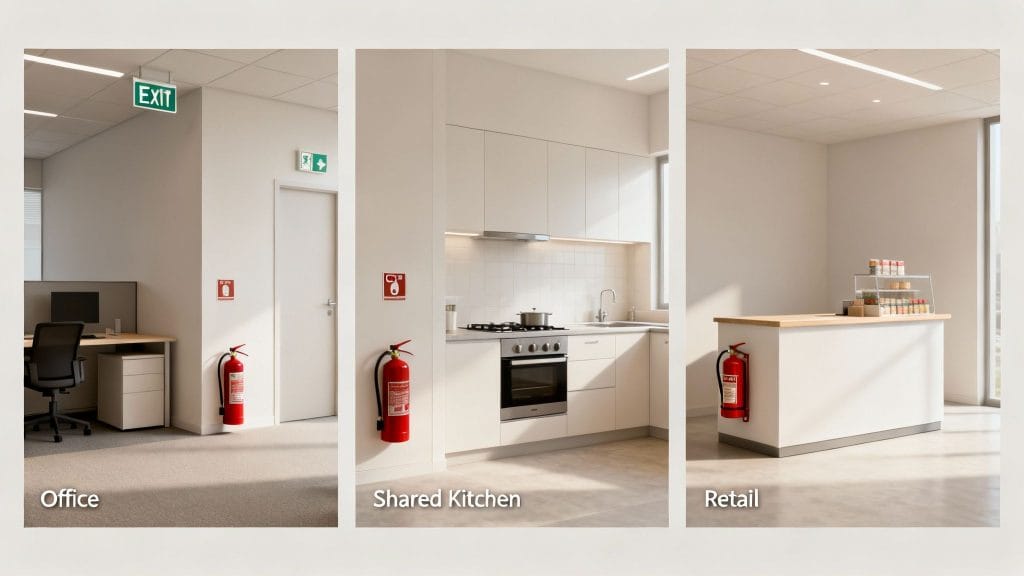
A standard office has predictable fire risks. The main hazards are Class A fires (from paper, cardboard, and office furniture) and electrical fires from computers, servers, and overloaded extension leads.
For an office, a smart combination of extinguishers is the best approach:
HMOs and other shared residential buildings present different challenges. You still have the usual Class A risks in bedrooms and living areas, but the shared kitchen introduces a major Class F risk from cooking oils and fats.
Because of this, the extinguisher setup in an HMO must be more specific:
Placing a standard water extinguisher in an HMO kitchen is a significant compliance failure. Using the wrong extinguisher on a chip pan fire can turn a small, containable blaze into an explosive fireball, with devastating results for both your tenants and your property.
Have you ever seen a code like ‘13A 34B’ on an extinguisher? That is not a random model number; it is a direct measure of its fire-fighting capability.
The number indicates the size of the fire it can successfully extinguish in a controlled test; the bigger the number, the more powerful the extinguisher. The letter confirms which fire class it is rated for (A for solids, B for flammable liquids). An extinguisher rated 21A can handle a larger Class A fire than one rated 13A. Your fire risk assessment must specify the minimum ratings required for your building.
Choosing the right tool is only half the job. Where you place it is just as important, and this is governed by British Standard BS 536-8 to ensure it is easy to see and access in an emergency.
Here are the key placement rules:
Getting the specification and positioning right is a critical part of your legal responsibility. For professional support, it is often best to engage a specialist for your fire extinguisher supply and installation to guarantee you are fully compliant. For more in-depth advice, check out this a comprehensive guide on which fire extinguisher for which fire. It helps ensure every decision is backed by expert knowledge and current standards.
A major change in UK fire safety regulations has directly affected one of the most common types of fire extinguishers. As the Responsible Person, you must be aware of this, because it impacts your legal compliance. The change centres on certain foam extinguishers, long considered a reliable all-rounder.
The problem lies with a group of chemicals called per- and polyfluoroalkyl substances (PFAS) found in older Aqueous Film-Forming Foam (AFFF) extinguishers. One chemical in particular, perfluorooctanoic acid (PFOA), has been labelled a ‘forever chemical’. It is incredibly persistent in the environment and carries significant health risks.
Due to these serious environmental and health concerns, the regulations had to change. The UK fire safety landscape shifted on 4 July 2025, when a strict ban on all PFOA-containing fire extinguishers took effect. This was a complete prohibition under updated UK REACH and Persistent Organic Pollutants (POPs) regulations.
From that date, the use, testing, maintenance, and refilling of these extinguishers became illegal across the UK. There is a minor exception for situations where all foam discharge can be fully contained, but this is almost impossible in a real-world fire scenario. You can learn more about the specifics of the UK fire extinguisher ban and what it means for your duties.
The bottom line is that if you have older foam extinguishers on site, they could now be illegal. Not knowing about the change is not a defence; holding onto non-compliant equipment is a breach of your fire safety obligations.
So, how can you tell if your foam extinguishers are the ones that have been banned? It comes down to checking the unit itself.
It is a common myth that all foam extinguishers are now banned. This is untrue. Modern, fluorine-free foam extinguishers are perfectly acceptable and remain a great choice for Class A and Class B fires. The ban is specifically aimed at older models containing PFOA.
You must take action now and audit your fire safety equipment. This is not something you can postpone. You have a legal duty to ensure every single fire-fighting device on your premises is compliant, correctly maintained, and fit for purpose.
Failing to remove and replace these PFOA units does not just put you at risk of enforcement action from the Fire and Rescue Service. It also creates a serious environmental liability. These old extinguishers must be disposed of as hazardous waste by a licensed specialist, which your fire safety provider can arrange for you.
Installing the right fire extinguishers is a crucial first step, but it is far from the end of the story. Under UK fire safety law, your role as the Responsible Person includes ensuring this equipment remains ready to use at a moment’s notice. This is a core part of your legal duties under the Regulatory Reform (Fire Safety) Order 2005.
The practical details of keeping your equipment in working order are laid out in British Standard BS 5306-3. This standard creates a simple two-part system: quick monthly checks performed by your team, and a mandatory annual service carried out by a professional. Neglecting this schedule makes your initial investment worthless and leaves your building dangerously exposed.
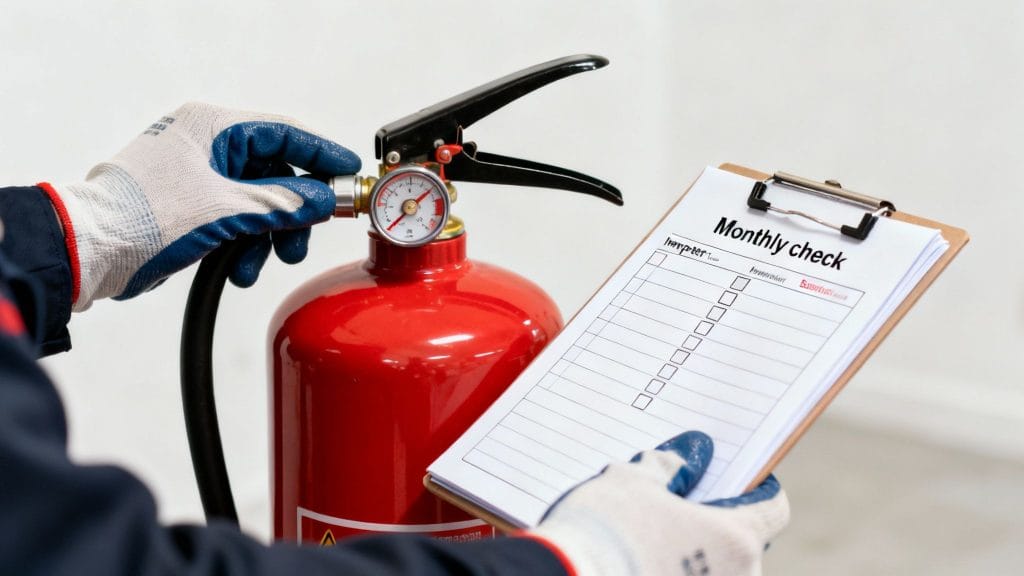
At least once a month, a designated person on your team should perform a quick visual inspection of every single extinguisher. It is a straightforward but vital task designed to catch obvious problems before they escalate.
This is a common-sense check. You are simply confirming that each unit:
Every check must be recorded in your fire safety logbook. This is your legal proof that you are actively managing your fire safety responsibilities.
A common mistake is seeing a fire extinguisher being used as a doorstop. This often damages the nozzle, making the unit useless in an emergency. These monthly checks are designed to spot and correct this kind of basic but dangerous misuse.
While your monthly checks are important, they do not replace a formal annual service. This is a job that must be done by a competent and qualified fire extinguisher technician. It is a much deeper inspection, where the technician assesses the internal and external condition of each unit, checks its weight, and ensures all mechanical parts are working correctly.
This annual service is not optional; it is a legal requirement. It is the only way to be certain your equipment meets British Standards and will work when you need it most. After the service, the technician will update the service label on the extinguisher and sign off in your logbook. Our expert team provides thorough fire extinguisher maintenance to keep you compliant year after year.
Beyond the annual check, extinguishers have a set lifespan and need more intensive maintenance at key milestones.
It is often more cost-effective to replace extinguishers with new, warranted units when they reach these milestones. Regulations also change, so keeping your equipment up to date is crucial. For instance, there’s a planned phase-out of all PFAS-containing fire extinguishers. A full ban isn’t expected before 2026, with phase-out periods likely running towards 2030. Staying on top of these changes is a key part of your ongoing duty.
Knowing which fire extinguishers to install is not a tick-box exercise. For any UK business owner, landlord, or property manager, it is a fundamental legal duty. Getting it right is a cornerstone of responsible fire safety management, directly protecting lives and your property.
The path to compliance is straightforward. It begins with a professional fire risk assessment to pinpoint your specific hazards, followed by selecting, installing, and properly maintaining the right equipment for those risks.
This is not just about avoiding fines from the Fire and Rescue Service. It is about creating a genuinely safe environment, protecting your assets from devastating damage, and ensuring your business can continue to operate without interruption. Your fire safety logbook, which should detail your monthly checks and annual professional servicing, is the evidence that proves your compliance.
If you have any doubt about your current equipment or the conclusions of your risk assessment, the safest action is to call in a professional. A competent fire risk assessor will provide the clarity and assurance you need to know your premises are properly protected.
When it comes to fire safety, everyone has practical questions. Here are the answers to some of the most common queries we receive from business owners and landlords across the UK.
There is no magic number. The correct quantity and type of extinguishers are determined by your fire risk assessment. This professional review considers the size and layout of your building, specific hazards like kitchens or server rooms, and the travel distance to an extinguisher.
As a general rule, British Standards suggest you should never be more than 30 metres from an extinguisher suitable for a Class A fire (paper, wood, textiles). However, this is just a starting point.
A professional assessment is the only way to be certain you have the right coverage to comply with the Regulatory Reform (Fire Safety) Order 2005. Attempting to figure it out yourself is a common and potentially costly mistake.
While they are not banned, official guidance strongly advises against using powder extinguishers indoors. British Standard BS 5306-8 is clear on this, recommending they should not be specified for use in enclosed spaces.
The reason is critical for a safe escape. When a powder extinguisher is discharged, it instantly creates a thick, choking cloud. This causes sudden vision loss and can make breathing difficult, which is the last thing you want when people are trying to evacuate a building.
They are now best reserved for outdoor areas or specific industrial settings where the risks of disorientation can be managed. For most shops, offices, and residential properties, foam or water extinguishers are much better choices for general risks.
A key part of any fire risk assessment is ensuring the fire-fighting equipment does not create a new hazard. Using a powder extinguisher in a narrow corridor could cause panic and confusion, turning a difficult situation into a disaster.
Do not dispose of them in a skip or your general waste. Fire extinguishers, whether used or simply past their service date, are classified as hazardous waste. They must be disposed of by a specialist to comply with environmental laws.
A discharged unit can sometimes be refilled by your servicing company, but it is often more economical to purchase a new one.
For old, damaged, or non-compliant units (like the banned PFOA foam models), you must have them collected by a licensed waste disposal company. Your fire extinguisher technician can usually arrange this for you. They will manage the safe, legal, and environmentally responsible removal as part of their service.
Understanding your fire safety obligations can feel complex. At HMO Fire Risk Assessment, our certified assessors provide clear, actionable fire risk assessments that tell you exactly what you need, where you need it, and why. We remove the guesswork from compliance, ensuring your property is properly protected.
Protect your property and meet your legal duties by booking a professional assessment today at https://hmofireriskassessment.com.
Not sure which colour does what? See our guide to UK fire extinguisher colours.
Most HMO landlords I talk to can rattle off their fire door requirements, their alarm grade, and their emergency lighting checks without missing a beat....
Most of the fire safety advice on this site assumes you already have a working HMO. This one is for the stage before that: the...