
Using Fire Extinguishers: A Practical Guide for UK Businesses and Landlords
15/01/2026
Using a fire extinguisher correctly starts with one critical decision: whether you should fight the fire at all, or just evacuate. Your primary legal and moral duty as a business owner, landlord or Responsible Person is always to protect life. An extinguisher is a tool for tackling a small, contained fire, perhaps one blocking an exit route. It is not for confronting a developing blaze.
This guide is for UK business owners, property managers, landlords and designated Responsible Persons who need to understand their legal obligations for fire extinguisher provision, use and maintenance under UK law. By the end, you will understand when to use an extinguisher, how to select the right type, and the steps required to remain legally compliant.
The moment you discover a fire is the most important one. Before considering reaching for an extinguisher, you must rapidly assess the situation. This split-second judgement can be the difference between a minor incident and a tragedy. Your responsibility is not to act as a firefighter; it is to ensure everyone can evacuate safely.
A portable fire extinguisher is only effective on a fire in its earliest stages. If it is already spreading, reaching the ceiling, or producing thick, black smoke, it is too late. Attempting to use an extinguisher in these conditions is not only futile but extremely dangerous.
Forget firefighting and initiate an immediate evacuation if you see any of these signs:
This decision tree provides a simple, visual guide to the thought process you must follow.
As the flowchart shows, the two absolute priorities are ensuring your escape route is clear and judging the size of the fire. Only then should you consider using an extinguisher.
Under the Regulatory Reform (Fire Safety) Order 2005, the ‘Responsible Person’ has an absolute duty to ensure the safe evacuation of everyone in the building. A failure to prioritise this over a misguided attempt to fight an uncontrollable fire could lead to severe legal consequences, including prosecution.
Placing the wrong type of extinguisher in a high-risk area is one of the most common and dangerous compliance failures we identify during site visits. Your fire risk assessment is not just a box-ticking exercise; it is a detailed plan that must identify specific fire hazards and match them with the correct equipment.
Using the wrong extinguisher can be ineffective at best and catastrophic at worst.
Imagine a small fire breaks out in your office server room. The instinct might be to grab the nearest red extinguisher, but a standard water-based unit will conduct electricity and could easily cause an electrocution. This is a perfect example of why understanding fire classes is a non-negotiable part of your legal duties as a Responsible Person.
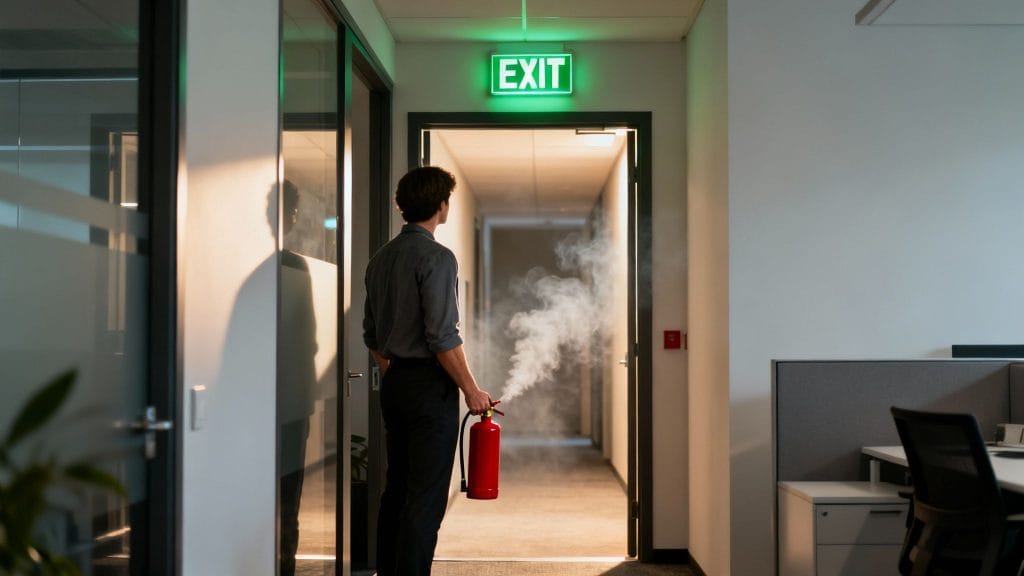
In the UK, fire extinguishers are colour-coded for rapid identification in a high-stress emergency. This simple system is designed to prevent life-threatening mistakes, but it only works if you and your staff understand what those colours mean for the specific risks in your building.
Let’s look at a few realistic workplace scenarios:
The crucial takeaway is this: a single type of extinguisher rarely covers all the risks in a building. A professional fire risk assessment is the only reliable way to determine the correct number, type, and placement of units needed for full compliance and safety.
To meet your legal duties, you must ensure the correct equipment is in place, as specified under British Standard BS EN 3. Making sure your employees or tenants can recognise these at a glance is a fundamental part of providing adequate fire safety information.
Here is a quick-reference table to help you match the colour code to the fire risk.
| Colour Code | Extinguisher Type | Suitable for Fire Classes | Common UK Property Application |
|---|---|---|---|
| Solid Red | Water | Class A (Solids) | Offices, schools, retail shops with paper, wood, and textiles. |
| Cream Panel | Foam | Class A & B (Solids & Flammable Liquids) | Garages, workshops, offices, areas with both solid and liquid fire risks. |
| Blue Panel | Dry Powder (ABC) | Class A, B, C & Electrical | Versatile for outdoor use or vehicles; not ideal indoors due to residue. |
| Black Panel | Carbon Dioxide | Class B & Electrical | Server rooms, switchgear rooms, near sensitive electrical equipment. |
| Yellow Panel | Wet Chemical | Class A & F (Solids & Cooking Oils) | Commercial kitchens, canteens, restaurants with deep fat fryers. |
While this table is a helpful guide, it is no substitute for the detailed analysis of a professional fire risk assessment. Getting the equipment right is a foundational step in meeting your legal obligations under the Regulatory Reform (Fire Safety) Order 2005, protecting both people and property.
Knowing which fire extinguisher to use is one thing, but operating it correctly under pressure is another challenge entirely. In the heat of the moment, with smoke in the air, you will not have time to read the instructions printed on the canister.
That is where the P.A.S.S. method comes in. It is a simple, universally recognised technique designed to be recalled instantly in a high-stress situation. Committing this simple acronym to memory is a fundamental part of effective fire safety, providing a clear sequence of actions that maximises your chances of putting out a small fire safely.
Each step is logical, helping you control the extinguisher’s powerful discharge and direct the contents exactly where they need to go. It is the difference between a panicked, ineffective spray and a controlled, successful first response.
First, Pull the pin. You will find this at the top of the extinguisher, and it prevents the handle from being squeezed by accident. The pin often has a small plastic tamper seal which will snap as you pull it out.
It may require a firm tug. The extinguisher will not work until this pin is completely removed.
Next, Aim the nozzle at the very base of the fire. This is the single most common mistake people make. Spraying the agent into the flames high up is a waste of time because you are not tackling what is actually burning: the fuel source.
By aiming low, you attack the source of the fire directly. Stand at a safe distance, usually between 6 and 8 feet away, and always ensure you have a clear escape route behind you.
A fire extinguisher is a first-aid response to a fire, not a replacement for the Fire and Rescue Service. Always keep your back to an unobstructed exit, so you can retreat immediately if the fire grows, the smoke becomes too thick, or the extinguisher runs out.
With the nozzle aimed at the base of the fire, Squeeze the lever above the handle in a controlled manner. This will release the extinguishing agent.
Squeeze the lever slowly and deliberately. If you press it down hard all at once, you will empty the canister in seconds. Most portable units only provide about 10-15 seconds of discharge time, so every second counts.
Finally, Sweep the nozzle from side to side across the base of the fire. As you continue to squeeze the lever, move the jet of extinguishing agent back and forth over the fuel.
Keep sweeping until it looks like the fire is completely out. Once it is, back away slowly but keep watching the area for any signs of reignition. If it flares up again and it is still safe to do so, repeat the process.
The P.A.S.S. method is the practical cornerstone of any effective workplace fire safety training programme for staff. As the Responsible Person for your premises, ensuring your employees are not just aware of these steps but are competent and confident in applying them is a vital part of your legal duties.
Simply having fire extinguishers on your property is not enough. Under the Regulatory Reform (Fire Safety) Order 2005, the designated ‘Responsible Person’ has a clear legal duty to ensure all fire safety equipment is fit for purpose. This means your extinguishers must be the right type for the risks identified, correctly sited, and, most importantly, properly maintained.
Failing to do this is not a minor oversight; it is a serious breach of fire safety law. An extinguisher that fails because it has not been maintained is no better than having no extinguisher at all. Worse, it creates a false and dangerous sense of security.
The responsibility to ensure these life-saving devices will work when needed falls squarely on your shoulders. This requires a structured programme of regular checks and professional servicing.
Your legal duties are very specific on this point: fire extinguisher maintenance must be carried out by a competent person. In practice, this means a qualified and certified technician, usually one working to British Standard BS 5306. Asking an employee to dust the unit down does not meet this requirement.
A professional service engineer performs checks that go far beyond a quick visual inspection. They will be assessing:
This annual service is mandatory. For a detailed breakdown of requirements, learn how often fire extinguishers should be serviced in our comprehensive guide.
Ignoring these maintenance duties can have severe consequences. Fire and Rescue Authorities are paying closer attention to fire safety compliance than ever before. In the year ending March 2025, Fire and Rescue Services in England carried out 51,020 fire safety audits, which led to 2,972 formal enforcement notices. You can review these fire prevention statistics on the official government page.
A poorly maintained fire extinguisher is a direct failing that would be noted in your fire risk assessment. If a fire occurs and an extinguisher fails, it could invalidate your building insurance policy and expose you to enforcement action, significant fines, or even prosecution in the event of injury or loss of life.
Proper maintenance is not just about ticking a compliance box. It is a fundamental part of managing risk. It ensures that if an employee or tenant needs to tackle a small fire to facilitate an escape, the equipment they reach for will not let them down. It is about protecting people, your property, and your business continuity.
Effective fire safety is not a one-off task. It is an ongoing commitment, a continuous process of checks and maintenance that ensures your equipment is ready the moment an emergency strikes. This is not just best practice, it is a core responsibility under UK fire safety law.
A simple yet vital part of this is the monthly visual inspection. This can be carried out by any designated member of staff and is your first line of defence against common equipment failures.
This is a straightforward but essential routine that should be conducted every month, with the findings recorded in your fire safety logbook.
While this simple monthly check is crucial, it does not replace the legal requirement for professional annual servicing.
An extinguisher that is hidden or out of service is a direct breach of your duties. Your fire risk assessment dictates the strategic placement of extinguishers, usually along escape routes, and it is your responsibility to ensure they remain there and are ready for use.
Those monthly checks are your responsibility, but the mandatory annual service by a certified technician is non-negotiable. This professional inspection is a legal requirement under BS 5306, ensuring the internal mechanics and pressure of the extinguisher are correct and safe.
Properly maintained equipment is also a factor when it comes to insurance. Should you ever have a fire, having compliant equipment will be a key part of any subsequent guide to navigating property insurance claims.
The growing emphasis on these obligations is reflected in market trends. The UK portable fire extinguisher market reached £400 million in 2024 and is projected to grow significantly, showing a clear increase in investment towards compliance. This makes understanding your legal duties, including specific fire safety regulations for landlords, more critical than ever.
Ultimately, this combination of regular visual checks and professional annual servicing is what transforms your fire extinguishers from red objects on a wall into reliable, life-saving assets. It is a vital investment in safety, legal compliance, and the continuity of your business.
Understanding the rules for fire extinguishers is crucial for keeping your property safe and staying on the right side of the law. Here are our answers to some of the most common, practical questions we hear from business owners, landlords, and property managers.
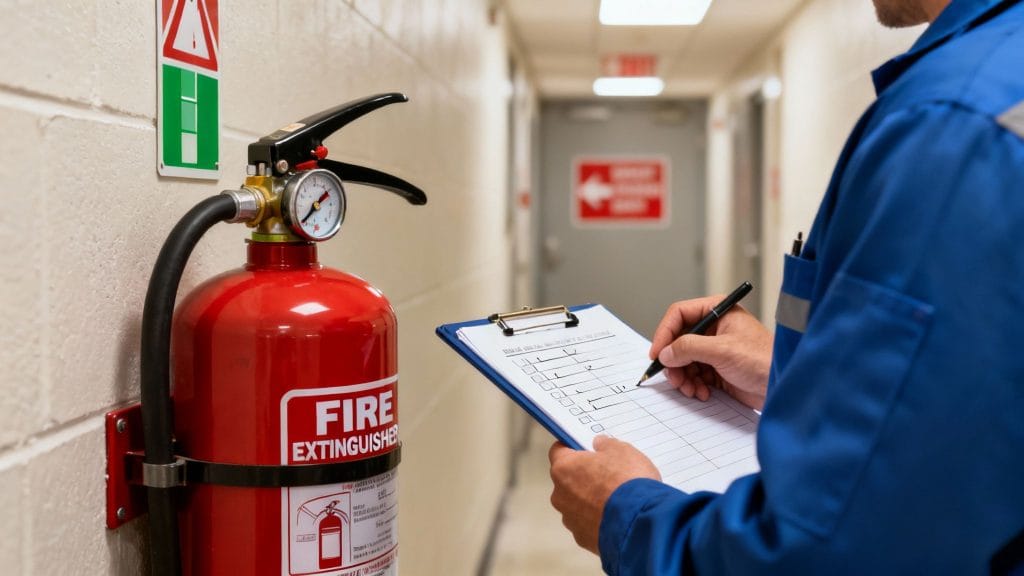
This is non-negotiable. In the UK, every fire extinguisher in a commercial or tenanted residential property must be serviced by a competent person at least once every 12 months. This is a strict legal requirement under British Standard BS 5306-3.
This annual “basic service” is a professional inspection to assess the pressure, weight, and overall condition of the unit. Beyond that, more in-depth “extended services” are needed every five years for most types, and every ten years for CO2 models. Always keep your certificate of inspection safe, it is the proof you need for your fire safety records.
This is highly unlikely to be compliant. A single type of extinguisher will rarely cover all the different fire risks in a typical office. For instance, a foam extinguisher is excellent for a bin fire full of paper (a Class A fire), but using it on an electrical fire could be disastrous.
Your fire risk assessment, which is a legal requirement, will identify every potential fire hazard and specify exactly which extinguishers you need. A common and compliant setup for an office is a CO2 unit for electrical equipment paired with a foam or water extinguisher for general risks.
Remember the PASS technique when you use one — see our guide on what PASS stands for in fire safety for the full step-by-step.
Most HMO landlords I talk to can rattle off their fire door requirements, their alarm grade, and their emergency lighting checks without missing a beat....
Most of the fire safety advice on this site assumes you already have a working HMO. This one is for the stage before that: the...