
How Often Should a Fire Extinguisher Be Serviced in the UK?
14/01/2026
When it comes to fire safety, your extinguishers are your first line of defence. But they are only useful if they actually work when you need them. That’s why in the UK, fire extinguishers in commercial properties and rented accommodation require three distinct types of checks: routine visual inspections you should conduct monthly, a mandatory professional service annually, and a more intensive extended service every five years.
Skipping any of these steps is not just poor practice; it can land the designated Responsible Person in serious legal and financial trouble. This guide is for business owners, landlords, and property managers who need to understand their legal obligations and ensure their fire safety measures are fully compliant.
Understanding your servicing schedule is a fundamental part of your duties under the Regulatory Reform (Fire Safety) Order 2005. This is not a friendly suggestion; it is a legal requirement designed to ensure this critical equipment works perfectly in an emergency. Getting this wrong could invalidate your insurance right when you need it most, not to mention the risk of significant fines.
Think of it as a layered approach to safety. The monthly visual checks are your quick, regular reviews for obvious problems. The annual service is a deep-dive health check by a professional. And the five-year service is a major overhaul to guarantee the extinguisher’s integrity for the long term.
The timeline for these checks is clearly laid out in British Standards, specifically BS 5306-3. Whether you are a business owner, landlord, or facilities manager, it is your legal responsibility to ensure this schedule is followed to the letter and recorded in your fire safety logbook.
This timeline gives you a clear picture of the checks needed throughout an extinguisher’s life.
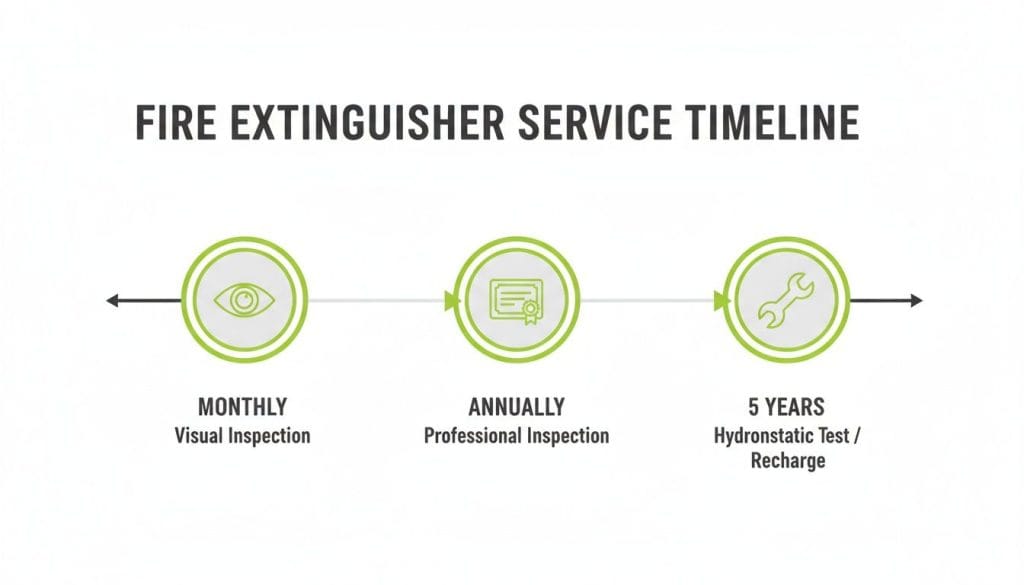
As you can see, the frequent, simple checks are backed up by less frequent but more technical professional services. It is this structured approach that prevents equipment failure and demonstrates to the Fire and Rescue Service that you are taking your responsibilities seriously. This is not just true for fire safety; the logic of regular checks applies across all facility management, where implementing a planned maintenance program for all safety equipment is a mark of good practice.
To make things even clearer, we have put together a simple table summarising your obligations.
This table breaks down the different types of checks, how often they need to happen, and who is qualified to carry them out. It is a handy reference for any Responsible Person.
| Type of Check | Frequency | Performed By | Core Responsibilities |
|---|---|---|---|
| Visual Inspection | At least monthly | Responsible Person or delegated staff | Check for accessibility, visible damage, correct pressure, and intact tamper seals. |
| Basic Annual Service | Every 12 months | Competent Person (e.g., BAFE technician) | A thorough inspection, functional check, and verification of all parts. |
| Extended Service | Every 5 years | Competent Person (e.g., BAFE technician) | Includes a test discharge and recharge (most types). CO₂ units may have different intervals. |
Keeping this schedule is not just about ticking boxes. It is about ensuring that when the worst happens, your first line of defence does not let you down.
While your monthly visual checks are good practice, the annual fire extinguisher service is entirely different. It is not a recommendation or a nice-to-have; it is a non-negotiable legal duty for every non-domestic premises in the UK.
This requirement is cemented in the Regulatory Reform (Fire Safety) Order 2005, with the technical details laid out in British Standard BS 5306-3. Skipping this annual service is a direct breach of fire safety law. The consequences can be serious, from official enforcement notices to substantial fines and even prosecution, especially if a fire breaks out and your equipment is found to be out of date.

This is not a job for the in-house handyman. The law is specific: the service must be done by a ‘competent person’. In the world of fire safety, that term has real weight. It means a technician with the right training, qualifications, experience, and specialist tools to do the job safely and correctly.
In practice, this almost always points to a technician accredited by a third-party body like the British Approvals for Fire Equipment (BAFE). When you hire a BAFE-certified engineer, you are not just ticking a box. You are getting peace of mind that the service meets the highest industry standards, ensuring your extinguishers are genuinely ready for an emergency.
An annual service goes far beyond a quick glance. The technician methodically works through a series of critical tests on every single extinguisher.
A basic annual service always includes these core checks:
One of the most common failings spotted during Fire and Rescue Service audits is a poorly kept or out-of-date fire logbook. The service label on the extinguisher and the entry in your logbook are your proof of compliance. Without them, you have no evidence you are meeting your legal duties.
Under UK fire safety law, every fire extinguisher in a commercial building or residential block needs this professional service at least once a year. Do not underestimate how seriously this is taken. Government figures show that Fire and Rescue Services (FRSs) in England carried out 51,020 fire safety audits in the year ending March 2025, and only 58% of premises passed with a satisfactory outcome. You can learn more about how UK fire safety regulations apply to your property.
Let us paint a picture. A facilities manager is preparing for a pre-arranged visit from the local Fire and Rescue Service. The fire safety officer arrives, starts checking the equipment, and quickly finds that half the extinguishers have not been serviced in over 18 months. The fire logbook is gathering dust, with no entries for two years.
In this situation, the business would almost certainly be issued with an enforcement notice, demanding they fix the problem immediately. Now, imagine if a fire broke out before they got around to it. The business owner could face prosecution, and their insurance company would have solid grounds to refuse any claim, potentially leading to catastrophic financial loss.
This is exactly why regular servicing is a cornerstone of workplace safety. For more ideas on creating a safe environment, take a look at these essential safety topics for work.
While the annual professional service is the cornerstone of your fire safety compliance, it is not the whole story. Ongoing vigilance is crucial, and this is where your role as the Responsible Person comes into sharp focus. Beyond the technician’s yearly visit, you are required to conduct regular visual inspections of all fire extinguishers on your premises, usually on a monthly basis.
This is not a replacement for the professional service; think of it as a vital, complementary check-up. It is the quick, routine inspection that catches problems early. A blocked nozzle, a drop in pressure, or a broken tamper seal can render a unit completely useless in an emergency. These monthly checks take only a minute per extinguisher but are essential for ensuring your equipment is ready for action at all times.
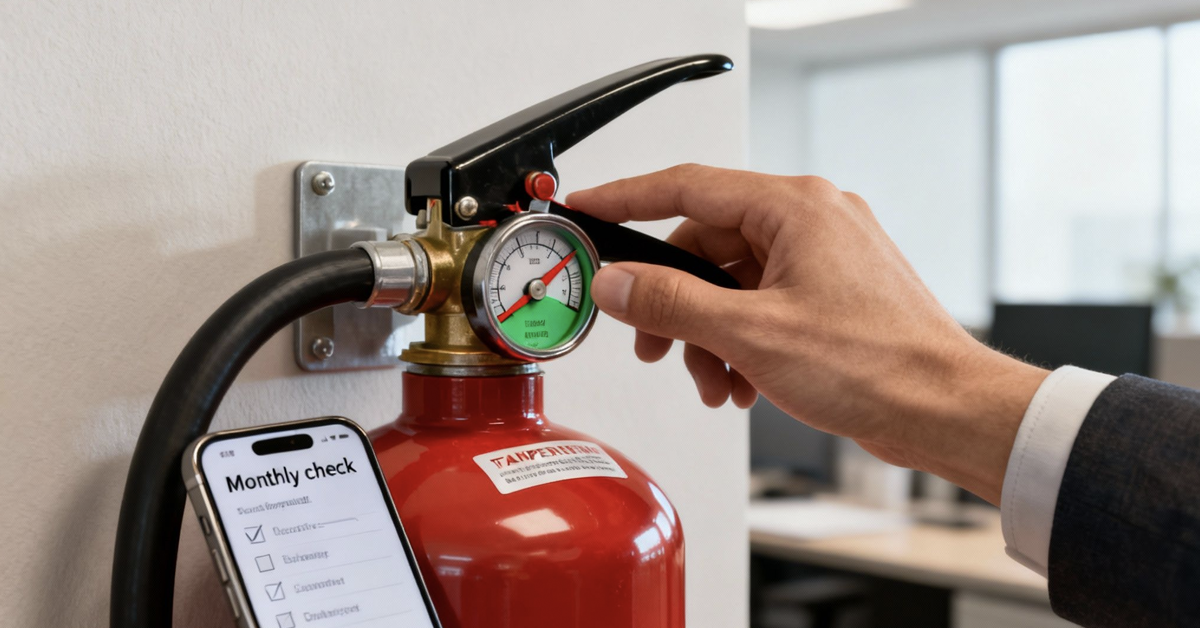
The good news is that these inspections are straightforward. You do not need specialist tools or training, just a keen eye and a methodical approach. Anyone you delegate this task to, from a facilities manager to a trusted member of staff, can easily perform these checks once they know what to look for.
Your monthly visual inspection should confirm the following for every single extinguisher:
These monthly checks are mandated by UK regulations like BS 5306-3, which require the Responsible Person to ensure extinguishers are in place and operational between professional services. These simple user checks are particularly effective at spotting issues in high-traffic areas like HMOs and shops, where equipment can be accidentally damaged or moved. In fact, Fire and Rescue Services often highlight these lapses during their 10,106 fire safety audits of such premises. You can discover more insights about fire safety visits and compliance statistics on defender-systems.com.
Imagine you are the landlord of a House in Multiple Occupation (HMO). During your monthly property walkthrough, you dedicate just ten minutes to inspecting the fire extinguishers in the hallways and kitchen. On the first floor, you spot that the pressure gauge on a water extinguisher is sitting in the red. Downstairs, the CO₂ extinguisher by the main electrical cupboard has been used as a doorstop, and its tamper seal is broken.
Because you are doing these checks regularly, you can take immediate action. You arrange for a competent technician to replace the faulty water unit and properly inspect the CO₂ extinguisher. This quick, proactive response prevents a minor issue from becoming a major compliance failure or, far worse, a tragedy if a fire were to break out.
Recording these checks is just as important as doing them. Every monthly inspection, along with any issues found and the actions you took, must be documented in your fire safety logbook. This record provides clear, undeniable evidence to inspectors that you are actively managing your fire safety duties.
Beyond the yearly inspection from a technician, your fire safety schedule has a couple of other crucial dates you cannot afford to miss. These longer-term service cycles are all about guaranteeing the structural integrity and long-term reliability of your extinguishers. Skip them, and you risk equipment failure and a serious breach of compliance.
The most common milestone is the five-year extended service. This is a mandatory requirement under British Standard BS 5306-3, and it is far more in-depth than the annual check. For most common extinguishers, this service makes sure the internal parts and the extinguishing agent itself are still up to the job after years of sitting under pressure.
If the annual service is a health check, think of the five-year service as a full medical. A competent technician will perform a test discharge, completely empty the unit, and then get a good look inside. They are checking for internal corrosion, rust, or any degradation that is completely invisible from the outside.
Once the internal inspection is complete, the extinguisher gets a fresh refill of extinguishing agent, is re-pressurised, and sealed up again. In essence, this process hits the reset button on its internal readiness, confirming it is good to go for another five years.
Key actions during a five-year service include:
Carbon dioxide (CO₂) extinguishers are a different case. They operate under immensely high pressure, far more than water or foam units. Because of this, they have their own, more rigorous, long-term service schedule. Instead of a five-year discharge test, CO₂ extinguishers need a hydraulic pressure test (often called an overhaul) every 10 years.
This test involves stripping the extinguisher right down and using high-pressure water to test the cylinder’s structural strength. It is a specialist job that has to be done at a dedicated testing centre. Due to the cost and logistics involved, it is usually more economical for property managers to simply buy a new CO₂ unit when it reaches the 10-year mark.
A common mistake for property managers is treating all extinguishers the same. A CO₂ unit with a 2020 manufacturing date will need its overhaul in 2030, but a foam extinguisher from the same year is due its extended service in 2025. Keeping a clear inventory with manufacturing dates is the only way to budget properly and stay compliant.
When an extinguisher’s five-year or 10-year service date arrives, the Responsible Person has a choice: pay for the extended service or just buy a new one? It nearly always boils down to a simple cost-benefit analysis.
For a standard water or foam extinguisher, an extended service might cost between £35 and £75. A brand-new, fully compliant replacement often costs about the same. When you consider the fresh guarantee and updated technology that comes with a new unit, replacement often looks like the smarter, more cost-effective option. It simplifies your records and guarantees you have the most reliable equipment on the wall. Planning for this is a core part of effective fire extinguisher maintenance.
For CO₂ extinguishers, the decision is even more straightforward. The cost of sending a unit for a 10-year hydraulic test, including transport and labour, almost always comes out higher than the price of a new replacement. For this reason, most businesses choose to replace their CO₂ extinguishers at the 10-year point.
By planning for these five and 10-year milestones, you can budget properly and avoid the unpleasant surprise of having to replace a large number of units all at once. This proactive approach does not just tick a compliance box; it builds a robust culture of fire safety across your properties.
Knowing how often your fire extinguishers need servicing is only half the battle. If you cannot prove it has been done correctly, you are failing in your legal duties. For any Responsible Person, diligent and accurate record-keeping is not just an administrative chore; it is a critical part of your fire safety compliance and your primary evidence of due diligence.
Without clear, accessible records, you have no defence against an enforcement notice from the Fire and Rescue Service (FRS) or a legal challenge. Every single action, from the simplest monthly check to a major five-year overhaul, must be documented in your fire safety logbook. This logbook is one of the very first things an FRS inspector will ask to see during an audit.
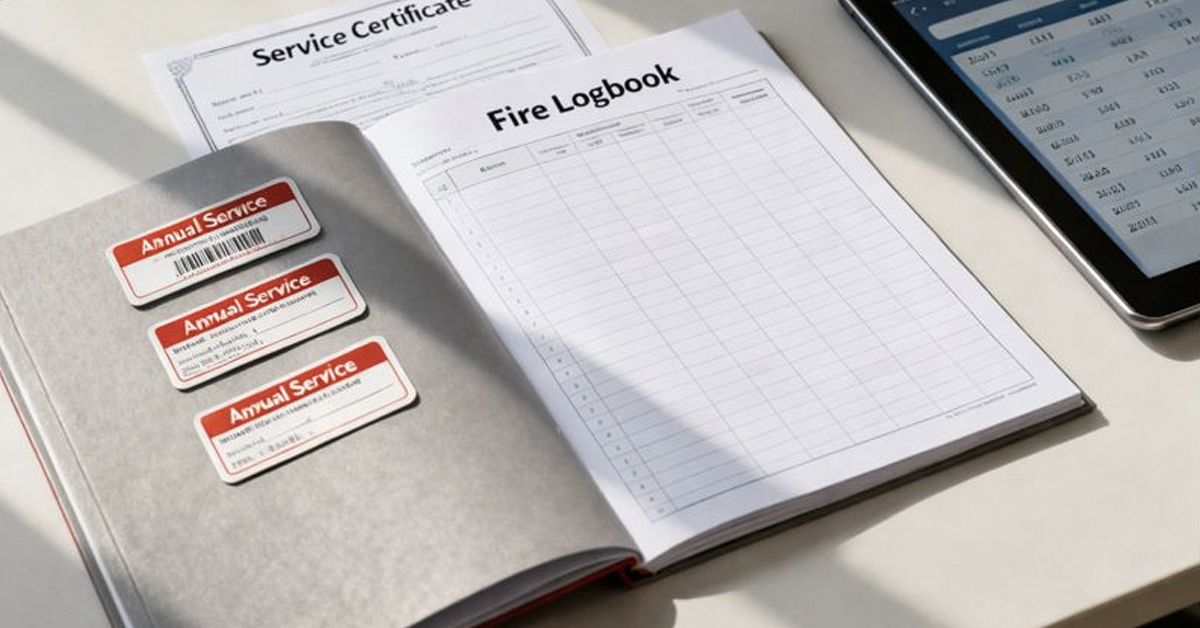
Your records need to tell the complete story of each extinguisher’s life, from installation to its latest check. Think of it as the equipment’s service history, just like for a vehicle.
At a minimum, your logbook must include:
Keeping proper records is a strict legal requirement under the Regulatory Reform (Fire Safety) Order 2005. Inadequate documentation often makes non-compliance findings much worse. The 51,020 fire safety audits in England for the year ending March 2025 found that a staggering 42% of premises were unsatisfactory. Poor records were a common theme, contributing to breaches in places like shops, which faced 10,106 audits alone. You can learn more from the official fire prevention and protection statistics on GOV.UK.
Imagine an FRS inspector visits two small, neighbouring businesses.
At Business A, the facilities manager presents a neat, organised logbook. Every monthly check is signed off, and the annual service certificates from a BAFE-accredited firm are filed correctly. The inspector can quickly verify that their duties are being met. The audit is swift, professional, and satisfactory.
Next door at Business B, the owner vaguely remembers the extinguishers were “done last year” but cannot find the paperwork. The logbook is empty, and the service labels on the units are faded and unreadable. The inspector has no choice but to issue an enforcement notice, giving them a strict deadline to fix the problems. This formal notice stays on the public record and could lead to prosecution if ignored.
The difference between these two outcomes was not the service itself, but the proof of the service. Meticulous records are your best defence, demonstrating a responsible and proactive approach to fire safety.
More businesses are moving away from paper logbooks and embracing digital systems. Using cloud-based software or apps can make record-keeping far easier, sending automated reminders for monthly checks and storing service certificates securely.
When you are choosing a professional fire safety provider, ask about their documentation process. A reputable company will provide clear, compliant digital or paper records as a standard part of their service, making your job as the Responsible Person much simpler.
Knowing the rules around fire extinguisher servicing is one thing, but taking decisive action is what keeps people safe and ensures you are compliant. As the Responsible Person, it is your job to manage this, but staying on top of it is straightforward once broken down.
Your main goal should be to create a simple, repeatable system for your property. A proactive approach not only protects people and buildings but also shows any inspecting authority, like your local Fire and Rescue Service, that you are taking your duties seriously. It turns fire safety from a reactive worry into a controlled, professional process.
To turn knowledge into action, here is a simple checklist you can follow today. These steps will help you get a solid servicing schedule in place and close any compliance gaps.
A common mistake is to treat fire extinguisher maintenance as a separate, isolated task. The best approach is to integrate it into your wider fire safety plan, ensuring it aligns perfectly with the findings of your fire risk assessment.
This integrated approach makes for a much stronger safety strategy. For example, your fire risk assessment might identify the need for specific types of extinguishers, and your maintenance plan then ensures they stay ready to use. You can learn more about professional fire extinguisher supply and installation that is tailored to your property’s unique risks.
By taking these practical steps, you are not just ticking boxes; you are actively reducing risk and fulfilling your legal duty to protect your property and everyone in it.
To help you stay on top of your fire safety duties, here are some straightforward answers to the questions we hear most often from business owners, landlords, and property managers.
No. While you are expected to handle the monthly visual checks yourself, the mandatory annual service must be carried out by a ‘competent person’.
In the UK, that means a qualified technician with the right training, tools, and accreditations, like those from BAFE. Attempting to service an extinguisher yourself is not just a breach of the British Standard BS 5306-3; it will almost certainly void your insurance and could lead to a catastrophic failure when you need it most. It is a risk that is never worth taking.
If a technician finds an extinguisher is faulty, corroded, has been discharged, or is otherwise unsafe, it will be condemned. They will recommend it is replaced immediately, as it is a legal breach to leave a non-functional fire extinguisher in place.
Most of the time, the servicing company can supply and commission a brand-new, compliant unit during the same visit. This is the best approach, as it ensures your premises remain protected without any dangerous gaps in your fire safety coverage.
The cost can vary depending on your location and chosen company, but it is usually broken down into a call-out fee plus a price per extinguisher.
As a rough guide, you can expect:
It is always a good idea to get a clear, itemised quote from a reputable provider that lists all costs for parts and labour upfront, so there are no surprises.
No, they are two separate but closely related legal duties. Your fire risk assessment is the high-level strategic review of your entire premises to find fire hazards and evaluate who is at risk. A key outcome of that assessment is deciding if you have the right type, number, and placement of extinguishers.
While a fire risk assessor will check that extinguishers are present and appear correct, the assessment itself does not include the physical, hands-on servicing of the units. This technical maintenance must be carried out separately by a competent servicing technician.
Many professional fire safety companies, including ours, can schedule both services together for convenience. This approach ensures the recommendations from your risk assessment are immediately backed up by a compliant maintenance schedule, creating a much stronger and more streamlined fire safety plan.
Your legal duties as a Responsible Person are clear, but managing them does not have to be complicated. At HMO Fire Risk Assessment, we provide BAFE-accredited fire extinguisher servicing and comprehensive fire risk assessments to ensure your property is safe, compliant, and protected. Contact us today to schedule a service or assessment and gain peace of mind. Learn more at https://hmofireriskassessment.com.
See our guide to how often fire extinguishers should be serviced for the full servicing schedule.
Most HMO landlords I talk to can rattle off their fire door requirements, their alarm grade, and their emergency lighting checks without missing a beat....

Most of the fire safety advice on this site assumes you already have a working HMO. This one is for the stage before that: the...