
A Landlord’s Guide to BS EN 12845 Fire Sprinkler Rules
11/01/2026
BS EN 12845 is the go-to British Standard covering the design, installation, and ongoing maintenance of fixed firefighting sprinkler systems. If you manage a commercial or industrial property in the UK, this is the technical rulebook that ensures these life-saving systems are reliable, effective, and fit for purpose.
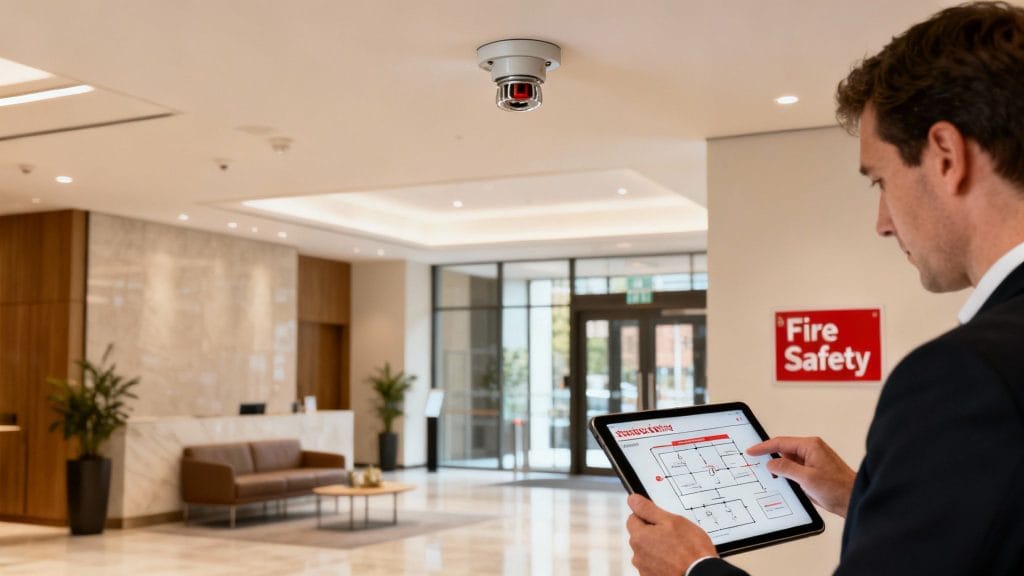
If you are the Responsible Person for a commercial building, a large House in Multiple Occupation (HMO), or an industrial site, understanding BS EN 12845 is a non-negotiable part of your fire safety duties. It’s important to understand that the standard itself is not a law. Instead, it’s the official “approved code of practice” that proves you are meeting your legal obligations under the Regulatory Reform (Fire Safety) Order 2005.
Think of it this way: the Fire Safety Order is the law telling you what you must do, which is maintain a safe premises. BS EN 12845 is the detailed, practical instruction manual explaining how to do it properly with a sprinkler system.
For property managers, business owners, and landlords, adhering to this standard is far more than a box-ticking exercise. It’s a cornerstone of any credible fire safety strategy, ensuring your sprinkler system will actually work as designed when a fire breaks out.
Getting it wrong or installing a non-compliant system can lead to serious problems, including:
A correctly installed and maintained sprinkler system is an active fire protection measure. It is designed to suppress or extinguish a fire in its early stages, working alongside other measures. For context on how this fits into a building’s overall fire strategy, you can learn more about what is passive fire protection in our detailed guide.
This guide is written specifically for the people legally responsible for fire safety in UK properties. Whether you manage a portfolio of commercial units, run a large HMO, or are a director of a business, this article will help you understand your responsibilities.
We will cut through the jargon and provide a clear roadmap. The goal is to help you make informed decisions, protect people, and shield your assets from the devastating impact of fire.
As a Responsible Person, understanding the relationship between UK fire safety law and the various British Standards can be challenging. It’s a common point of confusion, but it’s straightforward once broken down.
The law, primarily the Regulatory Reform (Fire Safety) Order 2005, sets the destination. It tells you what you have to do: take all necessary fire precautions to keep people safe. It’s the non-negotiable legal duty.
However, the law doesn’t provide the roadmap. It does not specify how to design a sprinkler system, what pipe sizes to use, or the required water pressure. That’s where standards like BS EN 12845 come in. They provide the technical, step-by-step instructions to get you to your destination safely and compliantly.
Following BS EN 12845 is the clearest and most respected way to demonstrate you have fulfilled your duties properly. For a fire officer, an insurer, or a court, a compliant system is solid proof that you have taken your fire safety duties seriously. For more on this, check out our plain English guide to UK fire safety regulations.
In the UK, BS EN 12845 is almost always applied alongside the LPC Rules for Automatic Sprinkler Installations. These rules, published by the Fire Protection Association (FPA), are an essential supplement that adapts the European standard for UK-specific risks and building methods.
The starting point for any sprinkler design under this framework is Hazard Classification. Before any design work begins, your property must be categorised based on its use and the flammability of its contents. This single decision shapes the entire system.
The standard defines three main categories. Getting this right is critical, as it dictates everything from the required water flow and pressure to the spacing of the sprinkler heads.
Do not underestimate this step. Correctly classifying your building is not just paperwork; it is the foundation of a system that will work when you need it most.
Since its adoption in the UK, BS EN 12845:2015+A1:2019 has become the primary standard for commercial and industrial sprinkler systems, underpinning most modern automatic installations in offices, warehouses, factories and retail premises. The standard is normally applied via the LPC Rules for Automatic Sprinkler Installations incorporating BS EN 12845, which are described as “the most widely used standard” for industrial sprinklers in the UK. This hazard classification drives critical design parameters such as minimum water flow rates, pressure and sprinkler density, which are used by UK insurers, fire engineers and risk assessors to evidence that fire risks are being controlled to an acceptable level.
A compliant fire safety strategy involves more than just sprinklers. It’s about how active systems (like sprinklers) and passive measures (like fire-rated walls) work together. When understanding comprehensive fire safety compliance, you begin to see how every element is connected. The hazard classification directly influences the design of the sprinkler system, highlighting why a ‘one-size-fits-all’ approach is not only ineffective but dangerously non-compliant.
To make this clearer, let’s look at how different UK properties would likely be classified.
This table shows how typical properties fit into the different hazard classes. It’s a good starting point for determining where your premises might fall.
| Hazard Classification | Description | Typical UK Property Examples |
|---|---|---|
| Light Hazard (LH) | Low fire load and low combustibility. Fires are expected to be small. | Offices, schools, hotels (bedrooms only), hospitals, libraries (excluding large storage rooms). |
| Ordinary Hazard (OH) | Medium fire load where materials may be processed or manufactured. | Car parks, restaurants, retail shops, light industrial workshops, breweries, laundries. |
| High Hazard (HH) | High fire load where materials burn intensely and spread rapidly. | Chemical plants, foam plastic manufacturing, paint shops, large-scale warehousing with high-piled storage. |
Getting this classification wrong has serious consequences. For instance, if you misclassify a high-risk warehouse as an Ordinary Hazard, the resulting sprinkler system will be completely inadequate. It would be designed to handle a much smaller fire and would fail to control a real event, a critical failure that any fire risk assessor or inspector would immediately identify.
One of the most serious, and surprisingly common, compliance failures we see is confusing commercial and residential sprinkler standards. A landlord or business owner might install a system compliant with the residential standard, BS 9251, in a building that legally requires the much tougher BS EN 12845. This is not just a minor technical slip-up; it’s a fundamental mistake with severe consequences.
Think of it like choosing a vehicle for a job. A BS 9251 system is like a family car: perfect for its intended domestic environment, reliable for getting people from A to B safely. A BS EN 12845 system, on the other hand, is a heavy-duty lorry. It’s built with industrial-grade components, has a far larger water supply, and is engineered to handle much more demanding conditions.
Using a family car to haul tonnes of industrial cargo would be reckless and destined for failure. In exactly the same way, installing a residential-grade sprinkler system in a commercial setting or a large, complex HMO creates a dangerous illusion of safety.
The gap between these two standards goes far beyond just the name. Their design philosophies and engineering principles are fundamentally different because they are built to tackle entirely different fire risks. A fire in a small flat behaves very differently to one in a workshop or a multi-storey office block.
Here are the critical differences every Responsible Person must understand:
This flowchart breaks down the hazard classifications that dictate whether a commercial system is needed.
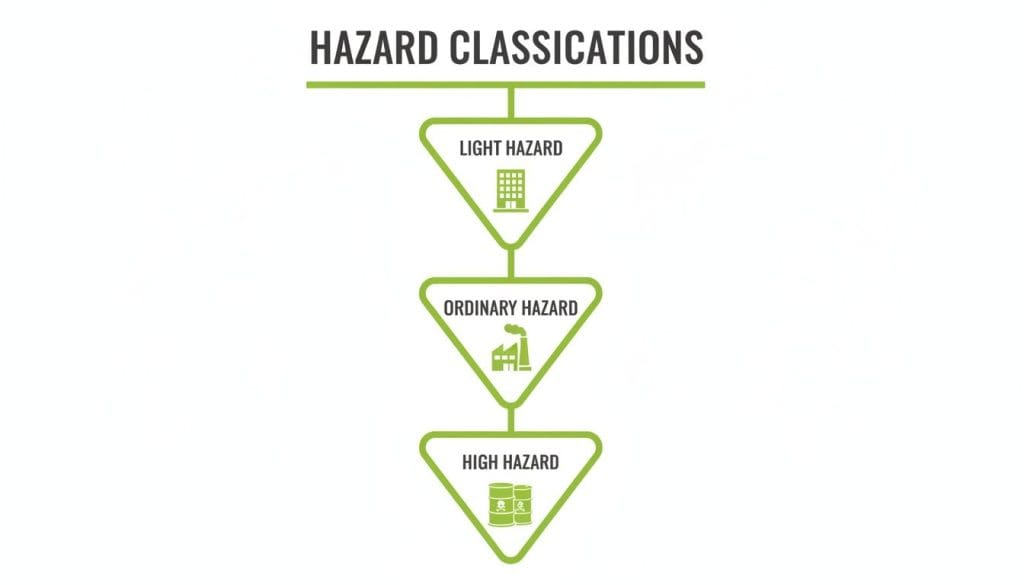
This hierarchy shows how the risk level, from a low-combustibility office to a high-risk chemical storage area, directly dictates the required system’s capability.
Installing the wrong type of system is not a mistake you can afford to make. If a fire risk assessment identifies a BS 9251 system in a property that clearly falls under the scope of BS EN 12845, the report will flag it as a significant risk to life and a major non-compliance.
The legal and financial fallout can be severe. Your building’s insurance may be completely invalidated, leaving you personally liable for all damages. The Fire and Rescue Service can issue enforcement notices compelling you to replace the entire system, a hugely expensive and disruptive process. Ultimately, it is a clear breach of your duties under the Fire Safety Order.
This is not just a technical detail you can delegate without oversight. It’s a critical compliance choice that directly impacts the safety of your occupants and the legal standing of your business or property portfolio.
Fitting a sprinkler system compliant with BS EN 12845 is a huge step forward for your building’s safety, but it’s really only the beginning. A system is only ever as good as its last check-up. As the Responsible Person, you have a legal duty to make sure it’s inspected, tested, and serviced on a strict schedule.
Think of it like the MOT for a commercial vehicle. Buying the lorry is just the start; it’s the constant, documented servicing that keeps it safe and roadworthy. If you let your sprinkler maintenance slide, you are not just taking a risk, you are in serious breach of the Fire Safety Order 2005. That hugely important safety asset becomes unreliable, creating a massive legal headache for you and your business.
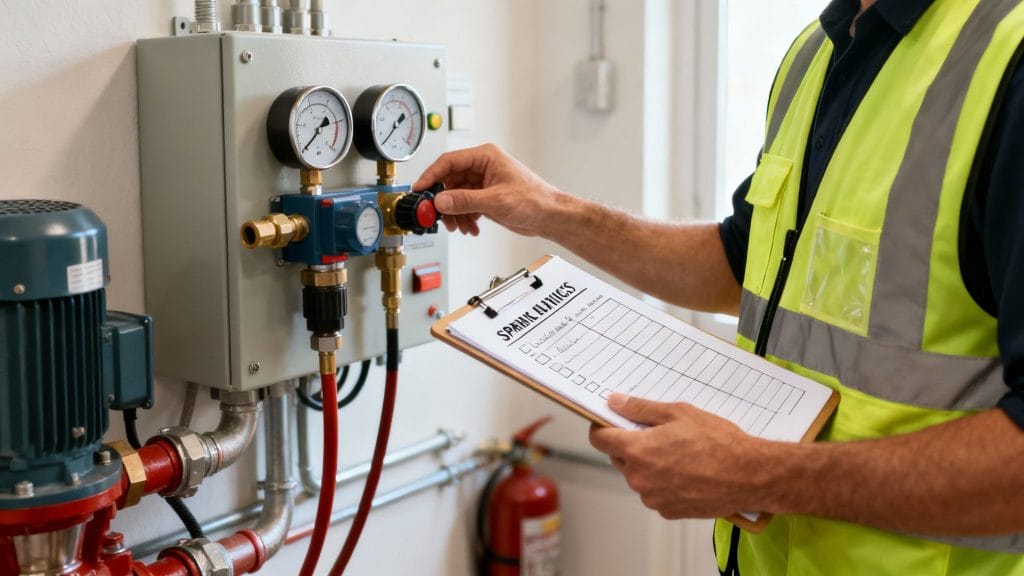
The standard lays out simple but crucial checks that need to be done every week. This can be performed by you or a trained member of your team. You do not need to be a specialist engineer, but these tasks are vital for catching problems early.
Every check needs to be logged meticulously in your fire safety logbook. This is the very first thing a fire officer or your insurance assessor will ask to see.
Your weekly routine should include:
While you handle the weekly checks, BS EN 12845 is crystal clear on one thing: a full, professional service must be carried out by a competent, third-party accredited fire engineering company at least once a year. This is not optional.
During this annual service, a qualified engineer will perform a deep dive into your system’s health. It is far more detailed than your weekly walk-around. They’ll test pumps, check flow rates, examine pipework, and make sure every single component is working exactly as it was designed to.
Any faults or required repairs will be documented in a service report, which you must file with your fire safety records. This paperwork is essential for proving compliance and forms a key part of your building’s overall fire safety inspections regime.
Under BS EN 12845, a sprinkler system is not a “fit and forget” solution. It is a dynamic life-safety system that demands consistent, scheduled attention throughout its operational life to remain compliant and effective. Neglect is not an option and will be identified during any competent fire risk assessment.
Beyond the yearly cycle, BS EN 12845 and its associated technical bulletins map out requirements for the system’s entire lifespan. This is where long-term planning becomes essential for property managers and business owners.
A key part of this is outlined in Technical Bulletin TB 203, which supplements the main standard. It reinforces how the UK manages the long‑term reliability and maintenance of sprinkler systems. With the right care, these systems can have a life of up to 50 years.
To ensure that happens, TB 203 mandates that after 25 years, a sample of sprinkler heads must be removed and sent for laboratory testing. This confirms they still perform as designed. You can discover more insights about the specific requirements of this bulletin from the FPA.
This long-range view is critical for budgeting and ensuring your business is not caught off guard. Remember, during periods when your sprinklers are being serviced or are temporarily offline, understanding when a fire watch is required is a crucial part of your ongoing responsibilities. It ensures your property and its occupants remain protected, demonstrating a robust approach to fire safety.
While meeting your legal duties is essential, the real value of a compliant BS EN 12845 sprinkler system goes beyond ticking a box for the fire authority. If you see it as just another expense, you are missing the bigger picture. A correctly designed and maintained system is one of the smartest strategic investments you can make in your business’s future.
Think of it as a silent, 24/7 guardian for your premises. This is not just about protecting the building’s walls and roof; it’s about safeguarding everything inside. Your stock, vital machinery, servers, and irreplaceable paper records are all under its watch. A compliant sprinkler system is engineered to control a fire in its infancy, stopping the kind of catastrophic losses that can put a company out of business for good.
The real goal here is business continuity. A major fire does not just cause physical damage; it unleashes a domino effect of expensive operational headaches. It can grind production to a halt, shatter supply chains, and ruin customer relationships that took years to build.
A compliant sprinkler system is your first and best line of defence against this kind of disaster. By containing a fire right away, it dramatically limits the damage, meaning you can get back on your feet and back to business much faster. This transforms the system from a simple fire safety measure into a core part of your operational resilience.
A common myth is that sprinklers flood the entire building. The reality is much smarter. Only the sprinkler heads directly over the fire’s heat will activate. This targeted response is far less destructive than the high-pressure hoses used by the Fire and Rescue Service to tackle a fully-developed blaze.
The value of these systems is not just theoretical, it’s backed by solid data from real incidents across the UK. The evidence consistently shows that sprinklers designed and maintained to standards like BS EN 12845 perform exceptionally well when needed most.
UK performance data shows that these systems have effectively controlled fires in 96–99% of instances where they operated. In those incidents, fires were controlled in 62% of cases and fully extinguished in 37%. For businesses like warehouses, where fires cause an estimated £230 million a year in direct financial losses, the business case is crystal clear. You can dig deeper into these findings on automatic fire suppression from the NHS.
Insurers do not deal in guesswork. They understand risk better than anyone, which is why they look so favourably on properties protected by a compliant BS EN 12845 system. Installing one can lead to significant reductions in your insurance premiums because the insurer sees you have taken a huge step to mitigate the risk of a massive claim.
Over time, this financial benefit can help offset the initial installation cost. More importantly, it shows your insurer that you are a responsible property manager who takes risk management seriously, strengthening your entire commercial relationship. At the end of the day, compliance is not just an overhead; it’s a direct investment in protecting your assets, your operations, and your future profitability.
Understanding your responsibilities under BS EN 12845 can feel daunting, but it boils down to a clear, logical process. By taking control of these key steps, you, as the Responsible Person, can confidently handle your legal duties, reduce risk, and ensure your system is a life-saving asset you can rely on. This is not about turning you into a sprinkler engineer; it’s about making you an effective and compliant manager.
Think of this as your roadmap. It pulls together all the crucial lessons into a straightforward action plan. Follow these steps, and you will build a solid framework for your compliance strategy, ensuring you have the right systems in place and, just as importantly, the correct paperwork to prove it.
Everything starts with your Fire Risk Assessment (FRA). This is the cornerstone document that should officially determine whether your property needs a sprinkler system and, if so, which standard it must follow. A competent fire risk assessor will examine the building’s use, size, layout, and occupants to decide if the robust commercial requirements of BS EN 12845 are necessary over the residential standard, BS 9251.
Do not guess and do not assume. The FRA provides the professional justification for your chosen system, protecting you from a costly and potentially dangerous compliance mistake.
Once your FRA confirms you need a BS EN 12845 system, your next move is to find a qualified and competent installation company. The industry benchmark for competence is third-party accreditation from a recognised body. This gives you independent proof that the company has the skills, knowledge, and processes to design and install your system correctly.
Never compromise on competence just to save money. Using an unaccredited installer for a life-safety system is a massive gamble that can invalidate your insurance, fail inspections, and ultimately put lives at risk. Always ask for proof of their accreditation.
Getting the system installed is only the beginning. You must implement and document a strict maintenance schedule exactly as the standard lays out. This is broken down into two distinct parts:
Every single activity, no matter how small, must be recorded in your fire safety logbook. This creates an unbroken chain of evidence that proves you are fulfilling your due diligence.
Your final responsibility is to keep a comprehensive and easily accessible record-keeping system. This file should contain everything related to your sprinkler system, including:
These records are not just for you. They are essential documents that will be scrutinised by Fire and Rescue Service inspectors and insurance surveyors. Having them organised and ready is the hallmark of a diligent and compliant Responsible Person.
Navigating fire safety standards always raises practical, real-world questions. Here are clear, straightforward answers to the most common queries we hear from property managers, landlords, and business owners about BS EN 12845.
Yes, absolutely. If your office building has a sprinkler system, your fire risk assessment is not complete unless it verifies the system was designed, installed, and is being maintained to the correct standard. For commercial systems, that standard is BS EN 12845.
A competent assessor will want to see everything, from the original commissioning certificates to your latest maintenance logs. Any gaps, like a missed service or patchy records, will be flagged as a significant failing and will require immediate action to meet your duties under the Fire Safety Order.
This is a critical question, and getting it wrong can be a costly mistake. Smaller, domestic-style Houses in Multiple Occupation (HMOs) often use the residential standard, BS 9251. But this is definitely not a one-size-fits-all solution.
For larger or more complex properties, such as buildings with several storeys, complicated layouts, or those housing more vulnerable tenants, the risk profile is much higher. In these cases, the more robust, commercial-grade protection offered by a BS EN 12845 system is usually the only appropriate choice.
There is no grey area here. Only a thorough, property-specific fire risk assessment can tell you which standard is right for your building. Guessing or choosing the wrong one is a serious compliance failure that could invalidate your insurance and, more importantly, put lives at risk.
Failing to maintain a BS EN 12845 sprinkler system is a major breach of the Fire Safety Order, and the consequences are severe.
Legally, you are looking at enforcement action from the Fire and Rescue Service. This could be a formal notice compelling you to fix the problems, but it can escalate to unlimited fines or even prosecution for serious neglect.
Financially, it is just as serious. Your building’s insurance policy will almost certainly be voided by the lack of maintenance. If a fire breaks out, you could be held personally liable for the loss. But the real consequence is that a poorly maintained system might not work when you need it most, with devastating results for people and property.
The standard is very specific about this. While your own trained staff should be doing visual checks every week (and logging them), this does not replace the need for an expert eye.
A full, detailed service must be carried out by a competent and certified fire engineering company at least once every year. On top of that, there are other crucial checks, like the 25-year system and head inspection, that you need to plan and budget for. Every single check, test, fault, and service must be meticulously recorded in a dedicated logbook, as this is your proof of compliance.
Meeting your obligations under BS EN 12845 is a non-negotiable part of your legal duties as a Responsible Person. To get absolute clarity and ensure your fire risk assessment properly reflects your property’s needs, it is vital to work with competent professionals. Get in touch with HMO Fire Risk Assessment to book your certified fire risk assessment and make sure you’re fully compliant.
Most HMO landlords I talk to can rattle off their fire door requirements, their alarm grade, and their emergency lighting checks without missing a beat....

Most of the fire safety advice on this site assumes you already have a working HMO. This one is for the stage before that: the...