
A Plain English Guide to Emergency Lighting British Standards
10/01/2026
When the power fails and a building is plunged into darkness, a working emergency lighting system is often the only thing standing between calm and chaos. It’s a critical life safety system, and UK law places the responsibility for ensuring it works squarely on the shoulders of building owners and managers.
This is not a matter of preference; it’s about following established British Standards. The main one you need to know is the BS 5266 series, which provides the official code of practice for designing, installing, and maintaining these systems. While the standards are not laws themselves, they are the benchmark authorities use to decide if your emergency lighting is adequate and, therefore, legally compliant.
This guide is for business owners, landlords, and property managers in the UK who need to understand their legal duties for emergency lighting. By the end, you will understand what the standards require, who is responsible, and the practical steps needed to ensure your property is safe and compliant.
For landlords, business owners, and property managers, understanding the link between the law and these technical standards is crucial. It’s not enough to just have a few lights that flicker on during a power failure. To be considered legally adequate, your system must meet specific, detailed requirements.
The cornerstone of fire safety law in England and Wales is the Regulatory Reform (Fire Safety) Order 2005. This legislation identifies a ‘Responsible Person’ for most non-domestic premises, which includes the shared areas of residential blocks such as HMOs and flats.
This person, who could be the building owner, an employer, or a managing agent, has a legal duty to keep occupants safe. A key part of this duty is carrying out a fire risk assessment and implementing the right fire safety measures. Emergency lighting is a fundamental piece of that puzzle.
The Fire Safety Order legally requires that all escape routes and exits are clearly marked and have enough emergency lighting to allow people to get out safely. You can learn more in our detailed overview of UK fire safety regulations.
While the Fire Safety Order tells you what you need to do (provide adequate lighting), it doesn’t explain how to do it. That’s where the British Standards step in.
Documents like BS 5266-1 give the precise, technical guidance needed to meet your legal duty. When the Fire and Rescue Service inspects your property, they use these standards as their yardstick. If your system does not meet the criteria in BS 5266, it will almost certainly be deemed inadequate, putting you in breach of the law.
An inspector will assess your system’s design, light levels, and maintenance records against the criteria set out in British Standards. A failure to meet these standards is viewed as a failure to provide safe premises, which can lead to severe penalties.
Ignoring these standards is not just a technical oversight; it’s a direct failure of your legal duties. The consequences can range from an informal notice demanding immediate fixes to hefty fines and, in the worst-case scenarios, prosecution. Following the standards is not optional—it’s a core part of responsible property management and, most importantly, protecting lives.
To ensure your emergency lighting system is doing its job and meeting legal requirements, you need to get to grips with the British Standards that govern its design, performance, and upkeep. These documents can look technical, but they follow a clear logic. Do not think of them as separate rulebooks, but as connected chapters in one complete guide to fire safety.
The main document you’ll hear about is BS 5266-1. This is the code of practice for emergency lighting on premises. Think of it as the master playbook. It gives you comprehensive guidance on where you need emergency lights, how the system should be designed, and what types are suitable for different buildings. It’s the first port of call for fire risk assessors, designers, and installers.
But BS 5266-1 does not work alone. It operates hand-in-hand with two key European standards that the UK has adopted.
Understanding how these standards fit together is the key to unlocking your compliance duties. Each one has a specific job to do, creating a clear hierarchy of rules that build on one another.
This diagram shows how the British Standards provide the technical bedrock that helps the Responsible Person meet their legal duties under the Fire Safety Order.
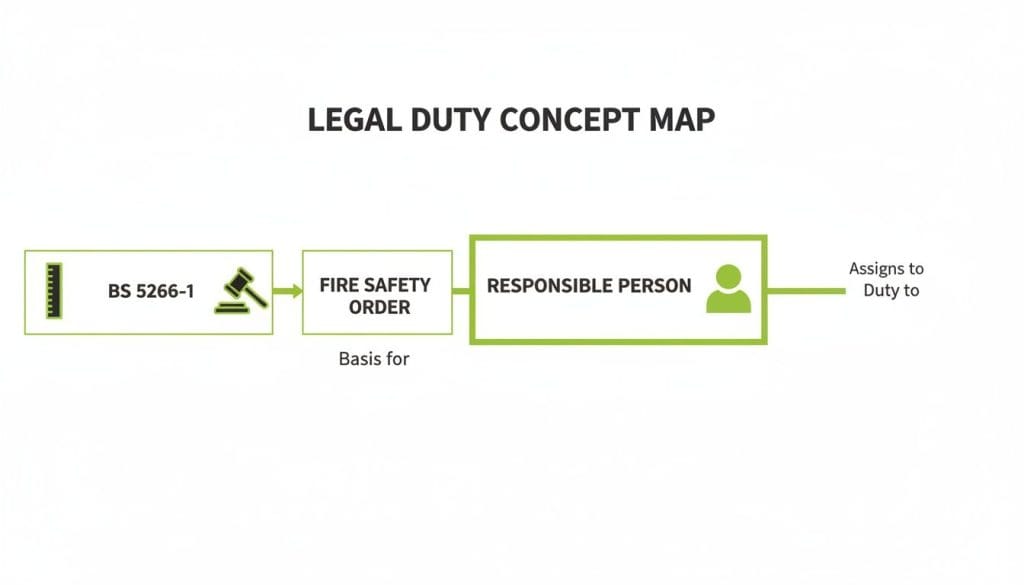
At the end of the day, following the technical guidance in BS 5266 is the practical, recognised way to meet the legal demands placed on you as the Responsible Person.
These standards are not a one-size-fits-all solution. They are designed to be applied based on risk. For instance, BS EN 1838 demands higher light levels in potentially hazardous areas to make sure machinery can be shut down safely, compared to what’s needed for a simple, straight corridor.
In the same way, the design must consider who is in the building and what the evacuation strategy is. This is where modern standards have really moved on.
Since the 1980s, UK emergency lighting standards have shifted from simply lighting up escape routes to a much smarter, risk-based approach. The 2016 update of BS 5266-1 officially aligned with European standards like BS EN 1838 and BS EN 50172, creating a much clearer structure. One of the key developments was the introduction of “Emergency Safety Lighting”, sometimes called ‘Stay Put Lighting’. This is for situations where not everyone is expected to evacuate immediately during a power cut, such as in high-rise residential blocks, hospitals, or critical business operations. You can find out more about how these standards have evolved to cover complex building strategies at firesafe.org.uk.
A common misunderstanding is that all emergency lighting is purely for getting out. In buildings with a ‘stay put’ policy, emergency lighting also has to support the safety of residents who remain in their flats, ensuring common areas are lit for firefighters or a later, phased evacuation.
This risk-led approach means your fire risk assessment is always the starting point. It’s what will determine which parts of the standards are most relevant to your property, making sure the final system is not just compliant on paper but is genuinely effective at protecting lives in a real emergency.
Knowing the standards is one thing, but putting them into practice is where safety truly happens. A compliant emergency lighting system is not just about installing a few backup lights and hoping for the best. It’s about a carefully thought-out installation where every single light is placed with purpose, delivering exactly the right amount of illumination for a specific amount of time. This is where the theory of the British Standards becomes a tangible, life-saving measure in your property.
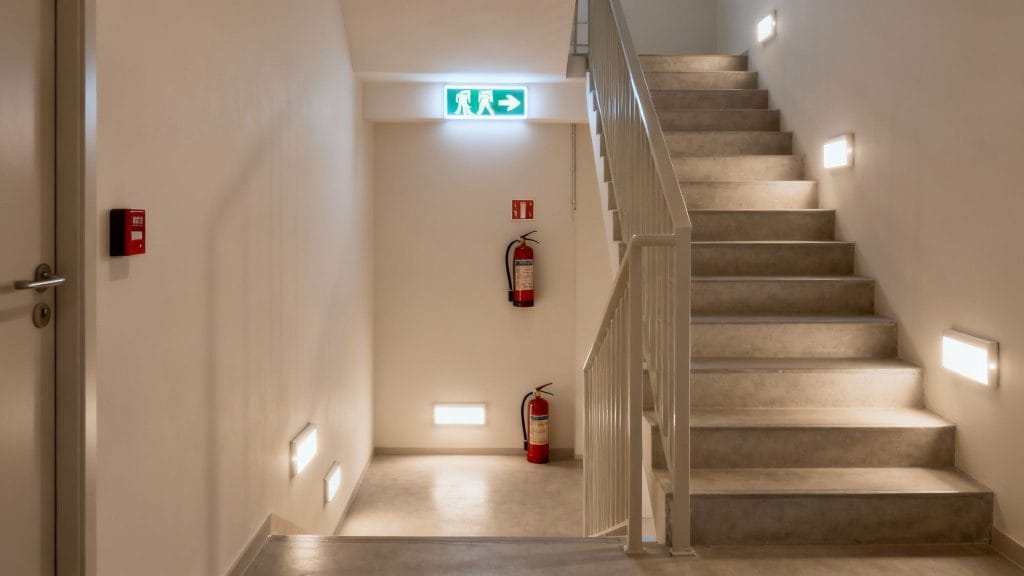
The primary goal is simple: when the main lights go out, nobody is plunged into sudden, dangerous darkness. The system must provide enough light for people to spot obstacles, navigate their way to an exit, and find crucial fire safety equipment like alarms or extinguishers. Getting this right demands a methodical approach to both design and installation.
One of the most common failings we find during a fire risk assessment is an emergency lighting system that’s too dim or does not stay on long enough. It’s a classic corner-cutting mistake. The British Standards are very clear on this, setting precise, measurable benchmarks that landlords and building managers must meet.
BS EN 1838:2013, which is the go-to standard referenced by BS 5266-1, specifies a minimum of 1 lux along the centre line of escape routes (such as corridors and stairwells) and 0.5 lux in open areas larger than 60 m². This is measured at floor level to ensure people can see what they might trip over. The guidance also recommends at least two emergency lights per room or area, so if one fails, you are not left completely in the dark.
Duration is just as critical. Most UK workplaces need their systems to last for at least 1 hour. However, a 3-hour duration is the standard for premises where people sleep or where a quick, clean evacuation is not guaranteed, such as in blocks of flats or care homes. You can find a deeper dive into these rules and how they apply at lumenloop.co.uk.
These are not just vague guidelines; they are the exact figures a competent engineer will test for with a light meter to certify your installation.
To make this easier to digest, here’s a quick summary of the minimum requirements your system needs to meet.
This table summarises the key performance benchmarks for emergency lighting systems as specified by relevant British Standards.
| Location or Area Type | Minimum Illuminance (at floor level) | Minimum Duration |
|---|---|---|
| Defined Escape Routes (e.g., corridors) | 1 lux along the centre line | 1 to 3 hours, depending on building use |
| Open Areas (>60 m²) | 0.5 lux throughout the area | 1 to 3 hours, depending on building use |
| High-Risk Task Areas | 10% of normal lighting (but not less than 15 lux) | Duration of the risk |
| Points of Emphasis (e.g., near exits) | 5 lux | 1 to 3 hours, depending on building use |
These values are the absolute baseline for a compliant system. A skilled designer will often exceed these minimums in complex or high-traffic areas to ensure total safety and clarity during an evacuation.
Where you put the lights is just as important as how bright they are. You could have the most powerful lights in the world, but if they’re all clustered in one corner, they’re useless. BS 5266-1 identifies several critical locations, or ‘points of emphasis’, where an emergency light is mandatory.
A compliant design will always include lights positioned:
This systematic placement creates a clear, continuous path of light, guiding people reassuringly towards safety without any confusing dark spots.
The ‘borrowed light’ myth is a dangerous misconception. Relying on light spilling in from a streetlamp or an adjacent building is never a compliant solution. Your emergency lighting must be a dedicated, self-sufficient system designed specifically for your building.
Finally, the physical installation must be robust. A competent electrician will ensure all wiring and components are installed correctly, protected from potential fire or accidental damage as required. The system should also be designed to be resilient, minimising the risk that a single fault could knock out the lighting in a large area.
For any Responsible Person, the key takeaway is that an effective emergency lighting system is meticulously planned from start to finish. It’s a network of strategically placed lights, each one performing to a quantified standard, all designed to work flawlessly at the most critical moment. Anything less is a serious failure in your fire safety duties.
A perfectly designed and installed emergency lighting system is only compliant if you can prove it works. This is where many businesses and landlords fall short, often through simple neglect rather than deliberate corner-cutting. Consistent testing and meticulous record-keeping are not optional extras; they’re fundamental requirements under BS EN 50172 (also known as BS 5266-8).
Think of your emergency lighting like the battery in a smoke alarm. You trust it’s ready to go, but you only know for sure by testing it regularly. Failing to do so makes the entire system unreliable and, in the eyes of an inspector, completely non-compliant. These checks provide the hard evidence that you, as the Responsible Person, are actively managing the safety of your building.
The routine testing schedule is designed to be straightforward, ensuring obvious faults are spotted and fixed quickly before they become a serious risk.
These monthly checks are crucial for catching individual component failures, like a burnt-out bulb or a failing battery pack in one particular light fitting. You can find more detailed guidance on these procedures in our complete guide to emergency lighting testing requirements.
While monthly flick tests confirm the lights turn on, the annual test confirms they stay on. This is the most critical check of the year and it must be carried out by a competent person.
The annual discharge test involves simulating a full power failure, leaving the entire system to run on its batteries for its full rated duration—which is typically one or three hours. The purpose is to ensure the batteries can still hold enough charge to last the distance. Any light that fails before its rated time is up must be repaired or replaced.
Scheduling this test properly is key. It should be done at a time of low building occupancy, because the batteries will be completely drained afterwards. They need several hours to recharge before they can provide effective protection again.
If it’s not written down, it did not happen. This is the mantra of fire safety compliance. Every single test, every fault, and every repair must be recorded in a dedicated emergency lighting logbook.
This logbook is a legal document. It’s the primary evidence you’ll show a fire risk assessor or a Fire and Rescue Service inspector that you are fulfilling your duties. A missing or incomplete logbook is a massive red flag and will almost certainly lead to a finding of non-compliance.
Your logbook must contain:
Ultimately, a well-maintained system backed by a complete logbook demonstrates diligence and a serious commitment to safety. It proves your emergency lighting is not just present, but fully operational and compliant with British Standards.
It’s easy to think of emergency lighting standards as just another piece of administrative burden, but ignoring them is a serious legal breach with severe consequences. For the Responsible Person, the risks go far beyond a minor penalty. Failures in this critical life safety system can lead to crippling fines, criminal prosecution, and even your building’s insurance being declared void. This is before considering the grave risk to life.
This is not a theoretical threat. Enforcement authorities, from local councils to Fire and Rescue Services, are actively prosecuting those who neglect their duties under the Fire Safety Order. These cases prove that compliance is not a discretionary expense—it’s a fundamental requirement.
The fines for breaching fire safety regulations can be enough to ruin a business or landlord. The courts have made it crystal clear they will not hesitate to impose massive penalties, especially when failures are repeated or put vulnerable people in harm’s way.
British Standards for emergency lighting are not just technical guidance; they form the bedrock of real prosecutions. One landlord, for example, was hit with a record £400,000 fine for a catalogue of failures that included missing emergency lighting. In another case, a Hertfordshire landlord was fined £50,000 for having inadequate systems across two properties. These are not isolated incidents; they show a direct link between cutting corners and severe legal outcomes. You can learn more about the legal framework from this IHEEM emergency lighting guide.
On top of the fines, these penalties often come with a criminal record for the Responsible Person, which can affect you personally and professionally for years.
Beyond the courtroom, the human and operational costs of non-compliance are immense. A fire in a building with poor emergency lighting dramatically increases the chance of injury or death. In the darkness and panic, people get disoriented, trip over unseen objects, or simply cannot find a way out.
A compliant emergency lighting system is a cornerstone of business continuity. In the aftermath of a fire, your insurer will be poring over your compliance records. A failure to maintain your systems according to British Standards could be all the justification they need to refuse a claim, leaving you to pay the bill for repairs and business interruption yourself.
A properly working system is one of the first things investigators and insurers will look for. If yours is found wanting, you could be held directly liable for any harm that comes to anyone in your building. The reputational damage alone can be impossible to recover from.
Ultimately, investing in a compliant emergency lighting system is not an optional cost. It is an essential investment in protecting lives, your property, and your own legal and financial future. The cost of getting it wrong is simply too high to contemplate.
Knowing the British Standards for emergency lighting is one thing, but taking practical steps is what truly keeps people safe and ensures you’re on the right side of the law. As the Responsible Person, you need a clear plan to check your property meets its obligations. This process always starts with your existing fire safety documents and a practical walk around the premises.
First things first, find your fire risk assessment. This document should already specify what’s required for your emergency lighting system. If it’s out of date, vague on the details, or non-existent, then sorting that out is your immediate priority.
With your fire risk assessment in hand, take a walk through your building. You’re looking for obvious problems that could hint at deeper compliance failures.
This initial check is not a replacement for a proper inspection by a competent person, but it’s an excellent way to spot immediate, glaring issues. For landlords, a thorough evaluation is a core part of your legal duties, which you can read more about in our fire risk assessment guide for landlords.
Crucial Takeaway: Following British Standards is not a tick-box exercise. It’s the recognised, practical way to fulfil your legal duties under the Fire Safety Order, protect lives, and ensure your business or property can continue to operate safely.
Ultimately, if you have any doubt whatsoever about your system’s design, maintenance, or compliance, you must bring in competent professionals. Any assessment, installation, or maintenance must be done by qualified people who understand the fine details of BS 5266. It’s the only way to guarantee your system is genuinely fit for purpose when it matters most.
When it comes to the technical details of emergency lighting, it’s completely normal for landlords, managing agents, and business owners to have questions. Let’s clear up some of the most common queries with straightforward, practical answers to keep you on the right side of the British Standards.
This depends on your building’s purpose and evacuation plan. For some low-risk workplaces, a one-hour duration may be sufficient.
However, the industry standard and most common legal requirement, especially where people sleep (such as in flats or HMOs), is three hours. A three-hour backup gives everyone plenty of time to get out, even if there are delays, and it also provides enough light for the fire and rescue service to safely enter and navigate the building afterwards. Your fire risk assessment is the official document that will specify the exact duration needed for your property.
In a word, no. You cannot simply rely on your standard light fittings. Proper emergency lights, known as luminaires, are purpose-built units with their own battery and control gear inside. It’s this self-contained design that allows them to activate automatically the second the mains power fails.
You might have seen ‘maintained’ emergency lights that do double up as normal lights day-to-day, but these are still specialist fittings. Using a regular light fixture that is not designed with an integrated battery backup gives you zero protection in a power cut. It’s a serious compliance failure and one that inspectors spot instantly.
The difference is quite simple and comes down to how they behave when the power is on.
The right choice for your building will be determined by its day-to-day use and, of course, the specific recommendations laid out in your fire risk assessment.
Yes, it’s almost certain you do. The Regulatory Reform (Fire Safety) Order 2005 applies to virtually all non-domestic premises, no matter their size. If a power failure would plunge your escape routes into total darkness, you have a legal duty to provide emergency lighting.
Even in a tiny office, sudden darkness can cause real panic and confusion, making it difficult for people to find the exit. A proper system ensures everyone can get out safely and calmly. The system does not have to be huge; it just needs to be proportionate to the size and layout of your space.
Ensuring your emergency lighting meets all relevant British Standards is a non-negotiable part of your duties as a Responsible Person. If you have any doubts about your system’s compliance or need an up-to-date fire risk assessment to confirm what’s required, HMO Fire Risk Assessment is here to help. We deliver clear, actionable reports that protect your property and the people inside it.
Visit us at https://hmofireriskassessment.com to book your certified assessment today.
For how this applies to maintained systems specifically, see our guide to maintained emergency lighting in UK properties.
Most HMO landlords I talk to can rattle off their fire door requirements, their alarm grade, and their emergency lighting checks without missing a beat....

Most of the fire safety advice on this site assumes you already have a working HMO. This one is for the stage before that: the...