
UK Emergency Lighting Testing Requirements: A Practical Guide
09/01/2026
Emergency lighting testing is not just a good idea—it is a legal duty defined by UK fire safety legislation and standards like BS 5266. The rules are clear: you must carry out monthly functional checks and an annual full-duration test to prove your system works when the power goes out. Every check, pass or fail, must be recorded in a fire safety logbook.
This guide is for business owners, landlords, facilities managers, and anyone designated as the ‘Responsible Person’ for a commercial or multi-occupancy residential property in the UK. By the end, you will understand the specific testing requirements, your legal obligations, and the practical steps needed to ensure your premises are compliant and safe.
When the main lights fail during a power cut, the flicker of emergency lighting is not for convenience. It is a critical life-safety system, and ensuring it works is a legal requirement in any commercial or multi-occupancy residential building. Simply having the system installed is not enough. The responsibility falls squarely on the ‘Responsible Person’ to ensure it is reliable through regular, structured testing.
This is not a vague “best practice” recommendation. It is a core part of your duties under the Regulatory Reform (Fire Safety) Order 2005. This is the foundation of fire safety law in England and Wales, and it requires the designated ‘Responsible Person’ to take all necessary precautions to keep people safe.
The term ‘Responsible Person’ carries significant legal weight. It refers to the individual or company with control over the premises. Depending on the building’s use, this could be:
If you fall into any of these categories, you are legally accountable for fire safety. This includes maintaining and testing the emergency lighting. While you can appoint a competent contractor to perform the tests, you cannot delegate the ultimate legal responsibility.
The purpose of emergency lighting is to enable a safe and swift evacuation if the mains power fails during a fire. It illuminates escape routes, highlights the location of fire-fighting equipment, and helps prevent panic from setting in when the building is plunged into darkness.
Following standards like BS 5266-1 is not just about avoiding a fine. It is a fundamental part of managing risk that protects lives, demonstrates due diligence, and supports business continuity. An incomplete test log is a significant red flag for fire authority inspectors, as it often suggests that other fire safety duties are also being neglected.
Your fire risk assessment is the document that should identify the need for emergency lighting, which in turn triggers the legal requirement for ongoing testing. For anyone seeking to understand their wider duties, grasping the full scope of fire risk assessment legal requirements is essential for ensuring full compliance.
Think of it this way: your assessment is the strategy, and your logbook is the proof that you are following it. Ignoring these duties is not an option and can lead to severe consequences if an incident occurs.
Ensuring your emergency lighting is reliable cannot be left to chance. UK fire safety standards demand a structured, routine testing schedule to prove every component is ready to function when needed most. These regular checks are designed to identify problems early, long before an actual emergency.
The process is broken down into different types of tests. Each has a specific purpose, a set frequency, and a different level of detail. For the person responsible for the building’s safety, knowing the difference between a quick ‘flick test’ and a full ‘duration test’ is crucial. These are not just best practices; they are legal duties designed to guarantee the system performs as intended during a real power failure.
If your property has a central battery system, where all emergency lights draw power from a single source, then daily visual checks are required. This is a straightforward but important task.
It involves a quick inspection of the system’s control panel to check for any fault indicators. A steady green light typically means everything is operating correctly. However, if you see any warning lights or hear an audible alarm, it must be investigated and logged immediately. It could signal an issue with the battery, the charger, or the wider circuit.
The most frequent hands-on check is the monthly functional test, often called a ‘flick test’. It is a short, practical assessment to confirm that every emergency light activates when mains power is cut.
The goal is simple: to ensure each light fitting switches over to its battery and illuminates correctly. The power is usually interrupted for around 30 seconds. This is long enough to spot any immediate failures like a faulty battery or a failed lamp, but not so long that it depletes the battery’s essential reserves.
Properly managing and recording these monthly checks is a key part of demonstrating robust fire safety compliance.
This is the most critical test. The annual test is the most demanding and important assessment of your entire emergency lighting system. While the monthly test is a brief health check, the annual test is a full stress test designed to simulate a prolonged power outage.
During this test, the system is switched to its battery backup and left to run for its full rated duration. For most UK buildings, this is three hours. The aim is to prove that the batteries can hold their charge and provide sufficient light for the whole period, allowing everyone to evacuate safely, even if the process is slow or complex.
The annual test is non-negotiable. It is the only way to prove that your system’s batteries have not degraded and can sustain the necessary output to protect occupants during an extended emergency. A light that works for 30 seconds but fails after 30 minutes is not compliant and presents a serious risk.
Current UK standards require emergency lighting in escape routes to activate within one second of a power failure and provide at least 1 lux of light along the centre line of the floor. For high-risk areas, the requirement is stricter, demanding at least 10% of the normal lighting level.
While a one-hour duration is the absolute minimum in the standards, UK guidance strongly recommends a three-hour duration for buildings where evacuation may be slow, such as in blocks of flats or care homes. You can learn more about the specific regulations for emergency lighting and fire safety in our detailed guide. These requirements exist to ensure your system is not just ‘working’, but is genuinely effective when it matters most.
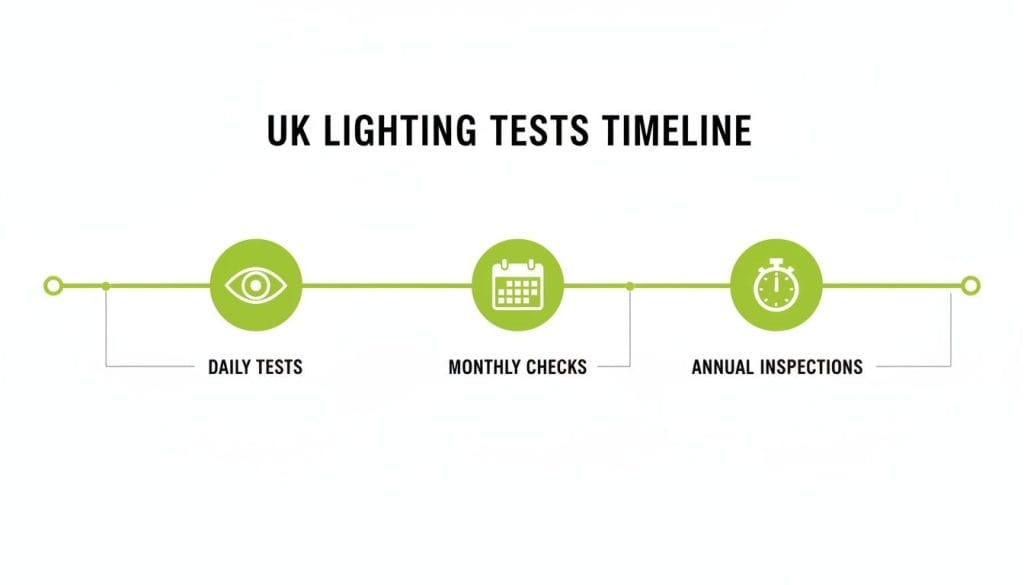
This table summarises the essential tests required by British Standards, making it easy to see what needs to be done and when.
| Test Type | Frequency | Minimum Duration | Key Purpose |
|---|---|---|---|
| Daily Visual | Daily (for central battery systems only) | N/A (Visual check) | To check the system panel for any fault indicators or alarms. |
| Monthly Functional | Monthly | Approx. 30 seconds | To verify that every light switches on and illuminates when power is cut. |
| Annual Full Duration | Annually | 1 to 3 hours | To stress-test the batteries and prove the system can last a full evacuation. |
Following this schedule is the most effective way to ensure your system is not only compliant with the law but is also ready to protect people in a real emergency.
Knowing the rules is one thing, but putting them into practice is where compliance truly matters. Performing the correct emergency lighting tests and keeping flawless records is what separates a responsible property manager from one facing potential enforcement action.
Your fire safety logbook is your primary evidence. It is the proof you provide to any authority, whether the local council or the Fire and Rescue Service, that you are meeting your legal duties. Without it, your tests might as well have never happened.
How you test your system depends on its design.
Many traditional installations use a dedicated key switch, often called a “fish key” switch due to its shape. A simple turn isolates the mains power to the emergency lighting circuit. This forces the fittings to switch to their backup battery power, allowing you to walk the site and manually check that every light is working.
More modern buildings often have automatic self-testing systems. These can be programmed to run monthly and annual tests automatically. Any faults are flagged on an indicator light or a central control panel. They have a higher initial cost but can save significant time and effort in larger or more complex buildings compared to manual checks.
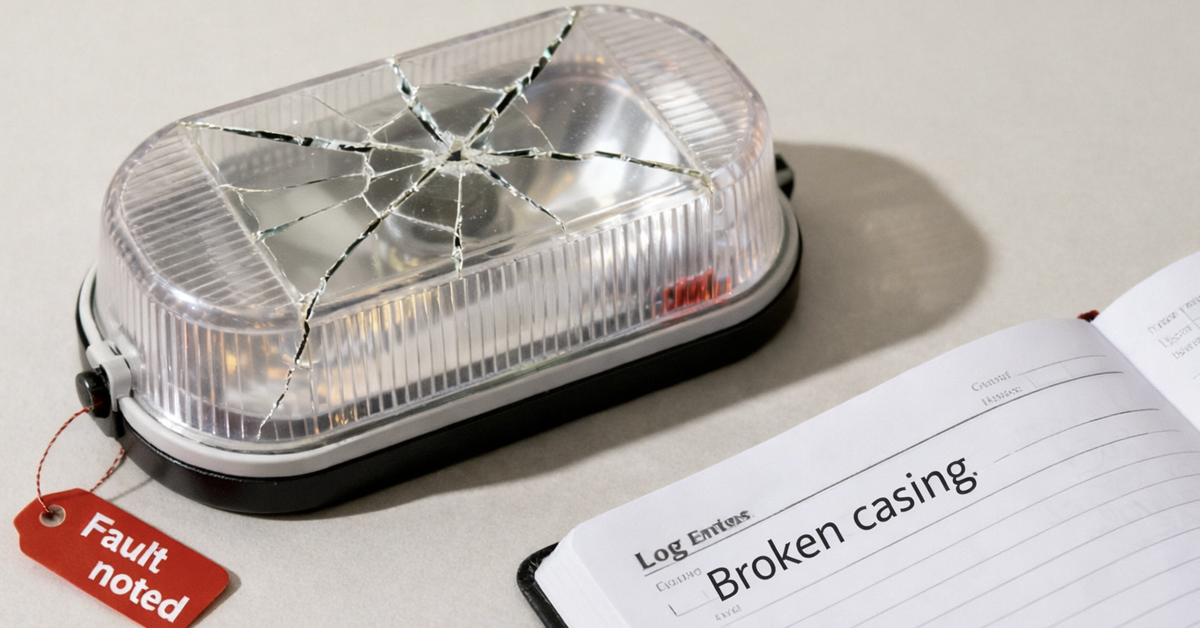
Your fire safety logbook must be a meticulous, chronological record of every test, fault, and remedial action. This creates a clear, auditable trail that shows you take safety seriously. Each entry should be straightforward and contain all the crucial information.
For every test you carry out, whether a quick monthly check or the full annual duration test, you must record:
This recurring record is the backbone of your compliance strategy, and your logbook should reflect it perfectly.
Let’s make this practical. Imagine you are the facilities manager for a two-storey office with ten emergency lights. Here is what your monthly test process should look like:
This detailed account demonstrates to a Fire and Rescue Service inspector that you have a robust system in place. You test, you find faults, and you take swift, documented action. It is this level of diligence that proves you are fulfilling your duties as the ‘Responsible Person’.
Of course, emergency lighting is just one piece of the puzzle. Our guide to fire alarm testing for landlords offers similar practical advice for another critical life-safety system.
The importance of this process cannot be overstated. Industry reports consistently show that a significant proportion of enforcement notices are issued for inadequate testing or poor record-keeping. UK guidance is clear that any fault found must be rectified “without undue delay.” Your logbook is the only definitive proof that you have done so.
Even with a perfect schedule, routine emergency lighting tests often uncover underlying problems that could seriously compromise safety. From our experience carrying out fire risk assessments across the UK, we see the same preventable issues repeatedly.
Understanding these common failings is the first step to building a safety system that is genuinely resilient and compliant. Ignoring them, no matter how minor they seem, undermines the purpose of having emergency lighting. A single failed unit in a stairwell or above a final exit door could be the difference between an orderly evacuation and a tragedy.
The good news is that most of these problems are easy to prevent with diligence.
The single most frequent point of failure in an emergency light is its battery. Like the battery in a mobile phone, they have a limited lifespan, and their ability to hold a charge degrades over time. This is precisely why the annual full duration test is so critical.
A failing battery might have enough power to pass a 30-second monthly flick test, but it could easily fail just 20 minutes into a three-hour annual drain test. This creates a dangerously false sense of security.
How to Avoid It:
Emergency lights are often installed in busy, high-traffic areas like corridors, stairwells, and warehouses, where they are vulnerable to damage. A cracked diffuser, a loose fitting, or even a thick layer of dust can dramatically reduce the light output, rendering it useless when needed most.
It is also common to find fittings obstructed by stacked boxes, tall filing cabinets, or newly installed signage. If the light cannot properly illuminate the escape route, it cannot do its job.
This is, without doubt, the biggest compliance failure we encounter. A fire safety logbook gathering dust in a forgotten drawer, filled with patchy entries, or missing entirely is a major red flag for any inspector.
Without a complete and up-to-date logbook, you have zero evidence that you have been fulfilling your legal duties. If an officer from the Fire and Rescue Service visits, you have no way to prove that any tests have been done. In the eyes of the law, a test that was not recorded is a test that did not happen.
Your fire safety logbook is your primary legal defence. It is the official record that demonstrates due diligence and proves you are actively managing the safety of your premises. An incomplete logbook makes it impossible to defend your actions.
How to Avoid It:
It is easy to view emergency lighting testing as just another administrative task. However, ignoring it is a serious legal failure, with real consequences for you as the Responsible Person and for your business. The enforcing authorities, usually your local Fire and Rescue Service, have far-reaching powers to ensure you comply with the law.
When an inspector visits your property, one of the first things they will ask to see is your fire safety logbook. An incomplete or missing record for your emergency lighting is an immediate concern. It suggests a wider neglect of your duties, and this single failure is often enough to trigger intense scrutiny and formal enforcement action.
Inspectors have the legal authority to compel you to act if they find serious breaches of the Fire Safety Order. Their actions are always proportionate to the risk they identify.
Common enforcement actions include:
Ignoring an enforcement notice is a criminal offence. The penalties for breaching the Fire Safety Order are severe. While minor issues might result in a fine, more serious failings can lead to unlimited fines and even prison sentences for individuals.
The financial consequences are significant. The Regulatory Reform (Fire Safety) Order 2005 placed responsibility squarely on the ‘responsible person’, making them personally accountable. UK guidance has only become stricter, expecting meticulous records of all tests. For instance, some authorities may issue fines of up to £5,000 for non-compliance with rules like emergency lighting testing. Where lives are put at risk, those fines become unlimited. You can learn more about the evolution of these workplace safety essentials from officetest.co.uk.
A breach of fire safety law is a criminal matter, not a civil one. A prosecution can result in a criminal record for individuals, including directors and managers, not just a fine for the company. This personal liability is a cornerstone of the legislation.
The repercussions of getting this wrong extend far beyond the courtroom. A proven failure to maintain and test your life-safety systems can have devastating commercial impacts.
Compliance is not optional. It is a fundamental, non-negotiable part of running any commercial or multi-occupancy residential property in the UK.
Understanding the rules around emergency lighting is only half the battle. The important part is turning that knowledge into action. A fully compliant system protects people, your property, and your business from serious, preventable risks. This is about creating a clear, manageable plan to ensure you meet your duties consistently.
Moving from theory to practice can seem like a big leap, but it breaks down into a few simple tasks. The goal is to establish a solid, repeatable process that becomes a routine part of how you manage your property.
To get your emergency lighting compliance in order, focus on these three practical steps right now. This is not just best practice; it is how you directly fulfil your legal obligations under the Fire Safety Order.
Systematic testing is a non-negotiable part of your role as the Responsible Person. It is not an administrative burden but a critical life-safety function that provides a clear, illuminated path to safety when it is needed most.
By taking these steps, you build a resilient safety culture. You move beyond simply having the equipment installed to actively proving it works, demonstrating due diligence, and ensuring your premises are genuinely safe for everyone inside. This systematic approach is the only way to manage your responsibilities effectively.
Even when you know the rules, real-world questions always arise when managing emergency lighting. We receive calls from business owners, landlords, and property managers with the same practical queries. Here are some of the most common ones, answered in plain English to help you handle your duties with confidence.
Yes, for the monthly ‘flick test’, you can. The regulations state that testing must be done by a ‘competent person’, but for this quick check, that does not necessarily mean you need a qualified electrician.
A facilities manager, a designated staff member, or even you can be considered competent, provided you have received basic instruction. This means knowing how to use the test switch, what to look for when walking the escape routes, and how to complete the fire safety logbook correctly. Remember, though, that the ultimate legal responsibility always remains with the Responsible Person.
It is crucial to know which type you have, as it affects how you manage and test them. The difference is simple but important.
A failed test is a red flag you cannot ignore. It is a breach of your fire safety duties and a direct risk to anyone in the building, so you must act immediately and document everything.
Do not panic. Follow this straightforward three-step process:
Making sure your emergency lighting is tested correctly and consistently is a non-negotiable part of your legal duties. If you are unsure about your procedures or want a professional to review your fire safety measures, HMO Fire Risk Assessment is here to help. Our assessors provide clear, practical guidance to get your property safe and fully compliant.
Head over to https://hmofireriskassessment.com to book an assessment.
Most HMO landlords I talk to can rattle off their fire door requirements, their alarm grade, and their emergency lighting checks without missing a beat....

Most of the fire safety advice on this site assumes you already have a working HMO. This one is for the stage before that: the...