
Fire Exit Door: An Essential Guide for UK Businesses
07/01/2026
A fire exit door is far more than just a way out of a building. It is a critical piece of life-saving equipment, engineered for one single purpose: getting people to safety during an emergency. For anyone responsible for a UK business, residential block, or HMO, understanding your legal duties for these doors is not optional—it is a core responsibility under the Regulatory Reform (Fire Safety) Order 2005.
This guide is for anyone legally accountable for fire safety in a commercial or multi-occupancy residential property in the UK. Whether you are a company director, a facilities manager, or a landlord, the responsibility stops with you. You are responsible for ensuring every fire exit is safe, compliant, and ready for immediate use. This guide will provide clear, practical advice to help you protect lives, your property, and your business.
One of the most common—and dangerous—mistakes is to treat a fire exit door like any other door. It is not. It is a purpose-built system designed to let people escape quickly and easily to a place of ultimate safety, without needing a key, any special knowledge, or having to use excessive force.
Getting fire exit doors right is a fundamental part of your fire risk assessment and overall safety strategy. Getting it wrong can have devastating consequences.
A fire exit door is the final link in the chain of escape. If that link is broken, the entire evacuation plan fails. Ensuring it is always functional is a non-negotiable aspect of your fire safety duties.
This article will walk you through the essentials for every fire exit door under your control. By the end, you will have a solid grasp of the necessary hardware, signage, and inspection routines needed to keep your premises safe and legally compliant. This is not just about technical specifications; it is about actionable knowledge. Your role is not just about ticking a box; it is about actively managing risk and safeguarding the people who rely on your safety measures every day.
In the UK, the law is clear about who carries the responsibility for fire safety. The cornerstone of legislation is the Regulatory Reform (Fire Safety) Order 2005, which places the legal duty to keep people safe squarely on your shoulders. This includes making sure every single fire exit door is fit for purpose.
This is not just about ticking boxes or filling out paperwork. It is a practical, life-saving mandate that requires a designated ‘Responsible Person’ to manage fire safety. If you own, manage, or have any control over commercial or multi-occupancy premises, that person is likely you.
The first step towards compliance is identifying the Responsible Person. This is not just a title; it is a legally defined role with serious duties attached.
Typically, this role falls to:
If more than one person shares control, you all have a collective responsibility to cooperate. Claiming ignorance of your status as the Responsible Person will not be a defence if something goes wrong.
Under the Fire Safety Order, your duties for fire exit doors are absolute. These are not suggestions; they are mandatory rules that form a critical part of your building’s fire risk assessment.
Key legal mandates include:
Failing to meet these basic requirements is a major breach of fire safety law. The scale of the problem is genuinely alarming, as recent findings from fire risk assessors show.
A recent survey revealed that approximately 80% of all fire escape routes were obstructed, and a staggering 85% of fire doors had their essential automatic closers disconnected. These figures highlight a widespread and incredibly dangerous level of non-compliance.
Ignoring your legal duties can lead to serious consequences, with local Fire and Rescue Authorities enforcing the regulations. These are not empty threats. Inspectors have the power to take immediate action if they find a serious risk to life.
For example, a restaurant owner who allows staff to store empty kegs in the rear escape corridor is committing a serious offence. If an inspector discovers this, they could issue an Enforcement Notice, demanding it is fixed immediately. For more detailed information, you can learn more about UK fire door legislation in our dedicated guide.
If the breach is severe—such as a locked fire exit in a nightclub—the inspector could issue a Prohibition Notice, shutting the business down on the spot until it is made safe. Fines can run into thousands of pounds, and the most serious cases can lead to prosecution and even prison sentences. The message from the authorities is clear: when it comes to a fire exit door, compliance is non-negotiable.
A compliant fire exit door is not just a single item; it is a complete system where every component—from the handle to the hinges—is certified, compatible, and works together perfectly. Simply having a door on an escape route is not enough. To perform flawlessly in an emergency, its hardware, signage, and installation must all meet strict UK standards.
For anyone designated as a ‘Responsible Person’, understanding these individual features is non-negotiable.
The purpose of a fire exit is to allow for immediate escape without a moment’s thought. This is why the hardware is so critical. The mechanism required is not a matter of choice; it is dictated by the building’s use and the number of people who might need to escape.
Choosing the right exit hardware is not about aesthetics or budget. It is a legal requirement defined by British Standards, and the decision depends on one simple question: could the people escaping be in a state of panic?
A common and serious compliance failure is fitting a push pad where a panic bar is legally required. The hardware must always match the risk level of the environment to guarantee a safe and fast evacuation for everyone.
This flowchart breaks down the core duties a Responsible Person has in keeping these exits safe and compliant.
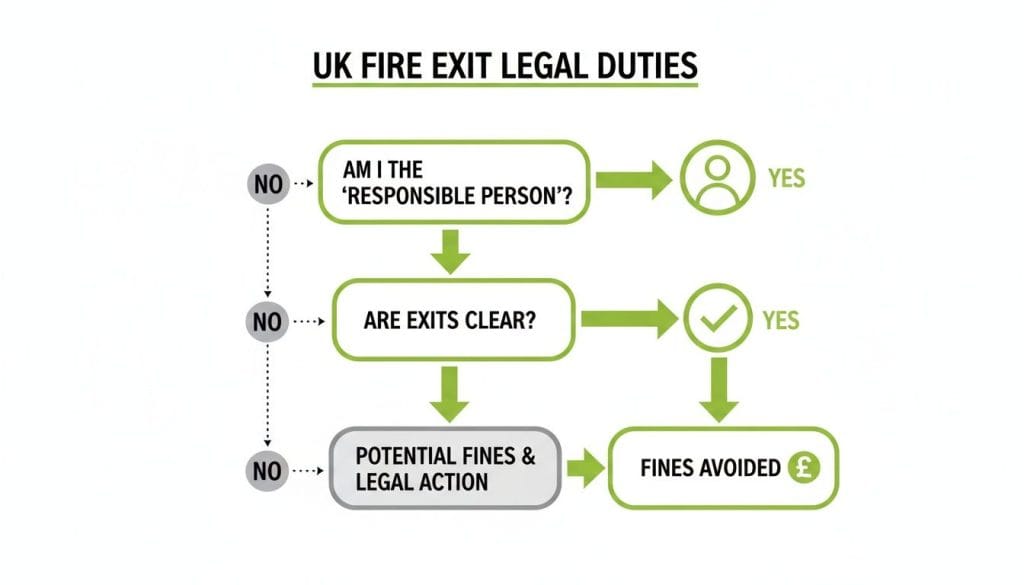
As you can see, simple actions like keeping exits clear are a direct path to fulfilling your legal duties and avoiding hefty fines.
To make it even clearer, the table below compares the two main types of panic exit hardware, outlining their proper use as defined by British Standards.
| Hardware Type | British Standard | Typical Use Case | Key Feature |
|---|---|---|---|
| Panic Bar / Push Bar | BS EN 1125 | Public buildings (cinemas, shops), high-occupancy areas (over 60 people) | Opens with body pressure; no hands needed |
| Emergency Push Pad | BS EN 179 | Non-public areas (offices, workshops), familiar occupants, low occupancy | Simple, single-action push to open |
Understanding this distinction is fundamental. Installing the wrong hardware can render an escape route useless in a real emergency.
Clear, unmistakable signage is a legal must-have. Every fire exit needs a compliant ‘Fire exit’ sign, usually with the green “running man” symbol. This sign must be visible at all times, even if the main lights go out.
In some locations, a vision panel (a small window in the door) is also required. This is vital for doors on escape routes that open into corridors or stairwells, as it helps prevent people from colliding with others and lets them see if the path ahead is clear of smoke.
Do not forget the ‘Fire exit keep clear’ sign. This must be displayed on the door, serving as a constant reminder that the area in front of it must stay completely empty.
It is a golden rule: fire exit doors must always open outwards, in the direction of escape. A door that opens inwards can create a deadly trap during an evacuation, as the weight of people pushing against it would make it impossible to open.
It is also important to remember that these doors are different from internal fire doors, which are designed to hold back fire and smoke. While an escape door can be fire-rated, its main job is to allow people to leave. This is a critical distinction in your building’s overall fire strategy.
Even with the best of intentions, it is alarmingly easy for a fire exit to become non-compliant. These failures rarely happen on purpose; they are usually the result of daily pressures, staff oversight, or simple neglect.
However, a Fire and Rescue Service inspector will not be interested in the reasons. They only see the risk. Understanding the most common pitfalls is the first step to staying on the right side of the law and keeping people safe.
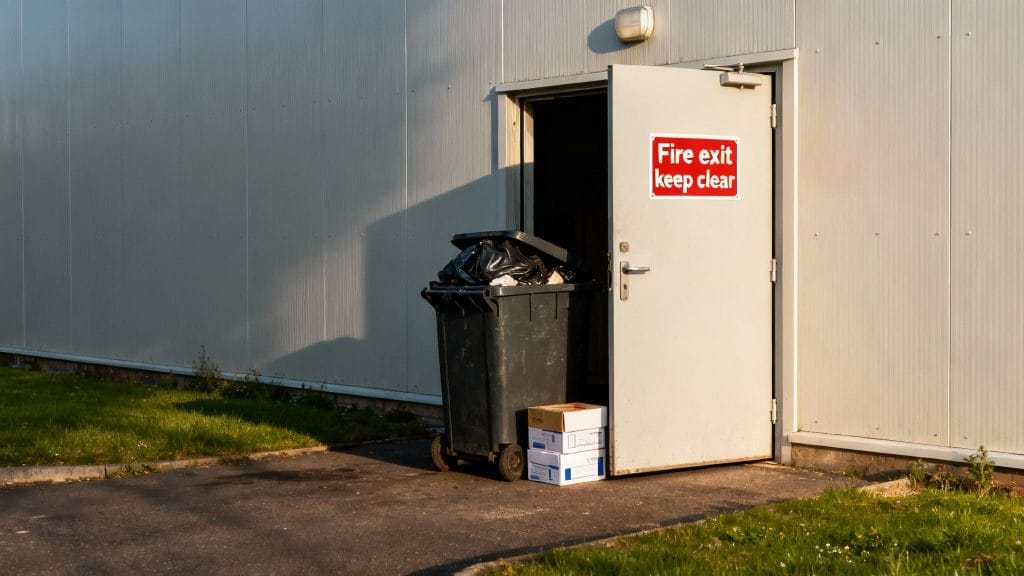
From our own inspections, we see the same critical mistakes time and time again. These issues can make an escape route completely useless in an emergency, exposing your business to significant legal penalties and, more importantly, putting lives at risk.
This is, without doubt, the most frequent and dangerous failure we encounter. A fire exit route must be kept completely clear at all times, inside and out. It is not a temporary storage area. It is a lifeline.
Concerns about security often lead to well-meaning but illegal modifications. A fire exit door must be openable from the inside with a single action, without a key. There are no exceptions.
It is a common mistake to think fire exits and internal fire doors are the same thing. They are not. Their functions are different, so they fail in different ways. The biggest risk for a fire exit is being blocked, whereas an internal fire door is more likely to fail because of damage or poor maintenance.
The moving parts of a fire exit door endure a lot of wear. A bent push bar, a sticking latch, or a warped frame can make the door impossible to open when it is needed most.
Regular checks are the only way to catch these problems early. It is a bigger issue than most people realise. Research based on over 100,000 UK inspections found that a staggering 75% of fire doors failed to meet the required standards. The most common issues were excessive gaps, poor upkeep, and incorrect installation. You can find more detail on these alarming fire door safety statistics at cesafety.co.uk.
In a panic or a smoke-filled room, people need to spot an escape route instantly. That is what the signs are for.
By tackling these common failures head-on, you shift from a reactive to a proactive fire safety culture. The goal is to build processes that stop these issues from ever happening, proving you take your duties as the Responsible Person seriously.
A fire exit door might look perfect, but it is only genuinely compliant if it works flawlessly on the day it is needed. This is where a solid inspection and maintenance routine becomes your most important tool. It is not about ticking boxes; it is a fundamental duty for the Responsible Person to ensure these life-saving doors are always ready.
Setting up a routine turns fire safety from an afterthought into an active, ongoing process. This proactive approach is your best defence against the slow creep of wear and tear, accidental damage, or staff oversight that can render an exit useless. It is also the first piece of evidence a fire authority or insurer will ask for to prove you are managing your responsibilities.
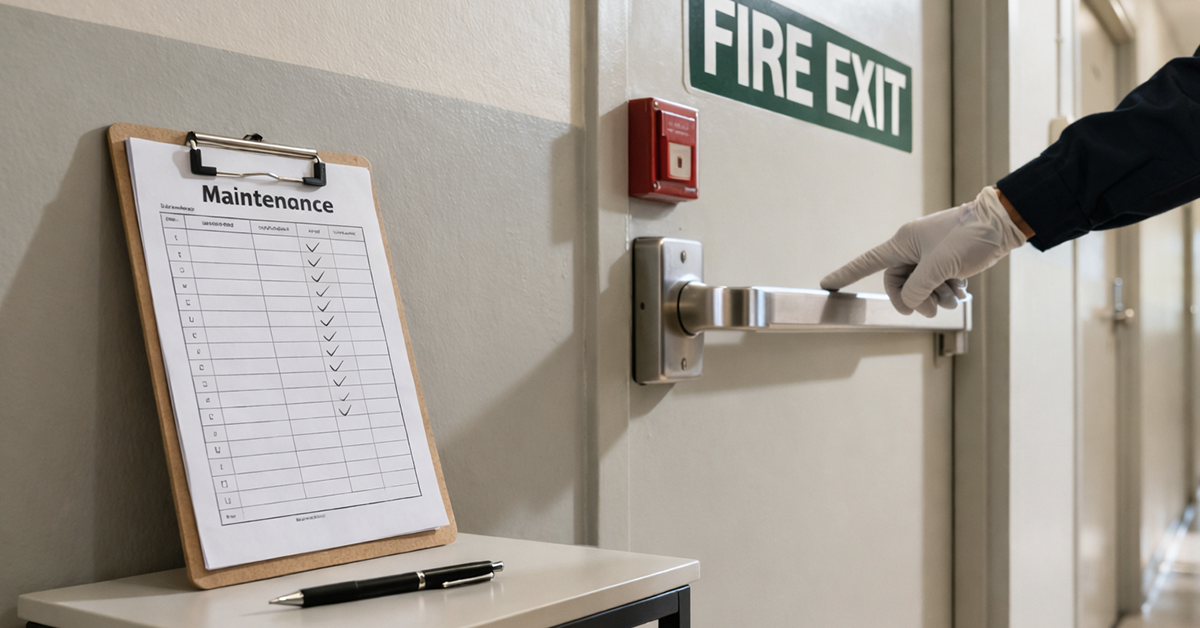
A good inspection plan involves a few layers of checks, from quick daily glances to more detailed examinations.
While frequent checks catch day-to-day issues, a much more detailed inspection is legally vital. At least every six months, a competent person must carry out and formally record a thorough examination of each fire exit door.
This competent person could be a trained in-house facilities manager or, more often, a specialist third-party inspector. Their inspection goes far deeper than the weekly checks.
A formal inspection is a systematic review of the entire door setup. It is there to verify that the door is not only working, but that all its individual parts still meet the standards to which they were built.
This detailed review should cover:
Your inspection routine is only as good as the records you keep. A detailed fire safety logbook is not just unnecessary paperwork; it is essential proof that you are performing your due diligence. If a fire officer investigates an incident or carries out a routine visit, that logbook is the first thing they will want to see.
Your log must document every single check, from the weekly check by staff to the formal six-monthly inspection. For a clear and compliant process, our comprehensive fire door inspection checklist gives you a practical template you can adapt for your building.
Each entry in your logbook should include:
This documentation creates a clear, auditable trail of your commitment to fire safety. It proves you are not just reacting to problems but are actively looking for them—which is the very essence of the Responsible Person’s duties under the Fire Safety Order.
A fire exit door is never just a door. It is a critical part of your building’s overall fire safety strategy, and its condition is a cornerstone of your legally required fire risk assessment. The assessment is where all the individual pieces of your fire safety plan—from escape routes to door hardware—are professionally evaluated as a single, cohesive system.
The purpose of a fire risk assessment is not to find fault. It is to systematically identify potential dangers and provide you with a clear, practical roadmap for reducing risk. When a competent assessor inspects your building, they are looking at your fire exits through a very specific lens, connecting their physical state directly to your legal duties under the Fire Safety Order 2005.
A professional fire risk assessment is far more than a quick visual check. The assessor will meticulously examine every link in the chain that forms your escape routes, with a sharp focus on the final fire exit doors themselves.
Their evaluation will methodically cover:
After the on-site inspection, the assessor translates their findings into a formal fire risk assessment report. This document is not just paperwork; it is your key to achieving compliance and ensuring the safety of everyone in your building.
The report is not a simple pass or fail document. Think of it as a management tool. It identifies significant findings, explains the risks, and provides prioritised, actionable recommendations. It is your proof of due diligence and your plan for improvement.
Any findings related to your fire exit doors will be laid out clearly, explaining what is non-compliant and, crucially, what you need to do to fix it. This creates a documented link between an identified hazard, the relevant legislation, and the necessary remedial action.
Following this professional guidance is the single most effective way to fulfil your duties as the Responsible Person, protecting both people and your property from harm.
When it comes to fire safety, there is no room for guesswork. Here are the clear, straightforward answers to the most common questions we hear from business owners, landlords, and property managers about their fire exit doors.
Let us be crystal clear: a fire exit door on a designated escape route must never be locked with a key from the inside. In a panic, nobody has time to fumble for a key. Escape must be instant and instinctive.
While you can secure the door from the outside to prevent unauthorised entry, the internal hardware must always allow for immediate escape. That is the entire purpose of a panic bar or push pad. Any lock, bolt, or chain that delays or prevents someone from getting out is not just non-compliant; it is a serious danger to life.
This is a common point of confusion, but the two doors have very different primary functions.
A two-step approach is the best way to keep your exits ready at all times.
Your inspection routine should include quick daily or weekly visual checks by staff to make sure exits are clear and the hardware looks right. This should be supported by formal, documented inspections by a competent person at least every six months.
These more thorough checks need to cover every single component – the door itself, the frame, all the hardware, and the signage. It is crucial to log every finding, even if everything is perfect. This creates a paper trail in your fire safety logbook that proves you are performing your due diligence.
Ensuring your fire exit doors are fully compliant is not just a box-ticking exercise; it is a fundamental part of your legal and moral duty. If you need professional verification that everything is as it should be, HMO Fire Risk Assessment provides certified fire risk assessments that give you a clear, actionable path to safety. Book your assessment today at https://hmofireriskassessment.com.
Most HMO landlords I talk to can rattle off their fire door requirements, their alarm grade, and their emergency lighting checks without missing a beat....

Most of the fire safety advice on this site assumes you already have a working HMO. This one is for the stage before that: the...