
Your Ultimate 10-Point Fire Door Inspection Checklist
06/01/2026
For UK business owners, landlords, and property managers, fire doors are not just part of a building’s fabric; they are a critical, active life-saving system. Under the Regulatory Reform (Fire Safety) Order 2005, the designated ‘Responsible Person’ has a clear legal duty to ensure these doors are correctly specified, installed, and maintained. A lapse in this duty is not a minor oversight; it can lead to severe penalties, including unlimited fines and prosecution, alongside the catastrophic risk to life should a fire break out. Simply having a fire door in place is insufficient; it must be proven to be functional and fit for purpose.
This article moves beyond theory to provide a definitive, practical guide to creating and using a comprehensive fire door inspection checklist. We will break down the ten essential checks every responsible person must carry out, from the integrity of the door leaf and frame to the condition of intumescent seals, hardware, and glazing. You will learn not just what to inspect, but why each component is vital for holding back fire and smoke.
By the end of this guide, you will have a clear, actionable framework for conducting thorough inspections. We will cover how to identify common defects, the required frequency of checks, and the importance of meticulous record-keeping for demonstrating compliance. This checklist is your tool for protecting people, safeguarding property, and fulfilling your legal obligations with confidence.
A fire door’s most critical function is to create a barrier against fire, smoke, and toxic gases. For this to be effective, the door must be closed when a fire breaks out. The self-closing and self-latching mechanism ensures this happens automatically, without human intervention, making it a non-negotiable component of your fire safety strategy. This mechanism, typically a hydraulic overhead closer or a spring-loaded hinge, is designed to pull the door shut from any open position and engage the latch securely within the frame.
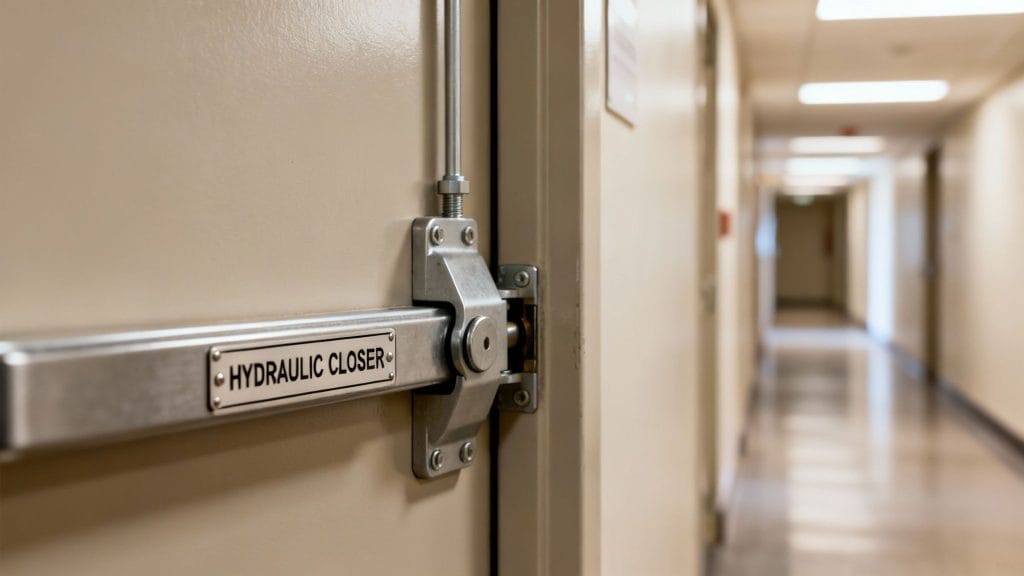
This functionality is vital in high-traffic areas like stairwells in residential blocks or busy corridors in commercial offices. In these environments, people may rush through without manually closing the door, inadvertently compromising the fire compartmentation of the building. In Houses in Multiple Occupation (HMOs), where residents have varying levels of fire safety awareness, a reliable self-closer is an essential safeguard. The core purpose of this check is to confirm that the door can perform its primary duty reliably every single time.
Regular checks are straightforward but essential. When inspecting the self-closing mechanism as part of your fire door inspection checklist, look for these common failures:
A simple yet effective test is to open the door to approximately 75mm (about 3 inches) and let it go. It should close firmly and latch from this position. Then, open it fully and observe its full closing cycle. It should close smoothly and securely without slamming. Any deviation from this performance requires immediate remedial action.
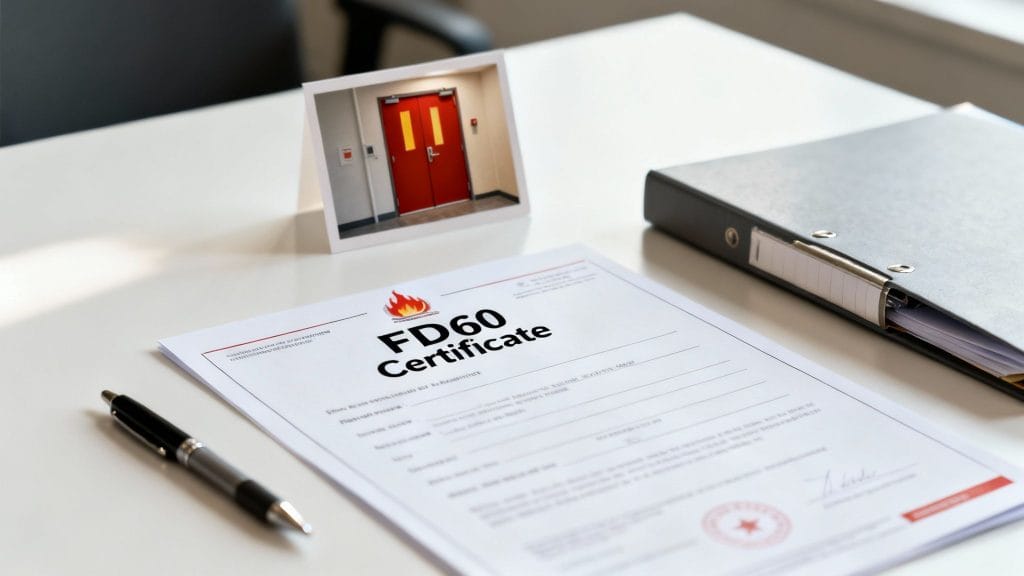
A fire door is not just a standard door; it is a precisely engineered safety device with a certified fire resistance rating. This rating, typically FD30 or FD60, indicates how long the doorset can withstand fire and smoke, providing either 30 or 60 minutes of protection. Verifying this certification is a fundamental part of a fire door inspection. Without correct documentation, you have no proof that the door installed is fit for purpose, potentially invalidating insurance and, more importantly, failing to meet legal obligations under the Regulatory Reform (Fire Safety) Order 2005.
The certification provides a crucial paper trail, linking the physical door to its tested performance. In premises like commercial offices separating high-risk kitchens from escape routes, or in HMO properties where individual flat entrances open onto a shared corridor, having a correctly specified FD30S door (30-minute rating with smoke seals) is non-negotiable. This check within your fire door inspection checklist is about ensuring accountability and traceability, confirming that the life-saving product you think you have is the one that was actually installed.
A physical inspection alone cannot confirm a door’s fire rating. This step requires diligent record-keeping and verification against the installed product. Key issues to look for include:
To check this effectively, you must request and retain all certification documents provided upon installation. Cross-reference the model numbers and specifications on the certificate with any identification marks on the door itself. We recommend creating a fire door register that includes the location, photo, rating, and a digital copy of the certificate for every fire door in the building. This provides a clear, auditable record for fire risk assessments and any future inspections.
A fire door leaf alone is not enough; its effectiveness is entirely dependent on the integrity of the complete doorset, which includes the door frame. The frame must be securely fixed to the surrounding structure, with no damage or significant gaps, to form a continuous barrier against fire and smoke. A compromised frame, whether through damage, warping, or poor installation, creates a direct path for fire to bypass the door, rendering it useless and undermining the building’s entire fire compartmentation strategy.
This is particularly crucial in older buildings or conversions, such as converted HMO properties or period residential blocks, where building settlement can cause frames to misalign over time. Even minor structural shifts can create dangerous gaps between the frame and the wall. As a key element of a building’s fire safety measures, ensuring the frame is robust and correctly sealed is fundamental. To learn more about how doorsets contribute to overall safety, it is helpful to understand the principles of passive fire protection.
Checking the frame is a vital part of any fire door inspection checklist. You are looking for any sign that the seal between the door, frame, and wall has been breached. During your inspection, be vigilant for these common issues:
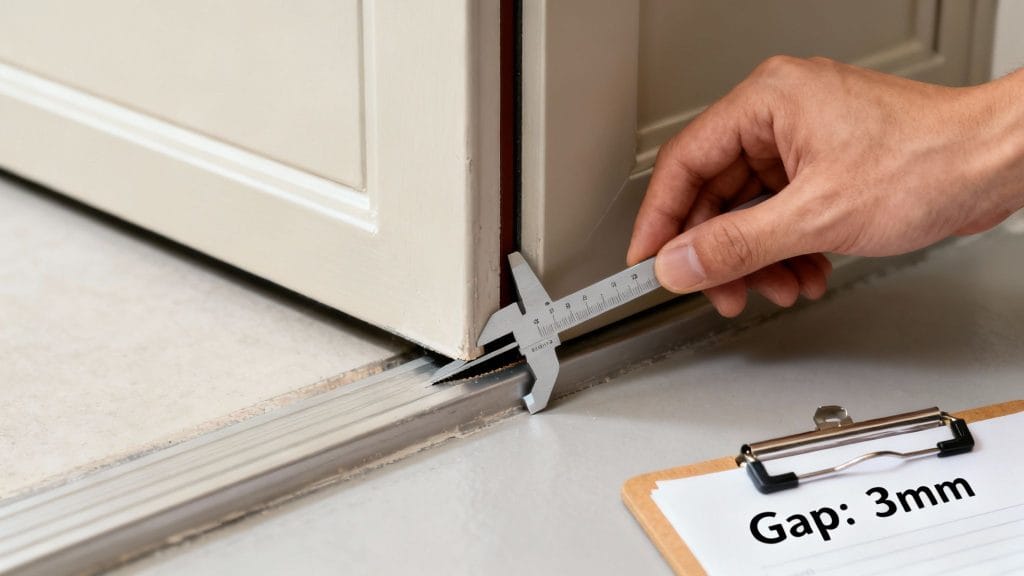
To check, visually inspect the entire frame for any signs of damage. Gently push against the frame to test its stability. Use a calibrated gap gauge to measure the space between the door and the frame at multiple points. Ensure any sealant used to fill the gap between the frame and the wall is appropriate, intact, and fire-rated.
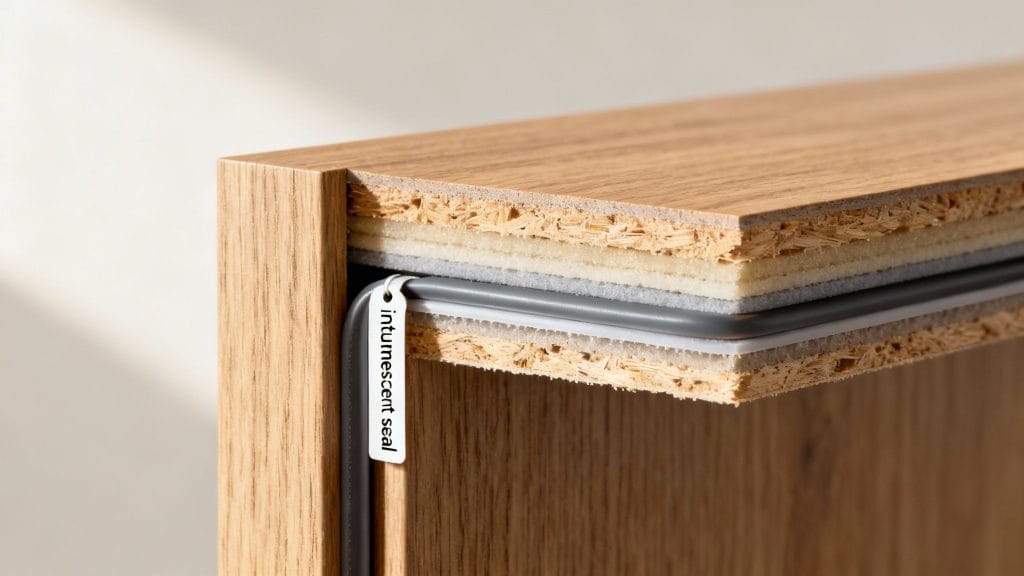
While the door leaf and frame provide the main barrier, the small gaps around the edges are a critical weak point. Smoke and flame seals are designed to eliminate this vulnerability. Fire doors are fitted with intumescent seals, which rapidly expand when exposed to heat, sealing the gaps between the door and frame to block the passage of flames. Many doors also have “cold smoke” seals, often integrated with the intumescent strips, which prevent the spread of toxic smoke at ambient temperatures.
This dual-seal system is fundamental to protecting escape routes and containing a fire event. In a residential block, effective smoke seals can prevent smoke from a flat fire from entering and contaminating the communal stairway, giving residents precious time to evacuate. Similarly, in high-traffic HMO common areas, these seals are constantly at risk of damage but are essential for compartmentation. Ensuring these seals are present and in good condition is a core part of any credible fire door inspection checklist.
Seals are susceptible to wear, damage, and even being painted over, which can render them useless. When inspecting, be thorough and check the entire perimeter of the door and frame.
To check, run your finger lightly along the seal to feel for any breaks, brittleness, or hardening. Visually inspect the full perimeter, paying close attention to the corners and the area around the hinges and latch. Any compromised seal must be replaced immediately with a compatible, certified product by a competent person.
Every component on a fire door, from the hinges holding it up to the handle you use to open it, plays a crucial role in its overall performance during a fire. This hardware, collectively known as ironmongery, must be UKCA/CE marked and certified as compatible with the specific fire door assembly. Using non-compliant hardware, such as a standard domestic lock on a 60-minute fire door (FD60), can fail under extreme heat, creating gaps that allow fire and smoke to pass through, thereby nullifying the door’s life-saving function.
The integrity of the entire doorset depends on the compatibility of its weakest link. For instance, in a commercial office, a facility manager might replace a faulty door closer with a cheaper, unrated model, inadvertently compromising the building’s fire compartmentation strategy. Similarly, in converted HMO properties, existing decorative handles are often left in place on newly installed fire doors, a common failure point identified during fire risk assessments. This check on your fire door inspection checklist ensures every single component is certified to withstand fire and work together as a single, cohesive unit.
A visual and functional inspection is necessary to verify the suitability and condition of all hardware. Look for the following issues:
During your inspection, carefully examine every piece of hardware. Check all hinges for the UKCA/CE mark and ensure they are securely fixed. Operate the handle and lock to confirm smooth and complete engagement of the latch. If any part has been replaced, you must seek documentation proving it is a certified, compatible component.
The primary purpose of a fire door is to provide a robust barrier against fire and, crucially, smoke. Excessive gaps between the door leaf and its frame create a direct path for hot, toxic gases to infiltrate a protected area, rendering the compartmentation ineffective. To be compliant and safe, the gaps around the top and sides of a fire door should typically be no more than 4mm, with the gap at the bottom often being slightly larger (up to 8mm is common) to allow for floor coverings, though this can vary.
This aspect of the fire door inspection checklist is critical in all properties, from commercial offices to residential blocks. In older buildings or HMOs with moisture issues, door or frame warping can cause these gaps to increase significantly over time, silently compromising safety. Even a 5mm gap is enough to allow dangerous levels of smoke to pass through, which is often the biggest killer in a fire. Verifying these tolerances ensures the door can perform its life-saving function when it matters most.
Checking door gaps is a precise measurement task. Simply eyeballing the gap is not sufficient; a dedicated gap gauge or a £1 coin (which is 3.15mm thick) can be used for a reliable assessment.
To check, take your gauge and measure at several points along both vertical sides and the top of the door. Slide the 4mm part of the gauge into the gap; if it fits through, the gap is too large and requires remedial action. Remember to check the gap between the two leaves on a pair of double doors as well. Any gaps exceeding the manufacturer’s specified tolerances must be flagged for correction.
Any opening or break in the surface of a fire door, known as an aperture, can potentially compromise its ability to hold back fire and smoke. For this reason, components like letterplates and vision panels must be fire-rated and installed correctly. An unprotected or poorly fitted opening acts as a direct channel for flames and toxic gases, rendering the expensive doorset useless in an emergency. The integrity of the entire door depends on every single component, including these apertures, performing to the required standard.
This is a critical point in the fire door inspection checklist, particularly in residential blocks or HMOs where letterplates are common. A standard, non-rated letterplate fitted into a fire door creates a significant fire safety breach. Similarly, vision panels in commercial office doors must contain the correct fire-rated glazing and be sealed with appropriate intumescent materials. The inspection ensures these penetrations do not negate the door’s fire resistance.
When inspecting apertures, you are verifying that they are certified as part of the doorset and have not been damaged or tampered with. Look out for these frequent failures:
During your inspection, carefully examine all openings. Confirm the presence of intumescent seals around the component. For letterplates, test the spring-loaded flap to ensure it closes fully. For vision panels, check the beading and look for any identifying marks on the glass itself. Any modification or damage to these components requires urgent replacement with a certified, compatible part.
The presence of glazing in a fire door, such as a vision panel, serves a practical purpose by allowing visibility and preventing collisions. However, standard glass offers almost no resistance to fire; it will crack and shatter within minutes of exposure, creating a significant breach for flames and smoke to pass through. For this reason, any glazed element within a fire door assembly must be specialist fire-rated glass, engineered to maintain its integrity for the same duration as the door itself.
This check is crucial in environments like stairwell doors in residential blocks or corridor doors in healthcare settings, where visibility is key for safe movement. The fire-rated glazing system, including the glass, beads, and seals, works together to uphold the fire compartmentation. Verifying that this system is correctly specified, installed, and maintained is a non-negotiable part of your fire door inspection checklist, ensuring the door provides complete protection without compromising safety and visibility.
Inspecting fire-rated glazing involves looking for signs that its integrity has been compromised. During your checks, identify these common failures:
To check the glazing, first visually inspect for any cracks or damage. Look for a certification mark, often etched into a corner of the glass, which indicates its fire rating (e.g., EW30, EI60). Ensure the beading is tight against the glass and frame with no gaps. Any identified issues with the glazing system require immediate replacement by a certified professional to restore the door’s fire integrity.
Clear and appropriate signage is a legal requirement and a critical component of a fire door’s effectiveness. Its purpose is not just to identify the door but to instruct building occupants on its correct use. Signage reinforces the message that the door must be kept shut to maintain the building’s fire compartmentation, a simple instruction that is vital for preventing the spread of fire and smoke. Without this clear visual cue, occupants might inadvertently compromise safety by propping the door open.
This is particularly important in managed properties like residential blocks or HMOs, where occupant behaviour directly impacts the safety of all residents. A “Fire Door Keep Shut” sign serves as a constant, non-verbal reminder of this shared responsibility. For commercial premises, this signage is essential for staff training and ensuring safe evacuation procedures are followed. This part of your fire door inspection checklist verifies that these crucial instructions are present, visible, and legally compliant. You can learn more about the legal requirements in our guide to fire door legislation.
Checking for correct signage is a visual and straightforward task, yet it is often overlooked. When inspecting fire doors, look for these common defects:
During your inspection, confirm that every fire door has the correct, compliant blue circular “Fire Door Keep Shut” sign on both sides. Ensure it is securely fixed, clearly visible, and in good condition. For doors in high-risk areas, such as near storage rooms, consider adding supplementary signs like “Do Not Obstruct”. All signage should be documented in your fire safety logbook.
A well-maintained fire door register is the backbone of a compliant and effective fire safety management system. It is a formal record that documents every fire door within your premises, detailing its location, specification, and maintenance history. This register is not just good practice; it is a critical tool for demonstrating due diligence and ensuring systematic inspections, as required under the Regulatory Reform (Fire Safety) Order 2005. It transforms fire door management from a reactive task into a proactive, organised process.
This documentation provides a single source of truth for the Responsible Person, property managers, and fire safety assessors. For a large residential block or a multi-site commercial business, a comprehensive register is indispensable for tracking the condition of hundreds of doors. It allows you to plan maintenance, budget for replacements, and provide evidence of compliance during an audit by the Fire and Rescue Service. The core purpose of this check is to ensure that your records are not only present but accurate, up-to-date, and complete.
An incomplete or poorly managed register can be as problematic as having no register at all. When reviewing your documentation as part of your fire door inspection checklist, look for these common failings:
To check your system, select a few doors at random from your register and physically locate them. Verify that the details recorded (location, hardware, signage) match the actual door. Conversely, pick a few doors in the building and check if they are accurately documented in the register. All maintenance and inspection reports should be filed logically and linked to the specific door asset number in the register. Any discrepancies require immediate correction to maintain the integrity of your records.
| Component | Implementation Complexity ???? | Resource Requirements ⚡ | Expected Outcomes ???? | Ideal Use Cases ???? | Key Advantages ⭐ |
|---|---|---|---|---|---|
| Door Self-Closing and Self-Latching Mechanism | Moderate — correct fitting and regular adjustment required | Moderate — hydraulic/spring closers, hold-open devices, skilled installer, ongoing maintenance | Strong compartmentation and reliable automatic closure. ⭐⭐⭐⭐ | Stairwells, flat entrance doors, high-traffic communal doors | Automatic closure & latching; supports accessibility; regulatory compliance |
| Fire Rating and Certification Documentation | Low–Moderate — gather and verify certificates; confirm match to assembly | Low — document storage, verification time, occasional consultant checks | Clear compliance evidence for audits and insurers. ⭐⭐⭐⭐ | All properties at installation, sale, or inspection stages | Traceability of performance; legal and insurer proof; audit-ready records |
| Frame and Doorset Integrity | High — may need skilled remedial work or full doorset replacement | Moderate–High — frames, fixings, sealants, possible structural work | Prevents bypass of smoke/flame; preserves doorset life. ⭐⭐⭐⭐ | Older buildings, properties with settlement, post-renovation audits | Critical seal for compartmentation; visible on inspection; often repairable |
| Smoke and Flame Seals | Low — straightforward replacement/retrofit but must match rating | Low — intumescent/acoustic strips, periodic replacement | Significant reduction in smoke passage; automatic activation. ⭐⭐⭐⭐ | Retrofitting existing doors; high-traffic doors needing smoke control | Cost-effective passive protection; acoustic benefit; quick to replace |
| Door Hardware and Ironmongery Compatibility | Moderate — check certifications and compatibility for each component | Moderate — specialist, fire-rated hinges, locks, closers; potential sourcing delays | Maintains doorset fire rating and predictable behaviour in fire. ⭐⭐⭐⭐ | New installs, replacements, compliance checks | Ensures collective performance; prevents voiding of rating; reduces liability |
| Gaps Between Door and Frame | Low–Moderate — measurement and minor adjustment or planing required | Low — feeler gauge, planing tools, shims; occasional remedial work | Stops smoke infiltration when within tolerance; easy to detect. ⭐⭐⭐ | Routine inspections, older or settling buildings | Simple to inspect and often inexpensive to fix; improves efficiency |
| Letterplates, Vision Panels, and Other Openings | Moderate — must fit certified components and seal correctly | Moderate — fire-rated letterplates/vision panels cost more | Maintains visibility/communication while preserving rating. ⭐⭐⭐ | Doors requiring mail/pass-through or visibility without compromising safety | Functional compliance; retrofittable with certified components |
| Glazing and Fire Rating | Moderate — specialist glazing, sealing and limits on size/area | High — fire-rated glass and specialist installation are costly | Allows light/visibility while preserving fire resistance. ⭐⭐⭐⭐ | Corridor doors, vision panels in communal doors | Maintains compartmentation with visibility; certified performance |
| Fire Door Signage and Labelling | Low — simple procurement and placement | Very low — signs and occasional replacement | Improves occupant awareness; supports inspections. ⭐⭐ | All fire doors, especially high-occupancy settings | Inexpensive, visible reminder; easy to verify during checks |
| Fire Door Register and Documentation Records | Moderate — initial data collection is time-consuming; ongoing updates needed | Low–Moderate — time, possible software or spreadsheet maintenance | Centralised compliance management and audit readiness. ⭐⭐⭐⭐ | Large residential blocks, landlords, managing agents | Demonstrates due diligence; schedules inspections; retains evidence |
We have navigated the critical components of a thorough fire door inspection, from the mechanical precision of self-closing devices to the vital integrity of intumescent seals and the clarity of legally required signage. This article has provided a detailed, actionable framework designed to empower you, the Responsible Person, to move beyond simple observation and towards a state of active, documented fire safety compliance. A robust fire door inspection checklist is more than a guide; it is a tool for systematising a process that is fundamental to life safety and legal duty.
The key takeaway is that a fire door is not a single object but a complex, engineered system. Every component, from the hinges and latches to the glazing and frame, must work in perfect harmony to perform its life-saving function during a fire. A seemingly minor issue, like an excessive gap or a painted-over seal, can lead to catastrophic failure, compromising escape routes and allowing the rapid spread of fire and smoke. Regular, methodical inspections, as outlined in this guide, are the only way to identify these vulnerabilities before they become critical risks.
Merely ticking boxes on a checklist is insufficient. The true value lies in translating your findings into decisive action. A completed checklist full of identified faults without a corresponding action plan is a record of recognised, unmanaged risk. It is a document that evidences non-compliance.
Your next steps should therefore be focused on creating a robust cycle of inspection, remediation, and record-keeping:
Mastering the fire door inspection checklist is a significant achievement, but it is one crucial piece of a much larger fire safety puzzle. Fire doors function as part of a building’s overall fire strategy, which is identified and managed through a comprehensive fire risk assessment. This assessment contextualises the role of each fire door, determining its required fire rating and its importance in protecting specific escape routes or high-risk areas.
Ultimately, this process is about more than avoiding fines or satisfying an inspector. It is about upholding your legal and moral duty to protect the lives of residents, employees, and visitors. A correctly specified, installed, and maintained fire door provides people with the most precious commodity in a fire: time. Time to escape, time for the fire and rescue service to arrive, and time to prevent a containable incident from becoming a tragedy. By embracing a diligent inspection routine, you are directly investing in the safety and well-being of everyone who uses your building.
A detailed fire door inspection checklist is an essential tool, but it works best when integrated into a comprehensive, legally compliant fire risk assessment. If you are unsure whether your current arrangements meet legal standards or need expert guidance to ensure every aspect of your property is assessed, consider a professional service. The specialists at HMO Fire Risk Assessment can provide a thorough evaluation of your premises, including all fire doors, delivering a clear, actionable report that gives you the confidence and clarity to manage your responsibilities effectively.
For the full inspection process behind this checklist, see our guide to fire door inspection in the UK.
Most HMO landlords I talk to can rattle off their fire door requirements, their alarm grade, and their emergency lighting checks without missing a beat....

Most of the fire safety advice on this site assumes you already have a working HMO. This one is for the stage before that: the...