
Fire Safety Certificate for Landlords: Your UK Guide to Compliance
04/01/2026
If you’re a landlord in the UK, you’ve probably searched for a “fire safety certificate” at some point. Here’s the first thing you need to know: there is no single, official document with this name.
Instead, think of your ‘certificate’ as the complete collection of paperwork that proves you have met all your legal fire safety duties. The cornerstone of this collection, and the most important document by far, is your Fire Risk Assessment (FRA). This guide explains what is required of you, why it matters, and what happens if these responsibilities are ignored.
Understanding UK fire safety law isn’t just about ticking boxes. It’s a fundamental responsibility that protects your tenants, your property, and your own financial future.
The main piece of legislation you need to know is the Regulatory Reform (Fire Safety) Order 2005 (FSO). This applies to the non-domestic parts of any residential building with multiple homes in England and Wales. That means it covers the shared areas of blocks of flats and all Houses in Multiple Occupation (HMOs).
The FSO places all legal duties squarely on the shoulders of the ‘Responsible Person’. For rental properties, this is almost always the landlord, freeholder, or managing agent: whoever has control over the building’s common areas. Your core job is to ensure residents are safe from fire by taking general fire precautions. This is not optional, and pleading ignorance of the law is no defence.
Identifying the Responsible Person is the first step to compliance. In most rental situations, it is fairly straightforward:
This distinction is vital. Your legal duties are focused on the parts of the building you actually control. For most landlords of multi-unit properties, that means the shared escape routes and the building’s structure, including the crucial front doors of flats that open onto shared hallways.
A common misunderstanding is that fire safety is just about installing a few alarms. While they are essential, your duties go much further. You are legally required to assess all potential risks, put in place the right fire safety measures, maintain them, and have a clear emergency plan.
To help clarify these duties, here is a summary of the key responsibilities and the documents you will need to prove you are compliant.
| Duty | Governing Regulation/Act | Required Document(s) | Frequency |
|---|---|---|---|
| Conduct a Fire Risk Assessment | Regulatory Reform (Fire Safety) Order 2005 | Fire Risk Assessment (FRA) Report | Annually & after significant changes |
| Install & maintain smoke/heat alarms | Smoke and Carbon Monoxide Alarm (Amendment) Regulations 2022 | Installation records, service reports | Tested on first day of tenancy; serviced regularly |
| Maintain electrical safety | Electrical Safety Standards in the Private Rented Sector (England) Regulations 2020 | Electrical Installation Condition Report (EICR) | Every 5 years |
| Ensure gas safety | Gas Safety (Installation and Use) Regulations 1998 | Gas Safety Certificate (CP12) | Annually |
| Maintain fire doors | Fire Safety (England) Regulations 2022 | Fire door inspection records, FRA notes | Regular checks (e.g., quarterly for communal doors) |
| Provide fire extinguishers | Regulatory Reform (Fire Safety) Order 2005 | Service certificate/label, FRA notes | Annually serviced |
| Maintain emergency lighting | Regulatory Reform (Fire Safety) Order 2005 | Service records, logbook | Monthly function test; annually serviced |
This table provides a snapshot of your core obligations. Keeping these documents organised and up to date is the best way to demonstrate you are a responsible landlord.
Failing to meet these obligations can have severe consequences. Your local Fire and Rescue Service has the power to inspect properties and enforce the law. If they find you have failed to take proper fire precautions, they will not hesitate to take formal action.
This could range from an informal notification to a formal Enforcement Notice, which legally requires you to make specific improvements by a fixed deadline. If they find a serious and imminent risk to life, they can issue a Prohibition Notice, banning people from using all or part of the building until you have fixed the problems.
Ultimately, serious breaches can lead to prosecution, resulting in unlimited fines and, in the worst-case scenarios, a prison sentence. For a more detailed breakdown of your legal duties, our guide on fire safety regulations for landlords provides even more context.
Beyond legal enforcement, non-compliance puts your entire investment at risk. A fire can cause devastating damage, and if it is found that your negligence played a part, your building insurance could be declared void. That would leave you personally liable for all the costs. Protecting your tenants and your property begins with understanding and actively managing your fire safety duties.
The Fire Risk Assessment, or FRA, is the absolute cornerstone of your fire safety duties. It is not just a piece of paper; it is the practical, on-site inspection that uncovers exactly how safe your property is and lays out a clear plan to protect your tenants. Knowing what to expect makes the whole process far less daunting and helps you get everything in order.
The entire process hangs on finding a ‘competent person’. Legally, this means someone with the right training, experience, and knowledge to properly assess your specific type of property. As the Responsible Person, it is your job to check their credentials before they step through the door. Think of it as your first and most important line of defence against bad advice and legal trouble.
Because the term ‘competent person’ is not legally defined, the burden of proof is on you. Be wary of a low price; it is often a red flag for a superficial, tick-box assessment that will not hold up if something goes wrong.
Instead, you need to actively look for signs of genuine credibility:
This infographic neatly sums up your core duties as a landlord when it comes to managing risk.
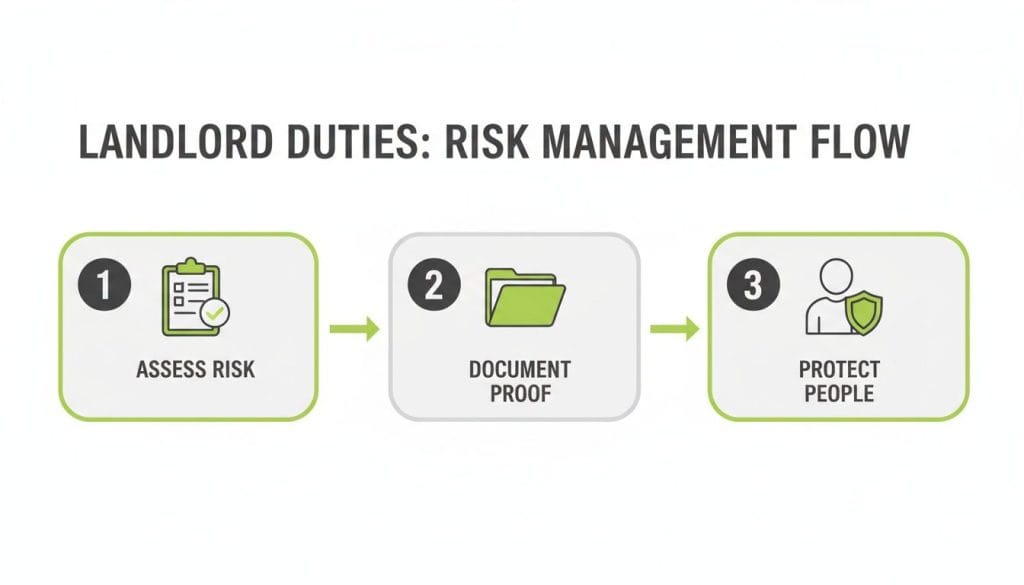
As you can see, the on-site assessment is just the starting point. It has to be followed by solid documentation and real, tangible actions to keep people safe.
Once you have booked a competent assessor, they will visit the property to carry out a physical inspection, focusing on the common areas under your control. Picture them walking through a converted Victorian house that is now an HMO. Their trained eye is searching for specific risks that are easily missed.
They will methodically work through the building, examining key safety features:
An assessor’s job is not to find fault; it is to identify risk. A good assessment gives you a clear, honest picture of what is working well, what needs a bit of improvement, and what is an urgent priority to meet your legal duties. It is an objective evaluation, not a pass/fail exam.
This detailed approach is a legal requirement. The result of this inspection is a detailed report that becomes your action plan. For a deeper look into the assessment itself, you can learn more by reading our detailed guide on what a Fire Risk Assessment is. This report is your roadmap to getting and keeping a safe and compliant property for your tenants.
Receiving your Fire Risk Assessment (FRA) report is a big milestone, but it is really just the starting line. Think of this document as your roadmap for managing fire safety. Understanding how to read it is the key to protecting your tenants and your property. It is designed to turn technical observations into a straightforward, manageable to-do list.
The report will break down all the findings and give each one a priority level. While the exact terminology might differ between assessors, the logic behind the ratings is usually consistent.
The ratings are a clear signal telling you how quickly you need to act. A good assessor will suggest a timeline for each point, but the general principle is always the same:
Your FRA report is not a pass or fail document. Its purpose is to provide a professional, independent evaluation of risk and give you the expert guidance needed to fulfil your legal duties as the Responsible Person.
Let’s walk through a common scenario. Imagine a Victorian terraced house in Manchester that has been converted into three flats. The FRA report comes back and flags a few things. How do you translate these technical points into an actual action plan?
One very common finding is “insufficient fire stopping around service pipes in the communal hallway.” All this means is there are small gaps where pipes for water or electricity run through the walls and ceilings of the main escape route. In a fire, these gaps act like small chimneys, letting smoke and flames shoot between floors and putting the whole building at risk. The fix is to seal these gaps with special fire-rated materials, a job known as passive fire protection.
Another common issue is “worn intumescent seals on the front doors of flats.” These are the small strips around the edge of a fire door. When they get hot, they expand to seal the gap between the door and its frame, stopping fire and smoke from pouring into the hallway. If they have been painted over, damaged, or are peeling away, they simply will not work. The fix here is simple: get them replaced.
Your action plan should list every recommendation from the report, assign a realistic deadline based on its priority, and note down who is responsible for getting the work done. This simple, structured approach turns what can feel like an overwhelming document into a series of achievable tasks, making sure you systematically reduce risks and build a solid record of compliance.
After assessing hundreds of rental properties across the UK, we see the same avoidable fire safety issues time and time again. These common problems often stem from simple oversights, but they can have incredibly serious consequences.
Getting ahead of these issues does not just make your formal assessment smoother; it keeps your tenants safer day-to-day. Think of this as a pre-assessment walkthrough. By checking these common problem areas yourself, you can fix minor issues before they get flagged as significant risks on your official Fire Risk Assessment report.
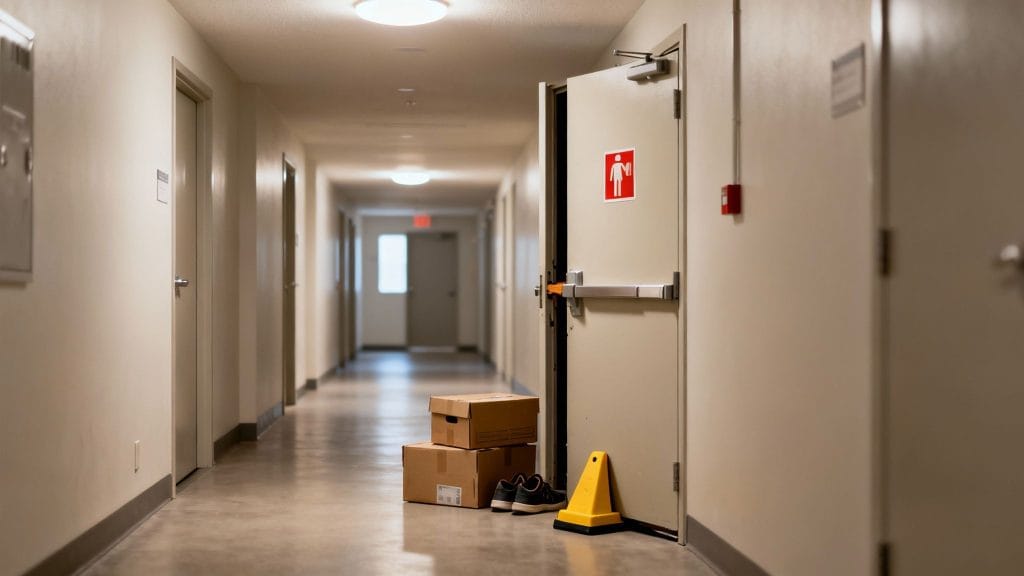
This is the single most common and dangerous failure we find. In an emergency, every second counts. A clear path to safety is completely non-negotiable.
Hallways, staircases, and final exit doors in common areas must be kept what is known as ‘sterile’. Yet, we frequently find them cluttered with bicycles, prams, bags of rubbish, shoe racks, and parcels.
The Fix: This comes down to clear communication. Your tenancy agreement must explicitly state that common areas must be kept clear at all times. Follow this up with regular inspections and prompt reminders. Remember, even if a tenant causes the obstruction, the legal responsibility remains yours.
Fire doors are a critical part of your building’s defence system, designed to hold back smoke and flames for a set period (usually 30 or 60 minutes). Unfortunately, they are often compromised.
A fire door propped open with a wedge or a fire extinguisher is not just a compliance failure; it renders the entire fire compartmentation strategy useless. In a fire, this simple act could lead to a catastrophic spread of smoke, which is the biggest killer.
Common issues include doors being wedged open for convenience, faulty self-closing devices that do not latch the door shut, and damaged intumescent seals around the door’s edge.
The Fix: Walk the property regularly and check every communal fire door yourself. Does it close firmly on its own? Remove any wedges immediately and educate tenants on why these doors must be kept shut. Any damaged seals or closers are a priority repair and need to be fixed by a competent person.
Fire safety equipment is only useful if it works when you need it. Expired service dates on fire extinguishers and dust-clogged smoke detectors are common findings, and they point to one thing: no consistent maintenance schedule.
Official statistics show that you are around 8 times more likely to die in a fire if you do not have a working smoke alarm. A faulty alarm is as bad as having no alarm at all.
The Fix: Create a simple maintenance logbook. Schedule annual servicing for your fire extinguishers with a certified technician. Test smoke and heat alarms weekly or monthly, and document every single check. Emergency lighting should be tested monthly with a full service annually. This logbook is your proof of ongoing diligence.
To help you get started, we have put together a practical checklist covering these common failure points. Use it to walk your property before the assessor arrives.
This checklist highlights the most common issues we find during assessments. Running through these points beforehand can save you hassle and help ensure a satisfactory formal inspection.
| Area of Inspection | What to Check | Common Failure Example |
|---|---|---|
| Escape Routes | Walk the entire route from the furthest flat to the final exit door. Is it completely clear? | A tenant’s bicycle is chained to the banister on the main staircase, reducing its width. |
| Fire Doors | Open each communal fire door and let it go. Does it close firmly and latch shut on its own? | A fire door to a boiler room has had its self-closing arm disconnected. |
| Fire Alarms | Press the ‘test’ button on smoke and heat alarms in common areas. Is the alarm loud and clear? | A smoke alarm in a top-floor hallway has been covered with a plastic bag. |
| Emergency Lighting | If installed, use the test switch. Do the emergency lights illuminate the escape route? | An emergency light unit above the final exit door fails to come on during a test. |
| Fire Extinguishers | Check the gauge is in the green and the service label is in date (serviced annually). | The water extinguisher in the entrance hall was last serviced three years ago. |
By addressing these common issues, you move from a reactive to a proactive mindset. You are not just preparing for an inspection; you are actively maintaining a safer home for your tenants and building a solid record of compliance.
Getting your Fire Risk Assessment (FRA) signed off is a huge step, but it is the beginning, not the end, of the process. Real fire safety compliance is a living, ongoing process. It is a continuous cycle of checking, maintaining, and reviewing to keep your tenants safe long after the assessor has left.
Think of your FRA as a dynamic blueprint for your property’s safety, not a certificate to file away and forget. The law is clear on this: you must review it regularly to make sure it is still relevant. A quick annual check is a good habit, but a full, professional review is non-negotiable whenever something significant changes.
Certain events are automatic triggers for a review because they can introduce new hazards or change the level of risk in the building. You absolutely need to plan for a review if:
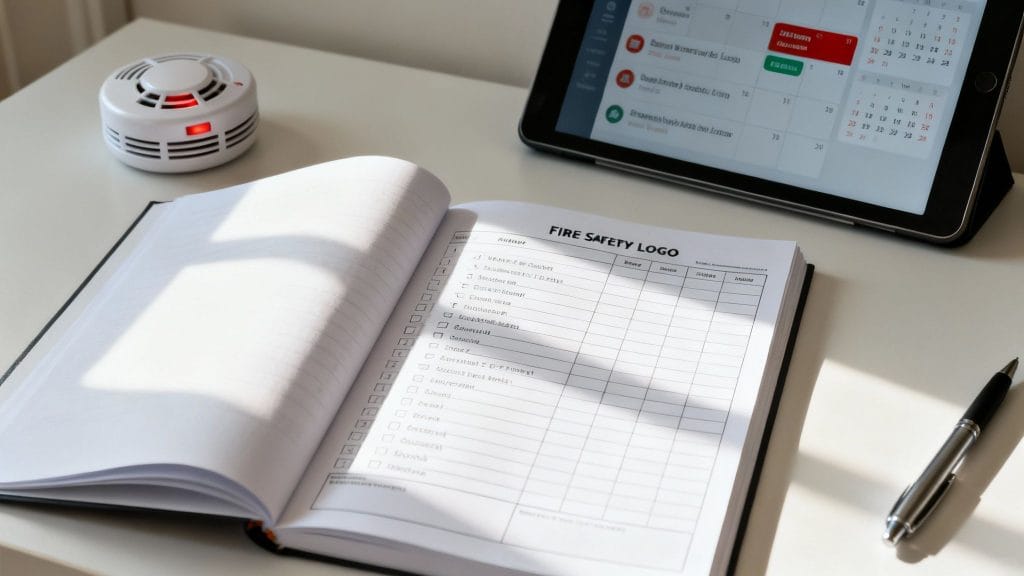
Beyond the FRA itself, your best defence is meticulous record-keeping. A well-maintained fire safety logbook is your proof of diligence, providing a clear, chronological history of every single safety check, test, and piece of maintenance done on the property.
If the Fire and Rescue Service ever visits for an inspection, that logbook is one of the first things they will ask to see. It is the evidence that shows you are proactively managing your building’s safety, not just reacting when things go wrong.
A detailed fire safety logbook is arguably as important as the FRA itself. It transforms your legal duty from a theoretical exercise into a documented, verifiable management system. An empty logbook suggests neglect, no matter how comprehensive your initial assessment was.
Your logbook is where you will record a series of recurring tasks. The key to staying on top of this is to create a simple, repeatable schedule so nothing gets missed.
A practical schedule stops compliance from becoming overwhelming by breaking your duties down into small, manageable chunks. Try implementing a straightforward plan like this:
Budgeting for these ongoing costs is simply part of being a professional landlord. When you factor in annual servicing fees and the possibility of repairs, you ensure that financial issues never compromise your tenants’ safety or your legal compliance. It is this proactive mindset that separates a responsible landlord from the rest, understanding that fire safety is a continuous process.
We are asked the same practical questions by landlords across the UK every day. Here are some clear, straightforward answers to your most common concerns, all grounded in current fire safety regulations.
This is a common point of confusion. There is no legal expiry date stamped on a Fire Risk Assessment (FRA), but that does not mean it is a ‘one and done’ job.
Best practice, which is fully supported by fire authorities, is to review your FRA annually. You should then commission a completely new assessment from a competent professional every one to three years, depending on the property’s risk level.
However, a new FRA becomes non-negotiable if you make any significant changes to the property. This could be anything from:
For higher-risk properties like large or complex HMOs, arranging for a professional FRA every year is the only sensible and legally defensible route. Think of the report as a living document; it must always reflect the reality on the ground.
Failing to comply with the Regulatory Reform (Fire Safety) Order 2005 is not just a minor issue. The consequences are severe and go far beyond a simple fine. Your local Fire and Rescue Service has the power to issue various notices, and if you ignore them, you could face prosecution.
Minor breaches might lead to fines of up to £5,000. But for major breaches where lives are found to be at risk, the penalties can increase to unlimited fines and even a prison sentence of up to two years for the Responsible Person.
Critically, non-compliance can completely invalidate your property insurance. If a fire breaks out and it is discovered you neglected your legal duties, your insurer may refuse to pay out. That leaves you personally liable for all the damages and any legal claims that follow.
For a standard house rented to a single family or household, a formal, comprehensive FRA covering the entire property is not a legal requirement. The Fire Safety Order mainly focuses on the shared common areas of multi-occupied buildings.
That said, your general ‘duty of care’ as a landlord absolutely still applies. You are still obligated to provide working smoke and carbon monoxide alarms, a valid Gas Safety Certificate, and a satisfactory Electrical Installation Condition Report (EICR).
So, while the law does not force you to get a full FRA, carrying out a basic risk assessment is just good practice. It helps you prove you have done everything reasonably possible to keep your tenants safe.
The official definition of a ‘competent person’ is someone with the right blend of training, experience, and knowledge to do a proper assessment. The problem is that this title is not legally protected, so the responsibility falls squarely on you, the landlord, to do your due diligence and check their credentials.
When you are choosing an assessor, look for solid proof of their competence:
Simply picking the cheapest assessor you can find without verifying their competence is a massive risk, both legally and financially. It is a corner you cannot afford to cut.
Most HMO landlords I talk to can rattle off their fire door requirements, their alarm grade, and their emergency lighting checks without missing a beat....

Most of the fire safety advice on this site assumes you already have a working HMO. This one is for the stage before that: the...