
A Guide to Building Regulations Fire Safety: Practical Steps to Compliance
03/01/2026
Getting to grips with your legal duties for building regulations fire safety is not just about ticking boxes. It is about protecting lives, properties, and livelihoods. For any UK landlord, business owner, or property manager, this means understanding two separate but deeply connected sets of rules: one for how a building is constructed, and another for how it is managed once people are inside.
This guide is for UK business owners, landlords, property managers, and anyone designated as the ‘Responsible Person’ for a commercial property or multi-occupancy residential building. By the time you have finished reading, you will have a clear grasp of your legal obligations under the two main pillars of UK fire safety law.
Think of fire safety as a two-sided coin.
On one side, you have the Building Regulations 2010, supported by the guidance in Approved Document B. This framework deals with the construction and design of a building. It is about making sure the property is built from the ground up with safety designed in, covering things like fire-resistant materials, protected escape routes, and proper access for the fire and rescue service. It creates the passive, physical foundation for safety.
Flip the coin, and you have the Regulatory Reform (Fire Safety) Order 2005. This law is about the ongoing management of a building once it is occupied. It focuses on day-to-day operational safety, making it a legal duty for the Responsible Person to carry out a fire risk assessment, maintain safety systems, and keep escape routes clear.
These two frameworks cannot work in isolation; they are designed to work together. A perfectly constructed building can quickly become a death trap through poor management, just as even the best management cannot completely make up for serious structural flaws.
This concept map helps visualise the two distinct branches of your fire safety duties.
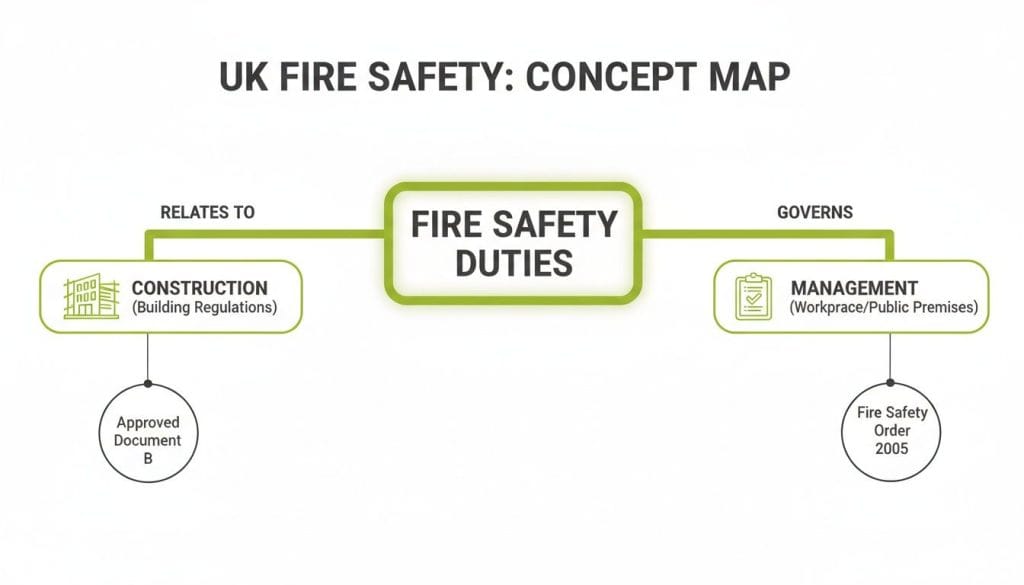
As the map shows, total compliance means looking after both the ‘as-built’ safety features and the ‘in-use’ management responsibilities.
Under the Fire Safety Order 2005, legal responsibility lies with the ‘Responsible Person’. This is usually:
If there is more than one Responsible Person, you all have a duty to cooperate and coordinate to meet your obligations. Crucially, you cannot delegate this legal responsibility, even if you have hired a managing agent to handle the day-to-day running of the property.
Ignoring either side of this fire safety coin exposes you to significant risks. Non-compliance can lead to enforcement action from your local Fire and Rescue Service, including unlimited fines and, in the most serious cases, a prison sentence. More importantly, it puts your employees, tenants, and visitors in avoidable danger.
This guide will break down what you need to know about both the structural and managerial sides of fire safety, helping you create a safe environment and meet your legal duties with confidence.
To fully understand today’s building regulations for fire safety, you have to look at the tragedies that created them. Modern fire law was not created in a boardroom; it was forged in the aftermath of devastating fires that cost thousands of lives and homes. These rules exist because history has shown us, time and again, what happens when they are ignored.
The most significant lesson came from the Great Fire of London in 1666. The blaze tore through the city’s tightly packed timber-framed houses, destroying 13,200 houses, 87 churches, and leaving an estimated 70,000 people homeless. It was a catastrophe born directly from medieval building practices, where narrow streets and flammable materials created the perfect conditions for a fire to spiral out of control. You can explore more about the history of fire safety legislation in the United Kingdom to see just how pivotal this moment was.
In response, the Rebuilding of London Act 1666 was passed. This marked the birth of systematic building controls in the UK. For the first time, building with flammable materials like wood was restricted, and the use of brick or stone was ordered to improve fire resistance. This single law introduced concepts we now take for granted, like minimum street widths for firefighting access and structural separation between properties.
This shift from reacting after a disaster to proactively preventing one continued over the centuries. The Fires Prevention (Metropolis) Act 1774 was another milestone, bringing in early ideas about classifying buildings based on their use and risk. It was a crucial step towards realising that a warehouse needs very different fire safety measures than a block of flats.
These early laws laid the groundwork for the detailed regulations we have today. They established the three core principles that still underpin all modern fire safety:
This journey through history leads us directly to the Building Act 1984, the legal framework for all current building regulations in England and Wales. It gives the government the power to set minimum standards for how new and altered buildings are designed and constructed.
The regulations we follow are not arbitrary rules. They are a collection of hard-won lessons, each one paid for by past disasters. Viewing compliance through this lens transforms it from a bureaucratic task into a fundamental responsibility to protect lives.
Understanding this history makes it clear why building regulations for fire safety are so focused on the structure and fabric of a property. These rules are there to make sure a building is inherently as safe as it can be from the day it is finished. They form the passive fire protection foundation that all other safety measures are built on.
But the law also recognises that a building’s safety is not a one-off job. Once it is occupied, the focus must shift to its day-to-day management. That is where the Regulatory Reform (Fire Safety) Order 2005 comes in, ensuring the safety features designed into the building are maintained and are not compromised by how it is used. This link between construction and management is the heart of modern UK fire safety.
Approved Document B is the government’s practical guide to meeting the fire safety standards set out in the Building Regulations. While it is a dense, technical document, its core principles are surprisingly straightforward. Think of it as the manufacturer’s handbook for your building’s built-in fire safety features, the elements designed to protect people long before the fire and rescue service arrives.
At its heart, Approved Document B ensures a building is designed and constructed to give occupants fair warning of a fire, provide safe ways out, and slow down the spread of fire and smoke. It also makes sure firefighters can access the building and do their job safely. For any Responsible Person, understanding these fundamentals is non-negotiable.
This is arguably the most critical part of the document. It boils down to one simple idea: everyone inside must be alerted to a fire and have a safe route to get out. In practice, this translates into having the right fire detection and alarm system and properly designed escape routes.
For a small, single-floor office, this might mean a few linked smoke detectors and clearly marked exits. For a large block of flats, the requirements are far more demanding. This would involve a complex system, often with heat detectors inside individual flats and smoke detectors in common areas, all connected to a central control panel.
The escape routes themselves must be ‘protected’. This means they are built from fire-resisting materials to create a sterile sanctuary, shielding people from smoke and flames as they evacuate. The classic example is the main staircase in a block of flats, which is designed to be a fire-resistant tunnel leading directly to safety.
These two sections are about controlling how fire and smoke travel inside a building. They work together based on a crucial principle called compartmentation, which involves dividing the building into a series of smaller, fire-resistant boxes, or ‘compartments’.
The aim is to trap a fire in the room or area where it starts for as long as possible, buying precious time for people to escape.
A vital part of this strategy is the fire door. These are not just normal doors; they are precisely engineered safety devices designed to hold back intense heat and toxic smoke for a specified period. A poorly maintained fire door or one that is propped open completely undermines the building’s compartmentation strategy. To learn more, you can explore our detailed guide on the critical importance of compliant fire door legislation and how it directly impacts your property.
To make this easier to digest, the table below breaks down the five key requirements of Approved Document B. It shows the official code, what it covers, and a simple, practical example of what it means for your building.
| Requirement Code | Focus Area | Practical Example for a Commercial or Residential Building |
|---|---|---|
| B1 | Means of Warning and Escape | Installing an interlinked smoke and heat alarm system and ensuring escape corridors are kept clear and well-lit. |
| B2 | Internal Fire Spread (Linings) | Using fire-retardant paint or plasterboard on the walls and ceilings of a shared hallway instead of flammable decorative materials. |
| B3 | Internal Fire Spread (Structure) | Fitting certified FD30 fire doors (providing 30 minutes of fire resistance) to all flat entrances that open onto a communal corridor. |
| B4 | External Fire Spread | Using non-combustible cladding on the outside of a high-rise block of flats to prevent fire from climbing up the building’s facade. |
| B5 | Access for the Fire Service | Ensuring the road to the building is wide and strong enough for a fire engine and that there’s a dry riser installed for firefighters. |
This summary helps connect the technical rules to the physical safety features you see (and do not see) in a property every day.
This requirement is designed to stop a fire from spreading between buildings or up the outside of a single building. This issue was thrown into the public spotlight by the Grenfell Tower tragedy, which starkly demonstrated the catastrophic dangers of using combustible materials on the exterior of high-rise blocks.
Approved Document B sets strict limits on the types of materials that can be used for cladding, insulation, and external wall systems. The aim is to ensure the building’s facade does not provide a route for fire to spread uncontrollably from one floor to the next.
This section also considers the distance between properties. The closer a building is to its neighbours, the more fire-resistant its external walls need to be and the fewer openings (like windows) are permitted. This rule is designed to prevent a fire in one building from easily jumping across and setting the next one alight.
Finally, the regulations ensure that firefighters can do their job safely and effectively. This goes far beyond just having a road that leads to the building; it is about providing the specific access and facilities needed for modern firefighting operations.
This can include:
In essence, B5 turns the building from a dangerous obstacle into a platform that actively helps the fire and rescue service in their mission. Together, these five areas of Approved Document B create a layered, robust defence against fire, forming the physical foundation upon which all your ongoing fire safety management should be built.
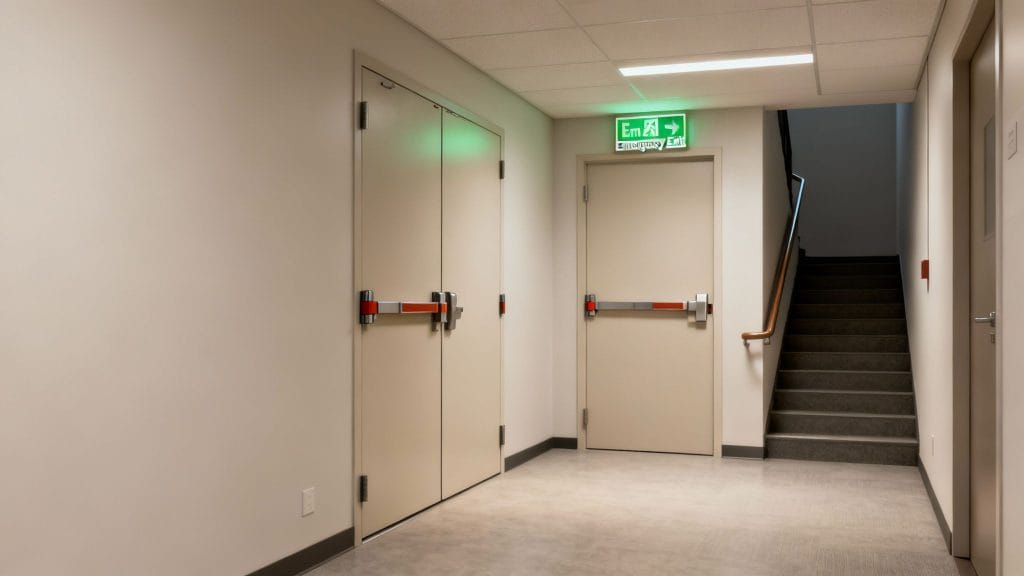
Once a building is complete and occupied, the focus on building regulations fire safety makes a critical shift. It moves from the architect’s drawings and builder’s materials to the real, day-to-day management of the property. This is where the Regulatory Reform (Fire Safety) Order 2005 takes centre stage.
This law transfers the responsibility for fire safety from the people who built the property to the people who control it now that it is occupied.
This legislation was a huge step forward, simplifying a tangled mess of around 70 different fire laws into a single, risk-based framework. The change placed the legal duty squarely on the shoulders of the individuals who could actually make a difference to safety on the ground. You can find out more about the history and impact of UK fire safety legislation to see how far we have come.
The Fire Safety Order introduced the crucial role of the ‘Responsible Person’. This is the individual or company legally accountable for fire safety in the building. Depending on the premises, this could be:
It is vital to understand that if you fit one of these descriptions, you cannot delegate your legal responsibility. You can hire a managing agent to handle the tasks, but the ultimate legal duty for compliance remains with you.
The cornerstone of the Fire Safety Order is the legal requirement for the Responsible Person to carry out a “suitable and sufficient” fire risk assessment. This is not a one-off, tick-box exercise to be filed away and forgotten. It is a live process of proactive risk management that connects the building’s physical safety features to its daily operations.
A fire risk assessment is a practical evaluation of your premises. The process involves:
A fire risk assessment is where theory meets reality. It is the documented proof that you are actively managing the fire safety systems and procedures in your occupied building, ensuring the protections designed into its structure remain effective.
This ongoing process ensures that the safety features mandated by building regulations are not undermined by carelessness. A fire door that meets FD30 standards is completely useless if it is wedged open, and a protected escape route offers no protection if it is cluttered with boxes.
The Fire Safety Order bridges the gap between construction and occupation. It makes sure that the duty to protect lives does not end when the builders leave the site. For every landlord, employer, and property manager in the UK, understanding and acting on these duties is a fundamental legal obligation.
Knowing the rules is one thing, but spotting and fixing real-world failures is where fire safety is truly tested. You can have the best-designed building in the world, but simple, everyday oversights can make it incredibly dangerous. These common mistakes do not just breach building regulations fire safety principles; they put lives, property, and businesses at severe risk.

Time and again, we see compliance failures that come from a basic misunderstanding of how a building’s safety features are meant to work together. Let us walk through some of the most frequent and dangerous errors we find on site.
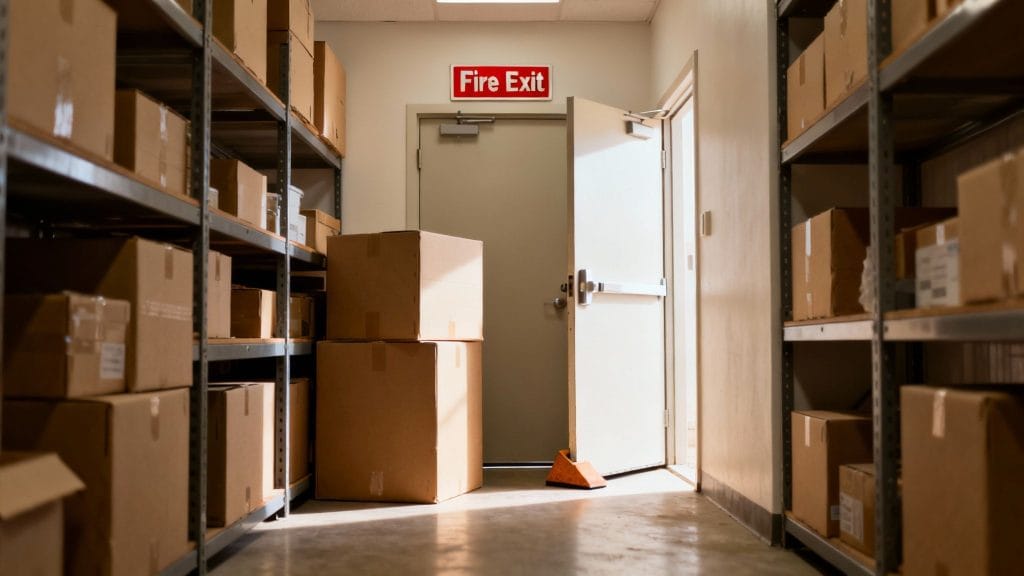
Picture a busy office. The storeroom is overflowing, so someone stacks a few boxes of old files and computer equipment in the corridor. The problem? That corridor is a designated escape route, and the boxes are now blocking a fire exit.
This scenario is frighteningly common, and it is a direct breach of the Fire Safety Order. Escape routes must be kept clear at all times.
A fire exit door that you cannot easily and immediately open is not a fire exit at all. It is a locked door that creates a deadly trap during an emergency.
The Fix: The Responsible Person must carry out regular walk-throughs of all escape routes. Any obstructions must be removed immediately, and a clear policy must be communicated to all staff: corridors and stairwells are not for storage.
In a House in Multiple Occupation (HMO), a tenant wedges their flat entrance door open for convenience. This is not just any door, it is an FD30 fire door, specifically designed to hold back fire and smoke for 30 minutes. Its job is to protect the shared hallway, giving everyone else in the building a safe route out.
By propping it open, the building’s entire compartmentation strategy is destroyed. A fire in that flat can now flood the corridor with toxic smoke and intense heat in seconds, making it impossible for other residents to escape. This is one of the gravest mistakes a landlord can allow, and you can learn more by reading our guide on the top fire safety mistakes made by landlords.
The Fix: The landlord or Responsible Person must ensure all fire doors are fitted with working self-closing devices. Regular checks are non-negotiable, and tenants must be educated on why these doors are life-savers and why they must never be tampered with.
Beyond obvious physical blockages, many of the most dangerous failures are invisible until it is too late. These issues almost always involve the critical life-safety systems that need routine, professional maintenance to work.
Commonly overlooked problems include:
The Fix: A strict schedule for checks and maintenance is essential. The Responsible Person needs to implement one for all fire safety equipment, as detailed in their fire risk assessment. Crucially, a logbook should be kept to record all tests, servicing, and staff training sessions, creating a clear audit trail that proves compliance.
Knowing the rules around building regulations fire safety is one thing, but putting them into practice is what really counts. Achieving compliance does not have to be a headache; it is a structured process of confirming your duties, checking your physical safety measures, and knowing when to call in a professional. Proactive steps are the only way to genuinely protect people and your property.
This simple checklist boils down your core duties under the Fire Safety Order and gives you a clear path forward.
While the Responsible Person carries the legal responsibility, they are not expected to be an expert in every nuance of fire safety law. In fact, bringing in a competent fire risk assessor is often the smartest and most legally sound move you can make.
An external professional provides an impartial, expert eye over your property. They are trained to spot subtle but serious risks that an untrained person could easily miss, ensuring your assessment is “suitable and sufficient” in the eyes of the law. This becomes vital for more complex buildings, like HMOs or busy commercial premises, where the risks are naturally higher.
Appointing a qualified assessor is not an admission of failure. It is a sign of responsible ownership and a commitment to getting fire safety right. It gives you the confidence that your approach is both thorough and legally defensible.
Ultimately, the goal is twofold: create a safe environment and have a clear, documented trail that proves you have fulfilled your duties. Taking these practical steps protects your property, your people, and your business from the very serious consequences of getting it wrong.
Navigating the world of building regulations and fire safety can raise many questions. Below, we have answered some of the most common queries we hear from property owners, landlords, and business managers.
The law states a fire risk assessment must be kept up to date with a ‘regular’ review. While that may sound vague, the industry standard and guidance from Fire and Rescue Authorities is clear: a full review should happen at least once every 12 months.
However, you cannot just wait for the annual review. A new assessment is legally required immediately if anything significant changes. This could be:
These terms are specific to fire risk assessments in residential blocks of flats, and it is crucial to know which one you need.
A Type 1 assessment is the standard choice. It is a non-destructive inspection of the common areas for which the landlord is responsible, such as corridors, stairwells, and entrance lobbies. The assessor does not enter any of the individual flats.
A Type 3 assessment is far more comprehensive. It covers all the same common areas as a Type 1, but the assessor will also need access to a sample of the flats. The goal here is to check the integrity of elements like the original fire separation between flats and the condition of the flat front doors, which are vital for protecting the communal escape route. This is generally only needed if there are serious doubts about the building’s construction or if major, undocumented alterations have taken place.
In a word, no. As the building owner or landlord, you are the designated ‘Responsible Person’ under the Fire Safety Order. This is a legal status you cannot delegate to someone else.
You can appoint a managing agent to handle day-to-day fire safety tasks, but the ultimate legal responsibility remains with you. If they fail to carry out their duties and a fire occurs, it is you who could face prosecution. It is vital to have a robust contract that clearly outlines their fire safety duties and to have your own system for checking that their work is being done properly.
The consequences of getting fire safety wrong are severe, and they are not just financial. The local Fire and Rescue Authority has a range of enforcement powers. For minor issues, you might receive an informal warning. For more serious problems, they can issue a formal Enforcement Notice, which is a legal demand to fix specific issues by a firm deadline.
In the most dangerous situations, where there is an immediate risk to life, an authority can serve a Prohibition Notice. This can legally stop people from using part or all of your building until it is made safe.
If you ignore a notice or the breach is particularly serious, it can lead to prosecution in court. This can result in unlimited fines and, for individuals held responsible, a prison sentence of up to two years.
Most HMO landlords I talk to can rattle off their fire door requirements, their alarm grade, and their emergency lighting checks without missing a beat....
Most of the fire safety advice on this site assumes you already have a working HMO. This one is for the stage before that: the...