
A Plain English Guide to UK Fire Safety Regulations
02/01/2026
Getting to grips with UK fire safety regulations can feel like navigating a minefield. The law places a significant legal duty on anyone in control of a non-domestic property, but the first step towards compliance is understanding what is expected of you. This guide cuts through the complexity, explaining the essential rules in plain English so you know exactly what is required, who is responsible, and why it matters.
This guide is for UK business owners, landlords, and property managers who need clear, practical answers about fire safety law. We will explain your legal duties without jargon, giving you a practical roadmap to confident compliance.
By the time you have finished reading, you will have a solid understanding of the key steps needed to protect your premises, your people, and your business from the risks of fire.
Fire safety compliance is not just for specialists; it is a legal requirement for a wide range of people in charge of properties. This article is written for you if you are:
This comprehensive guide will walk you through the core components of UK fire safety regulations. We will move past the theory and give you actionable advice that you can apply directly to your property. The cornerstone of these duties is the legal requirement to carry out a suitable and sufficient fire risk assessment. You can find out more about what is a fire risk assessment in our detailed article, which explains the process from start to finish.
The goal is not just about ticking boxes to meet legal demands, but about creating an environment that is genuinely safe. Effective fire safety management is an ongoing cycle of assessment, action, and review, not a one-off task to be completed and then forgotten.
Our focus will be on the fundamental piece of legislation that governs almost all non-domestic premises in England and Wales: the Regulatory Reform (Fire Safety) Order 2005. This is the law that sets out what the government and fire authorities expect from you, establishing a clear framework for managing fire risks effectively.
Before 2005, fire safety law in the UK was a real challenge. Imagine trying to run a business while navigating a tangled mess of over 70 different laws, each applying to a different type of building. This patchwork system was confusing, inconsistent, and made staying compliant a difficult task for property managers and business owners.
Then came the Regulatory Reform (Fire Safety) Order 2005 (often just called the FSO), which completely rewrote the rulebook. Taking effect on 1 October 2006, it swept away the old, complicated legislation and replaced it with a single, modern framework for almost all non-domestic buildings in England and Wales. Suddenly, the rules became much clearer. You can learn more about the history of this legislative change and its impact.
The biggest change? The FSO did away with the old system of fire certificates issued by the fire brigade. Instead, it put the legal responsibility for fire safety firmly on the shoulders of the people in control of the building. It is a proactive, risk-based approach that demands you manage fire safety yourself.
This is the most important question, and the FSO is very clear about it. The law introduced the crucial role of the ‘Responsible Person’, the individual or company legally accountable for fire safety. This is not a title you can simply delegate; if you have control over a premises, the responsibility is yours.
So, who is it? The Responsible Person is usually one of the following:
What if there is more than one Responsible Person, like a landlord and several business tenants in the same building? The law states you must cooperate and coordinate your fire safety efforts. Pleading ignorance is not a defence.
Think of it like a vehicle’s MOT. The FSO requires an ongoing process of checks, maintenance, and reviews to ensure the premises remain safe for everyone inside. The Responsible Person is the driver legally required to ensure this process is carried out correctly and consistently.
If there is one thing you absolutely must get right, it is this. The single most important duty the FSO places on the Responsible Person is to carry out a ‘suitable and sufficient’ fire risk assessment. This is not just paperwork or a box-ticking exercise; it is the absolute foundation of your entire fire safety strategy.
A fire risk assessment is a methodical inspection of your building to determine what could start a fire, who could be harmed, and what you need to do about it. If you have five or more employees, own a licensed property, or have an alterations notice served on your building, you are legally required to have a written record of this assessment.
A proper assessment breaks down into a few common-sense steps:
Without a thorough fire risk assessment, you have no way to prove you have managed the risks properly. That leaves you legally exposed and, far more importantly, puts people’s lives in danger.
Realising you are the Responsible Person is the first step. The next, and most critical, is turning that legal responsibility into practical, life-saving action. The Regulatory Reform (Fire Safety) Order 2005 is not just guidance; it lays out a clear set of duties you must fulfil to keep people safe.
Let’s be clear: these are not optional extras or helpful suggestions. They are absolute legal requirements. Falling short can lead to severe penalties, including unlimited fines and even prison sentences. Think of these duties as the essential pillars holding up your entire fire safety strategy.
Here, we will break down your core obligations into a practical checklist. We will cover what you must do and, just as importantly, why each element is so vital for protecting lives and your property.
This is the cornerstone of all UK fire safety regulations. Your fire risk assessment is a methodical evaluation of your premises, designed to identify potential fire hazards and honestly assess how well your current safety measures perform. Everything else you do flows from this single document.
A ‘suitable and sufficient’ assessment is not just a tick-box exercise. It must:
If you employ five or more people or your property requires a licence (like an HMO), the law states you must keep a written record of your assessment’s significant findings. This document is your proof of compliance and your road map for managing risk.
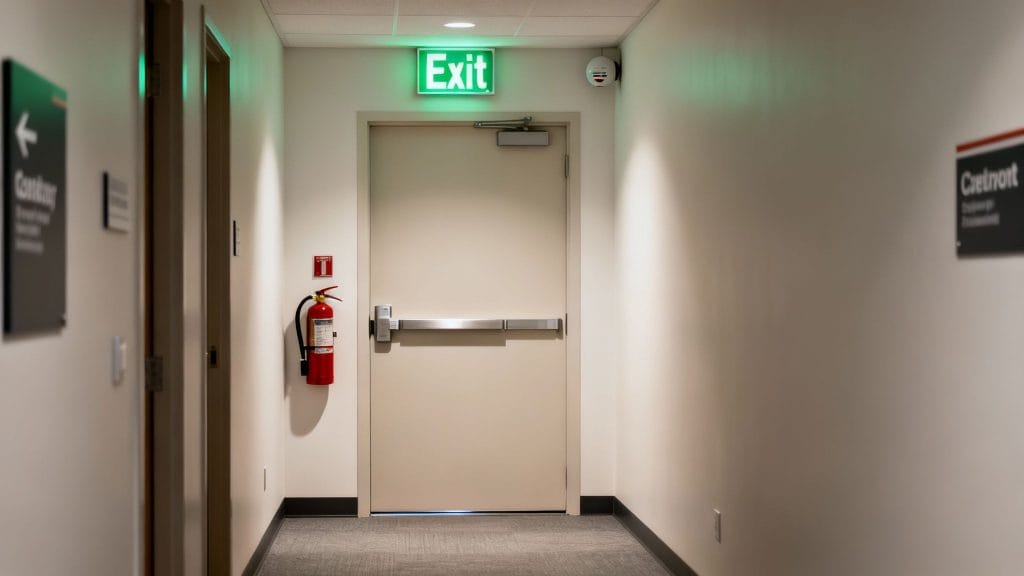
When a fire breaks out, every second counts. Your primary responsibility is to ensure every person can get out of the building quickly and safely. This goes far beyond simply having a fire exit sign over a door.
You must guarantee that all escape routes, such as corridors, stairways, and final exits, are kept completely clear of obstructions, 24/7. A delivery box left in a hallway or a piece of furniture awaiting collection can become a deadly obstacle in a smoke-filled emergency.
A common and incredibly dangerous mistake is propping open a fire door for convenience. In an office block or HMO, a single wedged-open fire door can allow toxic smoke and flames to spread through escape routes in minutes, turning a small, containable incident into a major disaster.
Proper emergency lighting and clear, unambiguous fire exit signage are also non-negotiable. These systems are not just for display; they must be regularly tested and maintained so they work when they are needed most.
Early detection saves lives. It is that simple. You must have an appropriate fire alarm system in place to give everyone the earliest possible warning of a potential fire. The right type of system depends on the size, layout, and use of your building, all of which your fire risk assessment should identify.
Regular maintenance is not just good practice; it is a legal duty. This includes:
These tests provide the critical assurance that your alarm will do its job in a real emergency. Remember to keep a logbook, as records of all tests and servicing are required.
While getting people out is always the priority, having the right firefighting equipment on hand can stop a small fire from escalating. For most buildings, this means providing the correct type of fire extinguishers.
You must ensure extinguishers are:
It is also essential that enough staff are trained on how and when to use them safely. An untrained person trying to fight a fire can be ineffective and put themselves in serious danger.
Finally, you must have a clear, simple plan for what to do if the worst happens. This emergency plan should be an easy-to-understand document outlining the evacuation procedures. Crucially, everyone in the building needs to know about it.
This includes providing thorough fire safety training to staff when they first start, with regular refreshers to keep the knowledge current. Where relevant, tenants and residents must also be given clear instructions on what to do. Fire drills are the only way to test whether the plan actually works in practice and to ensure everyone knows their role.
Making sure your fire doors are compliant is a crucial part of protecting escape routes. For a deeper look at your specific legal duties here, you can learn more about the details of fire door legislation in our dedicated guide.
The following table summarises these core duties, their required actions, and their ultimate purpose in creating a safe environment.
| Duty | Required Action | Purpose |
|---|---|---|
| Fire Risk Assessment | Conduct and regularly review a detailed assessment of the premises. | To identify hazards, evaluate risks, and create an effective fire safety strategy. |
| Means of Escape | Keep all escape routes clear, signed, and well-lit at all times. | To ensure everyone can evacuate the building quickly and safely during an emergency. |
| Detection & Alarms | Install and maintain an appropriate fire alarm system. | To provide the earliest possible warning of a fire, maximising evacuation time. |
| Firefighting Equipment | Provide and service suitable fire extinguishers for the identified risks. | To enable small fires to be tackled safely, preventing them from spreading. |
| Emergency Plan & Training | Create a clear evacuation plan and train all staff and occupants. | To ensure everyone knows exactly what to do in a fire, avoiding panic and confusion. |
Ultimately, these five duties form the bedrock of your legal responsibilities. Getting them right is not just about compliance; it is about protecting lives.
Modern UK fire safety regulations are not just administrative hurdles. They are profound, life-saving lessons written in the aftermath of real-world tragedies.
Every single requirement, from the type of fire alarm you need to the minimum width of an escape corridor, is a direct response to a past incident where people lost their lives. Grasping this history is what separates a truly Responsible Person from someone just ticking boxes.
It transforms compliance from a simple to-do list into a serious moral and ethical duty. When you test an alarm or check a fire door closes properly, you are honouring the memory of those who perished and actively preventing history from repeating itself.
Many of the legal duties you now hold can be traced back to specific, devastating fires that exposed catastrophic failures in building safety. These events acted as a catalyst, forcing the government and industry to confront dangerous oversights and introduce much tougher laws.
A powerful example is the tragic fire at Eastwood Mills in Keighley, Yorkshire, back in February 1956. The blaze claimed the lives of eight workers and exposed shocking gaps in factory fire safety. The incident led directly to major changes in the Factories Act, which became the foundation for the far more robust Factories Act 1961. You can find more detail on how this event shaped modern legislation.
Following the Eastwood Mills fire, a massive survey of up to 50,000 factory premises was launched. It uncovered widespread and dangerous problems, including totally inadequate fire alarms and escape routes blocked with stock. This led to a major shift, moving oversight from local councils to specialist fire brigades who knew what to look for.
This direct line between tragedy and regulation hammers home a vital point: fire safety law is reactive. It evolves because of past failures, and your compliance is the frontline defence against letting those lessons be forgotten.
The requirements set out in the Regulatory Reform (Fire Safety) Order 2005 are not abstract ideas. They are practical, common-sense measures born from harsh experience. Consider these connections:
Ultimately, these regulations exist because we came to the stark realisation that fires are predictable and, therefore, preventable. By fulfilling your duties, you are not just following the law; you are playing an active part in a nationwide effort to protect lives, an effort built on the hard-won lessons of the past.
It can be tempting to see fire safety as another administrative task, or worse, an expense to be postponed. But ignoring your duties as a business owner or landlord comes with consequences that can bring your operations to a sudden halt.
The Fire and Rescue Authorities across the UK do not just offer advice; they have serious enforcement powers. This is not about scaremongering; it is about making the clear business case for getting it right from the start. Once you understand what happens when things go wrong, the value of proactive fire safety management becomes crystal clear.
When a Fire Safety Inspector visits, their goal is to see if you are meeting your duties under the Regulatory Reform (Fire Safety) Order 2005. If they find problems, they have a range of tools at their disposal, and they will not hesitate to use them if people are at risk.
The response usually escalates depending on the severity of the situation.
The fines for breaching UK fire safety regulations are not just a minor penalty; they are designed to be substantial. They are issued by the courts, are often unlimited, and directly reflect the seriousness of putting people’s lives in danger.
For example, a landlord prosecuted for a catalogue of failures like faulty fire doors and blocked escape routes could easily face fines in the tens of thousands of pounds. In one notable case, a London hotel was fined a staggering £200,000 after a fire exposed just how poor its safety measures were.
But it is not just about the money. For the most serious breaches, where someone could have been killed or badly hurt, individuals can be prosecuted. That means a director, manager, or landlord facing a criminal record and, in the worst cases, a prison sentence of up to two years.
Let’s move away from theory and look at two realistic scenarios.
Imagine a small business owner in a converted office. They have taken on more staff and moved desks around, but never updated their fire risk assessment. For convenience, fire doors are wedged open, and a fire escape corridor is now used as a storage area for old files and stock. A routine inspection by the local Fire and Rescue Service changes everything.
The result? An immediate Prohibition Notice is issued for the cluttered corridor, making it unusable. They are also served a strict Enforcement Notice, giving them just 21 days to commission a new fire risk assessment and sort out the fire doors. The cost and disruption completely dwarf what they would have spent on getting professional advice in the first place.
Here is another example: a managing agent for a block of flats keeps ignoring residents’ complaints about a faulty fire alarm. A small kitchen fire breaks out one evening, and the alarm stays silent. The fire is contained, but the investigation that follows is thorough. The company is prosecuted and faces a massive fine, while the individual manager is held personally responsible for their negligence and handed a suspended prison sentence.
Knowing the law is one thing, but putting it into practice is what keeps people safe. This is where the theory stops and the real work begins. For any business owner, landlord, or property manager, the path to compliance is not a mystery; it just requires a clear, structured plan.
Think of this as your roadmap. It breaks down the entire process into logical steps, taking you from feeling uncertain about your duties to confidently managing them. This is not about ticking a box; it is about creating a lasting culture of safety.
This checklist gives you a practical framework to get your property compliant with UK fire safety regulations and, more importantly, keep it that way.
This infographic shows what happens when these steps are ignored and the authorities get involved.
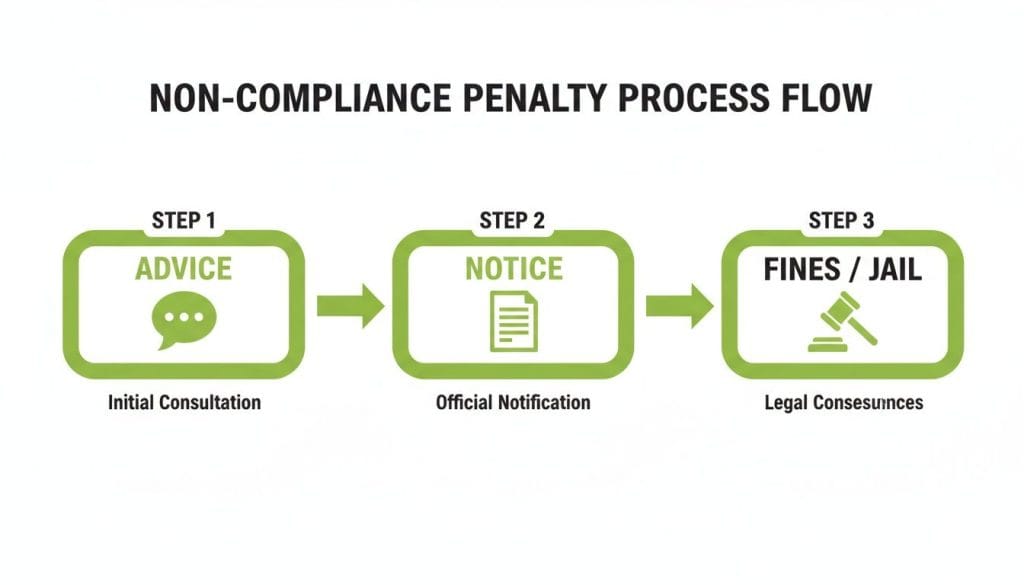
As you can see, the fire service will usually start with helpful advice. But if that advice is ignored, things will quickly escalate to legally binding notices and, eventually, serious penalties.
Your Ongoing Duty: Fire safety is a continuous cycle of review and improvement. A professional fire risk assessment is not a document you file away and forget about. It is a living tool that needs to be revisited regularly, especially if you change the building’s layout, how it is used, or the type of people occupying it.
Getting to grips with UK fire safety regulations often raises a few common questions. As experts in the field, we hear the same queries from business owners, landlords, and property managers time and again.
This section provides clear, practical answers to those questions. We want to clear up any confusion, reinforce your duties, and help you manage your fire safety obligations with confidence.
This is probably the most common question we get asked, and the answer is not as simple as “once a year”. The law does not state a fixed annual requirement. Instead, your fire risk assessment must be kept under regular review.
That is a crucial difference. A review is legally mandatory whenever there is a good reason to think your current assessment is no longer valid. This could be after a minor fire incident or, more commonly, after any significant change to your property.
What counts as a “significant change”?
While the law is flexible, best practice, and what any fire officer or insurer will expect to see, is a fresh review at least every 12 months. This ensures your assessment remains a “suitable and sufficient” document, even if no major changes have occurred.
These terms are specific to fire risk assessments for blocks of flats and similar residential buildings. Understanding the different ‘types’ is vital for landlords and managing agents, as they define the scope and intrusiveness of the inspection.
A Type 1 fire risk assessment is the standard, most common type. It is a non-destructive inspection of the building’s common areas only, such as hallways, stairwells, and plant rooms. The assessor does not look inside any of the private flats.
A Type 4 fire risk assessment, on the other hand, is a much deeper inspection. It is comprehensive and intrusive, involving an inspection of the common parts and a sample of the private flats. The goal here is to check the structural fire protection and compartmentation between them. This is usually only needed if there is a serious concern about how the building was constructed or altered.
See our guide to building regulations and fire safety compliance for the practical steps.
Most HMO landlords I talk to can rattle off their fire door requirements, their alarm grade, and their emergency lighting checks without missing a beat....
Most of the fire safety advice on this site assumes you already have a working HMO. This one is for the stage before that: the...