
Commercial Property Fire Safety Regulations: A Practical Compliance Guide
01/01/2026
When it comes to fire safety in UK commercial properties, the law is crystal clear: the responsibility does not lie with the fire and rescue service. It rests squarely on the shoulders of the person in control of the premises.
This entire framework is built around the Regulatory Reform (Fire Safety) Order 2005. It is a crucial piece of legislation that demands a proactive, risk-based approach to keeping people safe, with a thorough fire risk assessment right at its core. This guide is for business owners, property managers, and landlords who need to understand their legal obligations and implement them correctly.

Navigating your legal duties might seem like a maze at first, but the principle is refreshingly simple. It is all about ensuring the safety of every single person in or even near your commercial property. For years, the UK has been moving away from old-school, rigid rules towards a more intelligent system of risk management.
The story of UK fire safety law is one of a major shift in thinking, from a basic tick-box exercise to a culture of proactive risk reduction. Decades ago, you just needed a fire certificate. But that all changed with the Regulatory Reform (Fire Safety) Order 2005, a landmark law that swept away around 70 different pieces of legislation.
This Order swapped out inflexible demands for a dynamic approach centred on fire risk assessments, a system made even clearer by the Fire Safety Act 2021. What does this mean for you today? It means that as a property owner or manager, you must put in place safety measures that are tailored to the actual risks your specific premises present.
The 2005 Order introduced the all-important concept of the ‘Responsible Person’. This is the individual or company with control of the building, and therefore, the one with legal accountability for fire safety. Figuring out who this is has to be your first step.
The Responsible Person could be:
In the real world, it is quite straightforward. If you own a shop, you are the Responsible Person. If you manage an office block with multiple tenants, you probably share that responsibility with the business owners renting the spaces. Getting to grips with these fire risk assessment legal requirements is completely non-negotiable.
This role is not just a title; it comes with serious legal duties. Failing to fulfil them can lead to severe penalties, including unlimited fines and even prison time. The rest of this guide will break down exactly what those duties involve and how you can meet them, step-by-step.
The entire UK fire safety framework hinges on one key role: the Responsible Person. This is not just a bit of legal jargon; it is the individual or entity legally accountable for fire safety in a commercial property. Getting this right is the first and most critical step. If you do not know who is responsible, safety measures will inevitably fall through the cracks.
In simple terms, the Responsible Person is whoever has control of the premises. The law keeps this definition broad on purpose, because it is not about job titles, it is about who actually has the power to get things done.
Pinpointing who this is usually is not too complicated. The responsibility typically lands on one of the following:
It is also vital to remember that responsibility can be shared. In a building with several businesses, each employer is responsible for their own office or unit, but the landlord or their agent is responsible for the shared parts. Without clear communication between everyone involved, you end up with dangerous gaps in your fire safety management.
Being the Responsible Person comes with five non-negotiable legal duties. Think of these not as a one-off checklist but as a continuous cycle of risk management. Getting these right is the only way to stay on the right side of the law and, far more importantly, keep everyone in your building safe.
It is a common and dangerous myth that putting a fire extinguisher in the corner is enough. The law demands a much more proactive and documented approach, where every safety measure is a direct answer to a risk you have already identified.
These duties all link together to create a complete fire safety system for your property.
Below is a summary of the primary legal obligations you must fulfil. Each duty builds on the last, forming a complete and robust fire safety strategy.
| Duty | What It Means in Practice | Why It Is Critical |
|---|---|---|
| 1. Conduct a Fire Risk Assessment | Systematically identify fire hazards (e.g., faulty wiring, stored combustibles) and evaluate the risk they pose to people in the building. | This is the foundation of everything. Without a proper assessment, any safety measures you install are just guesswork. |
| 2. Implement Fire Safety Measures | Based on your assessment, install and maintain appropriate equipment like fire alarms, clear escape routes, fire doors, and correct signage. | These are the physical tools that prevent a fire from starting or spreading and allow people to escape safely. |
| 3. Create an Emergency Plan | Document clear procedures for evacuation, establish roles for key staff, and set up a safe assembly point. You must test this with drills. | When an alarm sounds, panic and confusion are the enemy. A clear, practised plan ensures an orderly and safe evacuation. |
| 4. Provide Information & Training | Ensure every employee knows the emergency plan, how to raise the alarm, and understands the specific fire hazards in their work area. | People are your first line of defence. Proper training empowers them to act correctly and avoid making a bad situation worse. |
| 5. Maintain Records | Keep a written record of your fire risk assessment, the actions taken, and all maintenance logs. | This is your proof of due diligence. It shows fire authorities you are actively and responsibly managing fire safety. |
Failing to meet any one of these duties can undermine your entire fire safety system and expose you to serious legal consequences. Let us break down each one in more detail.
1. Conduct a Fire Risk Assessment
This is the absolute cornerstone of your entire fire safety plan. You are required to carry out a detailed assessment of the premises and review it regularly. The process involves methodically identifying anything that could start a fire and figuring out who might be harmed. To get a better handle on this crucial first step, you can learn more about what a fire risk assessment is and why it is so vital for your legal compliance.
2. Implement Appropriate Fire Safety Measures
Once your risk assessment is done, you must act on its findings by putting adequate fire safety measures in place. This covers everything from making sure escape routes are clear and installing fire detection systems to maintaining fire doors and putting up the right signage. A well-kept fire alarm system, for instance, is a direct outcome of this duty and can be the difference between a minor scare and a total disaster.
3. Create an Emergency Plan
You must have a clear, written plan for what to do if a fire breaks out. This plan needs to spell out evacuation procedures, assign roles to key staff (like fire wardens), and designate a safe assembly point well away from the building. Critically, this plan must be shared with all employees and tested with regular fire drills.
4. Provide Information and Training
Every single employee must be given proper fire safety information and training when they first join, with regular refresher sessions after that. This has to include understanding the emergency plan, knowing how to raise the alarm, and being aware of the specific fire hazards related to their job.
5. Maintain Records
You are legally required to keep a written record of your fire risk assessment and all the actions you have taken. This paperwork is not just about bureaucracy; it is your proof of due diligence. It shows the fire authorities that you are managing fire safety in a structured, responsible way.
Your fire risk assessment is the absolute foundation of your entire fire safety strategy. Think of it less as a bureaucratic box-ticking exercise to be filed away and more as a living document that actively protects your property and everyone inside it.
Breaking it down into a logical, five-step process strips away the complexity. It transforms a legal duty into a series of practical, common-sense actions. This approach works for any commercial property, whether you are looking at cooking hazards in a high-street café or the electrical load in a server room. Each step builds on the last, creating a clear and defensible safety plan.
The diagram below shows how the duties of the Responsible Person form a continuous cycle, all driven by what the risk assessment uncovers.
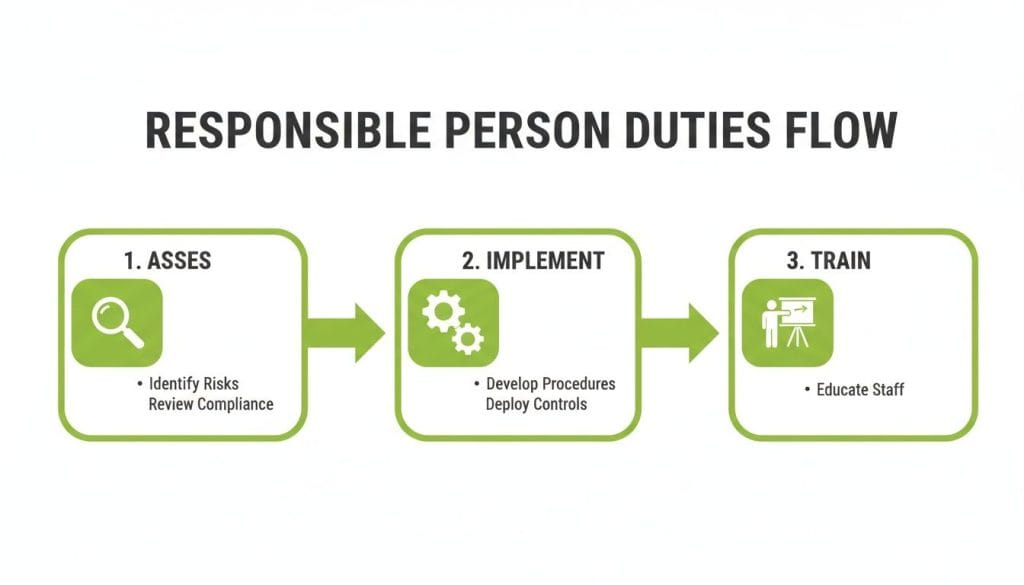
As you can see, the assessment directly leads to implementing safety measures and training people, creating a loop of continuous safety management.
The first job is to walk through your premises with a critical eye, actively looking for potential fire hazards. You are looking for anything that could realistically start a blaze.
It helps to think in terms of the ‘fire triangle’:
Once you have figured out where a fire could start, the next question is: who could get hurt? Your legal duty of care extends far beyond your direct employees to every single person who might be on your premises.
This includes people like:
This is where you connect the findings from the first two steps. For every hazard you found, you need to evaluate the level of risk it poses and decide on the right actions to either remove it completely or reduce it to an acceptable level.
Your goal is to put control measures in place that are both reasonable and practical. Sometimes, this is as simple as moving a heater away from a stack of paper or enforcing a clear-desk policy to reduce combustible clutter. Other times, it might mean a more significant investment, like upgrading an old fire alarm system or installing certified fire doors.
If you employ five or more people, the law says you must record the significant findings of your assessment in writing. This is not just a list of problems; it is your detailed action plan.
Your written assessment must detail the hazards you have identified, the people at risk, and the control measures you have put in place. It should also include a clear emergency plan outlining evacuation procedures. This document is your proof of compliance.
This written record is what you will show a fire officer to prove you have a structured and serious approach to fire safety. To get a real feel for what a finished report should look like, you can review this detailed example of a fire risk assessment to understand the required level of detail.
A fire risk assessment is not a one-and-done job. Buildings change, people come and go, and new risks appear all the time. The law requires you to review your assessment regularly to keep it relevant. An annual review is widely considered best practice.
However, you must carry out an immediate review if there is:
Failing to have a proper, up-to-date assessment is a serious breach. In fact, fire authority data consistently shows that an unsuitable or non-existent risk assessment is one of the most common reasons for enforcement action, leading to thousands of penalties every single year.
A fire risk assessment is an excellent starting point, but it is only valuable once you act on its findings. This next stage is all about turning that documented plan into tangible, physical safeguards in your building.
Think of these measures as the practical tools that control fire risks, alert everyone inside, and give them a safe way out. They form the absolute core of your day-to-day fire safety management and are a primary duty under the fire safety regulations.
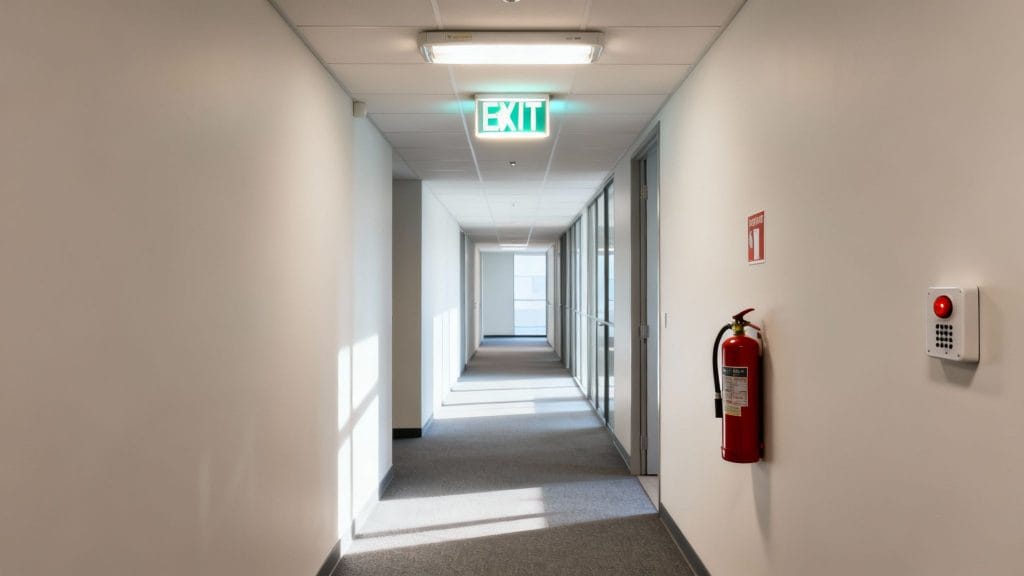
Giving people an early warning is arguably the most critical job of any fire safety system. The right system for your property depends entirely on its size, complexity, and the risks identified in your assessment. A small, single-storey shop has completely different needs to a sprawling, multi-floor office block.
There are several categories of fire alarms, but for most commercial properties, the choice boils down to a few key types:
Choosing the right system is not just about ticking a compliance box; it is about giving people the maximum possible time to get out safely.
One of the most common and most dangerous failings found by fire inspectors is a blocked escape route. It is a fundamental legal requirement that all routes leading to a final exit are kept clear of obstructions and hazards at all times.
An escape route is not just a corridor; it is a designated path to safety that must be protected. Storing stock, equipment, or even rubbish in a fire escape corridor can have fatal consequences and will almost certainly result in enforcement action.
This duty also means ensuring all your fire doors are in good working order, are kept closed, and are never wedged open. Fire doors are carefully engineered to hold back smoke and flames for a specific period (usually 30 or 60 minutes), creating a protected tunnel for people to escape through. A propped-open fire door makes that protection completely useless.
While getting everyone out is always the priority, having the right equipment to tackle a small fire can stop a minor incident from becoming a major disaster. Your risk assessment is the key here, it will determine the type and location of fire extinguishers you need.
Different extinguishers are needed for different classes of fire, so you need the right tool for the job:
Alongside extinguishers, emergency lighting is a vital component. If the power fails during a fire, this backup system must light up all escape routes, ensuring people can still find their way out in a dark and potentially smoke-filled environment.
Both extinguishers and emergency lighting need regular servicing and maintenance, and you have to keep a log of it. Ignoring this is a direct breach of your legal duties and puts lives at serious risk.
Ignoring your fire safety duties is not like forgetting to file some minor paperwork. The consequences are severe, stretching far beyond a simple fine. These are not just administrative rules; they are laws forged from tragedy, designed to protect lives. Understanding what is at stake is the first step toward responsible business management.
The local Fire and Rescue Service has serious enforcement powers. An inspector can visit your premises at any reasonable time to carry out an audit, and their findings will dictate what happens next.
Depending on how serious the safety breaches are, an inspector has a few tools at their disposal. Their goal is not to punish but to force you to make your premises safe, and fast.
Where the breaches are serious, the consequences jump from notices to the criminal courts. And the courts do not hold back. They have the power to impose unlimited fines for significant failings under the Fire Safety Order.
In the most severe cases, especially where a fire safety breach leads to death or serious injury, individuals can face prison sentences. It is critical to understand that directors, managers, and other company officers can be prosecuted personally if the offence happened with their consent, was a result of their neglect, or they turned a blind eye. Your company’s limited liability status offers zero protection here; you are personally accountable.
UK fire safety law is often described as being ‘codified by catastrophe’, meaning major laws are passed in the wake of horrific fires. Tragedies like the Bradford City stadium fire and the Grenfell Tower fire led directly to tougher regulations. This history is why the authorities take non-compliance so seriously; they are duty-bound to prevent these disasters from happening again. You can learn more about how these events shaped today’s laws in our resources on fire regulations in the UK.
The legal penalties are just one part of the problem. The commercial fallout from a fire safety prosecution can cripple a business.
One of the biggest immediate risks is invalidated insurance. Buried in the small print of most commercial insurance policies are clauses requiring you to comply with all relevant laws. A fire safety breach could give your insurer the perfect reason to refuse to pay out after a fire, leaving you to cover catastrophic losses all by yourself.
Beyond the financial hit, the reputational damage from a prosecution can be immense. News travels fast when a business is fined or shut down for putting people at risk. That kind of publicity destroys trust with customers, suppliers, and the community, a kind of damage that is incredibly difficult, and sometimes impossible, to repair.
Ultimately, getting fire safety right is not just a legal box to tick. It is an essential pillar of good business, crucial for continuity and resilience.
While the law technically allows a Responsible Person to do their own fire risk assessment, there is a significant catch: they must be genuinely ‘competent’ to do so. Competence is not about knowing your way around the building. It is about having the specific training, experience, and up-to-date knowledge of fire safety standards needed to spot complex hazards.
For most business owners or managers, this is a very high bar. That is why bringing in a professional is not just a safer option, it is a smart, strategic move.
An external assessor brings a fresh, impartial pair of eyes. They are trained to spot the non-compliance issues and hidden dangers that people who work in the building every day might miss. This is sometimes called ‘risk blindness’. This independent scrutiny is what makes an assessment truly ‘suitable and sufficient’ in the eyes of the law.
A professional fire risk assessment does far more than just tick a box. It gives you a clear, prioritised action plan, taking all the guesswork out of managing your fire safety. Instead of a long, confusing list of potential problems, you get a structured report. It tells you exactly what to do, why you need to do it, and how urgently it needs to be sorted.
This professional approach unlocks several key benefits:
Engaging an accredited assessor turns your fire risk assessment from a legal headache into a valuable management tool. It gives you a clear roadmap for compliance, shields your business from enforcement action, and shows a real commitment to protecting lives.
Ultimately, paying for a professional fire risk assessment is a strategic investment in the health and future of your business. The cost of an expert report is tiny compared to the fallout from getting it wrong. The potential consequences include unlimited fines, being shut down by a Prohibition Notice, or the catastrophic financial and reputational damage of a major fire.
It gives you the clarity and confidence to manage commercial property fire safety regulations properly. It ensures you are not just compliant on paper, but genuinely safe in practice. This proactive step is fundamental to business continuity, protecting your assets, and fulfilling your duty of care to every single person who walks through your doors.
When it comes to fire safety, it is natural to have questions. For business owners and property managers, getting the details right is crucial for compliance and, more importantly, for safety. Here are some straightforward answers to the questions we hear most often.
The law says you must keep your fire risk assessment under regular review to make sure it is up to date. While there is not a rigid legal deadline, best practice, and what the fire authorities expect to see, is a full review at least annually.
However, you cannot just wait for the annual review date to roll around. An immediate update is required if anything significant changes. This could be anything from an office refurbishment or bringing new hazardous materials on-site to a sudden increase in staff numbers. You also need to review it straight after a fire or even a near-miss, as that is a clear signal that your current measures might not be sufficient.
Legally, the answer is yes. The designated ‘Responsible Person’ can carry out the assessment, but there is a significant condition: they must be ‘competent’ to do it. Competence is not just about filling in a form; it means having the right training, experience, and knowledge to spot genuine fire hazards and properly understand the risks involved.
For a tiny, very simple business, say, a small single-room office, this might be realistic. But for the vast majority of commercial properties, especially those with multiple floors, members of the public visiting, complex layouts, or high-risk activities, the safest and most sensible option is to bring in an accredited, external professional. It ensures the assessment is impartial, thorough, and stands up to legal scrutiny, which is what protects you from liability if the worst happens.
See our guide to UK fire door regulations for landlords for what it means in practice.
Most HMO landlords I talk to can rattle off their fire door requirements, their alarm grade, and their emergency lighting checks without missing a beat....
Most of the fire safety advice on this site assumes you already have a working HMO. This one is for the stage before that: the...