
Mastering HMO Fire Safety Regulations: A Landlord’s Guide
31/12/2025
HMO fire safety regulations are not just administrative tasks; they are a non-negotiable legal framework designed to protect lives. Houses in Multiple Occupation (HMOs) carry a far higher fire risk than single-family homes, which is why they demand specific, much stricter safety measures to protect tenants. For landlords, compliance is a mandatory duty, not an optional extra.
This guide is for HMO landlords, property managers, and managing agents in the UK. By the end, you will understand your legal obligations, the key fire safety measures required, and the serious consequences of non-compliance.
Understanding your legal responsibilities as an HMO landlord or property manager is the first, most critical step. Unlike a standard single-let property, the nature of an HMO—with multiple, often unrelated tenants, shared facilities, and complex layouts—means fire can spread with terrifying speed. Escape routes can become confusing and quickly blocked. This heightened risk is exactly why the law places a much heavier burden on the people responsible for these buildings.
The core of your legal duties is built on two key pieces of legislation:
These two laws work together to create a robust legal framework with no ambiguity. If you own or manage an HMO, you are personally and legally accountable for the safety of every person inside.
Under the Fire Safety Order, the Responsible Person is almost always the landlord, freeholder, or managing agent—whoever has control of the property. This is a crucial point: you cannot simply delegate this responsibility away. While you can (and should) hire a competent professional to carry out your fire risk assessment, the ultimate legal accountability for acting on its findings rests with you.
Grasping the concept of personal liability is vital. If a fire breaks out and it is found you have neglected your duties, it will be you facing the local authority or the Fire and Rescue Service.
The increased risk in HMOs is not just theoretical; it is backed by government data. Statistics consistently show that people are significantly more likely to be injured or die in a fire in an HMO compared to a single-family dwelling. This is down to higher occupancy density, shared kitchens and electrical systems, and tenants who do not necessarily know each other’s routines. For a deeper dive into these obligations, you can read our complete guide on fire safety regulations for landlords.
The law is built on a simple premise: in an HMO, a fire starting in one person’s room is an immediate threat to everyone else. That is why the regulations focus heavily on protecting communal areas, guaranteeing clear escape routes, and installing early warning systems to give everyone the best possible chance of getting out safely.
This is precisely why fire safety rules for HMOs are so much more prescriptive. Measures that might be considered ‘best practice’ in a standard house—like interlinked smoke alarms and certified fire doors—are often mandatory legal requirements in an HMO. It is a fundamental difference that every HMO landlord must understand to protect their tenants, their property, and themselves.
If you manage an HMO in Manchester specifically, these fire safety duties sit alongside the council’s own HMO licensing requirements. Our guide to HMO licensing in Manchester breaks down mandatory and selective licensing, and how they interact with your fire risk assessment obligations.
If you are an HMO landlord or manager, your single most important compliance tool is the fire risk assessment (FRA). This is not a suggestion or a box-ticking exercise. It is a legal obligation and the absolute foundation of your entire fire safety strategy. A ‘suitable and sufficient’ assessment is a non-negotiable annual requirement that demonstrates you have proactively managed the safety of your tenants.
The purpose of an FRA is to systematically inspect your property, identify every conceivable fire hazard, and properly evaluate the risk they pose to the people living there. It is the document that informs every decision you make about fire alarms, escape routes, and fire doors. Without a thorough assessment, you are guessing about safety, which is not a defensible position when the council or fire service inspects your property.
Annual fire risk assessments are the cornerstone of UK HMO fire safety regulations. They are required by law for every HMO at least once a year. The risks are simply higher when you have multiple, unrelated people sharing a space. The Regulatory Reform (Fire Safety) Order 2005 makes this crystal clear, and government data confirms that deaths and injuries in HMOs are higher than in single-family homes. This is why the rules on early warning alarms and protected escape routes are so strict. You can discover more insights about fire safety for HMOs at hopewell.co.uk.
This infographic breaks down the simple but critical legal process every HMO landlord has to follow, from understanding what an HMO is to managing the risks that come with it.
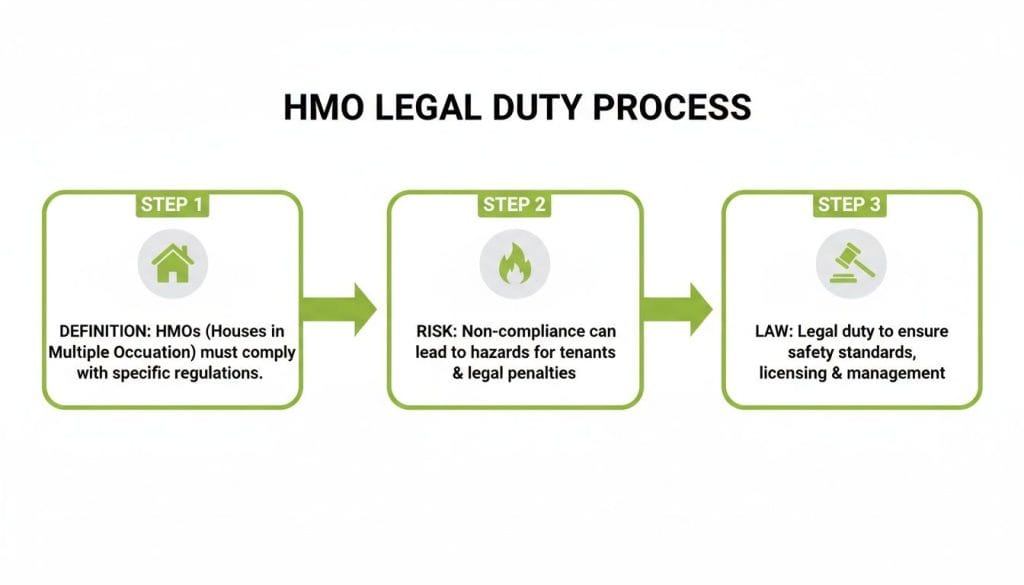
As the graphic shows, the moment you recognise your property is an HMO, a legal duty kicks in to assess and manage the heightened fire risks.
A proper fire risk assessment, whether you do it yourself or hire a professional, always follows a clear, five-step process. This structured approach ensures nothing is missed and your findings are logical and, most importantly, actionable.
For a very small, simple HMO, a knowledgeable landlord might feel competent to conduct their own assessment. This is permitted, provided you genuinely understand what is required.
However, for most properties—and certainly for larger or more complex HMOs—appointing a competent professional is the most reliable and safest option.
A professional assessor brings an impartial and expert eye. They are trained to spot subtle hazards an untrained person might overlook, like a fire door that appears fine but is incorrectly installed, or an alarm system that does not provide adequate coverage. They are also up-to-date with the specific requirements of local councils and national standards, which can be difficult for landlords to navigate.
A professional fire risk assessment is more than a report; it is an investment in risk reduction. It provides you with a clear, prioritised roadmap to legal compliance and the safety of your tenants. An expert’s findings also provide a robust defence should your safety measures ever be questioned by the authorities.
Opting for a professional provides peace of mind that your assessment is truly ‘suitable and sufficient’. The report you receive will detail all findings and provide a practical, prioritised list of recommendations. This allows you to turn expert advice into concrete actions, confidently protecting both your tenants and your investment from the devastating consequences of a fire.
A fire risk assessment is not the finish line; it is the starting point. The report it produces is your practical roadmap for installing the physical fire safety measures that protect your tenants and ensure legal compliance. Implementing these precautions correctly is a fundamental part of fulfilling your duties under HMO fire safety regulations.
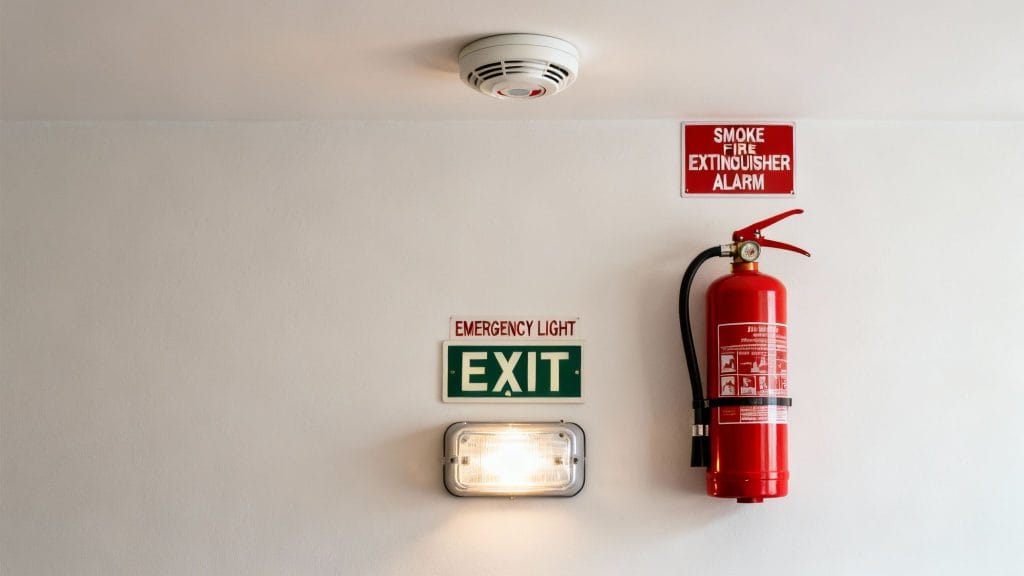
These measures are not optional. They are the active and passive systems designed to give early warnings, illuminate escape routes, and provide tenants with the best possible chance to get out safely in an emergency. The specific equipment your property needs will depend on its size, layout, and number of storeys, but some elements are almost always mandatory.
Choosing the right fire alarm system for your HMO is one of the most critical decisions you will make. These systems are classified by grades (reliability and robustness) and categories (the extent of coverage in the property). For any HMO, mains-powered, interlinked systems are the absolute standard.
Here are the systems you will most likely encounter:
Selecting the correct system is not a matter of guesswork. Your fire risk assessment and local council guidance will tell you exactly what minimum standard you must meet.
Imagine a fire trips the mains power, plunging your property into total darkness. This is where emergency lighting becomes a literal lifesaver, activating to illuminate escape routes so tenants can find their way out safely and without panic. It must be installed along corridors, landings, and stairwells that form the designated escape path.
Emergency lighting is a lifeline, not a luxury. In a smoke-filled corridor, the clear, green glow of a fire exit sign and the light from emergency fittings can be the difference between a safe evacuation and a tragedy.
Fire safety signage works hand-in-hand with emergency lighting. Legally required signs, like the green “Fire Exit” signs with the running man symbol, must clearly mark the escape routes. You will also need “Fire Door Keep Shut” signs on all relevant doors and signs showing where fire-fighting equipment is located.
While you should never expect tenants to fight a fire, providing the right equipment is a legal requirement. The type and placement of fire extinguishers will be dictated by the specific risks identified in your assessment.
Generally, you will be expected to provide:
To give you a clearer idea, the table below outlines some typical minimum standards. However, you must always consult your local authority’s specific guidance and your property’s fire risk assessment, as requirements can and do vary.
| HMO Type and Storeys | Minimum Fire Alarm System | Emergency Lighting Requirement | Fire Extinguisher Notes |
|---|---|---|---|
| 2 Storey, 3-4 Occupants | Grade D, LD3 (interlinked alarms in escape routes) | Usually not required, but check local guidance | Fire blanket in kitchen; multi-purpose extinguisher may be advised |
| 3-4 Storey, 5+ Occupants | Grade D, LD2 (alarms in escape routes and high-risk rooms) | Required in all escape routes (corridors, stairs) | Water/foam extinguishers on each floor; CO2 near electrics |
| 5+ Storey, Large HMO | Grade A, LD1 (full panel system with detectors everywhere) | Required throughout all escape routes | Multiple extinguishers on each floor as per risk assessment |
Ultimately, this combination of detection, lighting, and equipment forms a safety net. Each component plays a vital role in a layered defence system designed to give your tenants the best possible protection.
When discussing fire safety, it is easy to focus on active systems like alarms. But the silent heroes of any HMO are the passive fire protection measures—the features that work tirelessly in the background. At the top of that list is the fire door.
Its job is deceptively simple but absolutely vital: to contain a fire. By holding back flames and toxic smoke, a properly functioning fire door keeps escape routes clear, buying tenants precious time to get out safely.
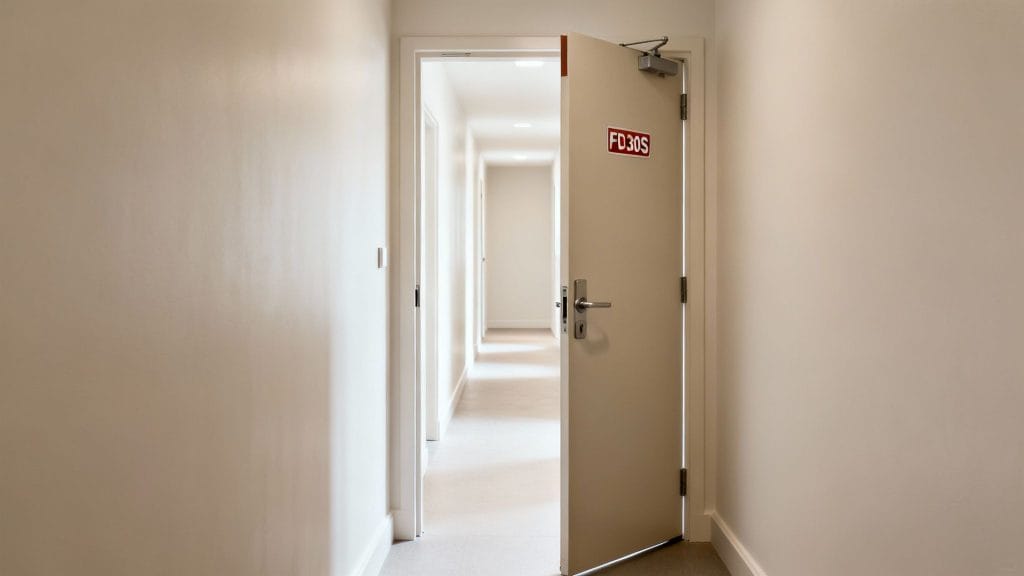
Imagine a fire breaks out in a tenant’s bedroom. A closed fire door acts as a robust barrier, containing the intense heat and deadly smoke within that room. This keeps the hallway and staircase passable, allowing everyone else to evacuate. This is precisely why understanding HMO fire safety regulations for doors is not just a compliance task; it is a non-negotiable part of being a responsible landlord.
Not just any door will do. A compliant fire door must be professionally certified to withstand fire for a specific amount of time. The most common standard you will encounter is FD30S.
Let’s break that down:
When these strips are heated, they expand to seal the gap between the door and its frame, stopping flames from passing through. The cold smoke seals, which often look like brushes, stop poisonous smoke from seeping out long before the heat becomes intense. For a deeper dive into the legal specifics, check out our complete guide to fire door legislation.
A fire door is only as good as its installation and maintenance. Unfortunately, this is where things often go wrong. The Fire Door Inspection Scheme (FDIS) found a shocking 75% failure rate among the doors they inspected. Digging into the data, excessive gaps were to blame in 77% of those failures, while poor maintenance was a factor in 54%. These are serious statistics for any HMO environment.
The most common issues we see that make a fire door completely useless are:
A fire door is a complete engineered system. Changing just one component, like fitting a non-rated lock, can cause the entire door to fail catastrophically in a fire, long before its 30-minute rating is up.
The best fire door in the world is pointless if the escape route it protects is blocked. A perfect FD30S door cannot help anyone if the corridor behind it is cluttered with tenants’ bicycles, furniture, or bags of rubbish.
As the Responsible Person for the property, you have an ongoing legal duty to make sure these routes are kept completely clear. This is not a one-off job. It means regular inspections are essential.
Checking that fire doors are undamaged and fully functional, and that escape routes are clear, is a fundamental part of your responsibilities. It is this diligence that ensures your passive fire protection systems will do their job when it matters most.
Failing to meet HMO fire safety regulations is not a minor oversight; it is a serious breach of the law with severe consequences. For landlords and property managers—the designated ‘Responsible Person’—ignoring these duties creates a legal, financial, and personal risk that is simply not worth taking.
Enforcement is handled by two main bodies: your local council and the local Fire and Rescue Service. These authorities have a range of powers to ensure properties are safe for tenants, and they will not hesitate to use them if they find significant failings.
The enforcement process usually follows a clear, escalating path. It often begins with an inspection, which could be routine or triggered by a tenant’s complaint. If an inspector finds any fire safety breaches, their first step may be informal.
Ignoring a formal notice is a criminal offence and will trigger much more severe action. The authorities have the power to protect tenants from immediate danger, and they will use it.
If an inspector finds a risk so serious that it poses an imminent threat to life, they can issue a Prohibition Notice. This is one of the most drastic measures available, and it takes effect immediately.
A Prohibition Notice can legally restrict or completely stop the use of your property, or parts of it, until the life-threatening issues are fixed. This means you could be forced to require your tenants to leave, leaving you with no rental income and a significant bill for repairs and alternative accommodation.
The financial consequences of non-compliance can be catastrophic. Under the Regulatory Reform (Fire Safety) Order 2005, any breaches can lead to prosecution in a criminal court.
The penalties for failing in your duties are deliberately severe. Courts can issue unlimited fines, reflecting the seriousness of putting tenants’ lives at risk. It is a clear message that fire safety is not an area for cutting corners.
These fines are levied directly against the Responsible Person. That means you, as the landlord or manager, are personally liable. In the most serious cases where neglect has led to a death or serious injury, a prison sentence is a very real possibility. The law is designed to hold individuals accountable.
The legal and financial fallout from a fire safety breach can destroy a property business. Diligent, proactive compliance is not just a good idea—it is the only responsible way forward.
Knowing the regulations is one thing, but putting them into practice is what counts. This checklist turns legal requirements into a clear, actionable plan for your HMO.
Think of it as your roadmap. It is designed to help you protect your tenants, safeguard your property, and remain on the right side of the law.
Every point here is a core, non-negotiable task. The golden thread tying it all together is meticulous record-keeping. Your logbook is the physical proof that you are taking your duties as a landlord seriously.
Good fire safety is not about one-off jobs; it is about building consistent habits. These tasks need to be integrated into your property management routine.
First, your fire risk assessment. It needs to be a current, working document, not something filed away. This is the cornerstone of your entire safety strategy, so it needs reviewing at least every 12 months or anytime you make significant changes to the property.
Next, get hands-on with your property’s safety features. This means scheduling—and documenting—regular checks on all your fire safety equipment. You need to know it will work when it is needed most.
Use these steps to build a fire safety routine that is both robust and legally sound. Consistent checks and detailed records are your best defence against enforcement action.
Following a structured approach is the only way to manage your responsibilities without letting things slip. A solid checklist turns complex legal duties into a manageable, repeatable process that significantly reduces your risk.
This list provides a strong foundation. For a more granular breakdown, you can use our comprehensive fire risk assessment checklist to guide your inspections and record-keeping.
By working through these actions systematically, you are not just ticking boxes. You are creating a genuinely safer home for your tenants and building a robust record of your diligence.
We understand. Navigating the world of HMO regulations can feel complex. To make things clearer, here are our answers to some of the most common questions we hear from landlords and property managers.
Yes, absolutely. The law, specifically the Regulatory Reform (Fire Safety) Order 2005, applies regardless of the number of tenants. It states that a written fire risk assessment is a legal requirement for all HMOs, no matter their size.
This is not just about paperwork. It is your formal proof that you have properly considered and managed the fire risks in your property. Furthermore, many local councils have their own, often stricter, rules. A professional assessment is the only reliable way to know you are compliant on all fronts.
Your fire safety measures are only as good as their last check. Establishing a simple, documented routine is your best defence against equipment failure and potential enforcement action.
A crucial tip: record every check in a dedicated fire safety logbook. This is not just good practice; it is your primary evidence that you are taking your duties as the Responsible Person seriously.
Tenants must never, under any circumstances, tamper with fire safety equipment. It is your responsibility as the landlord to make this clear from the moment they sign the tenancy agreement.
If you discover a detector has been covered or removed, you must act immediately. Have a firm conversation, explaining that their actions are not only a breach of their tenancy agreement but are also putting everyone in the building in serious danger. Document this conversation, and then rectify the issue straight away.
Feeling confident about your HMO’s compliance is one thing; being certain is another. HMO Fire Risk Assessment delivers certified fire risk assessments across the UK, providing a clear, jargon-free action plan to protect your investment and, most importantly, your tenants.
Ready to ensure your property is compliant? Book your assessment with our experts at https://hmofireriskassessment.com.
E-bike and e-scooter charging is a growing risk in shared housing — see our guide to lithium-ion battery fire hazards in HMOs for how to manage it.
E-bike and e-scooter charging is a growing risk in shared housing — see our guide to lithium-ion battery fire hazards in HMOs for how to manage it.
Most HMO landlords I talk to can rattle off their fire door requirements, their alarm grade, and their emergency lighting checks without missing a beat....

Most of the fire safety advice on this site assumes you already have a working HMO. This one is for the stage before that: the...