
A Complete Guide to the Type 1 Fire Risk Assessment
28/12/2025
A Type 1 fire risk assessment is the standard, non-destructive safety inspection required for the common parts of most residential buildings and commercial premises. It’s the fundamental legal check designed to protect everyone in the building by identifying and managing fire hazards in shared areas like hallways, staircases, and entrance lobbies. This guide is for business owners, landlords, facilities managers, and anyone designated as the ‘Responsible Person’ for a property in the UK.
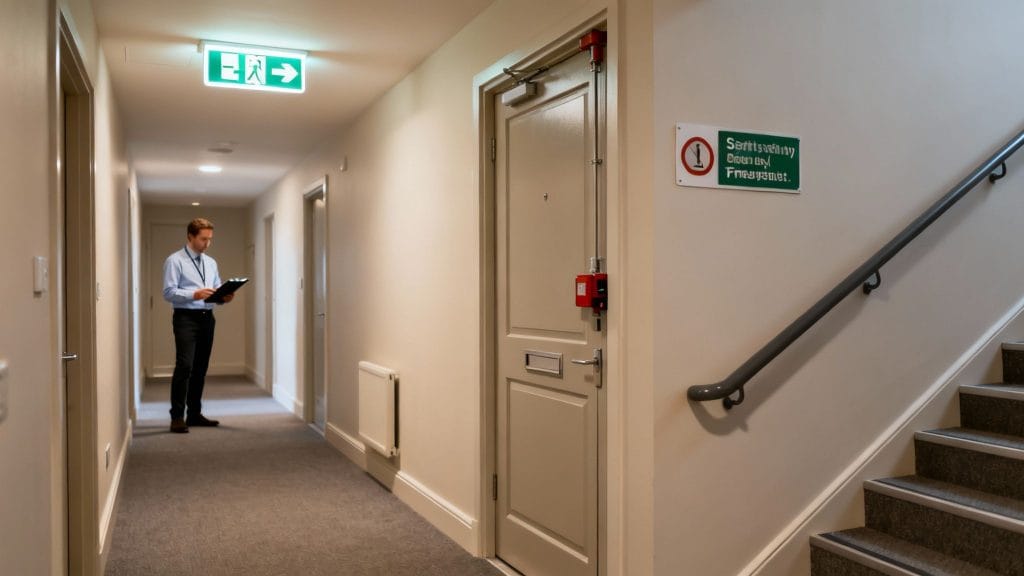
Think of a Type 1 fire risk assessment as the essential safety check for the shared areas of your property. Its purpose is to ensure the fundamental fire precautions are in place and working correctly, helping the person in charge of the building meet their legal duties.
This assessment is purely visual and non-destructive. What this means in practice is that the assessor will not be opening up walls or ceilings. The focus is strictly on what can be seen and reasonably checked within these shared spaces, not private areas.
Under the Regulatory Reform (Fire Safety) Order 2005, if you are responsible for a building with common areas, you have a legal duty to ensure a “suitable and sufficient” fire risk assessment is carried out. This legal responsibility falls to the ‘Responsible Person’.
The Responsible Person could be:
If you control the common parts of a building, the legal responsibility for fire safety rests with you. A Type 1 assessment is the cornerstone of fulfilling that obligation.
The scope is strictly limited to the shared areas accessible to all residents or employees. An assessor will not enter private flats or individual business units. The purpose is to evaluate the risks that affect everyone using the building.
A common misunderstanding is that a Type 1 assessment covers the entire building. Its strength lies in its focused approach: to meticulously check the safety of escape routes and shared facilities, which are critical for everyone’s safe evacuation during an emergency.
This targeted inspection includes looking for obvious hazards and checking that existing safety measures are adequate. For instance, an assessor would check if a fire exit is blocked by recycling bins in a communal hallway or if a fire door has been wedged open, creating a major risk for the entire building.
This is not just about ticking a box. It is the fundamental first step in a robust fire safety strategy, designed to protect lives and property. Ignoring this duty can lead to severe consequences, including enforcement action from the Fire and Rescue Service and even prosecution.
Getting to grips with UK fire safety law can seem complex, but the core responsibilities are straightforward and they are not optional. The key legislation is the Regulatory Reform (Fire Safety) Order 2005. This law places the responsibility for fire safety firmly on the shoulders of the ‘Responsible Person’.
Who is that? If you own, manage, or run a business from any property that is not a single private dwelling, it is likely you. Your primary legal duty is to ensure a ‘suitable and sufficient’ fire risk assessment has been completed. This is a legal requirement to keep people safe.
This means you must actively identify fire hazards, determine who is at risk, and implement appropriate safety measures. It is an ongoing responsibility that forms the foundation for your entire fire safety strategy.
Under the Fire Safety Order, you have several key legal duties:
The Fire Safety Act 2021 was introduced to clarify and extend the original Order, especially for residential buildings. It made it clear that the Responsible Person’s duties also cover the building’s structure and its external walls, including elements like cladding and balconies.
It also specifically includes all entrance doors to individual flats. These doors are critical for preventing fire and smoke from spreading from a private flat into the shared escape routes. This update reinforces the comprehensive nature of your legal duties.
Ignoring these responsibilities comes with serious consequences. Your local Fire and Rescue Service has the power to inspect your property and will take action if you are not compliant.
Enforcement can begin with an informal warning but can escalate to a formal Enforcement Notice, which legally compels you to make specific improvements. If there’s a serious risk to life, they can issue a Prohibition Notice, which could shut down part or all of your building until it is made safe.
Breaches of the law can lead to unlimited fines and, in the worst cases, a prison sentence of up to two years. These are not empty threats; they demonstrate how seriously the law views failures in fire safety. The first step to avoiding this is to understand your specific fire risk assessment legal requirements.
Recent government figures highlight the scale of the problem. In the year ending March 2023, Fire and Rescue Services in England carried out 49,765 fire safety audits. Alarmingly, only 59% of buildings were found to be satisfactory. This statistic shows just how many properties have compliance gaps that a professional assessment is designed to find and fix.
Understanding the different ‘types’ of fire risk assessments is one of the most important things a Responsible Person needs to do. Choosing the right one means you are not just ticking a legal box; you are ensuring your property gets the correct level of scrutiny without paying for an inspection that is either insufficient or excessive.
The type you need depends on your building’s complexity, its use, and the level of fire risk involved.
The most common and fundamental of these is the Type 1 fire risk assessment. This is the standard for the vast majority of residential blocks and business premises, forming the bedrock of your fire safety duties. It is a non-destructive inspection, meaning the assessor only examines what is visible in the building’s common parts.
This decision tree shows how your role as a building’s Responsible Person connects directly to your legal duties under UK fire law.
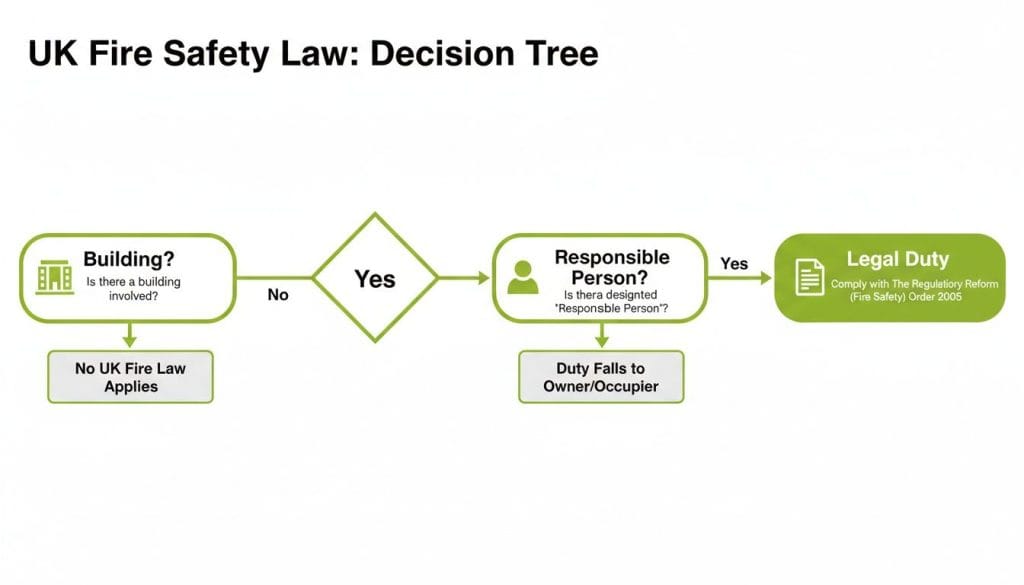
As the flowchart shows, if you control a premises, the law states you are responsible for managing its fire safety. That journey always starts with a suitable and sufficient assessment.
While a Type 1 is the standard for most properties, sometimes a more detailed inspection is needed. This usually happens when the initial assessment raises concerns about the building’s structural fire protection, such as fire stopping hidden inside walls or above ceilings.
Here is a simple rundown of the four main types:
For most landlords, managing agents, and business owners, the Type 1 fire risk assessment is the correct place to start. It provides the “suitable and sufficient” evaluation of risks that the Fire Safety Order demands for the areas under your control.
A more intrusive assessment (Type 2, 3, or 4) is typically only recommended by a competent assessor if a Type 1 assessment uncovers serious doubts about the building’s construction, fire stopping, or compartmentation. It is a response to a specific, identified concern.
Put simply, a Type 1 is your standard tool for staying compliant. The other types are more specialist investigations, used to answer significant questions about a building’s hidden safety features.
| Assessment Type | Scope of Inspection | Level of Intrusion | Typical Use Case |
|---|---|---|---|
| Type 1 | Common parts only (e.g., hallways, stairs) | None (Visual only) | Standard compliance for most residential and commercial buildings. |
| Type 2 | Common parts only (e.g., hallways, stairs) | Minor Intrusive | When there is doubt about fire compartmentation in common areas. |
| Type 3 | Common parts and sample of private flats | None (Visual only) | Buildings where internal flat fire safety is a known concern. |
| Type 4 | Common parts and sample of private flats | Fully Intrusive | To investigate serious structural fire safety defects or material issues. |
As you can see, the level of intrusion corresponds to the level of concern. Starting with a Type 1 is almost always the correct first step.
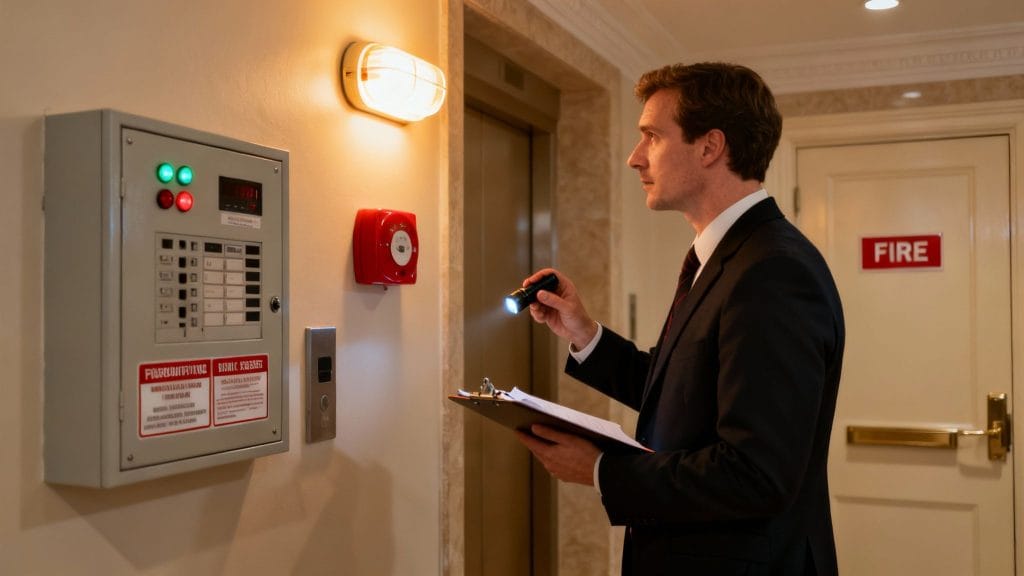
Knowing what to expect when an assessor visits can make the process smoother and more effective. A Type 1 fire risk assessment is not about finding fault; it is a practical, methodical inspection designed to give you a clear, honest picture of the fire safety in your building’s common areas.
When our assessor arrives, their goal is to carry out a thorough visual check of all the shared spaces. This is a systematic walk-through, not something disruptive or intrusive. The focus is on spotting potential fire hazards and evaluating how well your existing safety measures protect everyone in the building.
This transparent approach means you know exactly what we are looking for, helping you prepare for our visit and building confidence in the process. It is a partnership aimed at creating a safer environment.
The assessment begins with a comprehensive tour of all the common parts of the building. This includes everything from the main entrance lobby and corridors to stairwells, plant rooms, and any shared facilities like laundry rooms or bin stores.
During this walk-through, the assessor is looking for the three elements a fire needs to start: a source of ignition, a source of fuel, and oxygen.
In practical terms, this means they are checking for things like:
A critical part of any Type 1 fire risk assessment is ensuring people can get out of the building safely if an incident occurs. To do this, the assessor meticulously checks all designated escape routes.
This is much more than just looking for blockages. The inspection covers:
A classic failure we often see is a fire exit that leads into an enclosed yard with a locked gate. An escape route must lead people somewhere they are genuinely safe and away from the building, not into another trap.
Next, the assessor evaluates the measures designed to alert people to a fire and contain its spread. This involves looking at both active systems (those that perform an action) and passive systems (those built into the fabric of the building).
Active Fire Protection Checks
These are the systems that actively operate when there is a fire. Our assessor will visually inspect:
Passive Fire Protection Checks
Passive protection is about containing a fire and stopping it from spreading. In a Type 1 assessment, this is a visual, non-intrusive check.
By systematically working through these areas, the assessor builds a complete picture of your property’s fire safety compliance. For a more detailed look at what a professional site visit entails, you can learn more about our dedicated fire safety inspection process.

The assessor has completed their visit, and a detailed report from your Type 1 fire risk assessment has been sent to you. This document is your official legal record, but more than that, it is your practical roadmap to making your property compliant and safe.
Its real value, however, depends entirely on you. You need to understand what it says and, crucially, take action on the findings. Think of it as a tool designed to help you protect your building and the people inside it. Learning to interpret its structure and recommendations is a core duty for any Responsible Person.
A professionally written report is structured to be clear and easy to follow, even if you are not a fire safety expert. While the layout might vary slightly, any competent assessment will contain a few key sections that create a complete picture of your property’s fire safety status.
Here are the essential components you should always look for:
Not all findings are equal. A good assessor will use a risk rating system to help you distinguish between a minor issue and a serious, life-threatening hazard. This is vital because it allows you to focus your time, effort, and budget where they are needed most urgently.
Most reports categorise recommendations using a priority scale. Understanding this scale is the key to turning the report into a practical management plan.
A crucial part of your due diligence is being able to show an enforcing authority that you have a logical plan to address risks. This starts with tackling the most dangerous issues first, as identified by the report’s prioritisation.
The reality of fire risk is stark. There were 271 fire-related fatalities in England in the year ending March 2023. These assessments systematically uncover the very hazards that, if fixed, could prevent such tragedies. This data from the official government website underscores the need for professional intervention, ensuring every Responsible Person can act on clear, prioritised advice.
Learning to read your report effectively means knowing the difference between what needs fixing now and what can be scheduled for later.
Here is a practical comparison:
High Priority (Urgent Action Required)
Medium Priority (Action Required Soon)
Low Priority (Good Practice / Minor Improvement)
By breaking down the report this way, you can build a logical and defensible action plan. This not only makes your property safer but also provides clear evidence that you are responsibly managing your duties under the Regulatory Reform (Fire Safety) Order 2005.
Receiving your Type 1 fire risk assessment report is a critical milestone, but it is the start, not the end, of your legal duties. The document itself does not make your building safer; taking decisive action on its recommendations is what truly protects people, property, and your business.
As the Responsible Person, you have a legal obligation to act on the significant findings outlined in the report. This means creating a clear plan to address the identified hazards, starting with anything marked as high priority.
Think of your report’s action plan as your roadmap to compliance. The key is to address the recommendations systematically, documenting every step you take to rectify the issues.
This documented proof of action is essential. Should the Fire and Rescue Service inspect your property, they will want to see not just the assessment but also clear evidence that you have actively worked to resolve the findings.
A common failure is treating the fire risk assessment as a one-off, tick-box exercise. The law sees it as a live, ongoing process. Your report must be reviewed regularly, especially after any changes to the building, and the actions you take are what demonstrate true due diligence.
Not all risks carry the same weight, which is why your report uses a priority system. You must focus your resources on the most urgent issues first to make the biggest and fastest impact on safety.
To keep everything organised, it is helpful to use a comprehensive fire risk assessment checklist to track the completion of these remedial works.
Fire safety is not a project with an end date; it is a continuous management responsibility. Once you have addressed the initial findings, your focus must shift to maintaining these safety standards for the long term.
This involves scheduling regular reviews of your assessment, conducting routine checks on fire doors and escape routes, and arranging professional servicing for equipment like fire extinguishers and alarms. By embedding these practices into your property management routine, you ensure your building remains compliant and safe, protecting your investment and the people within it.
Understanding your responsibilities around a Type 1 fire risk assessment is the first step towards getting it right. It is a common source of confusion, so we have answered some of the most frequent questions we hear from landlords, property managers, and business owners.
While the law does not set a rigid expiry date, UK government guidance is clear: you should formally review your fire risk assessment at least once a year. It is a living document that needs to reflect the current reality of your property.
A new professional assessment is generally needed every 3 to 5 years, depending on the complexity or risk level of your building. However, you must commission a new assessment immediately if any significant changes occur.
Significant changes that trigger a new assessment include:
For the vast majority of standard Houses in Multiple Occupation (HMOs), a Type 1 fire risk assessment is exactly what is needed. It focuses on the shared parts of the property—the hallways, stairwells, and communal kitchens—which is precisely what the law requires you to manage.
It is the essential starting point for any HMO landlord. In some cases, for particularly large or complex HMOs, the local authority’s licensing conditions might require more, but the Type 1 assessment always serves as the fundamental legal building block.
The penalties for non-compliance under the Regulatory Reform (Fire Safety) Order 2005 are severe. Your local Fire and Rescue Service has serious enforcement powers, and they use them.
The penalties are not just financial; they can be personal. The law holds the ‘Responsible Person’ directly accountable. A failure to provide a ‘suitable and sufficient’ assessment can lead to the prosecution of an individual, not just a penalty for the company.
The potential consequences include:
The law states the assessment must be carried out by a ‘competent person’. This means someone with the necessary training, experience, and knowledge to properly identify fire hazards and evaluate the risks they pose.
While the owner of a very small, simple commercial premises might feel they meet this requirement, the life safety risks in a multi-occupied residential building are far more complex. For HMOs and blocks of flats, appointing a certified, third-party fire risk assessor is the only reliable way to ensure your assessment is ‘suitable and sufficient’ in the eyes of the law.
Hiring a professional ensures that critical dangers are not missed and demonstrates that you have taken your legal duties seriously, protecting both your occupants and yourself from liability.
Ensure your property is compliant and your occupants are safe. HMO Fire Risk Assessment provides certified, clear, and actionable Type 1 fire risk assessments across the UK. Book your assessment today to protect your property and fulfil your legal obligations. Book Your HMO Fire Risk Assessment Assessment
Most HMO landlords I talk to can rattle off their fire door requirements, their alarm grade, and their emergency lighting checks without missing a beat....
Most of the fire safety advice on this site assumes you already have a working HMO. This one is for the stage before that: the...