
How Often Should Fire Risk Assessments Be Done in the UK
27/12/2025
Under UK fire safety law, you are required to review your fire risk assessment regularly to keep it current and effective. While the legislation does not set a rigid annual deadline, a yearly review has become the industry gold standard for demonstrating you are fulfilling your duties.
This guide is for business owners, landlords, property managers, and anyone designated as a ‘Responsible Person’ for a non-domestic property in the UK. By the end, you will understand your legal obligations for reviewing fire risk assessments, what triggers a review, and the serious consequences of getting it wrong.

The core of your legal obligations is found in the Regulatory Reform (Fire Safety) Order 2005. This legislation places the responsibility for fire safety firmly on a designated ‘Responsible Person’. This individual could be a landlord, employer, managing agent, or anyone else with control over non-domestic premises.
Your duty does not end after completing a single assessment. You must treat it as a live, evolving document. The law uses the word ‘regularly’ to describe how often you should review it, which provides flexibility but also demands a proactive approach. In practical terms, you must continually ask: does my assessment still accurately reflect the fire hazards in my building today?
For most businesses and properties, a ‘regular’ review translates into an annual check. This frequency is considered best practice because a significant amount can change in a year. New tenants may move in, the building layout could be altered, or you might begin storing different materials. Even gradual wear and tear on fire doors can introduce new risks, making an old assessment obsolete.
An annual review provides a clear, defensible timeline. It demonstrates to authorities, such as your local Fire and Rescue Service, that you are actively managing your fire safety responsibilities. It serves as a practical benchmark for protecting your occupants, property, and business continuity.
Staying compliant is a fundamental legal requirement. The Regulatory Reform (Fire Safety) Order 2005 applies to almost all non-domestic premises, from offices and shops to blocks of flats and HMOs. The Order demands a ‘suitable and sufficient’ assessment that is reviewed regularly. Official guidance from bodies like the Health and Safety Executive (HSE) points to annual reviews as the accepted standard.
Ignoring this can lead to serious penalties, including unlimited fines and, in severe cases, prison sentences. You can find more details in our guide to the fire risk assessment legal requirements.
The purpose of a fire risk assessment is not to create a document that gathers dust on a shelf. It is an active risk management tool designed to protect lives, property, and business continuity. An outdated assessment is, in the eyes of the law, no assessment at all.
Ultimately, how often you review your assessment is directly linked to the specific risks in your building. While an annual review is the accepted standard, higher-risk environments will demand more frequent checks to remain both compliant and safe.
While UK law is flexible, requiring only a ‘regular’ review of your assessment, the annual review has become the gold standard for good reason. It is not an arbitrary deadline but a proven risk management strategy. A surprising amount can change in just one year, quietly making a once-solid fire risk assessment dangerously out of date.
Consider a typical office. Over twelve months, a department might expand, forcing a reshuffle of desks and partitions. This seemingly minor tweak can easily block a fire exit or obscure a fire extinguisher, rendering your emergency plan ineffective. Similarly, a warehouse that switches its stock from non-flammable goods to combustible materials introduces a major new hazard that did not exist when the last assessment was completed.
It is not just significant, obvious changes that create risk. The slow, creeping wear and tear on your building’s fire safety measures can be just as dangerous. Consider the daily use of a fire door that hundreds of people pass through.
Over a year, this constant use can lead to:
These subtle failures are easy to miss during daily operations, but a formal annual review is designed specifically to identify them before they can contribute to a tragedy. Each one is a broken link in your chain of fire safety.
An annual review acts as a critical reset. It ensures that your fire risk assessment remains a true and accurate reflection of your premises as they exist today, not as they were twelve months ago. This is fundamental to demonstrating due diligence.
An annual review is not just about ticking a box for the authorities. It brings tangible benefits that protect your entire operation. Insurers often include clauses in their policies that demand you maintain compliant fire safety measures. In the event of a fire, an outdated assessment could be grounds for them to dispute or invalidate your claim, leading to catastrophic financial losses.
A current, robust assessment is also a cornerstone of business continuity. It demonstrates to auditors, inspectors, and potential investors that you are actively managing risk to protect your people and assets. By understanding potential hazards, you can implement effective controls.
Ultimately, an annual review is the most practical and defensible way to keep your fire safety strategy effective. It closes the gap between the legal requirement to review ‘regularly’ and the real-world need to manage constantly changing risks, protecting lives, property, and the future of your organisation.
Not all properties carry the same level of fire risk, and your review schedule must reflect this. The law requires a “suitable and sufficient” assessment, meaning your review frequency must be appropriate for the building in question. A simple storage unit and a residential care home are worlds apart in risk and demand different levels of attention.
To determine how often you should review your assessment, you first need an honest evaluation of whether your premises are low, medium, or high risk. This is not guesswork; it involves analysing a combination of factors that, together, create a clear picture of your property’s unique challenges.
Calculating your risk level requires a practical, on-the-ground look at your building and the people who use it. The goal is to be able to confidently justify your review frequency, whether that is a standard annual check or something more frequent.
Consider these critical factors:
Once you have weighed these factors, you can place your premises into a risk category. This profile will directly inform how often your fire risk assessment needs to be professionally reviewed.
Low-Risk Premises
A low-risk property has few potential ignition sources, limited combustible materials, and occupants who can evacuate quickly and without assistance.
Medium-Risk Premises
These are properties with more potential hazards, more complex layouts, or more people. They might also store moderate amounts of flammable materials.
High-Risk Premises
High-risk environments are those with significant fire hazards, highly vulnerable occupants, or challenging escape routes. These properties demand the most rigorous and frequent oversight.
Relying on a simple calendar reminder for your fire risk assessment review is a common and significant mistake. While an annual check is a good rule of thumb, certain events can make your assessment obsolete overnight, leaving you non-compliant and your building unsafe. You must think proactively and recognise the critical triggers that demand an immediate review, regardless of when your last one was completed.
If you ignore these triggers, your assessment will no longer be ‘suitable and sufficient’ in the eyes of the law. This is not about administrative tasks; it is about ensuring your fire safety plan matches the real-world conditions of your building at all times.
The most obvious trigger is any physical change to the building itself. This includes not just major construction work, but also small alterations that can have a significant knock-on effect on fire safety. These changes demand an instant review because they can alter escape routes, compromise fire compartmentation, or introduce new hazards.
Consider these common scenarios:
This decision tree infographic shows how different risk levels influence your review frequency, helping you determine if your property falls into the low, medium, or high-risk category.
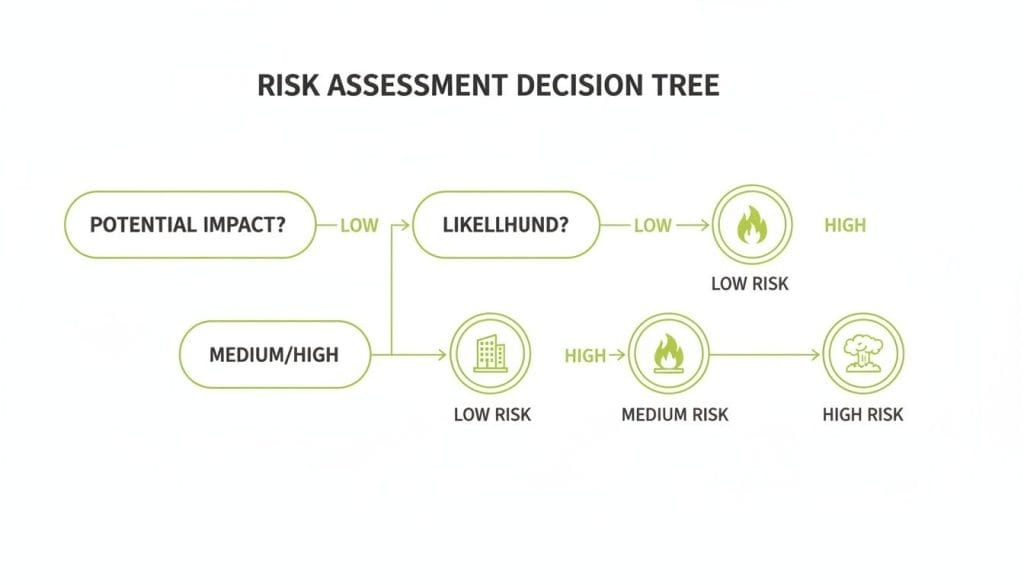
This visual guide reinforces that as risk increases, from a simple low-risk building to high-risk premises with complex hazards, the need for more frequent and triggered reviews becomes critical for compliance.
How your building is used, and who uses it, are at the heart of its risk profile. A change to either is a major red flag that your current fire risk assessment is likely out of date.
A fire risk assessment is a snapshot in time. If the subject of that photograph changes significantly, you need a new picture. Waiting for the annual review is like navigating with an old map after new roads have been built.
For instance, if a floor once used for office work is converted into a storeroom packed with stock, the fire load (the amount of combustible material) has increased significantly. This requires a completely fresh look at the risks and the safety measures in place. Similarly, if a property is let to tenants with known vulnerabilities, such as elderly residents or people with mobility issues, the evacuation strategy must be rewritten. The old plan is no longer adequate.
Your fire risk assessment must cover every potential ignition source and all combustible materials on site. Introducing new substances or work processes is a clear trigger for an immediate review.
This could include:
The legal backing for this is clear. The Regulatory Reform (Fire Safety) Order 2005 requires you to review your assessment ‘regularly’ to keep it up to date, especially after a significant change, as stated in Article 9(3). You can explore additional insights about how often fire risk assessments should be reviewed and discover more about these legal drivers.
Finally, any fire-related incident, no matter how small, is a non-negotiable trigger for a review. This includes a minor fire that was extinguished quickly or a “near miss” where a potential fire was narrowly avoided.
These events are a clear warning that your current safety measures may have failed or are inadequate. A thorough review will help you identify the root cause of the incident and implement corrective actions to prevent a recurrence. Ignoring such a warning is a serious failure of your duties as the Responsible Person.
Allowing your fire risk assessment to become outdated is far more than a simple administrative oversight. It is a significant risk that carries serious, real-world consequences, endangering your business and the people within it. In the eyes of the law and your insurer, an outdated assessment is as good as no assessment at all.
This compliance gap leaves you exposed to enforcement action from your local Fire and Rescue Service. Inspectors have little tolerance for assessments that are irrelevant to a building’s current use or condition. While initial contact may involve informal advice, it can quickly escalate to formal legal notices if you fail to act.
When a fire safety inspector determines your assessment is no longer ‘suitable and sufficient’, they have a range of legal powers. Their response will be proportionate to the level of risk they find, but the path of enforcement is clear and can bring your operations to a halt.
Here is what you could be facing:
Ignoring these notices is not an option and will almost certainly lead to prosecution.
If you are prosecuted for breaches under the Regulatory Reform (Fire Safety) Order 2005, the penalties are severe. Courts can issue unlimited fines, with the final amount often reflecting the severity of the risk and the size of your business.
For the most serious offences, especially where a risk of death or serious injury existed, the Responsible Person can face a prison sentence. These are not empty threats; they are the unfortunate reality for business owners and landlords who fail to take their fire safety duties seriously.
An outdated fire risk assessment is not just a compliance issue; it is a direct failure of your legal duty of care. When enforcement action is taken, inspectors and courts will see it as clear evidence that the safety of occupants was being ignored.
Fire and Rescue Services have a range of legal powers to enforce the Fire Safety Order. The table below shows the common types of notices they can issue and the serious consequences of non-compliance.
| Type of Notice | Purpose | Potential Outcome if Ignored |
|---|---|---|
| Alterations Notice | To compel the Responsible Person to make specific fire safety improvements to the premises by a certain date. | Can escalate to an Enforcement Notice and potential prosecution. |
| Enforcement Notice | To require the remedy of specific, serious breaches of fire safety legislation within a set timeframe. | Criminal prosecution, unlimited fines, and potential imprisonment. |
| Prohibition Notice | To immediately restrict or prohibit the use of a premises due to an imminent risk of serious personal injury. | Immediate business closure, followed by criminal prosecution if the notice is breached. |
As you can see, the legal framework is designed to ensure compliance, and the penalties for failing to act are significant.
Beyond direct legal action, the commercial and personal fallout from a neglected assessment can be devastating. One of the most common consequences relates to insurance. Following a fire, your insurer will scrutinise your compliance records. An assessment that is years old or does not reflect major changes to the building is often sufficient grounds to invalidate your insurance policy and refuse payment. This could leave you with catastrophic financial losses from which your business may never recover.
In the most tragic circumstances, where a fire leads to a fatality, an outdated assessment becomes a central piece of evidence in a criminal investigation. A clear failure to manage fire safety could lead to charges of gross negligence manslaughter or corporate manslaughter, carrying the risk of a prison sentence and immense reputational damage.
It is crucial to view your fire risk assessment review not as a chore, but as a fundamental pillar of responsible management. Keeping it current is one of the most important actions you can take to protect lives, secure your business, and avoid life-altering legal penalties.

A fire risk assessment is not a one-off document to be filed and forgotten. It is a live, working tool for your property. Your records are the official proof of your ongoing commitment to safety, creating a clear audit trail that shows you are fulfilling your responsibilities.
When the Fire and Rescue Service inspects your property, this paper trail is your first line of defence. An inspector will not just take your word for it; they will ask to see the records that prove you are meeting your legal duties as the Responsible Person. Without them, you have no tangible evidence of active fire safety management.
A well-kept record does not need to be complex. It just needs to be clear, simple, and contain all necessary information. Every time you review your assessment, whether it is an annual check or one triggered by a specific event, you must log the key details.
Your review documentation should always include:
This structured approach transforms your paperwork from a simple record into an active management tool, ensuring accountability and prompt risk mitigation.
Keeping your documents organised is vital, both for your day-to-day management and for presentation to authorities. Disorganised or inaccessible records can be as problematic as having none at all.
A fire safety logbook is more than just a legal requirement; it is the diary of your building’s safety journey. It tells the story of how you identify risks and, more importantly, how you act to control them, providing undeniable proof of your commitment to protecting people.
Here are a few straightforward tips to manage this process effectively:
Properly documenting your reviews proves that your fire safety strategy is a continuous process of improvement, not just an administrative exercise.
To help you stay compliant, here are straightforward answers to the most common questions we receive from business owners, landlords, and property managers. This is a practical summary to clarify your duties.
This is a classic point of confusion. The legal requirement for a written fire risk assessment applies when you have five or more employees. However, the fundamental duty to conduct and regularly review an assessment applies to all non-domestic premises, regardless of team size.
Even if not legally mandatory, keeping a written record of every review is always the wisest course of action. It serves as proof to the fire service or insurers that you are taking your responsibilities seriously and helps ensure you do not miss anything important.
The law states the review must be done by a ‘competent person’. If you operate a very small, simple, low-risk premises, such as a single-room shop with no stockroom, you may feel confident enough to handle a review yourself.
However, for most properties, and certainly for complex commercial sites, residential blocks, or any HMO, engaging a professional is the most sensible option. A professional assessor is an expert in current legislation and can spot subtle hazards you might easily overlook. This not only protects people but also protects you from serious liability.
A professional review is not just about ticking a compliance box; it is about providing you with genuine confidence. It is independent verification that your safety measures are adequate, which is invaluable during an inspection or in the event of an incident.
It is important to understand the difference, as they serve two distinct functions in keeping your property safe.
Best practice is to conduct a routine review annually. A completely new assessment is generally recommended every 3-5 years, depending on your building’s risk level, or immediately following any major changes, such as construction work.
Keeping your fire risk assessment current is not just a recommendation; it is a critical legal duty. For professional, compliant, and thorough assessments that provide peace of mind, trust the experts at HMO Fire Risk Assessment. We are here to help you protect your property, your people, and your business.
Book Your Professional Fire Risk Assessment Today
Most HMO landlords I talk to can rattle off their fire door requirements, their alarm grade, and their emergency lighting checks without missing a beat....

Most of the fire safety advice on this site assumes you already have a working HMO. This one is for the stage before that: the...