
UK Fire Risk Assessment Legal Requirements Explained
26/12/2025
If you are responsible for any non-domestic property in the UK, understanding your fire safety duties is not just good practice it is a legal necessity. The law, primarily the Regulatory Reform (Fire Safety) Order 2005, is clear: a designated ‘Responsible Person’ must carry out a suitable and sufficient fire risk assessment and keep it under regular review. This is not optional guidance; it is a fundamental legal requirement.
This guide is for business owners, landlords, facilities managers, and anyone designated as a ‘Responsible Person’. By the end, you will understand what the law requires, who is accountable, and the practical steps needed to achieve compliance and protect people.

Whether you own a business, manage a block of flats, or run an HMO, the responsibility for fire safety rests with you. The law is designed to be practical, placing accountability on the person or people best positioned to manage safety on a day-to-day basis. Legally, this individual is known as the ‘Responsible Person’.
Identifying the Responsible Person is the first step towards compliance. It is a legal status, not a title you can ignore or delegate without ensuring the duties are fulfilled correctly. In practice, the Responsible Person is usually one of the following:
In many buildings, such as office blocks or residential flats with multiple tenants, these duties can be shared. For instance, a landlord might be responsible for common areas like stairwells and corridors, while individual businesses are responsible for their own office spaces. In these situations, clear communication and co-operation are essential to prevent dangerous gaps in your fire safety strategy.
The law expects the Responsible Person to take specific actions to ensure safety. The table below provides a brief overview of these duties.
| Responsibility | What It Means in Practice |
|---|---|
| Carry out an FRA | Systematically check the premises for fire hazards and assess the risks to people. |
| Implement Fire Safety Measures | Act on your findings. This includes installing fire alarms, extinguishers, and signage. |
| Maintain Fire Safety Measures | Keep all equipment in good working order through regular checks and servicing. |
| Create an Emergency Plan | Have a clear, documented plan for what to do in case of a fire, including evacuation. |
| Provide Information & Training | Ensure staff and tenants know what the risks are and what they need to do in an emergency. |
| Keep Records | If you have 5 or more employees, your assessment findings must be recorded in writing. |
These duties form the foundation of UK fire safety law, ensuring a consistent and proactive approach to protecting lives and property.
A fire risk assessment is a thorough, practical review of your property. It is a systematic process designed to identify potential fire hazards and ensure the safety of everyone who uses the building. It is the cornerstone of your fire safety plan.
A common mistake is viewing it as a simple box-ticking exercise. In reality, it is a dynamic management tool that must be tailored to the specifics of your property and its occupants. For a complete walkthrough of the process, you can learn more about what is a fire risk assessment in our detailed guide.
The assessment is there to answer a few critical questions:
A proper fire risk assessment is more than just a piece of paper; it is your documented proof of due diligence. It demonstrates to the authorities, your insurers, and your occupants that you have seriously considered the risks and taken reasonable steps to control them, protecting both lives and your business.
Ultimately, meeting the legal requirements is about accepting your duty of care. The law is straightforward: you must take general fire precautions to ensure the safety of your employees, tenants, and visitors, so far as is reasonably practicable. This fundamental duty underpins everything else and is the starting point for creating a safe environment. Ignoring it comes with serious consequences, which we will cover later in this guide.
When it comes to fire safety law, everything starts with one crucial question: who is legally accountable for the building? The Regulatory Reform (Fire Safety) Order 2005 places this duty squarely on the ‘Responsible Person’. This is not just a job title or a voluntary role; it is a specific legal status that comes with significant personal and corporate liability.
Determining who this person or company is represents the first, most critical step toward compliance. Crucially, ignorance is no defence. Not knowing you are the Responsible Person will not protect you from enforcement action, fines, or even prosecution if a fire safety breach occurs.
The law identifies the Responsible Person based on who has the most control over the premises. While every situation has its own nuances, the duty typically falls to one of the following, depending on the property type.
This is a non-negotiable legal duty, and it demands a hands-on, proactive approach to managing fire safety.
In many buildings, fire safety duties do not just fall on one person’s shoulders; they are shared between multiple parties. This is very common in multi-occupied commercial buildings or blocks of flats where a managing agent has been appointed.
For example, a freeholder of a residential block might hand over the day-to-day running of the building to a property management company. In this scenario, both parties have legal duties. The freeholder retains ultimate responsibility, but the managing agent also becomes a duty holder for all tasks under their control, as set out in their contract.
It is absolutely vital that in any shared-duty scenario, a clear, written agreement exists. This document must specify exactly who is responsible for what, from ordering the fire risk assessment to maintaining the fire alarm. Ambiguity creates dangerous gaps in safety management and can lead to serious legal consequences.
Without that clarity, essential tasks can be missed, leaving occupants at risk and putting all parties in a legally vulnerable position.
While the Responsible Person is legally accountable, they are not expected to be an expert in the finer details of fire safety legislation. The law simply requires them to ensure the fire risk assessment is ‘suitable and sufficient’, which, in practice, usually means appointing a competent professional to carry it out. This duty to appoint a competent person is a core part of the legislation.
This point is reinforced by legal changes which introduce mandatory competency requirements for fire risk assessors. These changes demand independent verification by UKAS-accredited bodies to uphold standards under the Fire Safety Order. You can find out more about the recent changes and essential updates for landlords, HMO managers, and business owners. This move clearly highlights the growing emphasis on professional qualifications and verifiable expertise.
Ultimately, the Responsible Person must be able to confidently identify their position, understand the weight of their duties, and take all necessary steps to ensure a compliant and safe environment for everyone in the building.
A ‘suitable and sufficient’ fire risk assessment is not just legal jargon; it is a practical, logical framework that turns a daunting legal duty into a manageable set of actions. The UK government and fire authorities recommend a clear, five-step approach.
Following this structure ensures you systematically identify, evaluate, and control fire risks. It also creates a robust, legally defensible record that proves you are meeting your duties under the Regulatory Reform (Fire Safety) Order 2005. Let’s break down the steps.
First, you need to walk through the premises and look for anything that could start or fuel a fire. You are looking for the three parts of the ‘fire triangle’: a source of ignition, a source of fuel, and oxygen.
This means looking for potential problems in your day-to-day operations. Common hazards include:
Once you have found the hazards, the next question is: who could be harmed if a fire started? This is not just about counting the number of occupants. It is about understanding who is in the building, where they are, and what might make them vulnerable.
Your duty of care extends to everyone, not just staff or tenants. Consider contractors, visitors, and members of the public. Pay special attention to anyone who might be at greater risk:
For anyone with a known disability that would affect their escape, you may need to create a Personal Emergency Evacuation Plan (PEEP). This is a simple, tailored plan that outlines the specific assistance they would need to evacuate safely.
This is the action stage. Using the information gathered in the first two steps, you need to evaluate the level of risk and then implement fire safety measures to either eliminate the risk completely or reduce it to an acceptable level.
The goal is to ensure people can evacuate safely if a fire breaks out. This involves a combination of physical precautions and clear procedures. It is your job to check if your current measures are adequate or if improvements are needed.
A key part of this step is ensuring your fire safety provisions are suitable for the building and its occupants. This includes checking that fire doors close properly, escape routes are kept clear at all times, and fire alarm systems are working correctly and tested regularly.
This flowchart illustrates how the ‘Responsible Person’ duty applies across different property types. It is a crucial concept for understanding who is ultimately in charge of completing these steps.
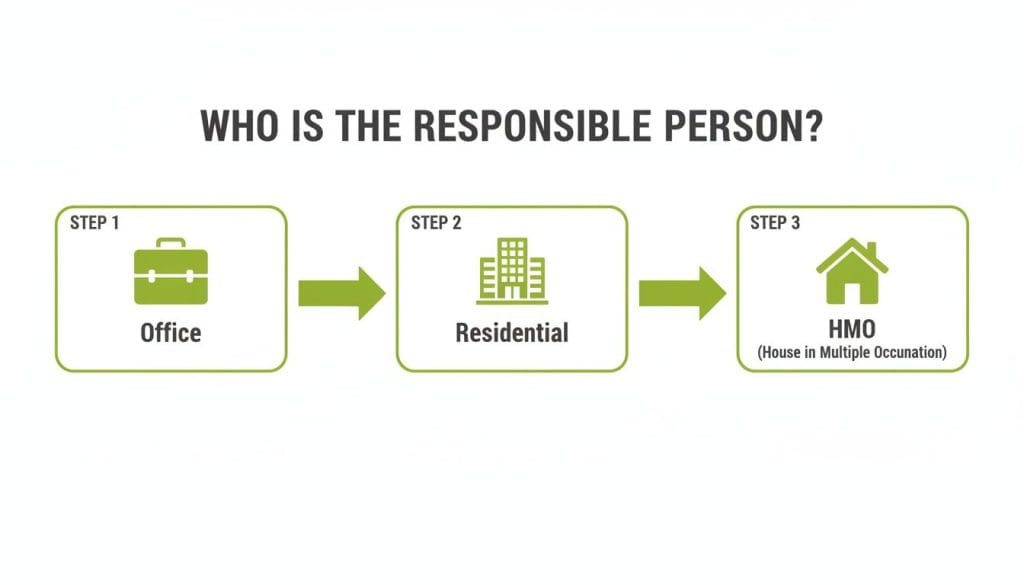
Whether it is an office, a block of flats, or an HMO, the fundamental duty to assess and manage fire risk always falls to a designated Responsible Person.
The fourth step is about documenting your findings and ensuring everyone knows what to do. If you have five or more employees, the law states you must record the significant findings of your assessment. For everyone else, it is simply good practice a written record is your best proof of compliance.
Your record should clearly state:
You also need a clear emergency plan that explains what to do in case of a fire. Finally, you must provide appropriate fire safety information and training to employees, tenants, or anyone else who needs it.
A fire risk assessment is a living document, not a one-off task. You must review it regularly to ensure it remains accurate and reflects any changes on your premises.
Best practice is to review your assessment at least once a year. A review is also legally required if there has been a significant change, such as building alterations, a large increase in the number of occupants, or the introduction of new flammable substances. An out-of-date assessment is as good as no assessment at all in the eyes of the law.
One of the most common and dangerous mistakes is treating a fire risk assessment as a task to be completed once and then filed away. The law views it very differently. Your fire risk assessment is a live document that must be reviewed regularly to remain valid. An outdated assessment offers no legal protection and, more importantly, fails to protect the people inside your building.
If you employ five or more people, the Regulatory Reform (Fire Safety) Order 2005 legally requires you to record the significant findings of your assessment. Regardless of your organisation’s size, keeping a written record is good practice. It serves as your primary evidence that you have exercised due diligence and systematically managed fire safety.
The legislation states you must review your fire risk assessment “regularly” to keep it up to date. While it does not specify a rigid timetable, the guidance from the Fire and Rescue Service and established industry best practice points to a clear standard: a formal review at least once a year.
This annual check can be thought of as an MOT for your building’s fire safety. It is your opportunity to confirm that the safety measures you have implemented are still effective, and that no new, unmanaged risks have emerged over the last 12 months. It formally verifies that your fire safety management remains fit for purpose.
An out-of-date fire risk assessment is legally equivalent to having no assessment at all. If a fire occurs, an inspector will immediately scrutinise the date and relevance of your document. If it does not account for significant changes, it will be deemed insufficient, leaving you open to enforcement action.
Beyond the annual cycle, the law is very clear on another trigger: you must review the assessment immediately if you have any reason to suspect it is no longer valid, or if there has been a significant change.
What exactly constitutes a ‘significant change’? It does not refer to minor, day-to-day adjustments. It refers to fundamental alterations to your premises, processes, or the people using the building that could introduce new fire hazards or undermine existing safety measures.
Here are some common examples that legally require an immediate review:
Proactive fire safety management is about protecting vulnerable people. For instance, Fire and Rescue Services are increasingly focusing their support where it is needed most, completing 588,855 Home Fire Safety Visits in England for the year ending March 2025, with 85% of those aimed at vulnerable households. As a Responsible Person, keeping track of changes in your building’s occupants is a critical part of this protective duty. You can find out more by reading the fire prevention statistics on gov.uk.
The table below provides practical scenarios that should prompt an immediate review of your assessment.
This table breaks down some key triggers that mean you cannot wait for your annual review.
| Trigger for Review | Practical Example |
|---|---|
| Building Works | A landlord reconfigures the layout of a communal hallway in a block of flats. |
| New Processes | A commercial garage starts offering spray painting services, introducing flammable paints. |
| Occupant Changes | An HMO landlord rents a room to a tenant who uses a wheelchair. |
| A Near Miss | An overloaded extension lead smoulders in an office, but is caught before a fire starts. |
Ignoring a review after changes like these is a direct breach of fire safety law. It demonstrates a serious failure in your management system and can lead to severe penalties. For a deeper look into this topic, you can read our full guide on how often a fire risk assessment is required.
Failing to meet your fire safety duties is not a minor administrative error; it is a serious legal breach with severe consequences. The Regulatory Reform (Fire Safety) Order 2005 gives local Fire and Rescue Authorities significant powers to protect lives, and they will act when they find non-compliance.
Ignoring these responsibilities puts people in danger and exposes you and your business to significant legal and financial penalties. While the authorities take a proportionate approach, any serious failings they uncover can have major repercussions.
Local Fire and Rescue Authorities are responsible for enforcing fire safety law. They carry out audits and inspections, paying close attention to premises they consider higher risk, to ensure the Responsible Person is fulfilling their legal duties.
If an inspector finds you have failed to complete a proper fire risk assessment, or have ignored its findings, they have a range of powers. The action they take will depend on the seriousness of the breach. These enforcement actions are legally binding instructions.
Failing to comply with a formal notice, or committing a particularly severe breach of the law, can lead to prosecution. The penalties are designed to be severe, reflecting the gravity of putting lives at risk, and can be applied to both the company and individuals such as directors or managers.
The consequences can include:
The scale of the problem is larger than most people realise. In the year ending March 2025, UK Fire and Rescue Services attended 603,942 incidents. During that same period, they issued 2,972 formal notices. Of the 51,020 fire safety audits they carried out, only 58% had satisfactory outcomes. This highlights how widespread compliance failures are. You can find more details in the latest UK fire and rescue incident statistics.
Beyond direct legal penalties, non-compliance creates other significant problems. Your insurance company could refuse to pay out after a fire if they discover your fire risk assessment was inadequate. The damage to your business’s reputation from an enforcement notice or prosecution can also be devastating and long-lasting.
Ultimately, managing fire safety proactively is about much more than just avoiding fines. It is about fulfilling your fundamental duty of care, protecting your property, and ensuring your business can continue to operate safely and legally.

The Regulatory Reform (Fire Safety) Order 2005 allows the Responsible Person to carry out their own fire risk assessment, but with a significant condition. The law insists that whoever completes the assessment must be ‘competent’. This is a legal requirement to have the appropriate training, experience, and knowledge to properly identify and assess fire risks.
For a very small, simple workplace, a diligent owner might feel they can handle a basic assessment. However, for most properties including commercial buildings, blocks of flats, and HMOs the complexity of fire safety legislation and building standards makes a DIY approach a significant risk. Appointing an external, qualified professional is the safest and most reliable way to ensure your assessment is legally compliant.
Appointing an unsuitable assessor can be as problematic as not doing an assessment at all. A low-cost, superficial report creates a false sense of security and will not stand up to scrutiny from an enforcement officer. To protect yourself and meet your legal duties, you must conduct proper due diligence.
A competent assessor provides more than a document; they deliver a clear, practical roadmap to safety and compliance. For those managing HMOs or other multi-occupancy properties, we cover this in more detail in our guide on the fire risk assessment for landlords.
Your selection process should focus on finding verifiable proof of their expertise and suitability for your specific type of property.
A competent fire risk assessor does not just identify problems; they provide practical, prioritised solutions that help you manage risks effectively. Their report should be a clear working document that guides your fire safety management, not a confusing list of generic recommendations that leaves you unsure of the next steps.
Before you hire anyone, ensure they meet all of these criteria. This is your best defence against unqualified individuals and helps guarantee you receive a high-quality assessment that will be legally robust if required.
Taking the time to choose the right professional is a fundamental part of fulfilling your duties as the Responsible Person. It is an investment in safety, compliance, and peace of mind.
When it comes to the legal side of fire risk assessments, the requirements can seem complex. However, the underlying principles are straightforward. Here are some of the most common questions we receive from business owners, landlords, and managing agents, with clear, practical answers.
Yes. A fire risk assessment is a legal requirement for almost every non-domestic premises in the UK, regardless of size. The rules apply as soon as you have one employee.
The law only requires a written record if you employ five or more people. However, it is best practice for everyone. A properly documented assessment is your definitive proof that you have met your legal duties should a fire inspector visit.
The official guidance is that your fire risk assessment must be reviewed ‘regularly’ to keep it up to date. In practice, established industry best practice is to conduct a formal review at least once every year.
For a completely new assessment by a professional, the general recommendation is every three to five years. However, you must arrange a full re-assessment immediately if there are any significant changes to the building, its use, or its occupants for example, after a major refurbishment.
A Type 1 Fire Risk Assessment is the standard, non-destructive inspection for residential blocks of flats. It is the most common type and it focuses exclusively on the shared or common areas of the building.
An assessor will inspect places such as:
The key point to remember is that a Type 1 assessment does not involve entering any of the private flats. Its purpose is to ensure the shared escape routes and fire safety systems managed by the landlord or building owner are safe and properly maintained.
This type of assessment is fundamental for meeting your duties under the Fire Safety Act 2021. This legislation clarified that the building’s structure, external walls, and flat entrance doors are all part of the Fire Safety Order. A Type 1 assessment addresses these shared responsibilities directly.
For flats specifically, see our guide to fire risk assessments for flats.
Most HMO landlords I talk to can rattle off their fire door requirements, their alarm grade, and their emergency lighting checks without missing a beat....

Most of the fire safety advice on this site assumes you already have a working HMO. This one is for the stage before that: the...