
Your Essential 8-Point Fire Risk Assessment Checklist for 2026
25/12/2025
For business owners, landlords, and property managers across the UK, the legal duty to ensure fire safety is an absolute. Under the Regulatory Reform (Fire Safety) Order 2005, the designated ‘Responsible Person’ has a non-negotiable obligation to carry out and regularly review a comprehensive fire risk assessment. The consequences of failing to meet this standard are severe, ranging from unlimited fines and potential imprisonment to the devastating loss of life and property.
This guide is designed specifically for you, the duty holder, providing a clear, practical, and compliance-led framework. We will move beyond abstract theory and break down the entire process into an actionable 8-point fire risk assessment checklist. Our focus is on the specific, tangible steps you must take to protect your premises, occupants, and business continuity.
By following this detailed checklist, you will gain a precise understanding of what to inspect, why each element is critical for safety, and how to create a robust record of your due diligence. From identifying ignition sources and assessing escape routes to verifying alarm systems and organising staff training, this article equips you with the knowledge needed to manage fire risks effectively. This ensures your premises are not only safer but also fully compliant with UK fire safety legislation, helping you avoid costly enforcement action and safeguard lives.
The foundational step of any credible fire risk assessment checklist is the systematic identification and evaluation of all potential fire hazards. This is not merely a box-ticking exercise; it is the cornerstone upon which all subsequent safety measures are built. It involves a thorough examination of the premises to locate every potential source of ignition, every type of fuel, and the sources of oxygen that could combine to start and sustain a fire.
Under the Regulatory Reform (Fire Safety) Order 2005, the ‘Responsible Person’ has a legal duty to identify these hazards to protect relevant persons. Failing to do so thoroughly can render the entire assessment inadequate, leaving people and property vulnerable.
This process is guided by the principle of the fire triangle. A fire needs three elements to start:
A robust hazard identification process involves a methodical, room-by-room inspection to ensure no area is overlooked. For a landlord managing a House in Multiple Occupation (HMO), this means checking each bedroom for personal electrical items and heating devices, alongside assessing the shared kitchen’s cooking appliances. For a business owner, it involves scrutinising workshops, storage areas, and offices, considering both operational processes and staff behaviours. Documenting findings with photographs provides invaluable, clear evidence for your report and helps prioritise actions.
A critical component of any fire risk assessment checklist is the rigorous evaluation of the building’s means of escape. This goes beyond simply noting the existence of fire exits; it is a comprehensive assessment to ensure that in the event of a fire, all occupants can evacuate safely, quickly, and effectively. This process verifies that escape routes are sufficient for the number of occupants, are kept clear and usable at all times, and lead to a place of ultimate safety away from the building.
Under the Regulatory Reform (Fire Safety) Order 2005, the ‘Responsible Person’ is legally mandated to ensure that routes to emergency exits and the exits themselves are kept clear. A failure to adequately plan, signpost, and maintain these routes can have catastrophic consequences, trapping people inside a burning building and significantly increasing the risk of injury or death.

The assessment must consider the entire journey from any point within the building to a designated safe assembly point outside. This involves several key elements:
A thorough assessment requires physically walking every potential escape route from the furthest points of the building. For a property manager of a residential block, this means checking communal corridors for obstructions like prams or bicycles and ensuring stairwell lighting is functional. For a business owner, it involves verifying that stock is not encroaching on designated walkways in a warehouse and that all staff, including those with mobility issues, have a viable and known means of escape. Documenting these routes on floor plans provides a clear record for both your assessment and for informing occupants.
An effective fire risk assessment checklist must rigorously scrutinise the means of raising the alarm. The verification of fire detection and alarm systems is a critical life-safety component, ensuring that occupants are given the earliest possible warning to evacuate. This is not simply about confirming a device is on the wall; it is a detailed evaluation of its suitability, functionality, and ability to alert everyone in the building, including those in remote areas or with sensory impairments.
Under the Regulatory Reform (Fire Safety) Order 2005, the ‘Responsible Person’ is legally obligated to ensure that fire detection and warning systems are suitable for the premises and are properly maintained. A system that is poorly positioned, inaudible, or non-functional offers a false sense of security and fails to meet legal duties, placing lives at significant risk.
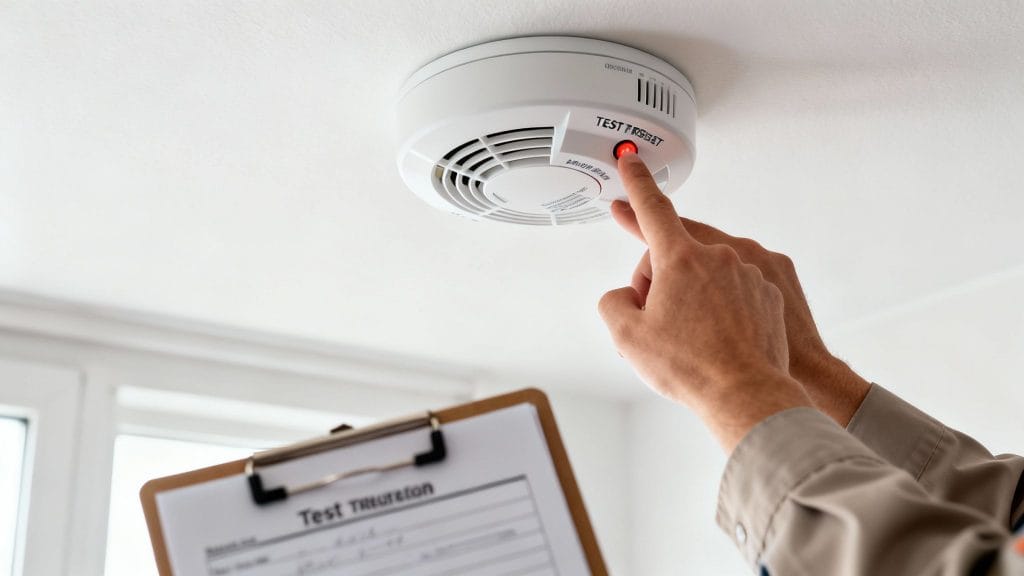
The assessment of alarms must be methodical and cover every part of the system, aligning with standards like BS 5839. Key verification points include:
For example, in a three-storey residential block, an assessor would verify that a hardwired, interlinked system is installed throughout all communal areas and individual flats, with a mains backup supply. In a commercial office, the focus would be on the zoned fire alarm panel, ensuring it correctly identifies the location of an activation and that all manual call points are unobstructed and clearly visible. Documenting each device’s location, type, and test result on a building plan is essential for a comprehensive and defensible fire risk assessment.
Effective fire safety signage and wayfinding are critical, non-negotiable components of a safe premises. This part of the fire risk assessment checklist verifies that all legally required signs are not only present and correct but also strategically placed to guide occupants to safety during an emergency. In the panic and potential low-visibility of a fire, clear, unambiguous signage can be the difference between a safe evacuation and a tragedy.
Under the Health and Safety (Safety Signs and Signals) Regulations 1996 and BS 5499 standards, the Responsible Person must ensure signage is adequate. This is not simply a matter of putting up ‘Fire Exit’ signs; it involves creating a clear, intuitive escape system that functions under pressure, ensuring nobody is left confused or trapped.
An effective assessment of signage focuses on creating a coherent journey from any point in the building to a final place of safety. This is achieved by checking for:
A thorough signage audit requires you to walk every potential escape route from the furthest point in the building. For an HMO landlord, this means checking the route from a top-floor bedroom all the way to the final exit, ensuring signs are visible and correctly positioned at heights between 2.0m and 2.5m. It is vital to ensure that signs are not obscured by furniture, temporary displays, or stock. Faded or damaged signs must be replaced immediately to maintain compliance and ensure they remain legible when they are needed most.
Having the correct manual firefighting equipment in place is a critical component of your fire safety strategy. This step in the fire risk assessment checklist involves more than just counting extinguishers; it is a thorough evaluation to ensure you have the right tools, in the right places, to tackle a small fire in its initial stages, thereby preventing a minor incident from becoming a major disaster.
Under the Regulatory Reform (Fire Safety) Order 2005, the ‘Responsible Person’ must ensure that the premises are equipped with appropriate fire-fighting equipment. The provision of such equipment must be based on the specific hazards identified in the assessment. A failure to provide adequate, correctly maintained, and properly located extinguishers can result in enforcement action and, more critically, could leave occupants defenceless during the vital first moments of a fire.
This process is guided by British Standard BS 5306, which provides a framework for selecting and positioning fire extinguishers. The assessment must verify that the equipment is suitable for the types of fire risk present.
A meticulous assessment involves creating an inventory of all manual firefighting equipment, noting the type, location, last service date, and overall condition of each unit. For an HMO landlord, this means ensuring a multi-purpose extinguisher is available in the shared kitchen. For a warehouse manager storing flammable liquids, it involves providing specialist foam or dry powder extinguishers in addition to standard coverage. Proper fire extinguisher maintenance is not just a recommendation; it is a legal requirement to ensure these vital tools work when you need them most.
A crucial element of a comprehensive fire risk assessment checklist is the review of the building’s inherent structural fire protection. This involves assessing how the building itself is designed and constructed to resist the spread of fire and smoke, a principle known as compartmentation. It is a fundamental safety feature that contains a fire within a specific area for a set period, protecting escape routes and allowing occupants time to evacuate safely.
Under UK Building Regulations (Approved Document B), compartmentation is a legal requirement designed to divide buildings into manageable areas of risk. For the ‘Responsible Person’, verifying the integrity of this system is not just a technical exercise; it is a core duty to limit the potential for a catastrophic fire that spreads rapidly throughout the entire structure.
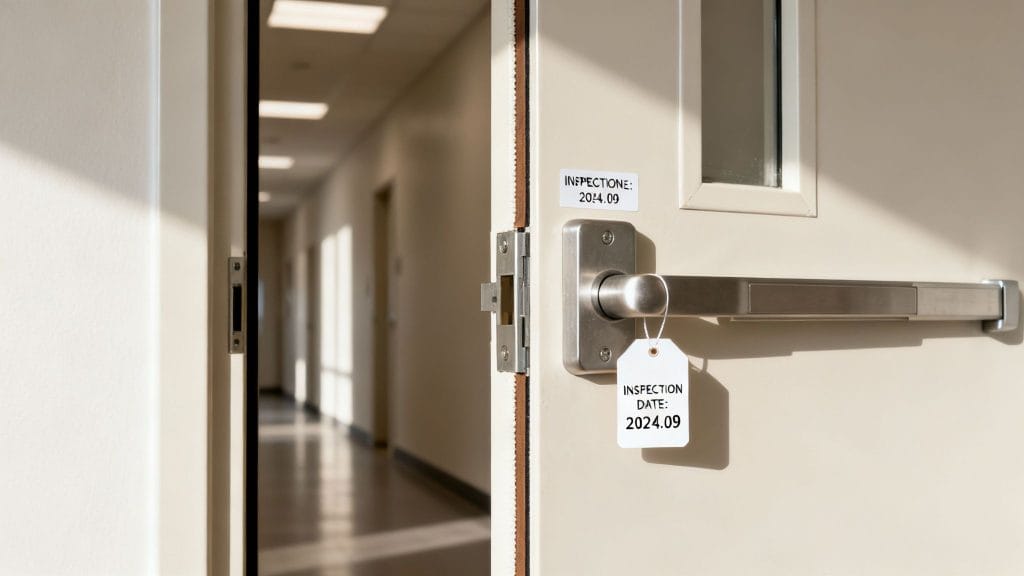
This review examines the passive fire protection measures that form the building’s hidden defences. The goal is to ensure these barriers are intact and performing as intended.
A meticulous assessment involves tracing the lines of compartmentation throughout the building, paying close attention to voids in ceilings and riser cupboards where fire can spread unseen. In a converted Victorian building, this could mean verifying that the separation between individual flats meets modern standards. For a commercial unit with an open-plan layout, it might involve ensuring that fire-rated partitions correctly segregate high-risk areas like kitchens or server rooms. Documenting any breaches with photographs is essential for creating a clear and actionable remedial plan.
A comprehensive fire risk assessment checklist must go beyond the physical infrastructure and scrutinise the human element. The most sophisticated alarm systems and clearest escape routes are rendered ineffective if occupants do not know how to react in an emergency. This step involves a critical evaluation of how well people in the building are prepared to respond to a fire, from initial training to the practical execution of emergency plans.
Under the Regulatory Reform (Fire Safety) Order 2005, the ‘Responsible Person’ is legally required to establish and, where necessary, implement appropriate safety procedures to be followed in the event of serious and imminent danger. This duty includes ensuring occupants are provided with adequate safety information and training, a responsibility that is central to protecting lives.
Effective verification focuses on three core areas: the clarity of procedures, the quality of training, and the results of practical drills.
A thorough assessment in this area confirms that your safety measures work in practice, not just on paper. It ensures that when an alarm sounds, the response is organised and immediate, not panicked and confused. By documenting and regularly testing these procedures, you create a robust safety culture that significantly mitigates risk. For more guidance on this critical area, you can learn more about fire safety training for your staff.
A fire risk assessment is a snapshot in time, but fire safety is an ongoing process. This item on your checklist addresses the organisational controls and maintenance schedules required to sustain safety long-term. It moves beyond the physical inspection to scrutinise the systems you have in place to manage, monitor, and maintain fire safety measures. Without robust management controls, even the best-implemented safety equipment can fail and compliant procedures can be forgotten.
Under the Regulatory Reform (Fire Safety) Order 2005, the ‘Responsible Person’ has a duty not just to conduct an assessment but to establish and implement appropriate management procedures to ensure ongoing compliance. This means creating a living safety system that adapts to changes and prevents the gradual erosion of safety standards over time, ensuring your premises, staff, and residents remain protected.
Effective management requires a documented and systematic approach. It is about proving that fire safety is actively managed rather than being an afterthought. Key areas to assess include:
A well-organised management system demonstrates that fire safety is embedded in your operational culture. For an HMO landlord with multiple properties, this might involve using a centralised digital system to track the status of each property’s alarm servicing and certification. For a facilities manager, it means having a clear process for vetting and overseeing contractors working on site, ensuring their work does not introduce new fire hazards. Documenting these procedures ensures consistency and provides a clear framework for delegation and responsibility.
| Item | Implementation (????) | Resource requirements (⚡) | Expected outcomes (????⭐) | Ideal use cases (????) | Key advantages (⭐) |
|---|---|---|---|---|---|
| Identification and Evaluation of Fire Hazards | Moderate–High: specialist room-by-room review | Moderate: assessor time, documentation, occasional specialist input | ????⭐⭐⭐⭐: comprehensive risk register; prioritised controls | All property types; HMOs, commercial premises, residential blocks | Identifies hidden risks; enables prioritisation; baseline for monitoring |
| Emergency Escape Route Assessment and Planning | High: precise measurements, accessibility & route validation | Moderate–High: survey tools, potential retrofit costs, testing time | ????⭐⭐⭐⭐⭐: faster, safer evacuations; reduced bottlenecks; compliance | High-occupancy buildings, narrow corridors, older layouts, HMOs | Ensures usable exits; reduces evacuation time; prevents liability |
| Fire Detection and Alarm System Verification | Moderate: technical testing of detectors, interconnection checks | Moderate: testing tools, access, maintenance schedules | ????⭐⭐⭐⭐: early warning; improved survival rates; compliance evidence | Sleeping accommodation, multi-storey blocks, care facilities | Early warning capability; cost-effective; integratable with fire services |
| Fire Safety Signage and Wayfinding Compliance | Low–Moderate: visual inspection and darkness walkthroughs | Low: signage, simple measurements, occasional replacements | ????⭐⭐⭐: clearer evacuation routes; reduced confusion; low-cost compliance | Complex layouts, HMOs, basements, commercial premises | Guides occupants in low visibility; inexpensive; universal symbols |
| Fire Extinguisher & Manual Firefighting Equipment Assessment | Moderate: technical checks and match to hazard classes | Moderate: servicing, training, replacement and inventory costs | ????⭐⭐⭐: improved early suppression; documented readiness | Kitchens, workshops, offices, HMOs with cooking areas | Enables early suppression; cost-effective vs damage; visible reassurance |
| Building Construction & Fire Compartmentation Review | High: structural knowledge and detailed inspection required | High: specialist surveys, possible remedial works, significant cost | ????⭐⭐⭐⭐⭐: containment of fire/smoke; increased evacuation time; major risk reduction | High-rise, converted older buildings, buildings with combustible cladding | Limits spread; protects occupants/property; enables phased evacuation |
| Occupant Training & Emergency Procedure Verification | Moderate: policy review, drill coordination, training delivery | Moderate: time for drills, materials, staff engagement | ????⭐⭐⭐⭐: organised evacuations; identifies procedure gaps; maintained readiness | HMOs, care facilities, offices with frequent turnover | Reduces panic; improves evacuation speed; demonstrates duty of care |
| Building Maintenance & Management Controls | Moderate–High: systems, records, change-management processes | High: ongoing management time, contractors, dedicated budget | ????⭐⭐⭐⭐: sustained compliance; early defect detection; lifecycle savings | Property portfolios, residential blocks, complex facilities | Prevents system degradation; ensures continuous compliance; reduces long-term cost |
Completing a detailed review of your premises using a comprehensive fire risk assessment checklist is a fundamental and proactive step towards safeguarding lives and property. However, it is crucial to recognise that the checklist is not the end of the journey; it is the beginning of a dynamic and ongoing safety management process. The true value lies not just in identifying hazards, but in the diligent actions that follow. This process transforms your findings from a simple list into a robust framework for fire safety and legal compliance.
Moving forward, your immediate priority is to formalise your findings into a clear, written record. This document is more than a formality; it is a legal requirement under the Regulatory Reform (Fire Safety) Order 2005 and serves as demonstrable proof of your commitment to safety. It should detail every significant finding, from obstructed escape routes and inadequate signage to deficiencies in fire door integrity or alarm system functionality.
Once documented, your findings must be translated into a structured and prioritised action plan. Not all risks carry the same weight, and your resources must be allocated effectively.
Assigning clear deadlines and responsibilities for each action is essential. This creates accountability and ensures that necessary improvements are implemented systematically rather than being overlooked.
A fire risk assessment is a snapshot in time. The environment it assesses is constantly changing. New tenants move in, workplace layouts are altered, different types of materials are stored, and equipment ages. Consequently, your assessment must be a living document, subject to regular and systematic review.
The law requires you to review your fire risk assessment regularly and to keep it up to date. An annual review is considered best practice, but a new assessment is legally required if there has been a significant change to the premises, processes, or people involved.
Failing to review your assessment can render it obsolete, leaving you non-compliant and, more critically, leaving occupants exposed to unmanaged risks. Setting a calendar reminder for an annual review is a simple yet effective control measure.
While this fire risk assessment checklist provides a thorough framework, self-assessment is not always the appropriate route. The complexity of certain premises, particularly multi-occupancy buildings like HMOs or large commercial sites, demands a level of expertise that goes beyond a general checklist.
If you find yourself lacking the specific knowledge, experience, or simply the time to conduct a suitably sufficient assessment, the responsibility falls on you to appoint a competent person. A professional fire risk assessor brings an impartial, expert eye, identifying subtle but significant risks you might miss. Their detailed report and actionable recommendations provide a clear pathway to compliance and offer peace of mind that your duties have been fulfilled to the highest standard, ready to withstand scrutiny from any enforcing authority. Ultimately, your commitment to this process is a direct reflection of your commitment to protecting people, your property, and your organisation.
If navigating the complexities of a thorough assessment feels daunting, or you need absolute certainty that your property meets all legal requirements, our expert assessors can help. HMO Fire Risk Assessment provides detailed, compliant, and easy-to-understand reports that transform your legal obligations into a clear action plan. Secure your compliance and protect your premises today with a professional fire risk assessment from HMO Fire Risk Assessment.
Most HMO landlords I talk to can rattle off their fire door requirements, their alarm grade, and their emergency lighting checks without missing a beat....

Most of the fire safety advice on this site assumes you already have a working HMO. This one is for the stage before that: the...