
Fire Risk Assessment for Landlords: A Practical UK Guide
24/12/2025
Understanding your fire safety duties as a landlord is a legal necessity. This process begins and ends with one critical document: the Fire Risk Assessment (FRA). This guide is written for UK landlords, property managers, and managing agents who need clear, practical advice on their legal responsibilities under the Regulatory Reform (Fire Safety) Order 2005.
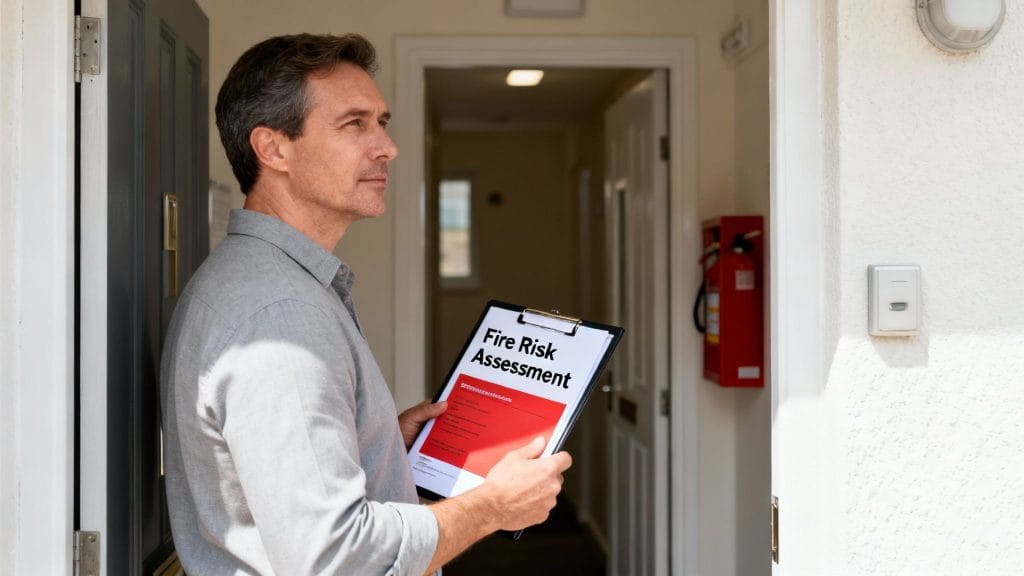
A fire risk assessment is a professional, systematic evaluation of your property designed to identify fire hazards, determine who is at risk, and specify the safety measures required to protect them. It is not an administrative task to be delegated and forgotten; it is the foundation of your entire fire safety strategy.
Under the Regulatory Reform (Fire Safety) Order 2005, a “suitable and sufficient” fire risk assessment is a legal requirement for the common areas of almost every multi-occupied residential building in England and Wales.
This guide will explain your legal duties, clarify the different types of assessment, and outline the step-by-step process. We will also detail how to convert the findings into a clear, documented action plan to ensure you remain compliant.
The primary purpose of an FRA is to ensure the safety of residents and visitors by proactively managing fire risks. It provides documented evidence that you have taken reasonable and necessary steps to protect people from harm.
Recent legislation has expanded these responsibilities. The Fire Safety Act 2021 amended the 2005 Order, clarifying that for any building with two or more domestic premises, the FRA must cover the building’s structure, external walls (including cladding and balconies), and all flat entrance doors opening onto common parts.
For buildings over 11 metres high, this now includes quarterly checks of communal fire doors and annual checks of flat entrance doors. Landlords are also legally required to provide residents with clear fire safety instructions, making communication a key component of compliance.
This guide will provide you with the knowledge to protect your tenants, your property, and your legal position. For a more detailed look at the basics, see our article explaining what a fire risk assessment is.
By the end of this guide, you will understand:
Under UK fire safety law, legal responsibility rests with a designated ‘Responsible Person’. If you own or manage a multi-occupied residential building, this will be you, the freeholder, or a managing agent appointed by you. If you exercise control over the premises, you have a legal duty to ensure the safety of all relevant persons.
This is a strict legal requirement under the Regulatory Reform (Fire Safety) Order 2005. This legislation mandates that the Responsible Person must carry out a “suitable and sufficient” fire risk assessment. The objective is to identify fire hazards and implement general fire precautions to protect tenants, visitors, and staff.
Failure to meet these obligations can result in serious legal and financial consequences.
A common point of confusion for landlords is the precise scope of their responsibility. The Fire Safety Order applies to the communal areas of your building.
This includes any space shared by tenants, such as:
Your legal duties do not extend to the internal, private areas of a tenant’s flat. However, the law recognises that a fire starting inside a flat can rapidly compromise the safety of the entire building. Recent legislative changes have significantly clarified a landlord’s duties in this regard.
The Fire Safety Act 2021 was introduced to amend the 2005 Order and address areas of ambiguity, particularly following the Grenfell Tower tragedy. It expanded the scope of a fire risk assessment for any building containing two or more sets of domestic premises.
Your fire risk assessment must now explicitly consider:
This is a critical change. While you are not responsible for the activities within a tenant’s flat, you are now legally responsible for ensuring their flat entrance door performs as an effective fire door. A failure in this single element places everyone in the building at risk.
This extension of a landlord’s duties requires a more comprehensive assessment than was considered standard practice just a few years ago.
Ignoring these legal duties is a criminal offence. The local Fire and Rescue Authority is the enforcing body and has the power to inspect your property to verify compliance. If they find you have failed to conduct a suitable risk assessment or have not acted upon its significant findings, they can take enforcement action.
This can range from an informal notification to formal legal proceedings.
These penalties underscore the seriousness of your responsibilities. Fire safety is a fundamental duty of care you owe to your tenants. A proactive approach is the only way to protect lives, your property, and your legal standing.
Commissioning a fire risk assessment is not a one-size-fits-all process. Selecting an inappropriate type of assessment can lead to non-compliance or unnecessary expenditure. It is vital to understand the different options available.
Assessments are graded from Type 1 to Type 4, with each level increasing in scope and intrusiveness. Understanding these distinctions will enable you to have an informed discussion with your assessor and ensure the work is appropriate for your building.
For the vast majority of landlords managing purpose-built blocks of flats or HMOs, a Type 1 fire risk assessment is the industry standard. It is a non-destructive inspection of the building’s common parts.
The assessor will conduct a visual inspection of the communal areas only. This includes hallways, staircases, lifts, and landings; they will not require access to private flats. The objective is to ensure these common areas are safe and provide a clear, protected route of escape in an emergency. For most blocks of flats, a Type 1 assessment is the baseline required to demonstrate compliance.
This diagram clarifies the core responsibilities of a landlord, from their designated role to the specific areas of the property covered by the legislation.
As shown, the duties of the Responsible Person are directly linked to the communal parts of the property—the areas outside tenants’ flat entrance doors.
In some cases, a visual inspection is insufficient. If there are valid concerns about the building’s construction or subsequent alterations, a more detailed assessment will be necessary. This is where the other assessment types become relevant, each building upon the previous one.
Before examining the more intrusive assessments, it is useful to compare their scope and purpose. Each type is designed for different circumstances, depending on the building’s age, history, and perceived level of risk.
| Assessment Type | Scope of Inspection | Typical Property Type | Intrusiveness Level |
|---|---|---|---|
| Type 1 | Communal areas only (visual, non-destructive). | Most purpose-built blocks of flats, HMOs. | Low – No entry to flats required. |
| Type 2 | Communal areas, plus destructive sampling in common parts. | Older buildings or where construction quality is unknown. | Medium – Destructive work in communal areas only. |
| Type 3 | Communal areas and inside a sample of private flats (non-destructive). | Older conversions, blocks with known fire separation issues. | Medium – Requires coordinated access to flats. |
| Type 4 | Communal areas and inside flats, with destructive sampling everywhere. | High-risk buildings with serious structural concerns. | High – Very disruptive and costly. |
This table illustrates that moving beyond a Type 1 is a significant step, typically driven by a specific, identified concern rather than routine compliance.
The key takeaway is that Type 2 and Type 3 assessments are more involved than a standard Type 1. They are not the default option but are used when specific construction methods or building layouts raise doubts about overall fire safety.
A Type 4 fire risk assessment is the most comprehensive and disruptive evaluation available. It encompasses all elements of a Type 3 assessment but adds destructive inspection throughout.
This means the assessor, often working with a contractor, will physically open up parts of the building’s structure in both communal areas and inside flats to verify the standard of fire compartmentation. This could involve drilling into walls or removing ceiling sections to confirm that fire separation is adequate.
A Type 4 is an exceptional measure, typically undertaken only for complex buildings where there is a serious, evidence-based concern about structural fire protection. It might be triggered after a significant fire or if major defects are discovered during other building work.
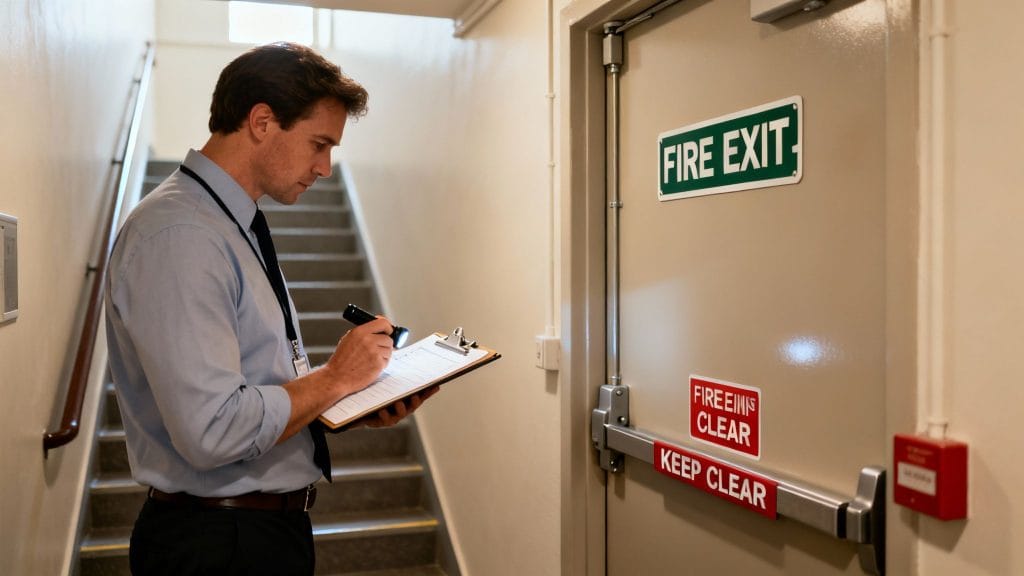
Understanding what happens during a fire risk assessment helps you, as the Responsible Person, to prepare for the visit and facilitate a thorough inspection.
Any competent assessor will follow a structured, five-step methodology. This is not a casual walk-through but a systematic evaluation based on the requirements of the Fire Safety Order. Knowing what to expect ensures the assessor has the access and information they need, resulting in a more useful report for you.
First, the assessor will identify potential ignition sources and fuel risks. They are trained to spot hazards that may be overlooked in the day-to-day management of a property.
This initial survey includes checking for:
Once hazards are identified, the focus shifts to the people who could be harmed by a fire. The assessor evaluates who uses the building and how a fire might affect them, paying particular attention to vulnerable individuals.
This includes not just tenants but also:
This step is critical for determining whether existing fire safety measures are adequate for everyone who uses the premises.
This is the core of the assessment. The assessor evaluates your current fire safety provisions against the identified hazards. They will determine if existing precautions are sufficient to keep people safe or if improvements are required.
Key areas of focus include:
A completed assessment is often the first step in a longer compliance process. For example, recent government data shows that while assessments have been completed on 99.9% of social housing buildings over 11 metres, a significant 11.0% were found to have life-critical fire safety defects related to external wall systems. This demonstrates how an FRA is the catalyst for identifying and planning essential remediation work. You can learn more about these fire safety remediation findings in the full government report.
Following the on-site inspection, the assessor will compile their observations into a formal written report. This document is your official record of the assessment and must be kept available for inspection by the Fire and Rescue Service.
A clear, well-structured report will not just list deficiencies. It will explain the risks in plain English and provide a prioritised, actionable list of recommendations.
Finally, fire safety is an ongoing process. The report will recommend a date for the next review, which is typically every 12 months. However, a new assessment will be required sooner if there are significant changes to the building, its use, or its occupants.
To help the inspection proceed smoothly, it is good practice to have key documents available and ensure the assessor can access all necessary areas. Using a structured guide can help you prepare. Our comprehensive landlord fire safety checklist is a useful starting point to ensure everything is in order before the assessor arrives.

Receiving your fire risk assessment report is not the end of the process. It is the beginning of implementing a documented action plan to mitigate fire risks across your property.
This document serves as your roadmap to compliance. It translates the assessor’s findings into a clear set of tasks, providing practical steps to protect both your tenants and your investment. Leaving the report in a drawer is a serious compliance failure.
A competent assessor will produce a report that is clear and easy to understand, even for a non-specialist. Crucially, they will prioritise the recommendations to help you focus your time and resources where they are most urgently needed.
Most reports use a simple, risk-based system:
This priority system is designed to prevent you from feeling overwhelmed. It allows you to create a logical, time-bound plan that addresses the most critical issues first while scheduling less urgent works for a later date.
Your next step is to convert these prioritised recommendations into a formal, written action plan. This document should detail what needs to be done, who is responsible for the task, and the target completion date.
For example, a high-priority finding like a defective self-closer on a lobby fire door should have an action such as, “Instruct contractor to repair or replace the fire door closer,” with a deadline of “within 24-48 hours“. A medium-priority item, like upgrading emergency lighting, might have a deadline of “within 3 months“.
Enforcing authorities are increasingly focused on how landlords act on their FRA findings. They expect to see evidence that the report is integrated into ongoing safety management, not simply filed away. With numerous buildings identified nationally with life-critical fire safety issues but no clear remediation plan, being able to demonstrate a system for addressing assessment outcomes is vital.
It is crucial that you document every action you take. This audit trail is your proof of compliance. Retain invoices from contractors, service certificates for fire safety equipment, and notes of your own checks. If the Fire and Rescue Service inspects your property, this file will be the evidence that demonstrates you are a responsible landlord.
Many recommendations will require ongoing maintenance rather than one-off fixes. This could involve arranging annual servicing for fire alarms and extinguishers or implementing more frequent checks of communal areas.
It is also vital that anyone else involved in managing the property, such as staff or a managing agent, understands their role. Ensuring they are properly briefed is a key part of your duty as the Responsible Person. Our guide on the importance of fire safety training for staff covers this in more detail.
The law is clear: the person who carries out your fire risk assessment must be ‘competent’. This is a direct legal requirement under the Fire Safety Order. But what does ‘competent’ mean in practice?
It means engaging an individual with the necessary training, practical experience, and knowledge to properly evaluate the fire risks in your specific type of property. An inadequate assessment from an unqualified individual is worthless. It leaves you legally exposed and can fail to identify genuine dangers that put your tenants’ lives at risk.
The most reliable way to ensure you are hiring a competent professional is to look for assessors who hold accreditations from recognised third-party certification bodies. These organisations act as a quality control measure, ensuring their members meet high professional standards and remain up-to-date with changing regulations.
Look for membership or certification from respected UK organisations like:
Accreditations from such bodies demonstrate that an assessor has been independently vetted. They also signal a commitment to continuing professional development, which is essential in a field where legislation and best practices are constantly evolving. Never hesitate to ask for proof of an assessor’s qualifications and memberships.
Before commissioning an assessment, it is important to conduct due diligence. Any credible professional will welcome your questions and provide clear answers. This vetting process is vital for establishing trust and confirming they are the right fit for your property.
Here is a practical checklist of questions to ask:
Choosing an assessor based solely on the cheapest quotation is a common and dangerous mistake. A low-quality assessment often results in overlooked hazards and can cost you far more in the long run, both financially and legally.
Your fire risk assessment is the foundation of your entire fire safety strategy. Investing in a truly competent professional is not an expense; it is a critical step in protecting your tenants, your property, and your legal standing as a responsible landlord.
Even with a good understanding of the basics, practical questions often arise. Here are some of the most common queries from landlords, with clear answers to help you manage your legal duties confidently.
While the Fire Safety Order 2005 does not set a fixed legal deadline, established best practice is to have your fire risk assessment reviewed at least annually. This ensures the document remains current and reflects any recent changes.
A new, comprehensive assessment by a professional should be conducted every three to five years. However, you must commission a new assessment immediately if there are any significant changes to the building. This includes alterations to the layout, a change of use, or a change in the type of tenants. The FRA is a live document that must reflect the property’s current reality.
The cost of a fire risk assessment for landlords varies depending on the property’s size, complexity, type, and UK location.
As a general guide:
It is essential to obtain quotations from properly accredited professionals. When making your choice, prioritise competence, experience with residential properties, and the quality of their reporting over the lowest price. An inadequate assessment is a false economy that exposes you to serious legal and safety risks.
An investment in a thorough, competent assessment is an investment in safety and legal compliance. It provides a clear, actionable roadmap to protect tenants and your property, which is far more valuable than the small saving from a cut-price, low-quality report.
No, the Regulatory Reform (Fire Safety) Order 2005 does not apply to single private dwellings rented to one family. The legislation is specifically designed to cover the shared, non-domestic parts of buildings.
The Order applies to the communal areas of HMOs and blocks of flats, such as hallways, stairs, and landings. However, landlords of single-let properties still have other important fire safety duties under different legislation. These include fitting working smoke and carbon monoxide alarms and ensuring any provided furniture and furnishings comply with fire safety standards.
If you’re based in the Didsbury area, see our guide to fire risk assessments in Didsbury for local context.
Most HMO landlords I talk to can rattle off their fire door requirements, their alarm grade, and their emergency lighting checks without missing a beat....

Most of the fire safety advice on this site assumes you already have a working HMO. This one is for the stage before that: the...