
Your Fire and Safety Policy: A UK Landlord & Business Guide
21/04/2026
Taking on a new property or opening a workplace often starts with the same problem. Keys are handed over, tenants or staff are due in, and the fire file is either thin, out of date, or full of generic paperwork that doesn’t match the building.
That’s where many fire and safety problems begin.
A proper fire and safety policy isn’t just a document for inspection day. It’s the written version of how fire risks are identified, controlled, communicated, and reviewed in the building you manage. For landlords, managing agents, directors, facilities managers, and business owners, that matters because legal compliance depends on what transpires on site, not what sits in a folder.
A fire and safety policy is the written framework for how a property or business manages fire risk. It sets out who is responsible, what precautions are in place, how people will respond in an emergency, and how those arrangements will be checked over time.
For a landlord, that might cover common parts, fire doors, alarms, escape routes, housekeeping, contractor control, and tenant information. For a business owner, it usually also includes staff training, evacuation roles, equipment checks, and workplace procedures.
The mistake I see most often is treating the policy as separate from the building. It isn’t. If the written policy says all escape routes are kept clear, but bikes, stock, or bins are regularly left in corridors, the actual policy is non-compliance. If the document says fire doors must self-close, but doors are wedged open every day, the paper version has already failed.
A usable fire and safety policy should do four things:
It also helps stop a common drift into reactive management, where issues are only addressed after a complaint, fault, near miss, or inspection.
A fire and safety policy works best when it reflects the actual building, the actual people using it, and the actual risks present on site.
If you’re still working out where your legal duties begin, this plain English guide to UK fire safety regulations is a useful starting point.
The legal starting point in most non-domestic premises, shared buildings, residential blocks, and many HMOs is the Regulatory Reform (Fire Safety) Order 2005.
It came into effect on 1 October 2006 and imposed a general duty on the responsible person to carry out fire risk assessments and put preventive measures in place. It also consolidated over 70 previous fire safety laws into one risk-based framework, which is why modern fire safety management is built around assessment, action, and review rather than a simple checklist of fixed rules under the Regulatory Reform (Fire Safety) Order 2005.

The title sounds formal, but in practice it usually means one of these:
The key point is control. If you control the premises, the systems, the common areas, or the way people occupy the building, you may hold legal duties.
The law expects more than a fire risk assessment arranged once and forgotten. A responsible person must make sure suitable precautions are in place and kept in working order. In day-to-day terms, that usually includes:
A written fire and safety policy helps turn those duties into something manageable. Without it, responsibility tends to become vague. Vague responsibility is one of the main reasons faults stay unresolved.
This area of law has teeth. In the years before the reform, UK fire deaths peaked at around 800 annually. By 2022-2023, primary fires had fallen to 109,000 incidents, with 299 fire-related fatalities in dwellings, a change linked to stronger compliance and modern risk-based management under the same legislation linked above.
The law also allows unlimited fines and up to 2 years imprisonment, and there were over 1,000 prosecutions annually by 2023 under the same legislative framework linked above. That should settle any idea that a fire and safety policy is optional paperwork.
Practical rule: If you would struggle to explain who checks what, how often, and where it is recorded, your fire management arrangements probably aren’t strong enough yet.
Landlords and agents looking specifically at fire law in residential settings should also review this landlord’s guide to the Regulatory Reform Fire Safety Order.
A compliant fire and safety policy should be easy to read, specific to the premises, and detailed enough to guide action. If the document is so generic that it could apply equally to a corner shop, a warehouse, and a three-storey HMO, it isn’t doing its job.
The best policies I review tend to be short on slogans and strong on operational detail. They state the standards expected, identify who does the work, and explain how those standards are checked.
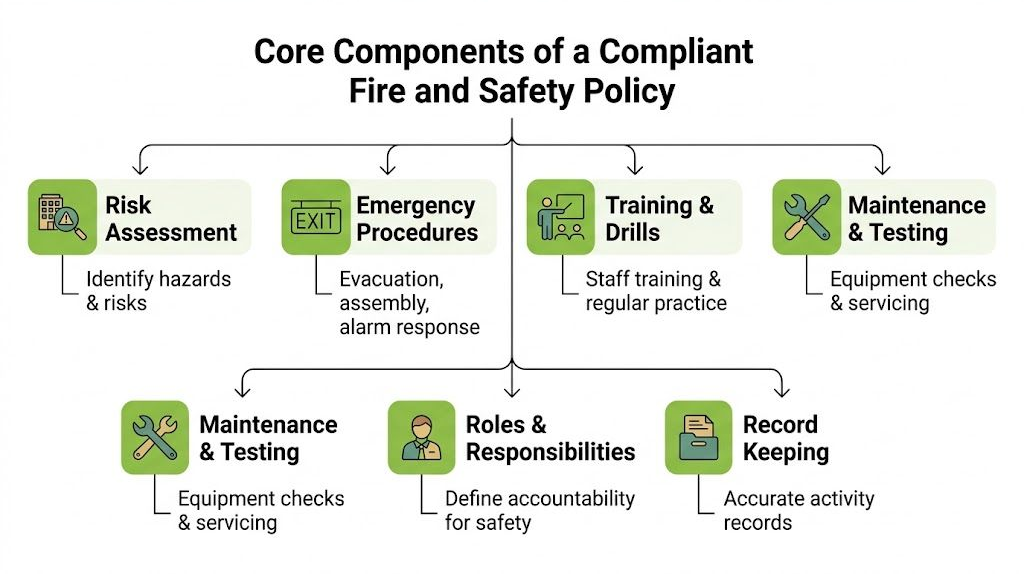
A solid fire and safety policy usually includes the following core parts.
| Section | Purpose and Required Content |
|---|---|
| Statement of intent | Confirms that fire safety is taken seriously, sets the standard expected, and commits the organisation or duty holder to maintaining suitable precautions |
| Scope of the policy | Defines which premises, common parts, work activities, or occupancy types the policy applies to |
| Roles and responsibilities | Identifies the responsible person, deputies, site managers, maintenance contacts, fire wardens if relevant, and reporting lines |
| Fire risk assessment arrangements | Explains how findings from the fire risk assessment are acted on, prioritised, and reviewed |
| Prevention measures | Covers ignition control, smoking arrangements, cooking risks, waste management, electrical safety, storage, contractor controls, and housekeeping |
| Detection and warning systems | States what alarm and detection systems are in place, who tests them, and how faults are escalated |
| Means of escape | Sets standards for escape routes, emergency lighting, signage, final exits, and keeping routes free from obstruction |
| Fire doors and compartmentation | Covers inspection, maintenance, closing action, gaps, seals, glazing, and protection of walls, risers, service penetrations, and cupboards |
| Emergency procedures | Explains what staff, tenants, visitors, or contractors must do on discovering a fire or hearing the alarm |
| Training and information | States who receives instruction, what they’re told, and when refresher training or drills are required |
| Maintenance and testing | Lists routine checks, servicing expectations, defect reporting, and who signs off completion |
| Record keeping and review | Sets out what is logged, where records are held, and when the policy and related risk controls are reviewed |
Many policies mention fire doors but say almost nothing useful about them. That’s a mistake, because fire door performance often depends on simple, visible details that are easy to neglect.
Under the Fire Safety (England) Regulations 2022, proper maintenance matters. Intumescent seal failures are noted in 35% of Category 3 HMO fires, 62% of assessed HMOs lack functioning self-closing devices, and self-closing devices alone can reduce fire spread by 50% according to BRE tests, while fines in this area averaged £12,000 per breach in 2025 under the Fire Safety (England) Regulations 2022 collection.
That means your policy shouldn’t stop at “fire doors must be maintained”. It should say what that means on site.
A better fire door section might cover points like these:
The same principle applies throughout the policy. General wording creates loopholes. Specific wording creates accountability.
Generic policy language invites generic behaviour. Specific instructions are much easier to follow, supervise, and record.
If you’re drafting or reviewing your own fire and safety policy, these are the parts worth pressure-testing:
A practical checklist can help when checking whether the policy matches the building. This 8-point fire risk assessment checklist for 2025 is useful for that purpose.
Poor policies usually fail in familiar ways:
A fire and safety policy should be written so that a manager, caretaker, supervisor, or landlord can pick it up and know exactly what standard is expected by the end of the day.
A finished policy isn’t the end of the job. It’s the start of site management.
Think of a typical handover. The assessment has been completed, the recommendations have been accepted, and the policy has been typed up neatly. If the next step is to save it as a PDF and move on, most of the benefit is lost. The building only becomes safer when the policy changes behaviour on site.

The first implementation step should be physical. Walk the building with the policy and the fire risk assessment findings in hand. Compare the written arrangements against what’s there.
That walk-round usually reveals the gap between intention and reality. A final exit may open into a yard that’s become a storage area. A riser cupboard may have been used for cleaning materials. A fire door may be present, but not latching. Those are not drafting problems. They are management problems.
Implementation improves when broad rules become recurring tasks. For example:
Most enforcement issues don’t come from exotic risks. They come from neglected basics.
According to National Fire Chiefs Council information on fire safety enforcement and implementation, 35% of enforcement actions relate to failed compartmentation and 28% relate to inadequate extinguisher maintenance. The same source notes that 2.5 minutes is the benchmark maximum evacuation time for a 5+ storey building during drills, and many buildings fail because of blocked routes or poor communication. It also states that successful implementation can avert 55% of potential fatalities in HMO fires.
That tells you something important. The written policy must direct attention to simple controls that are checked consistently.
If a policy says extinguishers are serviced annually, somebody still needs to notice the missing unit, the damaged pin, or the overdue label before the contractor’s next visit.
When a business or larger residential setting runs its first proper drill after issuing a policy, the weak points usually show up fast.
Sometimes staff don’t know who calls the fire service. Sometimes the assembly point is poorly chosen. Sometimes one team leaves quickly while another hesitates because no one has explained whether they shut down equipment first. In residential property, the equivalent problem is confusion about how defects are reported, who checks common parts, and what happens when a resident obstructs escape routes.
What works is a simple cycle:
A professional fire risk assessment earns its value. It gives the policy building-specific content. Without that, implementation becomes guesswork.
A good assessment tells you where the higher-risk areas are, which doors matter most, what escape assumptions the building relies on, and which shortcomings need action first. It also helps avoid false confidence. A generic policy can make a landlord or employer feel organised while the building still has unresolved faults hidden behind ceilings, in cupboards, at service penetrations, or along escape routes.
For businesses thinking beyond prevention and into continuity planning after an incident, this external Commercial Fire Damage Restoration Guide is a useful reminder that fire management also affects recovery, disruption, and reinstatement.
You know the policy is working when daily site behaviour starts to match the written standard:
That’s the true bridge between document and practice. The policy becomes a working management tool, not a binder on a shelf.
The quickest way for a fire and safety policy to become unreliable is to leave it untouched while the building changes around it.
Premises rarely stay still. Rooms are repurposed, tenants change, contractors alter layouts, storage creeps into common areas, and maintenance standards rise or fall depending on who is supervising them. If the policy isn’t reviewed against those changes, it stops describing reality.

Every responsible person should have a routine review process. In practice, that usually means setting regular review dates and also updating the policy when something significant changes.
Common triggers include:
A review should ask a practical question. Does the current document still describe how the premises are managed today?
Recent scrutiny has shifted the focus from having records to managing them properly. The Grenfell Tower Inquiry recommendations increased attention on the golden thread of digital records under the Building Safety Act 2022. That matters in HMOs and residential blocks because authorities increasingly expect to see not only the assessment and policy, but evidence that both are reviewed and kept live.
According to the Building Safety Regulator information linked to golden thread expectations, 28% of HMOs inspected by the London Fire Brigade in 2024/25 failed to show an adequate fire risk assessment review process, and there has been a 15% rise in enforcement notices for non-compliant HMOs since these recommendations were published.
That points to a clear shift. A static file is no longer enough where the building, risks, or arrangements have changed.
Keep records in a way that another competent person could follow. If you were unavailable tomorrow, the next person should still be able to see what was checked, what failed, what was repaired, and what still needs action.
The answer isn’t “everything”. It’s everything that proves key fire precautions are being managed.
A sensible record set often includes:
Digital storage is usually easier to maintain across multiple sites, but it still needs discipline. File names, dates, version control, and access permissions matter. The golden thread idea is really about continuity and traceability. You should be able to track a risk from identification to action to closure.
Some records look organised until you inspect them closely. Common weaknesses include undated forms, missing sign-off, servicing sheets with no linked repairs, and policy versions that don’t match current site conditions.
The better approach is simple:
That final point matters. Record-keeping doesn’t maintain itself. Someone has to own it.
Good review and record discipline helps during inspections, but it also helps before things go wrong. Patterns become visible. Repeat faults stand out. Slow responses from contractors become obvious. Weak supervision is easier to spot when there’s a clear trail.
A living fire and safety policy supports safer decisions because it stays connected to the building. Once that connection is lost, compliance becomes much harder to defend.
A fire and safety policy is a legal and practical management tool. It should set clear responsibilities, reflect actual conditions in the building, and guide day-to-day decisions about prevention, maintenance, and emergency response.
The biggest mistake is treating the policy as a finished document rather than a working system. A policy that isn’t implemented, tested, reviewed, and updated won’t protect people properly, and it won’t help much if your arrangements are challenged by enforcing authorities.
For landlords, managing agents, employers, and business owners, the next step is straightforward. Make sure your written policy is based on a suitable, site-specific understanding of risk. That means checking whether your current fire risk assessment is current, detailed, and actively being used to drive action.
A professional assessment isn’t just a compliance formality. It gives you the evidence and building-specific detail needed to create a fire and safety policy that works in practice, stands up to scrutiny, and helps protect life, property, and continuity.
No. They work together, but they do different jobs.
A fire risk assessment identifies hazards, evaluates risk, and recommends action. A fire and safety policy sets out how those risks will be managed in practice, who is responsible, and how control measures will be maintained.
The assessment tells you what the building needs. The policy tells people what to do about it.
Even where a business is small, written fire arrangements are still good practice because fire safety duties don’t disappear just because the team is small. If you employ people, receive visitors, or control premises used by others, clear written procedures help avoid confusion.
Small sites often rely too heavily on informal knowledge. That works until somebody is absent, new, or under pressure during an emergency.
You can use a template as a starting structure, but it should never be the final product.
The Grenfell Tower fire on 14 June 2017 killed 72 people, and post-Grenfell audits found fire door defects in 80% of surveyed blocks. The tragedy exposed serious failures involving non-compliant materials and flawed evacuation strategies, and it showed why generic documents can miss critical building-specific risks under the Grenfell Tower Inquiry collection.
A template won’t know your travel distances, occupancy pattern, compartmentation weaknesses, or management failures. That’s why a site-specific assessment is essential.
Review it regularly and also whenever the premises, occupancy, layout, or fire precautions change. If there has been building work, a change in use, a new managing arrangement, or a significant defect, the document should be checked straight away.
Usually, it’s not the wording. It’s the gap between the document and the building.
Policies fail when they assign vague responsibilities, ignore maintenance follow-through, or describe controls that aren’t implemented on site.
Most HMO landlords I talk to can rattle off their fire door requirements, their alarm grade, and their emergency lighting checks without missing a beat....
Most of the fire safety advice on this site assumes you already have a working HMO. This one is for the stage before that: the...