
How Many Smoke Alarms Do I Need in a UK Rental Property?
26/03/2026
As a UK landlord, property manager, or responsible person, your legal duties for fire safety are clear. You must install at least one smoke alarm on each storey and a carbon monoxide alarm in any room with a fuel-burning appliance.
However, simply meeting this minimum standard is rarely sufficient to ensure tenant safety or achieve full legal compliance. Your responsibility extends beyond a basic headcount of alarms; you are legally required to ensure your fire detection system is adequate for your property’s specific size, layout, and risk profile.
This guide is for UK landlords, business owners, and property managers who need to understand their specific obligations for installing smoke, heat, and carbon monoxide alarms to comply with UK law and protect their tenants. By the end, you will understand the requirements for different property types and know the next steps to ensure you are compliant.
The simple answer of “one alarm per storey” is only a starting point. Under the Regulatory Reform (Fire Safety) Order 2005, your legal duty as the ‘Responsible Person’ for fire safety requires a more detailed approach. You must ensure the entire system is suitable for the property’s specific risks.
Failure to install an adequate alarm system can lead to significant fines from the Fire and Rescue Authority, invalidate your insurance, and, most importantly, could put lives at risk.
This decision tree illustrates how legal obligations change depending on the type of property you manage.
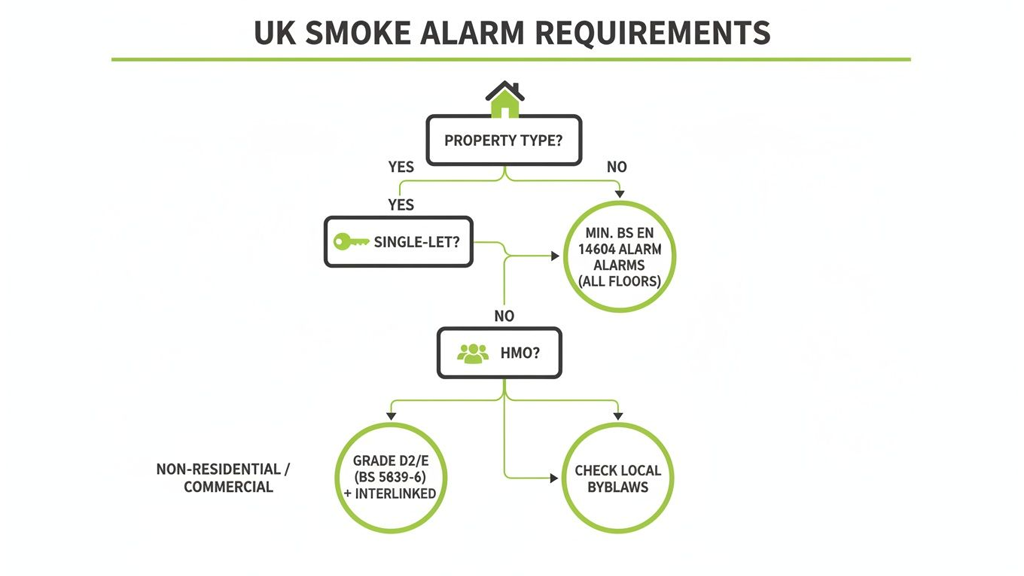
As shown, the requirements for a House in Multiple Occupation (HMO) are far stricter than for a standard single-let property. This is because the fire risk is legally considered to be significantly higher.
Assuming a “one-size-fits-all” approach to alarm installation is a common and serious compliance failure. The law expects you to manage fire safety proactively. This means the number and type of alarms you need are dictated by the specific risks your property presents.
Key factors that determine how many smoke and heat alarms you actually need include:
The following table summarises the absolute baseline legal requirements under current UK regulations.
This table outlines the minimum legal standards for smoke and carbon monoxide (CO) alarms in UK rental properties. This is the legal starting point, not a comprehensive safety plan. A property-specific fire risk assessment is required to determine the full extent of your obligations.
| Property Type | Minimum Smoke Alarm Requirement | Minimum Carbon Monoxide (CO) Alarm Requirement |
|---|---|---|
| Single-Let Properties | At least one smoke alarm on each storey used as living accommodation. | At least one CO alarm in any room with a fixed combustion appliance (e.g., boiler, gas fire). |
| Houses in Multiple Occupation (HMOs) | An interlinked, mains-powered system of smoke and heat alarms in all high-risk rooms (kitchens, lounges) and escape routes (hallways, landings). | At least one CO alarm in any room with a fixed combustion appliance. |
| Blocks of Flats | Dependent on the building’s fire strategy and risk assessment. Communal areas always require a dedicated system under the Fire Safety Order. | Within individual flats, at least one CO alarm in any room with a fixed combustion appliance. |
While this table provides a useful overview, it cannot replace a property-specific assessment, which is essential for ensuring full compliance and genuine tenant safety.
Relying solely on minimum guidance without a professional evaluation is a significant risk. The only reliable method to determine adequate alarm coverage is a property-specific Fire Risk Assessment.
This formal process, legally required under the Regulatory Reform (Fire Safety) Order 2005, involves a competent person evaluating your property. The assessment will identify all fire risks and then specify the necessary fire precautions, including the correct grade and category of alarm system required for compliance.
For a deeper dive into the different alarm systems available, you can learn more about UK smoke alarms in our detailed guide.
Your responsibility is not just to install a few alarms. It is to implement a suitable, interconnected system that gives every occupant the earliest possible warning, regardless of where a fire starts. An expert assessment is the only way to be certain you have met that crucial legal obligation, protecting both your tenants and your business.
It is not enough to know how many alarms you need. The type of alarm you install is just as crucial for protecting life and complying with UK fire safety law.
Not every alarm is manufactured to the same standard, and fitting the wrong type can be as negligent as fitting none at all. The British Standard BS 5839 provides a clear framework using “Grades” and “Categories” to define an alarm system’s power source and reliability, and where detectors should be placed.
Think of the Grade as the system’s design and power supply. The Category is the plan, telling you exactly where to place detectors for effective coverage.
For most rental properties, the decision centres on two main Grades.
A Grade F system consists of basic, battery-powered alarms available from DIY stores. While better than no protection, they have a serious flaw: they operate in isolation. If a fire starts in a room far from where a tenant is sleeping, they may not hear that single alarm in time. For this reason, Grade F systems are now considered unsuitable for almost all rental properties, especially HMOs.
A Grade D system is the recognised standard for modern rental properties and a mandatory requirement for all HMOs. These systems use mains-powered alarms that are interlinked and have a battery backup to ensure operation during a power failure.
What does ‘interlinked’ mean?
It means when one alarm detects smoke or heat, all alarms in the property sound at the same time. This creates a powerful, property-wide alert that ensures everyone is warned, no matter where they are or where the fire starts. This is a critical safety feature for multi-occupancy buildings.
Opting for a Grade D system is a clear way to demonstrate you are meeting your duty of care as a landlord or responsible person. It proves you have gone beyond the minimum and invested in a professional system designed to give everyone the earliest possible warning.
If the Grade defines the system’s power and reliability, the Category dictates where the alarms must be placed to achieve a specific level of protection. For domestic properties, this is broken down into three key levels: LD3, LD2, and LD1.
Category LD3: Basic Protection
This is the absolute minimum coverage, designed to protect the main escape routes. It requires alarms in all hallways, corridors, and landings that form the route out of the building. Think of it as a fundamental safety net.
Category LD2: Enhanced Protection
This category builds on LD3. As well as covering escape routes, alarms are also installed in rooms identified as being high-risk. This always includes the living room and may include other areas identified in a fire risk assessment. Kitchens are a notable exception, where heat alarms must be used. For the vast majority of HMOs and many single-let properties, an LD2 system is the required standard.
Category LD1: Comprehensive Protection
This offers the highest level of fire protection available in a domestic property. It requires alarms in all rooms where a fire might realistically start, including living rooms, hallways, and bedrooms. The only places typically excluded are low-risk areas like bathrooms, toilets, and small utility cupboards.
Your property’s fire risk assessment is the document that will specify which Grade and Category you need. It translates the technical standards of BS 5839 into a practical, legally sound plan tailored to your building.
To get a better grasp of how these systems apply to different properties, you can find more information by checking out our guide on the different fire alarm system categories. Understanding this terminology is crucial for any landlord, as it allows you to make informed decisions and communicate effectively with assessors and installers.
For many UK landlords, single-let houses and individual flats form the core of their portfolios. While these properties are not bound by the same stringent rules as HMOs, correctly fulfilling your fire safety obligations is just as critical. A compliance failure can expose you to legal and financial penalties, including prosecution.
The law sets a clear starting point: you must fit at least one smoke alarm on every storey that is used as living accommodation. This is the absolute bare minimum, not a complete safety strategy. Simply meeting this rule and stopping there is a common pitfall that can leave you non-compliant and your tenants unprotected.
Your primary legal duty, as set out in the Regulatory Reform (Fire Safety) Order 2005, is to ensure your tenants are adequately protected based on a property-specific fire risk assessment. This means you must consider the unique layout and risks of your property to determine how many alarms are actually needed for an effective early warning.
For instance, a single alarm on a long landing with bedrooms at opposite ends will not activate quickly enough. That is why best practice, guided by British Standard BS 5839, calls for a more thorough approach.
A fire risk assessment will almost always recommend smoke alarms be placed in all circulation areas that form part of an escape route, such as hallways and landings. This ensures that the primary means of escape are protected, giving tenants the earliest possible warning to evacuate safely.
This is a crucial distinction. The law mandates one alarm per storey, but your duty of care and a proper risk assessment demand alarms are placed where they can detect smoke along escape routes. In most cases, this means installing more than the minimum.
Where you place the alarms is as important as how many you install. Smoke alarms are designed to be highly sensitive, which is why they should never be installed in or near kitchens or bathrooms. Steam from a hot shower or fumes from cooking will trigger frequent false alarms.
When alarms become a nuisance, tenants often disable them, defeating their purpose and creating a significant safety risk. This is why a compliant installation will almost always use a heat alarm in the kitchen, which detects a sharp rise in temperature instead of smoke, alongside smoke alarms in adjacent hallways and living areas.
Your responsibilities do not stop with fire. The regulations also require you to install a carbon monoxide (CO) alarm in any room that has a fixed combustion appliance. This includes any room containing:
This is a non-negotiable legal requirement. Failing to provide a CO alarm where one is needed is a clear breach of your duties as a landlord and can lead to immediate fines and enforcement action. While this article focuses on UK regulations, understanding how fire safety is integrated into general building codes can provide a broader context for these types of regulatory frameworks.
Finally, do not forget your duty to test the alarms. You are legally required to confirm all smoke and CO alarms are working correctly on the first day of any new tenancy. You must be able to prove you have done this, so keeping a clear, dated record is essential for your compliance file.
When you move from managing a standard single-let rental to a House in Multiple Occupation (HMO) or a block of flats, the fire safety regulations become much more stringent. This is not bureaucracy; it is a direct response to a much higher risk profile.
With multiple, unrelated households sharing one building, a fire can spread more quickly, and escape routes can become congested and complex. That is why a simple setup of battery-powered alarms is completely inadequate and illegal for an HMO. The law is built on a simple premise: when one tenant is at risk, everyone in the building is at risk.
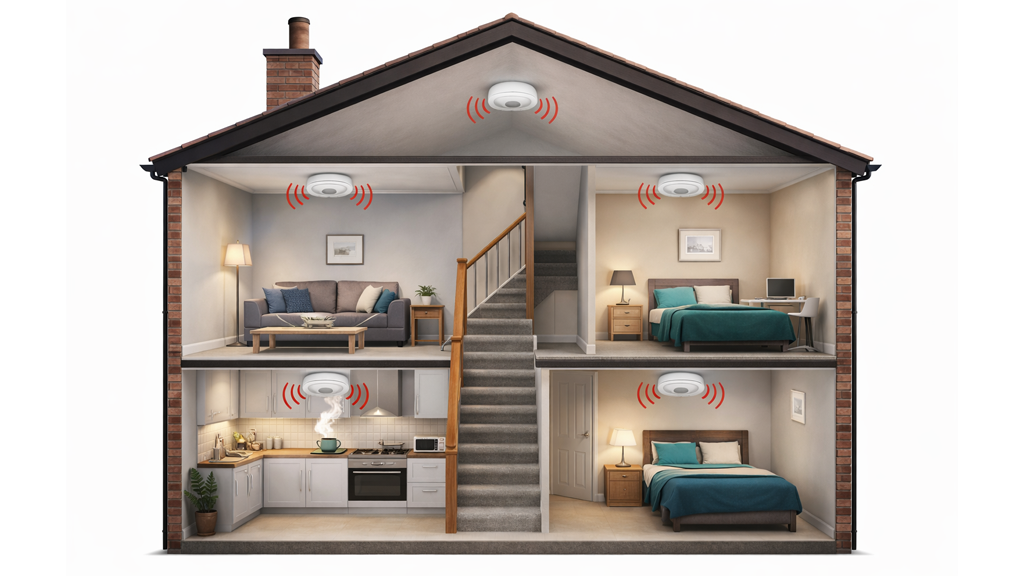
For the majority of HMOs, the required standard is a Grade D, Category LD2 system. This may sound technical, but it is straightforward. Let’s break it down.
This setup creates a robust, reliable system that gives every occupant the maximum possible time to evacuate safely. For an HMO, the question of “how many smoke alarms do I need?” always starts with this baseline: a fully interlinked system covering all escape routes and risk rooms.
Nuisance alarms are the single biggest point of failure in any alarm system. In an HMO with a shared kitchen, the risk of false alarms from cooking fumes is constant. It is only a matter of time before a frustrated tenant is tempted to disable a constantly shrieking smoke alarm, creating a deadly gap in your fire protection.
This is exactly why a heat alarm, not a smoke alarm, must be installed in every HMO kitchen. Heat alarms do not react to smoke, steam, or burnt toast. They are only triggered by a rapid and significant rise in temperature, the kind caused by an actual fire, like a chip pan igniting. This provides vital protection in a high-risk area without causing the disruptive false alarms that destroy tenants’ trust in the system.
By installing a heat alarm in the kitchen, you are directly addressing a primary fire risk while preventing the dangerous habit of tenants tampering with or removing life-saving detectors. It is a critical component of any compliant HMO fire safety strategy.
While a Grade D, LD2 system is a very common requirement, it is not a universal rule. The exact specification for your HMO or block of flats can only be determined by a property-specific Fire Risk Assessment. This professional evaluation is a legal requirement and is the cornerstone of your fire safety compliance.
Local council licensing standards can also vary, with some authorities demanding a higher-grade system based on local housing stock or other risk factors. Your fire risk assessment will take these local rules into account. It will identify every potential fire hazard and specify the precise number, type, and location of alarms needed to mitigate those risks effectively.
Relying on guesswork or generic advice instead of a formal, written assessment is a significant legal and financial risk you cannot afford to take.
So, you have determined how many alarms you need. That is a great start, but it is only half the job. An alarm installed in the wrong place is almost as useless as having no alarm at all. It might not provide a crucial early warning, or it could cause constant false alarms for your tenants.
Getting the placement right is not guesswork. It is about understanding how smoke behaves in a fire. The goal is to position your alarms to give everyone the maximum possible time to evacuate safely. The official guidance, British Standard BS 5839, gives clear instructions on where to fit alarms to achieve this. It is all about finding the spots where smoke will gather first, while avoiding areas that could interfere with the sensor.
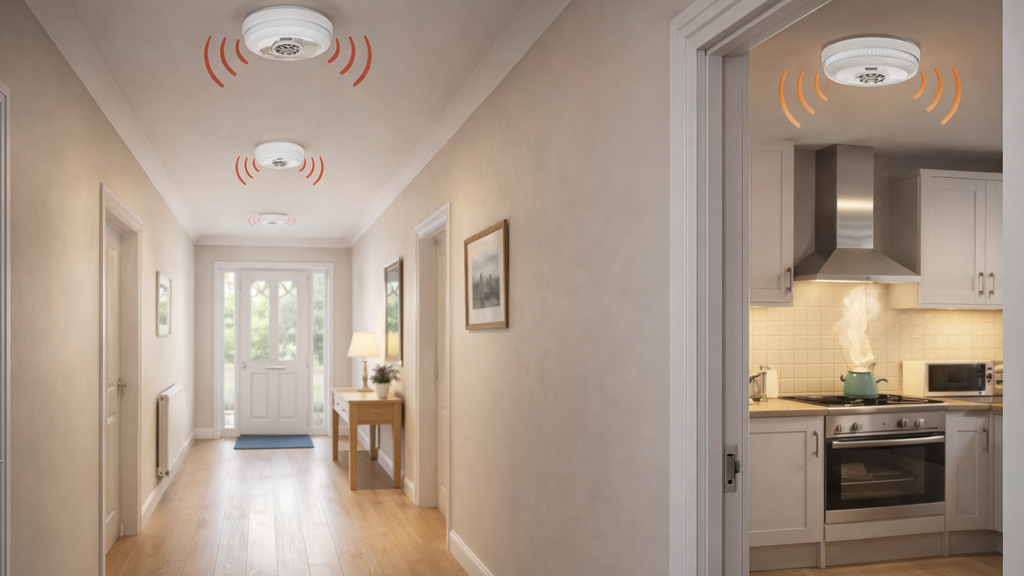
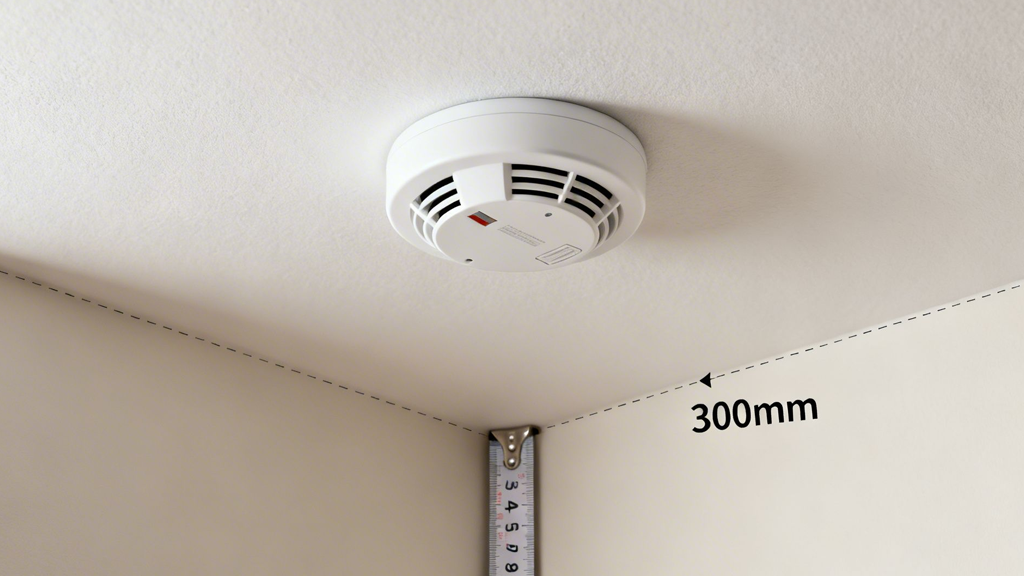
When fitting any smoke alarm, think centrally. Smoke rises and spreads, so the best place is almost always on the ceiling, in the middle of the circulation space like a hallway or landing.
To ensure your alarms work as intended, adhere to these key principles:
These measurements are based on extensive fire tests and are vital for ensuring an alarm performs its function when it matters most.
Some parts of a room are notorious for preventing smoke from reaching a detector. We call these ‘dead air’ spaces, where airflow is so poor that smoke may not reach the sensor in time. The corner where a wall meets a ceiling is a classic example of poor placement.
Equally important is avoiding locations that will cause nuisance alarms. A constantly beeping detector is not just annoying; it is the primary reason tenants will disable or remove them, leaving a large, and often fatal, gap in your fire protection.
That is why you should never install a smoke alarm in:
A significant part of your responsibility as a landlord is ensuring the fire safety system is practical for tenants to live with. Using the right type of alarm in the right place is key. A heat alarm in the kitchen is not just a suggestion; it is essential for a reliable system that people will not feel the need to tamper with.
Let’s imagine a standard two-storey terraced house in the UK. Downstairs, there is a living room at the front and a kitchen at the back, joined by a hallway with the stairs. Upstairs, a landing connects two bedrooms and a bathroom.
To meet the common LD2 standard, you would fit the alarms as follows:
This setup ensures that if a fire starts in any of these key risk areas, every alarm in the house will sound, waking sleeping occupants and protecting the main escape route.
Worryingly, a recent survey found that around 25% of UK households do not have a working smoke alarm on every level. You can see the full findings from the survey on astutis.com. For a landlord, that compliance gap is not just a statistic; it is a serious legal risk. The only way to be certain your property is correctly covered is with a professional fire risk assessment that accounts for your building’s unique layout and fulfils your duty of care.
Fitting the correct number of smoke and heat alarms is a crucial first step, but your legal duties as a landlord or property manager are ongoing. A fire alarm system is only effective if it works, which means you need a clear, consistent routine for testing and maintenance.
This obligation falls squarely on your shoulders.
Under the Regulatory Reform (Fire Safety) Order 2005, your responsibilities do not stop once the alarms are installed. You must have a robust process in place to ensure every alarm remains fully operational throughout every tenancy.
Before any new tenancy begins, you have a non-negotiable legal duty to perform. You must personally test every smoke, heat, and carbon monoxide alarm in the property to confirm they are in good working order.
This is not a casual check; it must be documented. You need a clear record showing the date, the property address, and a signature confirming that all alarms were tested and working on the day the tenants moved in. This document is a crucial part of your compliance evidence.
Once a tenancy is underway, the responsibility for testing can be shared, but the ultimate legal liability remains with you. A practical, compliant routine blends tenant involvement with professional servicing. For a deeper dive, you might find our guide covering fire alarm testing for landlords useful.
Your maintenance schedule should look something like this:
Weekly/Monthly Tenant Tests: You should encourage and instruct your tenants to test their alarms every month by pressing the test button. Provide clear, simple instructions on how to do this and explain that it is for their own safety.
Six-Monthly Landlord Inspections: When you or your agent carry out routine property visits, visually inspect all alarms for any signs of damage, tampering, or obstruction. While there, perform your own button test.
Annual Professional Service: Any mains-powered alarm system needs to be serviced once a year by a competent person. This is more than a simple button press. It involves cleaning the detectors and testing the power supply and interlinking functions to ensure the whole system operates as one.
Keeping a detailed log of every test, inspection, and service is not just good practice; it is your legal proof of due diligence. If a fire ever occurs, this logbook will be one of the first documents the Fire and Rescue Service will request to see.
Without a clear audit trail, you will find it almost impossible to prove you have met your ongoing fire safety duties. This record demonstrates that you have a proactive system for managing risk and protecting your tenants’ lives. Neglecting this continuous responsibility is a serious compliance failure.
When it comes to fire safety, the rules around alarms can feel complex. Let’s clear up some of the most common questions we hear from landlords and property managers about smoke and heat alarms in UK rental properties.
Not always, but this depends on the property type and its specific risks. For a straightforward single-let property, the bare legal minimum is one smoke alarm per storey. However, a professional fire risk assessment will almost always recommend a Category LD2 system. This means fitting alarms in all escape routes, like hallways and landings, and in the principal living room.
Houses in Multiple Occupation (HMOs) have much stricter rules. You will almost certainly need a fully interlinked system. This typically includes alarms in all circulation spaces, living rooms, and a dedicated heat alarm in the kitchen. Depending on the fire risk assessment, bedrooms may also require alarms.
While you should absolutely encourage tenants to test their alarms monthly for their own safety, the final legal responsibility for the system’s maintenance always rests with you, the landlord. It is your job to ensure every alarm is tested and working correctly on the first day of any new tenancy.
Relying solely on tenants for ongoing checks is a major compliance risk. Your legal duty under the Regulatory Reform (Fire Safety) Order 2005 means you must have a proactive maintenance schedule. For mains-powered systems, this includes an annual service by a competent person.
Understanding this distinction is crucial. A smoke alarm works by detecting tiny particles of smoke in the air. Its purpose is to provide the earliest possible warning, which is why we place them in living rooms, bedrooms, hallways, and landings. They are very sensitive, and for that reason, you should never place one in a kitchen or bathroom.
A heat alarm, on the other hand, is designed to detect a rapid rise in temperature to a specific point. It will not be set off by cooking fumes or steam, making it the only appropriate choice for a kitchen. A fully compliant system uses a smart mix of both alarm types to provide complete protection without the issue of constant false alerts.
Yes, provided they meet the BS 5839-6 standard. Modern radio-interlinked alarms are just as reliable as their hardwired counterparts. They use secure radio frequencies to communicate, so when one alarm detects a fire, they all sound instantly.
They are an excellent solution for retrofitting compliant systems into existing properties, saving the cost and disruption of installing new cables through walls and ceilings. To meet Grade D requirements, both types must either be mains-powered or have a 10-year sealed battery.
Most HMO landlords I talk to can rattle off their fire door requirements, their alarm grade, and their emergency lighting checks without missing a beat....

Most of the fire safety advice on this site assumes you already have a working HMO. This one is for the stage before that: the...