
Self Closing Fire Doors A Landlord’s Guide to UK Compliance
05/03/2026
A fire door is only a fire door when it’s closed. A self-closing fire door is what makes that simple but life-saving rule a reality, automatically shutting and latching to form a protective barrier against fire and smoke. It’s not an optional extra; it is a critical part of your building’s fire safety strategy, and it’s required by law.
This guide is for business owners, landlords, and property managers who are the ‘Responsible Person’ for fire safety in their buildings. It explains what the law requires for self-closing fire doors, why it matters, and the practical steps you must take to ensure compliance and protect lives.
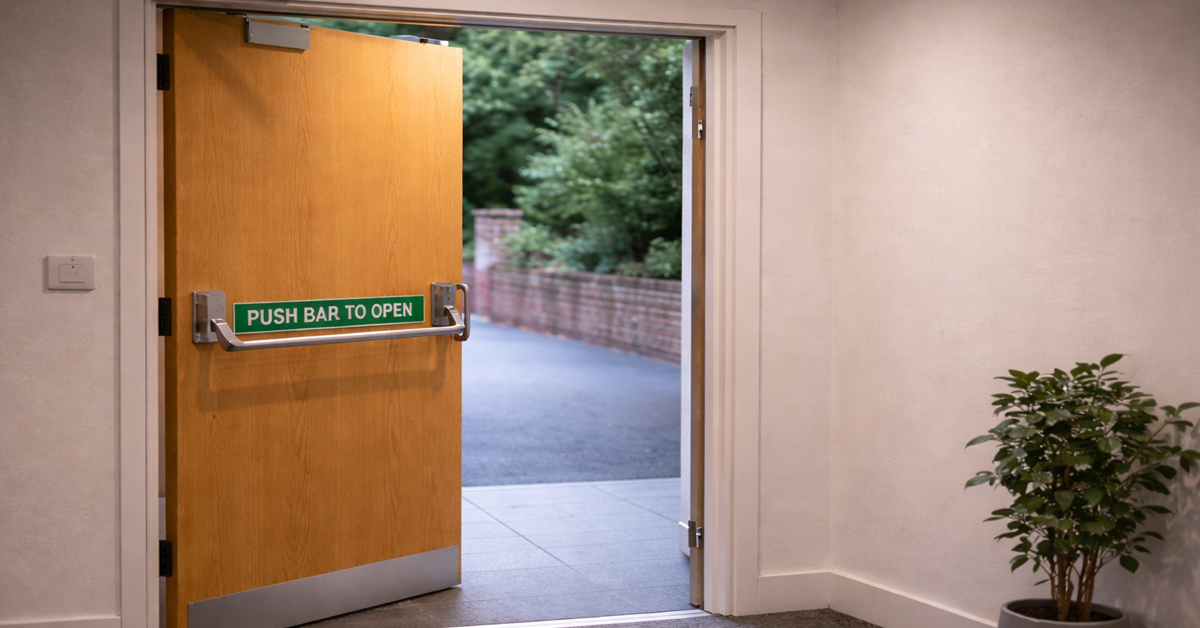
Think of a fire door as a shield. Now, imagine that shield only works if someone remembers to hold it in the right place during an emergency. It is a pointless exercise. This is precisely why a self-closing mechanism is not just a handy feature; it is a legal necessity.
For landlords of Houses in Multiple Occupation (HMOs) and managers of residential blocks, these devices are non-negotiable. They are the guardians that ensure protected escape routes like corridors and stairwells remain clear by holding back lethal smoke and flames, giving people precious time to get out safely.
This core function is central to a fire safety principle known as compartmentation.
In simple terms, compartmentation works by dividing a building into a series of fire-resistant “boxes”. The aim is to contain a fire within the box where it started, stopping it from spreading to other areas. A correctly functioning self-closing fire door is what keeps the lid on that box.
When a fire door is wedged open or its closer is broken, the entire compartmentation strategy fails. This is why the Regulatory Reform (Fire Safety) Order 2005 places a clear legal duty on the building’s “Responsible Person” to keep these devices in full working order.
To help landlords and property managers understand their obligations, the table below summarises the essential functions of a self-closing fire door.
| Key Function | Why It Matters For Landlords | Governing Legal Principle |
|---|---|---|
| Automatic Closing | Ensures fire doors are never left open by accident or negligence, maintaining the integrity of escape routes. | The Regulatory Reform (Fire Safety) Order 2005 requires fire safety provisions to be maintained in an efficient state. |
| Containment | It seals the “box” (compartment), preventing the rapid spread of fire, heat, and toxic smoke between rooms or floors. | Central to the concept of compartmentation, which is a cornerstone of UK building and fire safety regulations. |
| Protecting Escape Routes | Keeps corridors and stairwells free from smoke and flames, allowing occupants to evacuate safely. | A core duty under the Fire Safety Order is to ensure escape routes are safe and available for use at all times. |
In short, a self-closer is not just a mechanism; it is an active, legally required safety system that you are responsible for maintaining.
The failure to maintain these crucial devices is a widespread crisis. Shocking statistics from the Fire Door Inspection Scheme (FDIS) reveal that a staggering 75% of UK fire doors fail to meet the required safety standards.
Even worse, 31% of these failures are directly down to improper installation, frequently involving issues with the self-closing device, like a disconnected arm or a wrongly adjusted closer. This problem is especially acute in HMOs and multi-occupancy buildings, where communal fire doors are the main line of defence for escape routes. You can discover more about these fire door safety statistics to understand the full scope of the issue.
The responsibility for making sure a self-closing fire door works correctly rests squarely with the building’s Responsible Person. A closer that’s disconnected, broken, or out of adjustment is not just a maintenance task you can put off; it’s a critical failure of your legal duties. In the sections that follow, we will detail exactly what those duties are and how you can meet them to protect both your property and its occupants.
The legal landscape for fire safety in UK residential properties has been completely redrawn. In the wake of the Grenfell Tower tragedy, a raft of new legislation has introduced strict, non-negotiable duties for landlords and property managers when it comes to fire doors.
Simply having a fire door installed is no longer enough. The law now demands proactive management, regular checks, and detailed records to prove these life-saving doors are ready to perform at a moment’s notice. Understanding these duties is not optional; it is a fundamental part of your legal responsibility.
Under the Regulatory Reform (Fire Safety) Order 2005, the legal duty for fire safety rests with the designated Responsible Person. In a multi-occupied residential building, this is almost always the landlord, building owner, or managing agent.
The Fire Safety Act 2021 made this crystal clear. It extended the scope of the Fire Safety Order to cover a building’s structure, external walls, and crucially, all the flat entrance doors in buildings containing two or more homes. This means if you are a landlord, you are directly accountable for the fire doors separating individual flats from the shared corridors and stairwells.
A critical change came with the Fire Safety (England) Regulations 2022, which introduced a specific inspection timetable. As of 23 January 2023, these regulations require Responsible Persons, typically HMO landlords or managing agents, to check communal fire doors every three months and flat entrance doors annually on a ‘best endeavours’ basis for all multi-occupied residential buildings over 11 metres high. You can learn more by reading the official government fact sheet on fire doors.
This new law removes all guesswork. It sets out a clear schedule of inspections that you must follow and, just as importantly, you must be able to prove you have followed.
It is not just about how often you check the doors; it is about what you are checking for. The standard BS EN 1154, for example, covers controlled door closing devices. In simple terms, this means a self-closing fire door must be able to close itself fully and latch shut from any position without slamming. A door that closes too slowly, hangs open, or slams shut is a failure.
Correct fitting matters just as much as the device itself: the code of practice in BS 8214 sets out how self-closing devices should be installed and adjusted. A closer fitted outside this guidance can damage the door, prevent it from latching, or fail prematurely, which is why installation quality is as important as the hardware specification.
The term ‘best endeavours’, which applies to the annual checks of flat entrance doors, is a legal test. It means you must be able to show you have taken all reasonable steps to gain access to carry out the inspection. This includes communicating clearly with tenants, giving them proper notice, and making multiple attempts to arrange access. Keeping a detailed log of these attempts is your proof of due diligence.
Your duties also demand meticulous record keeping for every single inspection. For each check, you must document:
This creates an audit trail that is vital for proving your compliance to the Fire and Rescue Service.
Ignoring these legal duties can have severe consequences. Local Fire and Rescue Authorities have the power to take enforcement action, which can start with informal warnings but can quickly escalate to formal enforcement notices that legally compel you to fix the issues.
Failure to comply can lead to unlimited fines and, in the most serious cases where lives are put at risk, prosecution and even imprisonment.
The message from the law is clear: proactive management and verifiable proof of compliance are essential. These duties are in place to ensure self-closing fire doors do their job correctly when a fire breaks out, protecting escape routes and saving lives. For a deeper dive into the specific rules, you can read our comprehensive guide on UK fire door legislation. This proactive approach is your best defence against both unacceptable risks and major legal trouble.
Knowing the rules is one thing, but as a landlord or property manager, you also need to know what a compliant self-closing device looks like on the ground. This is where theory meets practice. Getting familiar with the hardware is essential for carrying out your own routine checks and spotting problems before they become serious risks.
While there are a few different designs out there, most of the closers you will find in UK properties are one of two types:
No matter the type, the job is always the same: to shut the door completely, every single time.
A standard overhead closer is a clever bit of engineering built for a single, life-saving task. Once you know the parts, you can spot failures in seconds.
The closer body is the main unit, a metal housing filled with hydraulic fluid and a powerful spring. This is what generates the controlled force to shut the door. If you ever spot oil leaking from this box, it’s a clear sign the unit has failed and needs replacing immediately.
Next is the arm assembly. This is the jointed metal arm that links the closer body to the door, transferring the power. It must be tightly secured at all connection points, with no signs of damage or bending. A loose or broken arm makes the whole mechanism useless.
Finally, you will find small adjustment valves on the side of the closer body. These allow a competent person to fine-tune the door’s behaviour. They usually control two key functions:
A properly adjusted self-closing fire door is all about controlled force. It must have enough power to close and latch securely from any position, whether it is wide open or just slightly ajar.
A common mistake is thinking that any closing movement is good enough. A compliant closer has to be strong enough to overcome the pressure of a real fire or the resistance from seals. At the same time, it cannot be so aggressive that it becomes a hazard for children or less mobile residents. The door should close firmly but never slam shut.
This infographic breaks down the relationship between UK fire safety law, the Responsible Person, and the practical steps needed for compliance.
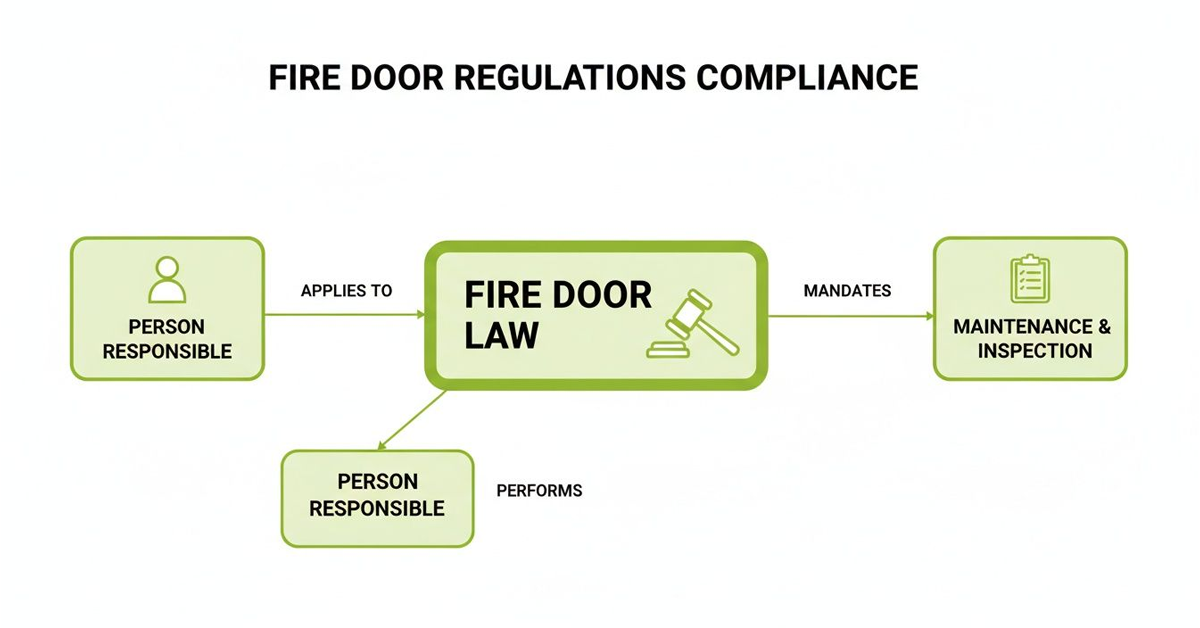
As the chart shows, regular inspection and maintenance are not just good practice; they are a direct requirement of your legal duties.
It is crucial to be clear on this: propping a fire door open is illegal and incredibly dangerous. The only lawful way to hold a fire door open is with an approved automatic device that is wired into the building’s fire alarm system. These ‘hold-open’ devices release the door the instant the alarm sounds.
Using a door wedge, a fire extinguisher, or any other object to prop open a self-closing fire door is strictly prohibited. This one action defeats the entire fire compartmentation strategy of your building. It puts lives at immediate risk and leaves the Responsible Person liable for huge fines and even prosecution. During any inspection, finding and removing these wedges should be a top priority.
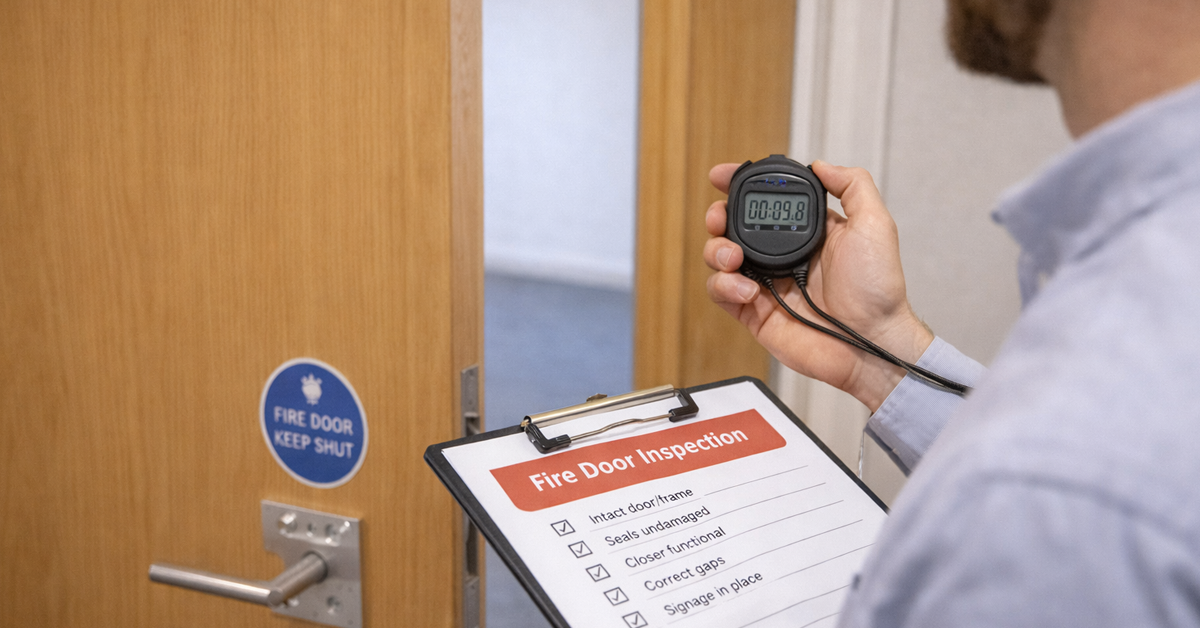
Knowing the theory behind fire doors is one thing, but the real test of your compliance happens on the ground, with a physical inspection. This is your practical guide to the routine checks that keep your property safe and legally compliant.
Think of it like a complete garage door maintenance checklist; a simple, repeatable process is your best defence against failure. Use these steps to build your own inspection routine, focusing on the common weak spots of self-closing fire doors.
Before you even test the door’s movement, give the closer mechanism a quick visual inspection. If the device is not securely attached, it’s completely useless.
This is the most critical part of your inspection. To be compliant, a fire door must close and latch firmly on its own, every single time, from any angle.
It is not enough for the door to just swing towards the frame. It absolutely must engage the latch with a definite ‘click’. A door that simply rests against the frame without latching has failed the test.
Here’s how to test it properly:
In every one of these tests, the door must close and latch securely without you helping it.
Over time, you will start to recognise common faults. This table breaks down what you might see and what you need to do about it.
| Observed Fault | Potential Cause | Action Required |
|---|---|---|
| Door slams shut violently | Closer is adjusted incorrectly or is the wrong power rating for the door. | Adjust the closing speed via the valve screws. If this fails, the unit may need replacing with a correctly specified model. |
| Door closes too slowly or stops before latching | Insufficient power, incorrect adjustment, or internal seal failure. | Adjust the latching speed. If ineffective, the closer has likely failed and must be replaced. |
| Visible oil leaking from the closer body | The internal hydraulic seals have failed. The unit has lost its damping fluid. | This is a terminal failure. The entire closer unit must be replaced immediately. Repair is not an option. |
| Grinding or crunching noises during operation | Internal mechanism damage or arm components are loose and catching. | Check all arm fixings. If the noise is internal, the unit has failed and must be replaced. |
| The arm is bent or disconnected | Vandalism, impact, or improper use (e.g., forcing the door against the closer). | Replace the arm assembly if possible. If the main body is damaged, the entire closer unit will need replacing. |
Recognising these signs early saves you from bigger headaches down the line and, more importantly, ensures the door will work when it matters most.
A door that slams shut is a hazard, especially for children or vulnerable adults. But one that closes too slowly might not be effective in a real fire. The law does not give a strict time, but there’s a good rule of thumb.
From a 90-degree open position, a safe and effective closing speed is between 3 to 6 seconds to reach the final 10 to 15 degrees before it latches. If it slams or takes forever to close, it needs adjusting by a competent person.
Finally, do a quick scan for two of the most common and dangerous issues. These are often the easiest problems to spot and fix.
A consistent inspection process is the key to compliance. To help you formalise these checks, our detailed fire door inspection checklist can be a huge help for managing your properties.
Your routine inspections are a vital activity, but they are just one piece of a much larger compliance puzzle. The formal **Fire Risk Assessment (FRA)** is the cornerstone of your property’s fire safety management, and the condition of your self-closing fire doors is a fundamental part of it.
While you perform weekly or monthly checks, the FRA is the overarching legal document that proves your entire fire safety system is fit for purpose. It’s where a qualified professional validates your procedures, records the state of your building’s defences, and ultimately, protects you from liability. This professional documentation is what demonstrates a complete, properly managed approach to fire safety.
When a competent fire risk assessor evaluates your property, their review of self-closing fire doors goes far beyond a simple open and shut test. They look at the bigger picture to ensure each door fits correctly into the building’s overall fire strategy.
An assessor’s evaluation includes:
A crucial function of the FRA is to create a formal record of any failings and to prioritise the necessary remedies. An assessor will not just note that a closer is broken; they will assign a level of urgency to the required action, based on the risk it presents.
For example, a finding might be documented as: “High Priority: Self-closer on first-floor landing fire door is disconnected. Repair required within 24 hours to re-secure protected escape route.” This provides a clear, time-bound instruction that shows you understand the risk and have a plan to fix it.
This formal documentation serves as critical evidence of your due diligence for the Fire and Rescue Service. It demonstrates that you have not only identified a fault but have also implemented a structured process to address it. Your own inspection records then feed into this, showing you are proactively managing safety between formal assessments. For a detailed overview of what is involved, you might be interested in our guide on the fire risk assessment for landlords.
The importance of this structured approach was heavily underscored by the Grenfell Inquiry. Its recommendations, specifically 33.29(a) and (b), urged building managers to conduct urgent and regular inspections of fire doors, ensuring effective self-closers were fitted and checked at least every three months. This directly influenced the Fire Safety (England) Regulations 2022, cementing the need for detailed compliance records that form an audit trail for authorities. You can read more about the regulations on self-closing doors to understand the requirements fully.
This guide has driven home one crucial point for every landlord, property manager, and business owner: keeping your self-closing fire doors in perfect working order is a legal and moral duty, not just a task on a checklist. We have covered their life-saving role in fire compartmentation, the laws governing their use, and the heavy price of getting it wrong.
The buck stops with you. As the designated Responsible Person, you are legally accountable for fire safety. A faulty door closer is not a minor snag to fix later; it is an immediate failure in your duty of care and a direct threat to the lives of your occupants.
The only acceptable approach is proactive management. You simply cannot afford to be complacent when it comes to protecting your tenants, your property, and your reputation. Inaction is not an option. It can lead to enforcement notices, huge fines, and, in a worst-case scenario, a tragedy you can never undo.
The time to act is now. These next steps give you a clear, straightforward plan to get compliant and make your building safer.
To turn this knowledge into action, follow this simple process:
Your duty is to ensure these life-saving devices work perfectly, every time. This is not about ticking a box for the council or your insurer; it’s about proving your commitment to protecting lives. When it comes to fire safety, there is no substitute for certainty.
As a landlord or property manager, you are bound to have questions about the finer points of fire safety. When it comes to self-closing fire doors, the rules can seem complex, but getting them right is non-negotiable. Here are some straightforward answers to the questions we hear most often.
No. This is a common but critically dangerous misconception. It creates a false sense of security and is a major compliance failure.
A certified fire door is an engineered doorset. This means the door leaf, the frame, the intumescent seals, and all the hardware, including the closer, have been tested together as a complete unit. They are certified to a specific standard, like BS 476-22 or BS EN 1634-1, to prove they can hold back fire for a set period.
Simply bolting a closer onto a standard internal door gives you absolutely zero certified fire resistance. In a real fire, the door itself would likely burn through in minutes, making the closer completely redundant. A fire risk assessor or the Fire and Rescue Service would flag this as a serious hazard immediately.
As the ‘Responsible Person’ for the property, you have a legal duty to ensure fire doors are never compromised. You must act decisively.
The only legal way to hold a fire door open is with a compliant electromagnetic ‘hold-open’ device. This must be professionally installed and wired directly into the building’s fire alarm system, so it releases the door automatically when the alarm sounds.
This is not guesswork; it is a science. Self-closers are rated by ‘power size’ according to the standard BS EN 1154, and picking the right one is crucial for the door to work correctly.
The correct power size depends on factors like the door’s width, its weight, and even its location in the building, which can affect air pressure.
If the closer is too weak (for instance, a power size 3 on a very heavy door), it will not have the force to overcome the latch, leaving the door ajar and unsecured. On the other hand, if it is too strong, it can make the door incredibly difficult for children, the elderly, or people with disabilities to open, creating serious accessibility problems. This is a job for a competent installer or fire safety professional who can specify the correct closer for each individual door.
Yes, almost certainly. In virtually all licensed Houses in Multiple Occupation (HMOs), any fire door protecting the main escape route must be fitted with an effective self-closing device.
This typically includes the doors to shared kitchens and living rooms, as well as every individual bedroom door that opens onto a hallway or staircase. The entire point is to ensure that if a fire starts in one of those rooms, the door closes automatically to contain the fire and smoke, keeping the escape route clear.
Your property’s Fire Risk Assessment and the specific HMO licensing conditions set by your local council will confirm the exact requirements for every single door.
Most HMO landlords I talk to can rattle off their fire door requirements, their alarm grade, and their emergency lighting checks without missing a beat....

Most of the fire safety advice on this site assumes you already have a working HMO. This one is for the stage before that: the...