
Evacuation for Fire: A Guide for UK Businesses and Landlords
05/03/2026
Having a solid plan for an evacuation for fire isn’t just a good idea—it’s a strict legal duty for UK businesses and landlords. A clear, well-rehearsed strategy is what allows people to escape safely, reduces panic, and demonstrates you are serious about protecting lives. It is the absolute cornerstone of your fire safety responsibilities.
This guide is for business owners, landlords, and anyone designated as the ‘Responsible Person’ under UK fire safety law. By the end, you will understand your legal duties for creating, implementing, and maintaining an effective fire evacuation plan.
Understanding your legal obligations for fire evacuation is non-negotiable under UK law. This is not about best practice; it’s a firm requirement set out in the Regulatory Reform (Fire Safety) Order 2005. This legislation places the legal duty squarely on the designated ‘Responsible Person’.
For a business, this is usually the employer. If you’re a landlord of an HMO or a block of flats, it’s you, the freeholder, or your managing agent. You cannot simply pass this responsibility on, even if you hire a professional to manage your fire safety. The ultimate responsibility always stops with you.
Your core duty is to ensure a safe escape route is available at all times. This all starts with a “suitable and sufficient” fire risk assessment, which must cover your emergency procedures. This is not a one-off task; it needs regular reviews to remain valid.
Your risk assessment must identify not just fire hazards but also the people who are especially at risk. This goes beyond a simple headcount. You need to think carefully about:
One of the most common compliance failures is treating the risk assessment as a box-ticking exercise. Its findings must translate directly into a practical, working evacuation plan.
For instance, a fire risk assessment for a multi-tenanted office block in Manchester would highlight the need for coordinated drills and a clear chain of command involving every business. In contrast, an assessment for a residential HMO in Bristol would focus heavily on ensuring tenants understand the “Stay Put” or “Simultaneous Evacuation” policy, and that escape routes are kept completely clear.
The core duty is to create a plan that works for your specific building and its occupants. A generic template is insufficient and will not stand up to scrutiny from a Fire and Rescue Service inspector. Failing to establish and implement these procedures can lead to severe legal consequences.
Do not underestimate the consequences of getting this wrong. Fire and Rescue Authorities can issue enforcement notices, forcing you to make immediate fixes. If they find a serious risk to life, they can issue a prohibition notice, which could shut down part or all of your building. Breaches can lead to prosecution, with unlimited fines and, in the most serious cases, a prison sentence.
Official data proves that good fire safety works. In 2017/18, for example, English fire services attended 6,228 primary fires that needed an evacuation. While this figure shows a downward trend thanks to better prevention, dwelling fires still accounted for about 80% of these incidents. These statistics underscore that while major fires are less frequent, the risk, especially in residential properties, is very real.
Ultimately, your legal duties are about more than avoiding fines; they are about protecting people. You can explore more about your specific obligations by reading our plain English guide to UK fire safety regulations. A properly planned and practised fire evacuation strategy is a critical pillar of both legal compliance and your moral responsibility.
Your legal duties as a landlord or business owner demand a written emergency plan. But this is not just a box-ticking exercise to satisfy the law. In a real fire, this document becomes a life-saving tool, providing clear instructions that anyone can follow under immense pressure.
A good plan is not a dense manual that gathers dust on a shelf; it’s a practical, actionable guide.
The most basic part of this is the fire action notice. These are the signs you see in corridors and next to fire alarm call points, detailing the immediate steps to take when a fire is discovered or the alarm sounds. They must be simple, clear, and specific to your building.
This visual guide breaks down the core duties of a Responsible Person into three key stages.
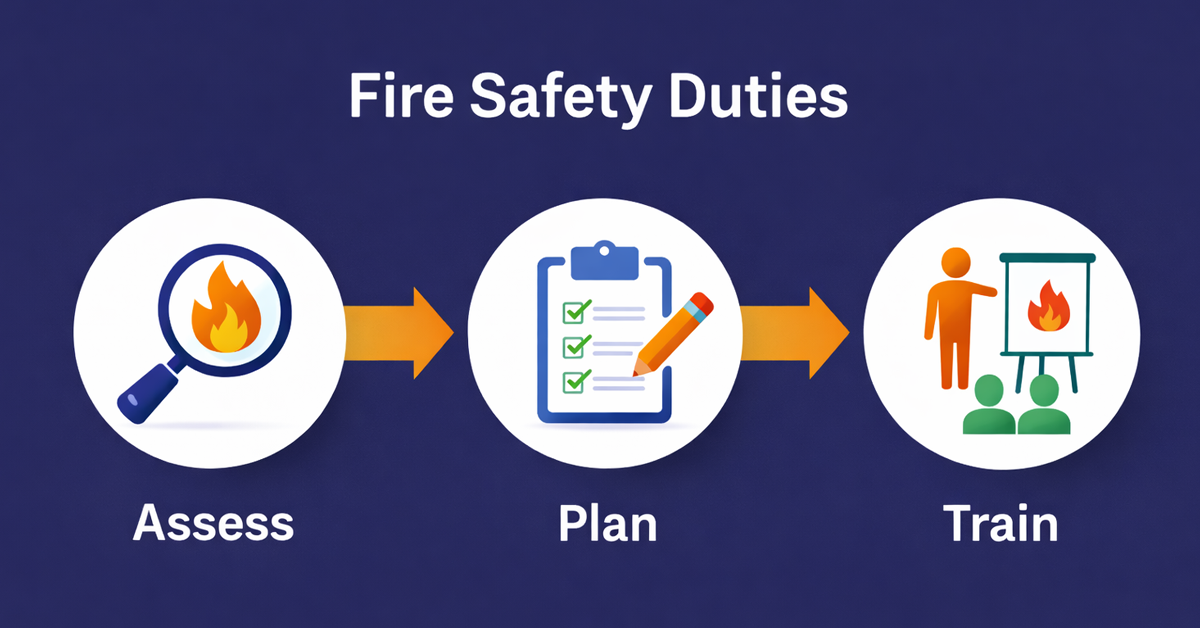
As the infographic shows, a compliant fire safety strategy is a constant cycle. You assess the risks, plan the response, and train people on what to do, and each step feeds back into the others.
Every building must have clearly defined and protected escape routes. Your plan needs to document these with simple floor plans that even a new tenant or first-time visitor can understand in a hurry.
You must identify and map out:
The level of detail depends on your building’s complexity. For a small high street shop, a single page showing the way to the front and back doors might be enough. But for a multi-storey office block or a large HMO, you will need detailed plans for each floor, clearly marking all fire exits and the protected corridors and stairwells that lead to them.
Once people are outside, where do they go? Your evacuation plan must name a specific fire assembly point. This needs to be a pre-agreed location far enough from the building to be safe from heat, smoke, and falling debris. Crucially, it must not block access for fire and rescue service vehicles.
Ambiguity here is dangerous. “The car park” is too vague. “The far right corner of the staff car park, by the large oak tree” is much better. This location must be clearly communicated to everyone.
Your plan also needs a clear chain of command. It should name the individuals responsible for coordinating the evacuation, often known as fire wardens or fire marshals. Their duties include:
This structure prevents chaos. It also ensures that critical information, like the fire’s location or details of anyone unaccounted for, can be passed to the fire service the moment they arrive.
A common compliance failure is not appointing deputies. If the designated fire warden is on holiday, off sick, or is the first person to leave, the whole plan can fall apart. Always ensure you have enough trained people to provide cover.
One of the most critical, and frequently overlooked, parts of any emergency plan is making provisions for vulnerable individuals. The law requires you to create specific arrangements for anyone who might not be able to evacuate without help. This is done through a Personal Emergency Evacuation Plan (PEEP).
A PEEP is a bespoke plan created for a specific person. It’s designed for anyone who, due to a disability or mobility issue, cannot get out of the building independently. This could be a wheelchair user, someone with a severe visual or hearing impairment, or even an employee with a temporary injury like a broken leg.
The process involves three steps:
Failing to have PEEPs in place is a serious breach of both fire safety and equality law. It means you have not provided a safe way out for everyone in your building, leaving you exposed to significant legal and financial penalties.
A written evacuation for fire plan is useless without the physical systems to back it up. When an emergency hits, it’s the alarms, lighting, and signs that do the real work of guiding people to safety. As the Responsible Person, you’re legally required to ensure these systems are not just present, but properly installed, fully functional, and regularly maintained.
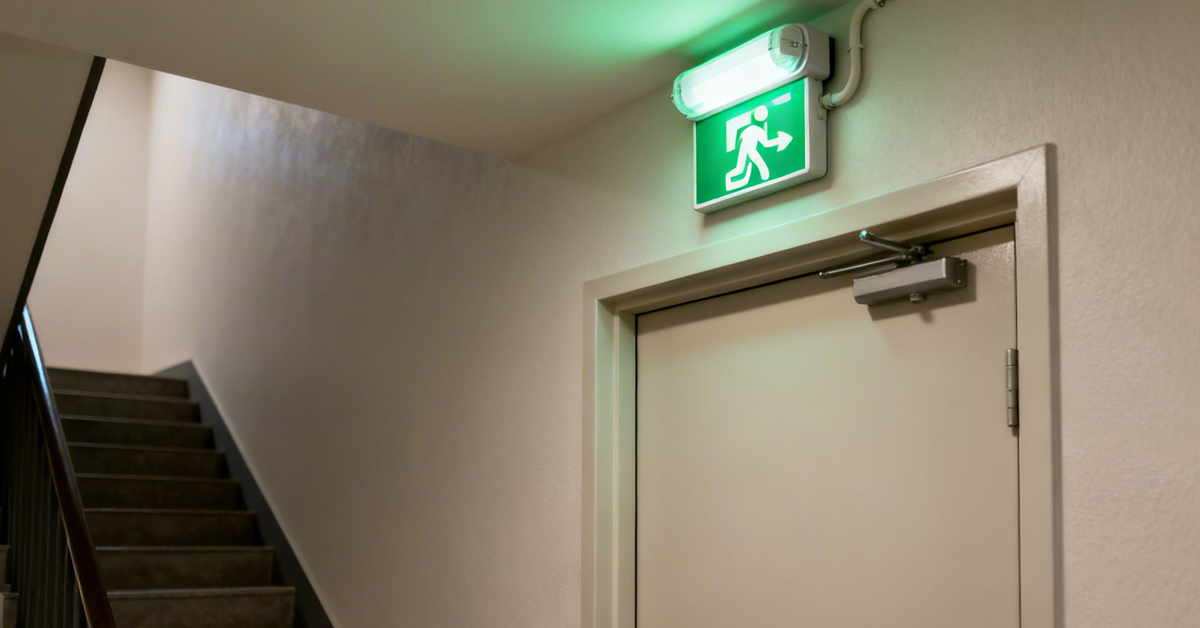
If these crucial elements fail, even the most well-thought-out plan falls apart, leaving occupants confused and in serious danger.
The fire alarm is your first and most critical line of defence. It provides the early warning everyone needs to get out in time. The exact system you need will depend entirely on your property’s size, use, and risk profile, as determined by your fire risk assessment.
A high-risk property like a large House in Multiple Occupation (HMO), for example, will almost certainly require a Grade D, LD2 system. This means you need interconnected, mains-powered smoke and heat alarms in all risk rooms and along escape routes, each with its own battery backup. That interconnection is non-negotiable; when one detector is triggered, they all sound, making sure everyone hears the alarm no matter where they are.
Regular testing is a fundamental part of your legal duty. A simple weekly test, done by activating a manual call point, confirms the panel and sounders are working. This action, recorded diligently in your fire logbook, is your proof of ongoing compliance and a cornerstone of responsible management.
In the panic of a fire, clear and simple guidance is everything. Your signage must be unambiguous, directing people along escape routes without a moment’s hesitation. In the UK, all fire safety signs must conform to British Standards, using recognisable pictograms that anyone can understand instantly.
The ‘running man’ symbol is the universal sign for a fire exit route. These signs need to be strategically placed at key decision points, such as corridor junctions, changes in floor level, and directly above every final exit door. The arrow’s direction is crucial, telling people whether to go straight, turn left or right, or head up or down stairs. A common and dangerous mistake is placing a sign with no arrow on an exit door; it fails to guide anyone towards it from a distance.
These signs lead people through protected escape routes, which depend on another critical component: fire doors. A correctly fitted and maintained fire door with a working self-closer is designed to hold back smoke and flames for a set period (usually 30 or 60 minutes), keeping the route clear and passable.
One of the most serious breaches we find during inspections is a fire door illegally propped open. A single wedge holding open a stairwell door renders the entire protected route useless. Smoke and toxic gases can spread in seconds, blocking the primary escape route for everyone in the building.
A fire can easily knock out the main power supply, plunging a building into total darkness. This is precisely when emergency lighting proves its worth. It’s a secondary, battery-backed system that automatically illuminates escape routes the moment the mains power fails.
The law is clear: emergency lighting must provide enough light for people to see their way out. This means it must illuminate:
To ensure these systems are ready when needed, you need a robust checklist.
Here’s a breakdown of the key systems that facilitate a safe evacuation, their purpose, and what you need to check to stay compliant.
| Equipment / System | Purpose in Evacuation | Key Compliance Check |
|---|---|---|
| Fire Alarm System | Provides immediate, building-wide audible warning of a potential fire. | Weekly manual call point test. Annual professional service. |
| Emergency Lighting | Illuminates escape routes during a power failure, preventing panic and falls. | Monthly functional “flick” test. Annual full-duration battery test. |
| Fire Doors | Compartmentalise fire and smoke, protecting escape routes for a specified time. | Daily visual check for damage; ensure self-closers work correctly. Never prop open. |
| Escape Route Signage | Provides clear, unambiguous directions to the nearest fire exit. | Regular checks to ensure signs are visible, correctly placed, and illuminated if required. |
This table summarises the core equipment, but a comprehensive fire risk assessment will detail the specific requirements for your unique property.
Just like your fire alarms, this lighting must be tested regularly. This involves a quick monthly functional test to see if the lights switch on, plus a full annual duration test to ensure the batteries last for their required period (typically one or three hours). A facilities manager methodically checking each luminaire and logging the results is a perfect example of proactive fire safety. Modern emergency mapping systems can also be a huge help, giving a clear visual overview of routes and assembly points to guide first responders and building managers during an incident.
An evacuation plan is just a piece of paper until you test it. Regular fire drills are what turn theory into a life-saving reflex, building the muscle memory everyone needs to stay calm and evacuate in an orderly way when it really counts.
These drills are not about ticking boxes for compliance. They are your chance to identify and resolve any weaknesses in the plan and make sure everyone, from a new tenant to a long-serving employee, knows exactly what to do. Without practice, people panic.

For a fire drill to be truly effective, it needs to be more than just a quick walk to the assembly point. You do not want to cause unnecessary alarm, but introducing small, controlled challenges can make a huge difference in how prepared people are.
Consider adding these realistic scenarios to your drills:
The goal is to test the entire strategy, not just perform a headcount. These small changes help build adaptable thinking, moving people beyond just following a routine without a second thought.
Your fire risk assessment should state how often you need to run drills, but there’s a general rule that applies to most UK properties.
Most commercial properties, like offices and shops, must conduct and record a fire drill at least once per year. However, if you’re in a higher-risk environment or have high staff turnover, best practice is to hold them more often, for example, every six months.
In residential buildings like HMOs and blocks of flats, full-building drills are often impractical. Here, the focus shifts to clear communication. You must give all tenants detailed information on the evacuation procedure when they move in, reinforced with regular reminders.
As the Responsible Person, you are legally required to record every fire drill in your fire safety logbook. This entry must include the date, time, any problems you found, and what you did to fix them. This log is your proof of compliance for the Fire and Rescue Service.
A drill is only as good as the training people receive beforehand. Everyone in the building needs clear, consistent information. Providing comprehensive fire safety training for your staff is not just good practice; it’s a non-negotiable part of your legal duties.
Your training must cover these five key points:
This is not just a one-off induction task. Regular refreshers keep this vital information at the front of people’s minds. For tenants, this can be done with welcome packs, newsletters, and clear notices in communal areas. For businesses, short toolbox talks and email reminders are great for reinforcing the key messages. The aim is to create a culture where fire safety is a shared responsibility.
The emergency does not end just because everyone is safely outside the building. What you do next at the assembly point is absolutely critical, as is the detailed documentation you keep long-term to prove your compliance. This phase of an evacuation for fire is all about accountability, clear communication, and maintaining the records that form the backbone of your entire fire safety system.
Once everyone has gathered at the designated assembly point, the Responsible Person or their appointed fire wardens must immediately take control. The first and most urgent job is to account for every single person who was in the building. This means staff, tenants, contractors, and any visitors who were signed in.
This is where your visitor log and staff or tenant register become indispensable for a swift and accurate roll call. If you’re managing an HMO, you’ll be checking against a current tenancy list. This process is not just a box-ticking exercise; it gives the Fire and Rescue Service the critical information they need to know if anyone might still be trapped inside.
When the Fire and Rescue Service arrives, their Incident Commander needs immediate and precise information. You must be ready to tell them:
Giving them this clear, concise handover is vital. It allows firefighters to begin their search and rescue or firefighting operations with better intelligence, which maximises their safety and effectiveness.
Your fire safety logbook is one of the most important documents you will ever keep. It is the comprehensive, physical evidence that you are meeting your legal duties under the Regulatory Reform (Fire Safety) Order 2005. During an inspection, this logbook is often the very first thing a fire officer will ask to see.
A well-maintained logbook is not just a record; it’s a living management tool. It tracks the health of your fire safety systems and demonstrates your proactive approach to managing risk.
Your fire safety logbook is your proof of compliance. If an incident occurs, this document will be scrutinised to determine if you fulfilled your legal obligations. Missing or incomplete records can be interpreted as a failure to manage fire safety, with severe consequences.
Your logbook must contain records of all fire safety maintenance, testing, and training. This includes:
This documentation is invaluable for both business continuity and legal protection. In the aftermath of a fire, it’s also important to be prepared for the financial challenges that lie ahead. For business owners and landlords, understanding common fire claim denials is a crucial part of a smooth recovery, as insurers will almost certainly ask to see these very records. Diligent record-keeping is your best defence.
Even the best evacuation plan can leave landlords and business owners with lingering questions. As the Responsible Person, getting clear answers is essential for keeping your tenants and staff safe and staying on the right side of the law. Here are the answers to some of the most common questions we get asked about putting an evacuation for fire into practice.
The frequency of your fire drills comes down to the risk level of your property. For most standard commercial buildings like offices or shops, the rule is to hold and record at least one full fire drill every year.
However, if your premises are considered high-risk, or you have a lot of staff turnover, you’ll need to do them more often. Best practice in these situations is typically every six months.
In residential properties like HMOs or blocks of flats, getting everyone to participate in a building-wide drill can be almost impossible. Here, your legal duty is more about communication. You must give every new tenant detailed information on the evacuation plan when they move in, and then send regular reminders to keep it fresh in their minds.
Ultimately, your fire risk assessment is the definitive document. It will analyse your specific circumstances and specify the appropriate frequency for drills and other safety measures, which a fire officer will expect to see being followed.
PEEP is short for a Personal Emergency Evacuation Plan. It’s a bespoke plan made specifically for anyone who might need assistance to get out of the building safely in a fire. This could be someone with a mobility issue, a significant hearing or sight impairment, or a cognitive disability that affects their ability to react.
And yes, as the Responsible Person, you absolutely have a legal duty to have a process for creating them. Fire safety and equality laws require you to identify anyone who may be vulnerable and work with them directly to create a PEEP. This applies whether they are an employee in your business or a tenant in your property.
The plan itself must be specific, detailing exactly what help the person needs to ensure they are not put at a disadvantage during an emergency.
Yes, without a doubt. The Regulatory Reform (Fire Safety) Order 2005 makes it a criminal offence to fail to have a suitable and sufficient emergency plan. If a Fire and Rescue Service inspection reveals that your evacuation procedures are poor and put people at risk of death or serious injury, you will face enforcement action.
The penalties can be severe. It might start with an enforcement notice, which is a legal demand to fix specific problems. For more serious failings, however, you could be looking at unlimited fines or even a prison sentence if there is a blatant disregard for life safety.
Your fire assembly point needs to be a specific, designated spot that’s a safe distance from the building. The main aim is to get everyone clear of any potential heat, smoke, or falling debris.
When choosing a spot, there are a few non-negotiable points:
Whenever possible, mark the assembly point with a permanent sign. This removes any confusion and makes sure that in the panic of a real emergency, everyone knows exactly where they need to go.
Ensuring your evacuation plan is robust, rehearsed, and legally compliant is a fundamental duty. If you have any doubts about your current procedures or need a professional review, our team is here to help. Our certified assessors provide comprehensive fire risk assessments across the UK, delivering clear, actionable reports to help you protect your property and its occupants.
Secure your compliance and book your assessment today.
Most HMO landlords I talk to can rattle off their fire door requirements, their alarm grade, and their emergency lighting checks without missing a beat....

Most of the fire safety advice on this site assumes you already have a working HMO. This one is for the stage before that: the...